
Negative-pressure wound therapy (NPWT), commonly known as VAC therapy, has revolutionized the treatment of complex wounds. By applying controlled suction to the wound bed, VAC therapy removes exudate, reduces edema, and promotes tissue granulation. Clinically, it improves healing times, reduces infection risk, and often prevents more invasive interventions.
For billing teams, however, VAC therapy presents challenges. Choosing the correct CPT code, documenting properly, distinguishing between professional and DME services, and navigating payer requirements are all crucial to avoiding claim denials. This guide provides a step-by-step roadmap for coding, billing, and securing reimbursement for VAC placement.
What Is VAC Therapy?
VAC therapy is a form of negative-pressure wound therapy that uses a foam or gauze dressing placed inside a wound, connected to a pump that applies controlled suction. The therapy:
- Removes excess fluid and exudate
- Reduces tissue edema
- Stimulates granulation and angiogenesis
- Helps prepare wounds for grafts or closure
VAC therapy is commonly used for:
- Diabetic foot ulcers
- Pressure ulcers (decubitus ulcers)
- Traumatic wounds
- Surgical wounds that have dehisced
- Skin graft preparation sites
From a billing standpoint, the key point is that VAC therapy involves both a professional service (application/management) and durable medical equipment (pump and supplies), which are billed separately.
CPT Codes for VAC Placement
There are two primary CPT codes for professional VAC placement:
CPT 97605
- Negative pressure wound therapy for wounds ≤ 50 square centimeters
- Includes assessment, dressing application, and instructions to the patient/caregiver
- Covers only professional service, not equipment
CPT 97606
- Same service as 97605, but for wounds > 50 square centimeters
- Correct surface area calculation is critical, especially for patients with multiple wounds
Example:
- Wound 1: 30 sq cm
- Wound 2: 25 sq cm
- Total: 55 sq cm → report 97606
These codes are not surgical codes and do not include debridement or excision. Those are billed separately if performed.
ICD-10 Codes Commonly Used for VAC Therapy
VAC therapy billing requires accurate diagnosis coding to demonstrate medical necessity. The ICD-10 code must clearly identify the wound type, severity, and underlying condition causing the wound.
Common ICD-10 codes used in NPWT billing include:
| ICD-10 Code | Description |
|---|---|
| L97.421 | Non-pressure chronic ulcer of right heel and midfoot |
| L97.422 | Non-pressure chronic ulcer of left heel |
| L89.153 | Pressure ulcer of sacral region stage 3 |
| L89.154 | Pressure ulcer of sacral region stage 4 |
| E11.621 | Type 2 diabetes mellitus with foot ulcer |
| T81.31XA | Disruption of surgical wound |
Correct diagnosis coding strengthens the medical necessity justification for negative pressure wound therapy (NPWT) and reduces the risk of claim denials.
HCPCS Codes for Equipment
The pump and supplies are billed under HCPCS, not CPT:
| HCPCS Code | Description | Notes |
| E2402 | Negative pressure wound therapy electrical pump | Rental or purchase |
| A6550 | Dressing set | For use with the VAC system |
| A7000 | Tubing and related supplies | Single-use components |
Medicare reimburses equipment under DMEPOS rules, not the physician fee schedule. Accurate HCPCS coding ensures both the provider and the DME supplier are reimbursed.
Documentation Requirements
Documentation is the cornerstone of defensible VAC therapy billing. Without proper documentation, payers may deny claims for lack of medical necessity or incomplete information.
Essential Documentation Elements:
- Wound type and etiology
- Exact anatomical location
- Length, width, and depth of the wound
- Total surface area calculation
- Amount of exudate
- Presence of necrotic tissue
- Prior treatment attempts and failures
- Pressure settings and treatment plan
- Patient education and instructions
VAC Therapy Billing Workflow
Billing negative pressure wound therapy involves coordination between clinical providers, billing teams, and DME suppliers. A typical VAC therapy billing workflow includes:
- Initial wound assessment and measurement
- Documentation of failed conservative wound care
- Physician order for NPWT
- Prior authorization verification (if required by payer)
- VAC dressing placement and therapy initiation
- Equipment and supplies provided by DME supplier
- Professional claim submission using CPT 97605 or 97606
- Equipment claim submitted using HCPCS codes
- Ongoing wound monitoring and follow-up visits
- Documentation of wound progress and therapy adjustments
A structured workflow helps ensure compliance with payer requirements and improves reimbursement efficiency.
Medical Necessity
Medical necessity is a top reason VAC claims are denied. Patients want evidence that conventional therapy has failed.
Requirements for Medicare and most commercial payers:
- 30+ days of standard wound care (e.g., moist wound dressings, offloading)
- Debridement is performed if indicated
- Offloading for diabetic ulcers
- Pressure redistribution for pressure ulcers
Pro Tip: Clearly link diagnosis to wound type. Use ICD-10 codes like:
- L97.421 – Non-pressure chronic ulcer of right heel and midfoot
- L89.122 – Pressure ulcer of sacral region, stage 2
- E11.621 – Type 2 diabetes with foot ulcer
Claims submitted without evidence of prior failed therapy risk denial.
Place of Service (POS) and Global Period
Typical POS:
- Office (11)
- Outpatient hospital or wound care clinic
Global Period:
- CPT 97605/97606 has a 0-day global period
- Only same-day care is included; follow-ups can be billed separately if medically necessary
- Document same-day E/M services separately and clearly
Tip: Avoid automatic bundling by clearly separating E/M notes from VAC procedure documentation.
Modifier Usage for VAC
Correct use of modifiers protects reimbursement when multiple services occur on the same day.
Modifier 25
- Use when a significant, separately identifiable E/M service is performed on the same day as VAC therapy.
Example: Patient comes in for a wound assessment and also has diabetes medication management addressed during the same visit. Modifier 25 justifies separate billing.
Modifier 59 or XS
- Use when VAC therapy is performed on a distinct anatomical site from another procedure.
Example: VAC for plantar ulcer (97606) + scrotal lesion destruction (17110), same visit → use modifier 59 or XS.
Modifier 50
- Do not use. VAC therapy is applied to wounds, not bilateral structures.
Surface Area Calculation
Surface area determines whether 97605 or 97606 is reported.
Rules:
- Add multiple wounds together
- Calculate using length × width (cm²)
- Depth does not count in surface area calculation, but should be documented for clinical and medical necessity purposes
Example:
- Wound 1 = 20 sq cm
- Wound 2 = 40 sq cm
- Total = 60 sq cm → CPT 97606
Incorrect calculations often cause underbilling or denials.
CPT Code for VAC Dressing Changes
Routine dressing changes for negative pressure wound therapy are generally considered part of wound management and are typically included in the NPWT service.
However, additional procedures performed during the visit may be billed separately if medically necessary.
Examples include:
- Debridement procedures (CPT 11042–11047)
- Evaluation and Management (E/M) services (99202–99215) when a significant and separately identifiable service is provided
Proper documentation must clearly support the additional service to avoid claim bundling.
Medicare and Commercial Reimbursement
Medicare:
- Professional services reimbursed via MPFS using RVUs, geographic adjustments, and conversion factor
- DME reimbursed separately under DMEPOS rules
Commercial Payers:
- Often follow Medicare rules, but may require prior authorization
- Confirm coverage for diagnosis, DME rental/purchase rules
Example VAC Therapy Billing Scenario
A patient presents with a diabetic foot ulcer measuring 35 square centimeters on the plantar surface of the foot.
During the visit, the provider performs:
- Wound assessment and documentation
- VAC dressing placement
- Initiation of negative pressure wound therapy
Billing example:
- CPT 97605 – NPWT for wounds ≤50 cm²
- ICD-10 E11.621 – Type 2 diabetes mellitus with foot ulcer
- HCPCS E2402 – NPWT electrical pump
- HCPCS A6550 – Dressing kit
This separation ensures that both the professional service and equipment components are reimbursed appropriately.
Frequency and Duration of VAC Therapy
Negative pressure wound therapy is typically continued until the wound shows sufficient healing progress.
Common clinical guidelines include:
- Dressing changes every 48 to 72 hours
- More frequent changes if infection or heavy drainage is present
- Treatment duration typically ranges from 2 to 6 weeks, depending on wound severity
From a billing perspective, consistent documentation of wound measurements and treatment progress is essential to justify continued therapy.
Common Denials for VAC Therapy and How to Avoid Them
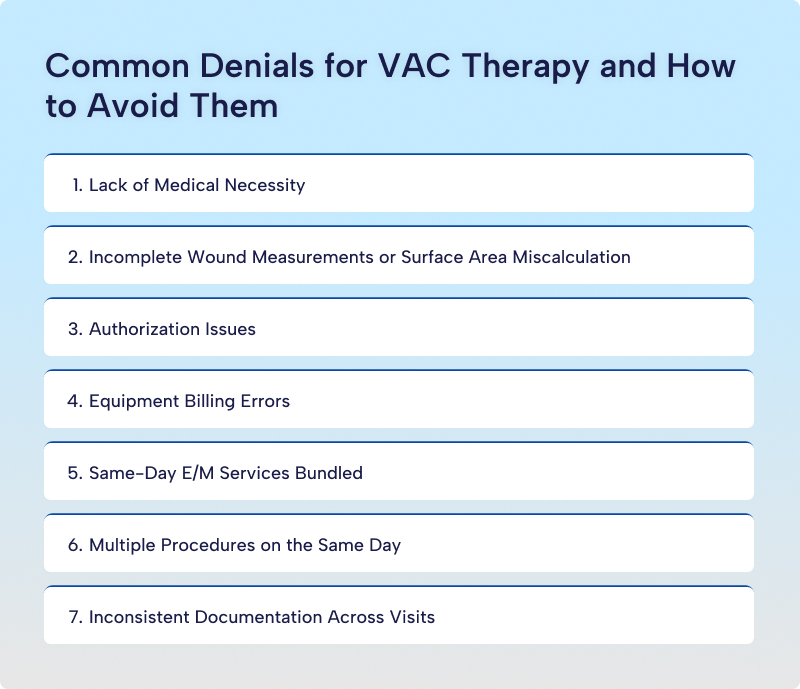
Even though VAC therapy is widely used and clinically effective, claims are frequently denied due to documentation gaps, coding mistakes, or payer-specific requirements. Understanding these denials and how to prevent them is crucial for maintaining clean claims and protecting revenue.
Lack of Medical Necessity
One of the most frequent denials is lack of medical necessity. Payers may deny claims if they believe conservative wound care was not attempted before initiating VAC therapy.
To prevent this, documentation must clearly show prior treatments, such as advanced moist dressings, offloading for diabetic ulcers, or pressure redistribution for pressure ulcers, and how the wound responded.
Include the duration of prior therapy, wound progress, and the rationale for starting VAC therapy. Linking the ICD-10 diagnosis directly to the wound ensures the payer understands why VAC therapy is medically required.
Incomplete Wound Measurements or Surface Area Miscalculation
Another common denial occurs when wound measurements or surface area calculations are missing or incorrect. CPT codes 97605 and 97606 are based on total wound surface area, so precise documentation is essential.
Each wound should be measured in centimeters for length and width. When multiple wounds exist, sum the total surface area to determine the correct CPT code.
Depth should also be documented for clinical purposes, although it does not affect CPT selection. Accurate measurements help prevent underbilling, overbilling, or claim denials.
Authorization Issues
Denials related to missing prior authorization are common, especially with commercial payers. Some insurers require approval before initiating VAC therapy.
Billing without verifying authorization can result in immediate denial.
To prevent this, always confirm payer-specific rules before scheduling therapy and keep the authorization number in the patient chart for submission.
Equipment Billing Errors
Billing errors involving HCPCS codes for the VAC pump and supplies are another frequent denial reason. The professional service (97605 or 97606) must be billed separately from the equipment.
Use the correct HCPCS codes: E2402 for the pump, A6550 for the dressing set, and A7000 for tubing. Ensure the DME supplier is enrolled with the payer.
Incorrect billing, coding under CPT instead of HCPCS, or unverified suppliers often triggers claim denials.
Same-Day E/M Services Bundled
Claims can be denied if same-day E/M services are bundled with VAC therapy.
Payers may combine the E/M evaluation into the procedure if documentation does not show that the evaluation was significant and separately identifiable.
To prevent this, use modifier 25 and keep E/M documentation separate from VAC notes.
Clearly justify why the E/M service was distinct from wound therapy, such as managing unrelated chronic conditions or new complaints.
Multiple Procedures on the Same Day
When multiple procedures are performed during the same encounter, denials may occur if modifiers are not used properly.
For example, if VAC therapy is applied to a plantar ulcer and another procedure is performed at a different anatomical site, append modifier 59 or XS.
The operative note should clearly describe the distinct locations of the procedures to justify separate billing.
Inconsistent Documentation Across Visits
Denials can also occur due to inconsistent documentation between visits. Differences in wound description, measurements, or treatment plans can trigger payer audits.
Use standardized wound templates, document each visit consistently, and include progress notes to show wound healing or changes.
Photographs, when allowed, provide additional evidence of wound size and progression, strengthening the claim.
Frequently Asked Questions About VAC Therapy Billing
What CPT code is used for wound VAC placement?
CPT 97605 and 97606 are used for negative pressure wound therapy depending on the wound surface area.
What is the difference between CPT 97605 and 97606?
CPT 97605 applies to wounds 50 square centimeters or less, while 97606 applies to wounds larger than 50 square centimeters.
Is VAC therapy considered a surgical procedure?
No. VAC therapy is considered a wound management procedure, not a surgical operation.
Can VAC therapy and debridement be billed together?
Yes, if both services are medically necessary and documented separately.
Final Thoughts
VAC therapy billing becomes straightforward when you separate the professional service (97605/97606) from equipment (HCPCS), accurately calculate surface area, document medical necessity, and use modifiers appropriately.
Clear documentation, attention to payer rules, and pre-billing checks minimize denials and protect revenue. Practices that implement these steps see smoother revenue cycles and fewer claim delays.
Need Help With Wound Care Billing?
Negative pressure wound therapy billing can be complex. Accurate CPT coding, proper documentation, and correct HCPCS billing for equipment are essential to avoid claim denials and delayed reimbursements. Even small coding errors in VAC therapy billing can lead to lost revenue for wound care clinics and medical practices.
RCM Xperts is a USA-based medical billing company specializing in revenue cycle management for healthcare providers. Our certified billing specialists help wound care centers, podiatry practices, and surgical clinics streamline their billing workflows, reduce denials, and maximize reimbursements.
Our services include:
- Wound care billing and coding support
- CPT and ICD-10 compliance review
- Insurance eligibility verification
- Prior authorization management
- Claim submission and denial management
- Full revenue cycle management (RCM)
Whether your practice performs VAC therapy, wound debridement, or advanced wound treatments, our team ensures your claims are coded correctly and paid faster.
Schedule a Free Billing Audit Today
Discover hidden revenue opportunities and improve your wound care billing performance.