
Aetna is one of the largest health insurers in the United States, operating as a subsidiary of CVS Health Corporation. Aetna covers approximately 22 million medical members across commercial, Medicare Advantage, and Medicaid plans. The network includes roughly 1.7 million healthcare professionals and more than 5,700 hospitals.
Joining the Aetna network gives providers access to a patient population that spans employer-sponsored group plans, individual and family plans through the ACA marketplace, Medicare Advantage plans, and Medicaid managed care programs in participating states. That breadth matters for practices looking to grow a diverse, stable patient panel.
But access to that patient base requires completing two separate processes: medical credentialing and contracting in full. Neither alone is enough. Both must be finished before a provider can see Aetna members and bill for reimbursed services.
What Is Aetna Credentialing
Aetna credentialing is the process Aetna uses to verify that a healthcare provider meets the qualifications to join its provider network. Credentialing is separate from contracting. Both processes must be completed before a provider can see Aetna members and submit reimbursed claims.
Credentialing involves verifying:
- Education and training
- State licensure
- Board certifications
- DEA registration
- Malpractice insurance coverage
- Work history
- Disciplinary actions or sanctions
- Professional references
Contracting involves signing a participation agreement that outlines fee schedules, payment terms, and network obligations. A provider can be credentialed but not contracted. Both are required to be an in-network provider.
Aetna Credentialing Requirements
Before applying to join the Aetna network, providers must gather specific documentation. Incomplete applications are the number one cause of credentialing delays.
Required for All Providers
| Requirement | Details |
| National Provider Identifier (NPI) | Type 1 (individual) NPI, active and current in NPPES |
| State license | Active, unrestricted license in every state where the provider will see Aetna members |
| Malpractice insurance | Minimum $1 million per occurrence / $3 million aggregate professional liability coverage |
| Curriculum Vitae (CV) | Comprehensive CV accounting for every month since graduation; gaps over 30 days need a written explanation |
| W-9 form | For tax identification number verification |
| CAQH ProView profile | Completed, attested within the last 120 days, with Aetna authorized to access data |
| Board certification | Documentation, if applicable to the specialty |
| DEA certificate | Required for providers who prescribe controlled substances |
| Government issued photo ID | Driver’s license or passport |
| Peer references | Three references from professionals in the same or similar specialty |
Additional Requirements for Group Practices
| Requirement | Details |
| Group NPI | Type 2 NPI, active in NPPES |
| IRS Determination Letter | Documentation of employer identification number (EIN) |
| Individual provider applications | Separate Type 1 NPI application for each provider in the group |
Each provider in a group practice needs their own individual application. One missing provider application can hold up the entire group’s go-live date.
The Role of CAQH in Aetna Credentialing
Aetna uses CAQH ProView for credentialing individual providers in most states. The exceptions include Washington state, physicians in Arkansas, and the Allina Health/Aetna joint venture in Minnesota, which use different vendors.
For providers in states where Aetna uses CAQH, the CAQH profile is the foundation of the credentialing process. Aetna pulls all credentialing data directly from CAQH. Aetna does not accept paper applications or separate forms for most provider types.
CAQH Profile Requirements for Aetna
Before Aetna can begin credentialing, the provider’s CAQH profile must meet four requirements:
- 100 percent complete – No blank fields. No skipped sections.
- Attested within the last 120 days – 180 days for Illinois providers
- Aetna is designated as an authorized health plan – Without this step, Aetna’s system cannot pull the data
- All uploaded documents are current – No expired licenses, certificates, or insurance policies
If any of these four requirements are missing, Aetna cannot start the credentialing process. The application sits in a queue until the provider fixes the CAQH profile.
How to Authorize Aetna in CAQH?
To authorize Aetna to access the CAQH profile:
- Log in to the CAQH ProView portal
- Navigate to the Authorize section
- Search for “Aetna”
- Select Aetna from the list of health plans
- Set authorization to “Yes, I grant access.”
- Save the authorization settings
Without this authorization, Aetna’s credentialing system cannot pull the provider’s data. The application will not move forward.
Step-by-Step Process for Aetna Credentialing
Complete Prerequisites
Before submitting any application to Aetna, complete these prerequisite tasks:
- Obtain a Type 1 NPI through the NPPES system
- Obtain active state licenses in all states where the provider will practice
- Obtain malpractice insurance with minimum $1M/$3M coverage
- Complete the CAQH ProView profile at 100 percent
- Attest to the CAQH profile within the last 120 days
- Authorize Aetna to access the CAQH profile
- Gather all supporting documents (licenses, DEA, board certifications, CV, W-9, photo ID)
Do not skip any of these steps. Submitting an Aetna application before completing these prerequisites guarantees delays.
Submit the Request for Participation
The first step in the Aetna credentialing process is submitting a Request for Participation form. This form is available on the Aetna provider website.
The form asks for basic information:
- Provider name and contact information
- NPI number
- CAQH Provider ID
- Practice locations
- Specialty
- Target participation date
Aetna reviews this request to determine whether there is a need for providers of this type and specialty in the geographic area. Aetna typically notifies providers within 45 days whether they are eligible to proceed.
If Aetna determines there is no need for additional providers in the area, the application stops here. The provider cannot join the network at that time.
Complete the Credentialing Application
If Aetna approves the Request for Participation, the provider moves to the full credentialing application. The application is completed through Aetna’s provider portal. Aetna pulls the provider’s data directly from CAQH, so the provider does not need to re-enter all the information.
The provider must:
- Log into the Aetna provider portal
- Complete any Aetna-specific questions not covered in CAQH
- Upload any documents not already in CAQH
- Sign the application electronically
- Submit the application
Wait for Credentialing Review
Aetna’s credentialing team reviews the application. The team conducts primary source verification, which means contacting the original issuing bodies directly:
- State licensing boards to confirm license status
- Medical schools and training programs to confirm education
- Certification boards to confirm board certification
- National Practitioner Data Bank (NPDB) to check for adverse actions
- OIG and SAM to check for exclusions
- Malpractice carriers to verify coverage and claims history
This review takes 90 to 180 days in most cases. The timeline depends on how quickly the provider responds to any requests for additional information and how quickly the primary sources respond to verification requests.
Receive Credentialing Decision
Aetna sends a written notice once credentialing is complete. The notice includes:
- Credentialing approval or denial
- Effective date of network participation
- Provider number or billing ID
If credentialing is approved, the provider moves to contracting. If credentialing is denied, the notice explains the reason for the denial and the appeal process.
Complete Contracting
Credentialing and contracting are separate processes. Credentialing verifies the provider’s qualifications. Contracting establishes the legal agreement between the provider and Aetna.
After credentialing is complete, an Aetna network management representative contacts the provider to complete contracting. The provider reviews and signs a participation agreement that outlines:
- Fee schedules
- Payment terms
- Network obligations
- Termination provisions
- Compliance requirements
Both credentialing and contracting must be complete before the provider can see Aetna members and submit reimbursed claims.
Aetna Credentialing Timelines
| Step | Typical Timeline |
| Request for Participation review | Up to 45 days |
| Credentialing application processing | 90 to 180 days |
| Contracting | 30 to 60 days |
| Total from application to active | 120 to 285 days |
These timelines assume the provider submits a complete application with no errors. Missing documents, incomplete CAQH profiles, or expired attestations add weeks or months to the timeline.
Aetna credentialing can take three to six months or longer. Providers should plan accordingly. Do not schedule Aetna patients until credentialing and contracting are fully complete.
How to Check Aetna Credentialing Status?
Providers can check their credentialing status through two channels.
For providers in Missouri , Aetna provides an online form to request credentialing status updates.
For providers in all other states – Call Aetna’s provider customer service team:
- Medical and behavioral health providers: 1-800-353-1232
- Dental providers: 1-800-451-7715
Have the following information ready before calling:
- Provider NPI number
- CAQH Provider ID
- Date the application was submitted
- Any reference numbers from the application
Call every two to three weeks for status updates. Do not assume no news is good news. Applications stall without notification. Regular follow-up catches problems early.
Aetna Credentialing for Different Provider Types
Behavioral Health Providers
Aetna credentialing for behavioral health providers follows the same general process but has specific requirements. To be credentialed with Aetna as a behavioral health provider, the provider must:
- Be a licensed mental health provider (LCSW, LMFT, LPC, psychologist, psychiatrist, etc.)
- Have a completed CAQH profile
- Have a service location that can receive mail
Behavioral health providers should call Aetna’s dedicated behavioral health credentialing line at 1-800-353-1232 and select the behavioral health option.
Dentists
Dental providers follow a separate credentialing process through Aetna’s dental network. The timeline for dental credentialing is approximately 90 days.
Group Practices
Group practices must complete credentialing for each provider in the group. The group’s Type 2 NPI and tax identification number are handled through separate contracting processes.
When adding a new provider to an existing group contract, the group submits a request to add the provider. Aetna credentials the new provider using their CAQH profile. The existing group contract remains in place.
Facilities
Facility credentialing (hospitals, skilled nursing facilities, ambulatory surgery centers, etc.) follows a different process than individual provider credentialing. Facilities should contact Aetna’s facility credentialing department directly for specific requirements.
Aetna Credentialing vs. Aetna Prior Authorization
Providers often confuse credentialing with prior authorization. They are completely different processes.
- Credentialing – Verifies the provider’s qualifications to join the Aetna network. Happens once when joining the network and then every three years for recredentialing. Required before the provider can bill Aetna for any services.
- Prior authorization – Obtains approval from Aetna before performing a specific service for a specific patient. Happens per service, per patient. Required for many procedures, including inpatient admissions, advanced imaging, surgeries, and specialty medications.
A provider can be fully credentialed with Aetna but still needs prior authorization for individual services. Credentialing does not waive prior authorization requirements.
How to Appeal an Aetna Credentialing Denial?
If Aetna denies a credentialing application, the provider receives a written notice explaining the reason for the denial. Common denial reasons include:
- Incomplete or inaccurate CAQH profile
- Expired license or DEA certificate
- Sanctions or exclusions on record
- Failure to meet Aetna’s qualification standards
Providers have the right to appeal a credentialing denial. The denial notice includes appeal instructions and deadlines.
- Level 1 Appeal – Submit a written appeal to Aetna within the deadline stated in the denial notice. Include documentation addressing each reason for denial. Aetna reviews the appeal and issues a decision within 30 to 60 days.
- Level 2 Appeal – If the Level 1 appeal is denied, providers can request a second-level appeal. A different review team evaluates the application.
- External Review – After exhausting internal appeals, providers in some states can request an external review by an independent organization.
Most credentialing denials result from correctable issues like expired documents or incomplete profiles. Fix the issue and reapply. Do not give up after one denial.
Maintaining Aetna Credentialing Status
After Aetna approves credentialing, the provider must maintain an active status. Aetna recredentials providers every three years.
To maintain Aetna credentialing status:
- Keep the CAQH profile current – Update the CAQH profile whenever anything changes. New license, new address, new malpractice carrier, new board certification. Re-attest every 120 days.
- Keep Aetna authorized in CAQH – Do not revoke Aetna’s authorization to access
Common Aetna Credentialing Mistakes and How to Avoid Them?
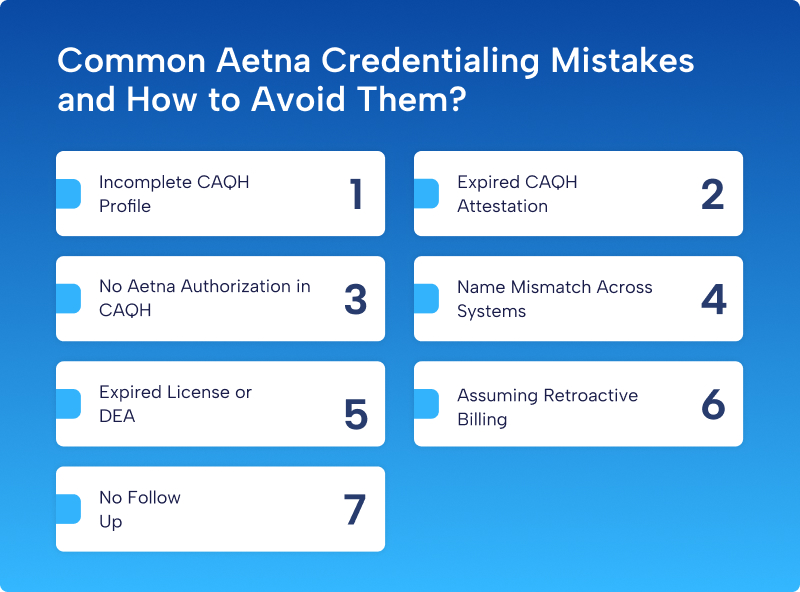
Incomplete CAQH Profile
The provider submits the Aetna application. Aetna tries to pull the CAQH profile. The profile shows 85 percent complete. Aetna cannot start credentialing. The application sits in a pending queue. The provider does not know anything is wrong for weeks.
How to avoid – Before submitting the Aetna application, log into CAQH and confirm the profile shows 100 percent complete. Run the Review and Attest check. Fix any errors.
Expired CAQH Attestation
The provider completed the CAQH profile six months ago. The provider has not reattested. The profile is inactive. Aetna cannot access the data. The application stalls.
How to avoid – Check the CAQH attestation date before applying to Aetna. If the last attestation is more than 120 days ago (180 days for Illinois), re-attest before submitting the application.
No Aetna Authorization in CAQH
The provider completed the CAQH profile and attested. But the provider never authorized Aetna to access the profile. Aetna’s system cannot pull the data. The application never moves.
How to avoid – Before submitting the Aetna application, log into CAQH, go to the Authorize section, search for Aetna, and grant access. Confirm that Aetna appears in the authorized list.
Name Mismatch Across Systems
The provider’s name on the state license is “Jennifer Smith.” The CAQH profile says “Jenny Smith.” The NPI registry says “Jennifer A. Smith.” Aetna’s system flags the mismatches. The application goes to manual review. The process adds weeks.
How to avoid – Use the exact legal name that appears on the state license. Match the name exactly across CAQH, NPPES, DEA, and all licenses. Do not use nicknames or abbreviations.
Expired License or DEA
The provider uploaded a state license that expires in 30 days. The provider submits the Aetna application. By the time Aetna reviews it, the license has expired. Aetna denies the application.
How to avoid – Before applying, verify that all licenses and DEA certificates are current and will remain current for at least six months. Renew any licenses that are close to expiration.
Assuming Retroactive Billing
The provider submits the Aetna application. The provider starts seeing Aetna members while waiting for approval. The provider assumes payment will be retroactive to the application date. It will not. Aetna typically only allows billing from the official effective date, not the application date.
How to avoid – Do not see Aetna members until credentialing and contracting are fully complete. Clarify the effective date with Aetna before scheduling any appointments. If retroactive billing is allowed, get it in writing.
No Follow Up
The provider submits the application and waits. Months pass. No response. The provider calls and learns the application was pended for missing information that the provider had never received notice about.
How to avoid – Call Aetna every two to three weeks for status updates. Document every call with the date, representative name, and reference number. Ask specifically whether any additional information is needed.
Conclusion
Aetna credentialing comes down to three things. A complete CAQH profile. Current attestation every 120 days. Active authorization for Aetna to access the data.
Get these three rights, and the process moves. Get any of them wrong and the application stalls.
The providers who succeed prepare before they apply. They gather every document. They check every date. They follow up every two weeks. The providers who fail rush. They skip steps. They assume everything is fine. They wait months for news that never comes.
Need Help With Aetna Credentialing?
Completing Aetna credentialing involves much more than submitting an application. Your CAQH profile, primary source verification, contracting, and ongoing follow-up all need to be completed correctly before you can begin seeing Aetna members and receiving in-network reimbursements. Even small errors can delay approval for weeks or months.
RCM Xpert is a New York-based medical billing and credentialing company helping healthcare providers across the United States navigate commercial insurance credentialing from start to finish. Our credentialing specialists manage every stage of the Aetna enrollment process, including:
- Aetna provider credentialing and enrollment
- CAQH profile setup, optimization, and maintenance
- Provider contracting and payer follow-up
- Medicare, Medicaid, and commercial payer credentialing
- Group practice enrollment and provider additions
- Recredentialing and ongoing credentialing support
We also provide complete revenue cycle management services, including medical billing, insurance verification, prior authorization, denial management, accounts receivable follow-up, payment posting, and practice consulting to help providers improve collections and reduce administrative workload.
Contact RCM Xpert today for a free consultation and let our credentialing experts help you complete your Aetna enrollment efficiently so you can focus on caring for your patients.
CTA Button: Get Started with Aetna Credentialing
Frequently Asked Questions About Aetna Credentialing
How long does Aetna credentialing take?
Aetna credentialing takes 90 to 120 days from the date of a complete application submission in most cases. That window covers the credentialing review phase, during which Aetna’s CVO contacts primary sources to verify your qualifications. The total time from initiating contact with Aetna to your effective date — including the initial participation request review and the contracting phase — ranges from 120 to 285 days depending on application completeness and primary source response times.
Does Aetna use CAQH for credentialing?
Yes. Aetna uses CAQH ProView for credentialing individual healthcare providers in most states. The exceptions are Washington state, physicians in Arkansas, and providers in the Allina Health/Aetna joint venture network in Minnesota, which use different vendors. For all other states, your CAQH ProView profile must be 100 percent complete, attested within the last 120 days (180 days for Illinois), and have Aetna designated as an authorized health plan before Aetna can begin processing your application.
How do I check my Aetna credentialing application status?
Providers in Missouri can request a status update through Aetna’s online status inquiry form for Missouri applicants. Providers in all other states must call Aetna’s provider customer service line. Medical and behavioral health providers call 1-800-353-1232. Dental providers call 1-800-451-7715. Have your NPI number, CAQH Provider ID, application submission date, and any reference numbers available before calling. Call every two to three weeks for updates — applications stall without notification.
Can I bill Aetna while credentialing is pending?
No. You cannot bill Aetna for services rendered before your official effective date. Aetna generally does not allow retroactive billing from the application date. Services rendered before your credentialing and contracting are fully complete and your effective date is confirmed will be denied. Do not schedule Aetna members until you have written confirmation of your effective date from Aetna.
What is Aetna’s Credentialing Verification Organization?
Aetna maintains a Credentialing Verification Organization (CVO) that performs primary source verification on all credentialing applications. Aetna’s CVO meets the credentialing standards of the National Committee for Quality Assurance and holds CVO accreditation from URAC. The CVO contacts state licensing boards, medical schools, certification bodies, the National Practitioner Data Bank, and federal exclusion databases directly to verify the accuracy of provider-submitted information.
What happens if Aetna’s panel is closed in my area?
If Aetna determines there is no need for additional providers of your specialty in your geographic area, the Request for Participation is denied at the initial review stage — before credentialing begins. You receive written notification. You can reapply when the panel opens. Aetna makes this determination based on network adequacy assessments that evaluate whether existing network providers can meet member demand in the service area. Panel closures are not permanent, but Aetna does not publish a timeline for when closed panels will reopen.
How much does Aetna credentialing cost?
Aetna does not charge providers a fee for credentialing. The process itself is free to participate in. Costs you may incur include the time cost of managing the application internally, the cost of a credentialing specialist or service if you outsource the process, and indirect costs from delayed revenue during the credentialing period if you begin your practice before credentialing completes. Credentialing service providers typically charge $100 to $300 per payer for managed credentialing services.
What is the difference between Aetna credentialing and Aetna recredentialing?
Initial credentialing is the process a provider completes when joining the Aetna network for the first time. Recredentialing is the process Aetna requires every three years to verify that credentialed providers continue to meet network standards. Recredentialing uses the same CAQH-based process as initial credentialing and requires an updated, fully attested CAQH profile. Failing to complete recredentialing on time results in termination from the network, requiring the provider to restart the full initial credentialing process.
Does Aetna credentialing cover all Aetna plan types?
Credentialing with Aetna through the standard commercial network process covers commercial employer-sponsored plans and individual/family plans in most cases. Medicare Advantage participation is subject to additional federal compliance requirements and operates under separate CMS rules. Medicaid managed care participation depends on the state contract and may require separate credentialing through Aetna’s Medicaid products in applicable states. Confirm which plan types your participation agreement covers during the contracting phase.