

A payment arrives from an insurance company. The practice deposits the money. Staff assumes the claim was processed correctly. Then, sixty days later, the same insurance company takes the money back. No warning. No phone call. Just a sudden deduction on the next remittance advice.
This is recoupment. And it terrifies practice administrators because it destroys cash flow without notice.
Recoupment happens when an insurance company demands repayment for a claim they already paid. The payer does not ask permission. They simply deduct the amount from future payments. One week, the practice has a healthy bank balance. The next week, the practice owes money or loses a chunk of expected revenue.
Many providers do not understand recoupment rules. They do not know their appeal rights. They do not know the deadlines. This lack of knowledge costs practices real money. This guide explains recoupment for healthcare providers who want to protect their revenue.
What is Recoupment in Medical Billing?
Recoupment is the process by which an insurance company takes back money already paid to a provider. The payer identifies a claim as overpaid. Instead of asking for a check, the payer subtracts the overpayment amount from current or future claim payments.
Think of it as a reverse payment. Instead of the payer sending money to the practice, the payer keeps money that would have gone to the practice until the debt clears.
Here is a simple example. An insurer pays $1,000 for a patient visit. Sixty days later, the insurer decides the visit should have paid only $600. The insurer recoups $400 by deducting that amount from the next set of claim payments. The practice never writes a check. The practice just received $400 less than expected on the next remittance.
Recoupment applies to many situations. Overpayments. Duplicate payments. Claims paid without proper authorization. Services that lacked medical necessity. Coordination of benefit errors. Any reason an insurer decides a claim was overpaid can trigger recoupment.
How Recoupment Differs from Other Payment Adjustments

Providers often confuse recoupment with other types of payment reductions. Understanding the differences helps practices respond correctly.
Recoupment versus Offset
An offset happens when a provider owes money from a separate issue. For example, a practice fails to repay a signing bonus from a payer contract. The payer offsets future claim payments to recover that bonus. Recoupment specifically targets overpaid claims, not other debts.
Recoupment versus Denial
A denial means the payer never pays the claim at all. Recoupment means the payer paid first and then took the money back. Denials happen before payment. Recoupment happens after payment.
Recoupment versus Adjustment
An adjustment corrects a billing error on a claim that has not yet paid. The provider or payer changes the claim before money changes hands. Recoupment happens after the money already moved.
Recoupment versus Refund Request
A refund request asks the provider to write a check back to the payer. Recoupment takes the money automatically from future payments. Refund requests give providers more control. Recoupment gives the payer all the control.
Why Insurance Companies Use Recoupment
Payers love recoupment because it shifts work to providers. Instead of the payer chasing a check, the payer simply takes the money. The provider must then fight to get it back if the recoupment was wrong.
Common reasons for recoupment include:
- Duplicate Payments – The payer accidentally paid the same claim twice. The system catches the duplicate sixty days later and recoups the extra payment.
- Coordination of Benefit Errors – Another insurance plan should have paid primary. The payer paid as primary but later discovered the error and recoups the money.
- Retroactive Denials – A post payment audit determines the service lacked medical necessity. The payer recoups the full payment amount.
- Missing or Expired Authorizations – The provider submitted a claim with an authorization number. Later, the payer discovers the authorization expired before the date of service. Recoupment follows.
- Patient Coverage Termination – The patient had active coverage on the date of service. The payer later discovers the patient’s coverage actually terminated before that date. The payer recoups the payment.
- Billing Code Errors – The provider billed a higher level code than documentation supported. A payer audit recodes the claim to a lower level and recoups the difference.
- Medicare Advantage Plan Actions – Medicare Advantage plans have broad recoupment rights under federal law. They can recoup payments months or even years after the original payment.
The Legal Framework for Recoupment
Providers do have rights. Recoupment is not unlimited. Federal and state laws set boundaries on when and how payers can take money back.
Medicare Recoupment Rules
Medicare follows strict recoupment timelines. A provider can request a redetermination within 120 days of receiving an overpayment notice. If the provider requests a redetermination within 15 days, Medicare cannot recoup during the appeal. This is called a stay of recoupment. Many providers do not know about this protection and lose money unnecessarily.
Commercial Payer Recoupment Rules
Commercial payers follow state laws and contract terms. Most contracts give payers the right to recoup overpayments within a certain timeframe. Common recoupment windows range from 12 months to 24 months from the original payment date. Some contracts allow recoupment for up to 36 months.
The Timely Filing Limitation
Payers cannot recoup payments indefinitely. Most states have laws limiting recoupment to a specific time period. If a payer tries to recoup a payment from three years ago, the provider should check state law and contract terms. Many states set a 12 month or 24-month recoupment limit.
ERISA Plans
Self-funded ERISA plans follow different rules. These plans often have broader recoupment rights. Providers should review ERISA plan documents carefully to understand recoupment terms before signing contracts.
How to Identify a Recoupment on Your Remittance Advice
Recoupments appear on the standard remittance advice. Providers must know how to spot them.
Look for these codes on the RA or ERA:
- Claim Adjustment Reason Code 237 – Legally obligated to recover claim payment under a recoupment right
- Claim Adjustment Reason Code 22 – This care was not covered by the member’s benefit plan at the time of service
- Claim Adjustment Reason Code 29 – The time limit for filing the claim has passed
- Remark Code N32 – Payment recouped due to patient not having active coverage on the date of service
- Remark Code N47 – Payment recouped due to lack of medical necessity
When a recoupment appears, the remittance advice shows a negative charge for the claim line. Instead of a positive payment amount, the practice sees a deduction. The explanation section lists one of the codes above.
Do not ignore these adjustments. Many practices assume the negative amount is an error that will correct itself. It will not. The payer took the money. The practice must act to get it back.
Steps to Take When a Recoupment Happens
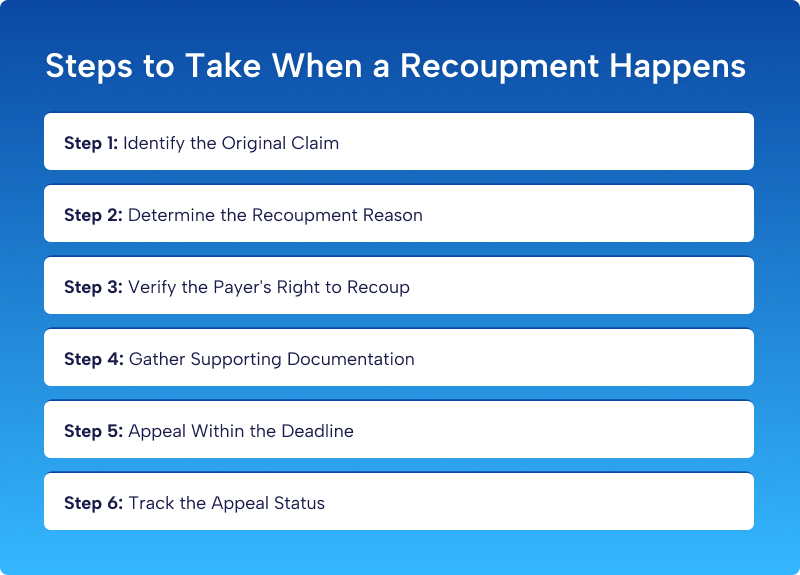
Do not panic. Do not ignore it. Follow these steps in order.
Identify the Original Claim
Find the original claim that the payer recouped. Match the patient name, date of service, and procedure codes. Pull the original remittance advice that showed the payment. Pull the claim submission details including any authorization numbers.
Determine the Recoupment Reason
Read the remittance advice carefully. Identify the exact reason code and explanation. Was this a duplicate payment issue? A missing authorization? A retroactive denial for medical necessity? Understanding the reason guides the response.
Verify the Payer’s Right to Recoup
Check the contract. Does the contract allow recoupment for this reason? Check the state law. Is the recoupment within the legal time limit? Check the appeal deadline. How many days remain to dispute the recoupment?
Gather Supporting Documentation
Collect the clinical notes. Collect the authorization approval. Collect proof of patient coverage on the date of service. Collect any correspondence with the payer about the original claim. Build a complete file.
Appeal Within the Deadline
Do not wait. Recoupment appeals have short windows. Medicare gives 120 days. Commercial payers often give 60 days or less. Submit a written appeal with all supporting documentation. Request a stay of recoupment if available under the plan.
Track the Appeal Status
Follow up every 14 days until the payer responds. Document every phone call. Record every reference number. If the payer upholds the recoupment, decide whether to escalate to a second level appeal.
How to Prevent Recoupments Before They Happen
Prevention beats appeal every time. These steps reduce recoupment risk significantly.
Verify Eligibility on the Date of Service
Check eligibility 24 hours before the appointment. Then check again on the day of service. Patient coverage can terminate mid-month. Do not trust a verification from last week. Verify fresh for every visit.
Confirm Authorization Before Providing Care
Do not start a procedure without a valid authorization number. Confirm the authorization matches the exact CPT codes, the exact date of service, and the exact place of service. Write the authorization number on the claim before submission.
Document Medical Necessity Thoroughly
Insurance companies audit claims months after payment. When an auditor reads the clinical note, the medical necessity must be obvious. Link every procedure code to a specific diagnosis. Explain why the patient needed the service. Do not assume the auditor will connect the dots.
Double Check Coordination of Benefits
Ask every patient about other insurance coverage at every visit. Document the primary and secondary payers correctly on every claim. Send claims to the correct primary payer first. Do not send a claim to secondary until the primary payer processes it.
Submit Clean Claims the First Time
Review every claim before submission. Check patient demographics. Check procedure codes. Check diagnosis linkages. Check modifiers. Check place of service codes. A clean claim is less likely to be audited or recouped later.
Track Authorization Expiration Dates
Put authorizations on a calendar. Set reminders 30 days before expiration. If a patient needs ongoing care, renew the authorization before it expires. Do not assume an old authorization covers new dates of service.
Recoupment Appeal Strategies That Work

When a recoupment happens, appeal aggressively. Here are strategies that win appeals.
Request a Stay of Recoupment Immediately
For Medicare claims, request a redetermination within 15 days of the overpayment notice. This triggers an automatic stay. Medicare cannot recoup during the appeal. For commercial payers, ask about stay options. Some contracts include stay provisions.
Focus on Contract Language
The payer’s contract defines recoupment rights. Quote the contract directly in the appeal. If the contract limits recoupment to 12 months and the recoupment happened at 18 months, state this clearly. Attach the relevant contract page.
Provide Clinical Evidence
For medical necessity denials, submit the complete clinical record. Highlight the sections that justify the procedure. Include relevant guidelines from medical societies. Show why the service met the standard of care.
Document Authorization Approval
If the payer recoups for missing authorization but the practice had an approval, submit the authorization number and the approval letter. Include the date of the authorization. Include the name of the payer representative who issued it.
Escalate to a Second Level
Do not stop at the first appeal denial. Most payers offer multiple appeal levels. Medicare offers five levels. Commercial payers offer two or three. Each level gives a new chance to win. Many providers give up too early.
Consider External Review
If internal appeals fail, request external review. Many states have external review programs for commercial claims. Medicare allows review by an administrative law judge. External reviewers are independent. They overturn payer denials at a surprising rate.
When to Write a Check Instead of Waiting for Recoupment
Sometimes writing a refund check makes more sense than waiting for recoupment. Here is when to choose the refund path.
Small Dollar Amounts
If the recoupment amount is under $100, write the check. The staff time spent fighting a small recoupment costs more than the recoupment itself.
Clear Billing Errors
If the practice clearly made a mistake, admit it. Write the check. Move on. Fighting a correct recoupment wastes resources.
Expired Appeal Deadlines
If the appeal deadline passed, the payer has the legal right to recoup. Writing a check voluntarily looks better than a forced recoupment. It also resets the relationship with the payer.
Contract Termination Situations
If the practice is terminating a payer contract, expect recoupments. Payers often audit claims from terminating providers. Setting aside funds for potential recoupments prevents cash flow surprises.
How to Track Recoupments in Your Practice
Good tracking separates successful practices from struggling ones. Build a recoupment tracking system.
Create a Recoupment Log
Build a spreadsheet or use practice management software to track every recoupment. Include these fields:
- Payer name
- Patient name
- Date of service
- Original payment amount
- Recoupment amount
- Recoupment date
- Recoupment reason code
- Appeal deadline
- Appeal status
- Final resolution
Review Recoupments Monthly
Sit down with the recoupment log every month. Look for patterns. Does one payer recoup more than others? Does one procedure code trigger recoupments repeatedly? Does one provider have more recoupments than the rest? Use these patterns to change processes.
Calculate Recoupment Rate
Divide total recoupment dollars by total collected revenue. Multiply by 100 to get a percentage. A recoupment rate above 2 percent signals a serious problem. Investigate the root causes immediately.
Assign Ownership
Put one person in charge of recoupment tracking and appeals. This person monitors the log, meets deadlines, and coordinates with billers and providers. Without a single owner, recoupments fall through the cracks.
Common Recoupment Traps to Avoid
Providers make these mistakes repeatedly. Avoid them.
Ignoring the Recoupment
Many providers assume a recoupment is a mistake that will reverse automatically. It will not. The payer will not fix it. Only an active appeal reverses a recoupment.
Missing the Appeal Deadline
Recoupment appeal windows are short. Medicare gives 120 days. Commercial payers often give 60 days or less. Mark the deadline on a calendar. Do not assume more time exists.
No Documentation
An appeal without supporting documentation fails. Submit clinical notes. Submit authorization approvals. Submit eligibility verifications. Submit the original claim. Submit everything.
Giving Up After One Denial
First level appeals deny frequently. Second level appeals win more often. Third level appeals win even more. Do not stop at the first denial. Keep climbing the appeal ladder.
Not Training Staff
Front desk staff, billers, and providers all play roles in recoupment prevention. Train each group on their responsibilities. A single untrained person can trigger a recoupment that costs the practice thousands.
Final Thoughts
Recoupment is a fact of medical billing. Payers will take money back. It will happen to every practice eventually. The question is not whether recoupments will happen. The question is how the practice responds when they do.
Build prevention systems first. Verify eligibility. Confirm authorizations. Document medical necessity. Submit clean claims. These steps stop most recoupments before they start.
Build response systems second. Track recoupments. Know appeal deadlines. Gather documentation. Appeal aggressively. These steps recover money when recoupments happen despite best efforts.
And remember the most important rule. Do not ignore a recoupment. The payer will not fix it. The money will not come back on its own. Only action recovers recouped revenue. Act quickly. Act decisively. Protect the practice’s hard-earned revenue.