
In the world of medical billing, the Superbill is your golden ticket. But unless you are a billing specialist, it can feel like trying to read ancient hieroglyphics.
Think of a Superbill as the “Universal Translator” for your healthcare. You speak the language of medicine (treatments, diagnoses, and procedures). The insurance company speaks the language of money (codes, premiums, deductibles, and dollars). The Superbill translates your visit into the specific codes that insurance companies require to send you a check.
In this guide, we aren’t just defining a Superbill. We are showing you exactly how to use one to maximize reimbursement, avoid claim denials, and decide if it’s right for your practice or wallet.
What is a Superbill?
A Superbill is a detailed, itemized receipt provided by a healthcare provider to a patient. It includes specific medical codes (CPT, ICD-10) and provider data required by insurance companies to process an out-of-network (OON) claim.
A Superbill is a detailed, code-filled invoice that a healthcare provider gives to a patient after an out-of-network (OON) visit. Unlike a standard receipt that says “Therapy – $200,” a Superbill translates that visit into the specific language insurance companies understand: CPT codes (what you did), ICD-10 codes (why you did it), and modifiers (how you did it). The patient submits this document to their insurer to get reimbursed for part of what they paid.
The Golden Rule of Superbills:
- In-Network Provider: Doctor bills insurance directly. Insurance pays Doctor.
- Out-of-Network Provider: Patient pays Doctor first. Doctor gives patient a Superbill. Patient sends Superbill to insurance. Insurance reimburses Patient.
Superbills go by many aliases: Encounter Forms, Charge Slips, Fee Tickets, or Insurance Reimbursement Statements.
Superbill vs. CMS-1500: What is the Difference?
Superbill vs. CMS-1500 vs. Standard Receipt
Most providers confuse these. Here is the simple breakdown:
| Feature | Superbill | CMS-1500 | Standard Cash Receipt |
| Purpose | Patient-led insurance reimbursement | Provider-led insurance billing | Proof of payment only |
| Medical Codes? | Yes (CPT, ICD-10, Modifiers) | Yes (CPT, ICD-10, Modifiers) | No (just dollar amounts) |
| NPI & Tax ID? | Yes | Yes | No |
| Who submits? | Patient (or provider on their behalf) | Provider directly | N/A |
| Insurance accepts? | Yes (for OON claims) | Yes (for In-Network) | No |
| HSA/FSA accepts? | Yes | Yes (but provider must be registered) | Sometimes (but risky) |
For example, you buy a bandage at CVS. Receipt is fine. You see a chiropractor for a herniated disc. You need a Superbill or CMS-1500. If the chiropractor is in-network, they file the CMS-1500. If out-of-network, they hand you a Superbill.
Who Creates a Superbill?
Usually, a doctor creates a superbill for the patients. The patients then submits it to its insurance provider.
Here’s who does what:
| Role | Create? | Submit? | Get Paid? | Responsible for Accuracy? |
| Provider (Doctor/Therapist) | Yes | Optional (if they offer “concierge submission”) | Yes (from patient upfront) | High (codes must be correct) |
| Patient | No | Usually Yes | Yes (from insurance later) | Medium (must verify their own OON benefits) |
| Insurance Company | No | No | No (they pay, but don’t keep) | Low (they just adjudicate) |
| Medical Biller | Optional (provider hires them) | Optional | No | High (if hired to create) |
If the provider makes a coding error (e.g., using CPT 90834 for 45 minutes instead of 90837 for 60 minutes), the patient suffers. The patient gets less money back. The provider already got paid. This creates tension. Smart providers offer a “coding accuracy guarantee” or review the superbill with the patient before they leave.
What a Superbill Contains?
The original blog listed components. Here is the Non-Negotiable Checklist to ensure your Superbill isn’t rejected instantly.
Section A: Provider Information
- Provider’s full legal name (not nickname)
- Provider’s NPI number (10 digits, no dashes)
- Provider’s Tax ID (EIN) or SSN
- Practice name (if applicable)
- Street address where service was rendered (not a PO Box unless required)
- Phone number (with area code)
- Email address (for electronic submissions)
- Provider signature (digital or wet ink – some payors require original)
Section B: Patient Information
- Patient’s full legal name (as it appears on insurance card)
- Date of birth (MM/DD/YYYY)
- Address (street, city, state, zip)
- Insurance policy/group number
- Insurance member ID number
- Patient’s relationship to insured (self, spouse, dependent)
Section C: Referring Provider
- Referring provider’s name (e.g., primary care doctor who sent you)
- Referring provider’s NPI number
- Referring provider’s Tax ID (if required by plan)
Section D: Service Details
- Date of service (start and end if multiple days)
- Place of Service (POS) code:
- 11 = Office
- 02 = Telehealth (critical for 2026)
- 12 = Home
- 99 = Other location
- CPT code(s) (5 digits, e.g., 90837 for 60-min therapy)
- CPT code description (optional but helpful)
- Number of units (e.g., 1 unit = 60 minutes, or 4 units of 15 minutes)
- Modifier codes if needed (e.g., 95 for Telehealth, GT for synchronous video)
- ICD-10 diagnosis code(s) (3-7 characters, e.g., F41.1 for Generalized Anxiety Disorder)
- ICD-10 description (optional but helpful)
Section E: Financials
- Total charge for services (your full fee)
- Amount paid by patient (what they gave you)
- Remaining balance (usually $0 if they paid upfront)
- Date of payment
Section F: Optional but Recommended
- Claim number (if resubmitting)
- Patient’s email (for electronic superbills)
- Notes section (for unusual circumstances)
The Pros & Cons of a Superbill
Pros
- Providers collect payment directly from the patient at the time of service, eliminating the waiting time associated with insurance reimbursement cycles.
- Providers avoid the complex and time-consuming process of credentialing with insurance panels and submitting claims, reducing overhead costs.
- It allows providers to treat clients with various insurance plans without being restricted to in-network provider panels.
- Because the patient handles the submission, the responsibility for managing insurer denials and disputes lies with the patient, not the provider.
Cons
- Patients may find the process daunting, which can lead to lower patient satisfaction if not managed properly.
- Superbills must be impeccably accurate with proper diagnosis (ICD-10) and procedure (CPT) codes, as errors can ruin trust and make it difficult for the patient to get reimbursed.
- Providers must maintain detailed, accurate documentation to justify the codes listed on the superbill.
- If a patient’s insurance plan has poor or no out-of-network benefits, the provider might still struggle to retain those clients compared to in-network competitors.
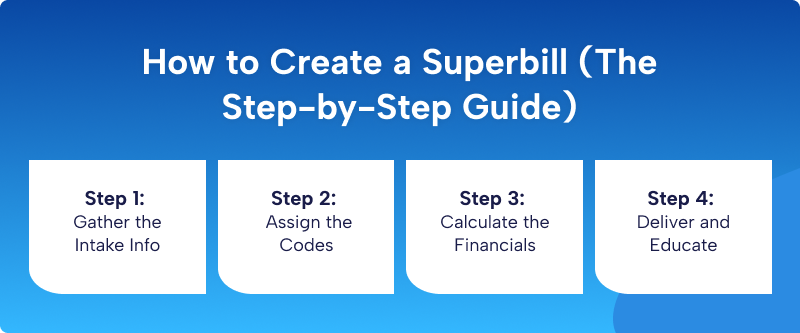
How to Create a Superbill (The Step-by-Step Guide)
You don’t need expensive software, but you need discipline. Follow this workflow:
Step 1: Gather the Intake Info
Get a copy of the patient’s insurance card (front and back). Note the Payer ID if available.
Step 2: Assign the Codes
- DX (Diagnosis): Be specific. “Anxiety” (F41.1) is different from “Panic Disorder” (F41.0).
- CPT (Procedure): Match the time spent. The 8-Minute Rule: For timed services (massage, physical therapy), you cannot bill a full unit unless you provide at least 8 minutes of service.
- Units: If you did 90 minutes of therapy, that is 2 units of 90837 (if your software allows), or one line item of 90 minutes. Check your software logic.
Step 3: Calculate the Financials
- Total Charge: Your full fee ($200).
- Amount Paid: What the patient paid you at the visit ($200).
- Remaining Balance: ($0). Note: Do not put the estimated insurance reimbursement here. That is the patient’s guess, not your debt.
Step 4: Deliver and Educate
This is where most providers fail. Handing over a piece of paper is not enough. Include a “Patient Instruction Slip”:
“To file your claim: Log into your insurance portal (Anthem/Blue Cross/etc.). Look for ‘Submit Out-of-Network Claim’. Upload this PDF. Keep this receipt for your records.”
Superbill vs. Direct Claim Submission (Which is Better for Providers?)
This is a strategic decision every practice must make.
| Factor | Superbill (Patient Submits) | Direct Claim (Provider Submits) |
| Provider time per claim | 2-3 minutes (generate PDF) | 5-10 minutes (submit via clearinghouse, track, handle denials) |
| Patient satisfaction | Medium (patient does work) | High (provider does work) |
| Reimbursement speed for patient | 2-8 weeks | 2-4 weeks (slightly faster) |
| Provider gets paid? | Yes, upfront | No, waits for insurance |
| Risk of provider non-payment | None (patient paid already) | High (insurance denies, patient may not pay) |
| Best for | Cash-flow focused practices, solo providers | Patient-experience focused practices, high-end concierge |
Telehealth and Superbills (The 2026 Update)
Telehealth is here to stay, but superbill rules have changed.
Insurance companies want to know: Was the patient in their home (POS 02) or in a medical office (POS 11)? Was the session live video (modifier 95) or just audio (not covered by most plans)?
The 2026 Rules
- Medicare: Still requires modifier 95 and POS 02 for telehealth superbills. Audio-only is not reimbursed except for specific behavioral health services.
- Blue Cross Blue Shield: Varies by state. Most require modifier 95. Some require a specific telehealth add-on code.
- UnitedHealthcare: Requires modifier GT or 95. Audio-only denied.
- Aetna: Requires modifier 95 and POS 02. No audio-only.
- Cigna: Most flexible. Modifier 95 recommended but not always required for mental health.
The Checklist for Telehealth Superbills
- POS code set to 02 (Telehealth)
- Modifier 95 appended to CPT code
- Documentation in clinical note: “Service delivered via HIPAA-compliant video platform (Zoom for Healthcare/Doxy.me)”
- Patient’s location documented (city and state)
- Provider’s location documented
If you miss any of these, the claim is denied.
State-by-State Variations
| State | Unique Rule | Impact on Superbills |
| California | Balance billing restrictions for HMO patients | You cannot give a superbill to an HMO patient seen in a facility without prior disclosure |
| New York | Surprise Bill Law | Out-of-network providers in in-network facilities must accept in-network rates |
| Texas | Prompt Pay Act | Insurers must reimburse out-of-network claims within 45 days or pay interest |
| Florida | Assignment of benefits law | Patients can sign a form allowing insurance to pay provider directly, bypassing patient reimbursement |
| Washington | No Surprises Act enforcement | State attorney general actively fines providers who fail to provide Good Faith Estimates |
| Colorado | Out-of-network transparency law | Providers must post average out-of-network reimbursement rates on their website |
Search “[Your State] out-of-network billing laws” before implementing superbills.
Superbill Templates & Tools (Free & Paid)
Free Templates (Use with caution)
- CMS.gov: Official Out-of-Network Claim Form (same as CMS-1500, but patient-submitted)
- SimplePractice Free Template: Google Doc version (search “SimplePractice superbill template”)
- TherapyNotes Sample: PDF download
Paid Tools (Recommended)
- Superbill.com: Dedicated superbill generation tool, $19/month, integrates with no EHR
- Claim.MD: Patient submission portal, $29/month
- Office Ally: Free clearinghouse for providers, pays for itself via transaction fees
EHRs with Built-in Superbills (Most popular)
- SimplePractice (mental health)
- TheraNest (group practice)
- Kareo (medical)
- Practice Fusion (medical, free tier available)
- DrChrono (medical, iPad-native)
Common Superbill Mistakes (And How to Fix Them)
Based on current 2026 rejection data, here is what gets claims denied:
- Mismatched Modality: You saw the patient in the office (POS 11) but your Superbill accidentally has the Telehealth code (02). Fix: Double-check your POS settings in your software.
- Missing Referring Provider: If your state or insurance plan requires a referral for reimbursement (e.g., a PPO plan requiring an MD referral for massage therapy), and the MD’s NPI is missing, the claim is dead on arrival.
- Invalid Date Format: Believe it or not, MMDDYY vs DDMMYYY can trigger an auto-reject. Stick to the standard: YYYY-MM-DD.
The Verdict: Who is the Superbill For?
Doctors: You benefit if you hate insurance headaches. However, you must ensure your documentation (Progress Notes) is tight because insurers can audit the patient later.
Patients: You benefit if you have a PPO plan with Out-of-Network benefits.
- Warning for Patients: If you have an HMO or EPO, you likely have ZERO out-of-network benefits. A Superbill will not help you; you will just pay the full price.
Conclusion
The Superbill is one of the most powerful tools in healthcare billing, when used correctly. It gives providers freedom from insurance networks and gives patients a path to reimbursement for out-of-network care. But it is not magic.
Providers: You must code accurately, document thoroughly, and educate your patients.
Patients: You must verify your benefits, submit promptly, and appeal when denied.
Frequently Asked Questions
Can I use a superbill for an HSA or FSA reimbursement?
Yes. HSA/FSA administrators do not require CPT/ICD codes. They just need proof of a medical service. A superbill works perfectly. Alternatively, a standard receipt with provider name, date, service description, and amount also works. But a superbill is safer.
What if my insurance company says “we don’t accept superbills”?
That usually means they require a CMS-1500 form instead. Ask your provider if they can fill out a CMS-1500 (most can). It’s the same information, just on a different (more formal) form.
How long does insurance take to reimburse a superbill?
- Electronic submission: 14-30 days
- Paper mail submission: 30-60 days
- Appeals: 60-90 days
Can I submit a superbill for a past date of service?
Yes, but there is a time limit. Most insurance companies have a timely filing limit of 90 days to 1 year from the date of service. After that, they will deny the claim regardless of medical necessity. Check your policy.
What happens if my superbill is denied and I have already paid the provider?
You do not get your money back from the provider. They provided the service. You owe them. The denial is between you and your insurance. You can appeal the denial or accept the loss. This is why verifying out-of-network benefits before the visit is critical.