
Most providers assume Medicare will handle at least basic dental care, but the reality is far more restrictive.
Original Medicare draws a hard line between routine dental work and medically necessary care tied to a broader treatment plan. That distinction drives coverage, billing, and reimbursement outcomes.
If you code or bill dental-related services without understanding that boundary, you risk denials and lost revenue.
This guide breaks down where Medicare says no, where it makes exceptions, and how those exceptions actually work in real clinical scenarios.
The General Rule – Medicare Does Not Cover Routine Dental Care
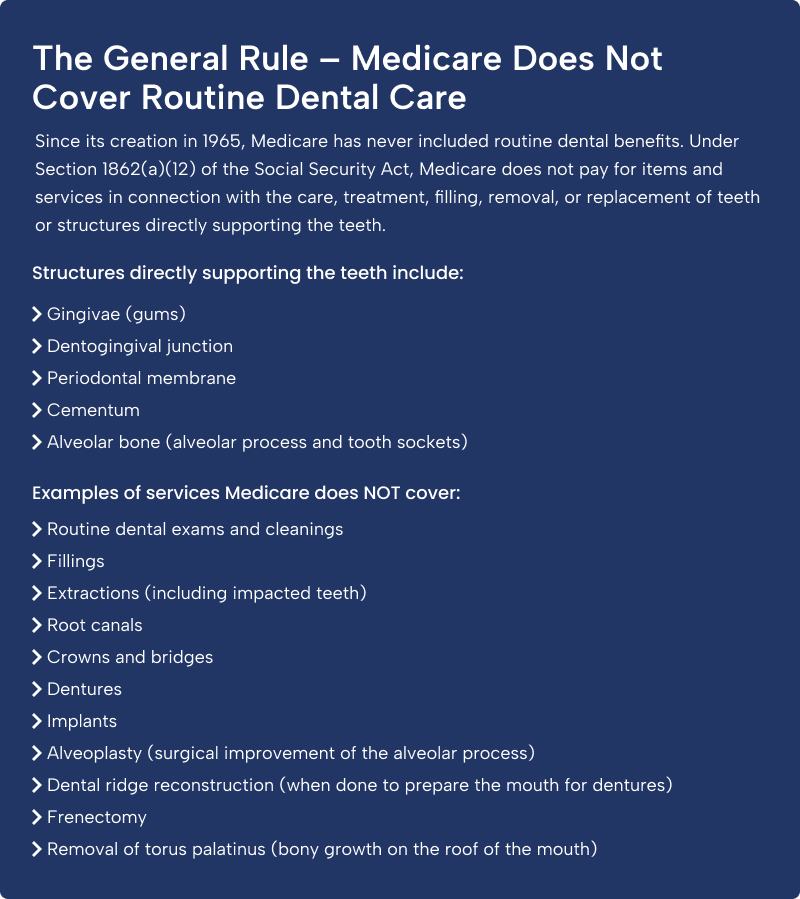
Since its creation in 1965, Medicare has never included routine dental benefits. Under Section 1862(a)(12) of the Social Security Act, Medicare does not pay for items and services in connection with the care, treatment, filling, removal, or replacement of teeth or structures directly supporting the teeth.
Structures directly supporting the teeth include:
- Gingivae (gums)
- Dentogingival junction
- Periodontal membrane
- Cementum
- Alveolar bone (alveolar process and tooth sockets)
Examples of services Medicare does NOT cover:
- Routine dental exams and cleanings
- Fillings
- Extractions (including impacted teeth)
- Root canals
- Crowns and bridges
- Dentures
- Implants
- Alveoplasty (surgical improvement of the alveolar process)
- Dental ridge reconstruction (when done to prepare the mouth for dentures)
- Frenectomy
- Removal of torus palatinus (bony growth on the roof of the mouth)
The Exception – Dental Services Covered Under Original Medicare
Medicare covers dental services in two specific situations: (1) inpatient hospital dental services and (2) dental services inextricably linked to other Medicare-covered services.
Inpatient Hospital Dental Services
Medicare Part A covers inpatient hospital dental services when the patient requires hospitalization because of:
- The patient’s underlying medical condition and clinical status, or
- The severity of the dental procedure
In these cases, Medicare pays for the hospital stay, including related dental services, even though the dental procedure itself would not normally be covered.
Dental Services Inextricably Linked to Covered Medical Services
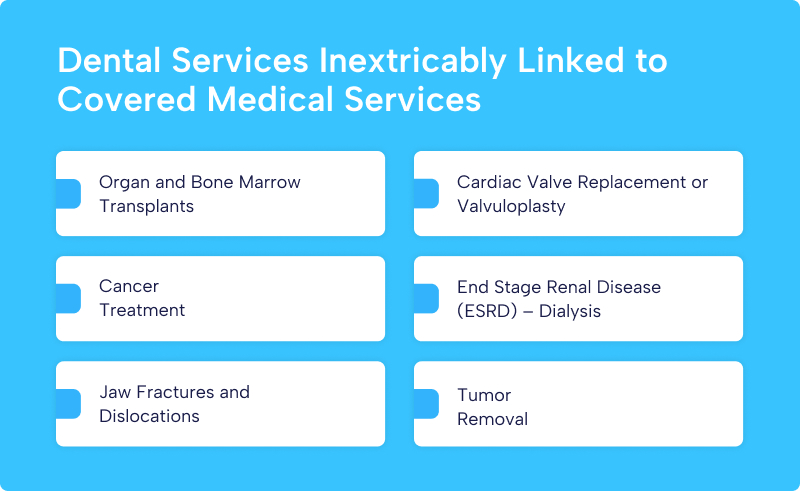
The dental services coverage exclusion does not apply when dental services are “inextricably linked to, and substantially related and integral to the clinical success of” other Medicare-covered procedures or services.
For dental services to be covered under this rule:
- Different providers (e.g., a physician and a dentist) must coordinate care
- The dental service must be integral to the clinical success of the medical service
- Coordination must be documented in the medical record
Medicare covers dental services in the following specific clinical scenarios:
Organ and Bone Marrow Transplants
- Dental or oral exams as part of a comprehensive workup prior to organ transplant, hematopoietic stem cell transplant, or bone marrow transplant
- Medically necessary diagnostic and treatment services to eliminate oral or dental infection prior to or contemporaneously with these transplants
Cardiac Valve Replacement or Valvuloplasty
- Dental or oral exams as part of a comprehensive workup prior to these procedures
- Medically necessary diagnostic and treatment services to eliminate oral or dental infection prior to or contemporaneously with these procedures
Cancer Treatment
- Dental or oral exams as part of a comprehensive workup prior to Medicare-covered treatment of head and neck cancer using radiation, chemotherapy, surgery, or any combination
- Medically necessary diagnostic and treatment services to eliminate oral or dental infection prior to or contemporaneously with head and neck cancer treatment
- Medically necessary diagnostic and treatment services to address dental or oral complications after head and neck cancer treatment
- Dental services for chemotherapy, CAR T-cell therapy, and high-dose bone-modifying agents (antiresorptive therapy) when used to treat cancer
End Stage Renal Disease (ESRD) – Dialysis
- Dental or oral examinations are performed as part of a comprehensive workup prior to Medicare-covered dialysis services
- Medically necessary diagnostic and treatment services to eliminate oral or dental infection prior to or contemporaneously with dialysis services
- Effective starting in 2025
Jaw Fractures and Dislocations
- Services to stabilize or immobilize teeth related to reducing a jaw fracture
- Dental splints used as part of the covered treatment of a covered medical condition, such as dislocated jaw joints
Tumor Removal
- Dental ridge reconstruction is done as a result of and at the same time as surgery to remove a tumor
Ancillary Services Covered with Dental Services
When Medicare covers the primary dental service, it also covers ancillary services and supplies incident to that service, including:
- Administering anesthesia
- Diagnostic x-rays
- Operating room use
- Other related procedures
What Is Not Covered – Even Under the Exceptions
Even when a patient has a qualifying medical condition, certain dental services remain excluded. Medicare does not cover dental services performed in connection with excluded services, such as services to prepare the mouth for dentures, including:
- Alveoplasty
- Dental ridge reconstruction (when done for denture preparation)
- Frenectomy
- Removal of torus palatinus
These services remain non-covered even if the patient has a qualifying condition like ESRD or is preparing for an organ transplant.
Medicare Part C (Medicare Advantage) Dental Coverage
Medicare Advantage plans are offered by private insurance companies that contract with Medicare. Unlike Original Medicare, most Medicare Advantage plans include dental benefits as an added benefit .
Key facts about Medicare Advantage dental coverage:
- Nearly all Medicare Advantage plans offer dental benefits. According to KFF, virtually all Medicare Advantage plans for 2026 provide extra benefits like vision, hearing, and dental .
- The American Dental Association estimates that up to 97% of Medicare Advantage plans include dental benefits .
- Coverage varies significantly by plan. What one plan covers, another may not .
- Typical benefits include preventive services (exams, cleanings) at $0 copay, with coinsurance (often 50%) for major services like crowns, root canals, and dentures .
- Most plans have annual coverage limits ranging from $500 to $2,000 .
- Plans cover both in-network and out-of-network services in many cases .
Providers should never assume a Medicare Advantage patient has dental coverage. Verify every patient, every visit, every procedure. Treat each Medicare Advantage plan as a separate payer.
Medicare and Medicaid Dual Eligibility
Some states cover dental services for individuals dually eligible for Medicare and Medicaid. Patients can check with their state Medicaid agency to determine what dental services are covered . State coverage varies significantly, with some states providing comprehensive dental benefits and others providing limited or emergency-only coverage.
What Medicare Covers and Does Not Cover
| Service Category | Original Medicare | Medicare Advantage |
| Routine exams and cleanings | Not covered | Covered by most plans |
| Fillings | Not covered | Covered by most plans |
| Extractions | Only if inextricably linked to covered medical service | Covered by most plans |
| Root canals | Not covered | Covered by many plans |
| Crowns | Not covered | Covered by many plans |
| Dentures | Not covered | Covered by many plans |
| Implants | Not covered | Covered by some plans |
| Dental services for organ transplant prep | Covered | Covered |
| Dental services for cancer treatment prep | Covered | Covered |
| Dental services for ESRD/dialysis | Covered (effective 2025) | Covered |
| Jaw fracture treatment | Covered | Covered |
| Inpatient hospital dental services | Covered (Part A) | Varies by plan |
Conclusion
Original Medicare does not cover routine dental care. This exclusion is statutory and has been in place since the program’s inception in 1965. The only dental services covered under Original Medicare are those that are (1) provided during an inpatient hospital stay due to medical necessity or procedure severity, or (2) inextricably linked to the clinical success of other covered medical services such as organ transplants, cancer treatment, cardiac valve procedures, and dialysis for ESRD.
Medicare Advantage plans fill this gap for many beneficiaries. Nearly all Medicare Advantage plans offer dental benefits, but coverage levels, cost-sharing, annual limits, and networks vary significantly by plan.
Providers who treat Medicare patients must know which category applies. Routine dental services are patient responsibility unless covered by Medicare Advantage or Medicaid. Medically necessary dental services tied to covered medical treatments may be billable to Medicare Parts A or B. Verify coverage. Document the inextricable link. Coordinate care between physicians and dentists. Get paid correctly.
FAQs
Does Medicare cover routine dental checkups?
No, Original Medicare does not cover routine dental exams, cleanings, or preventive care. This exclusion applies regardless of medical history or age. Patients must pay out of pocket or rely on other coverage like Medicare Advantage or standalone dental plans. Providers should clearly communicate this upfront to avoid confusion at the front desk. From a billing standpoint, these services should never be submitted to Medicare Part A or B. Doing so only leads to avoidable denials and rework.
When will Medicare pay for dental services?
Medicare pays only when the dental service directly supports a covered medical procedure. The key factor is medical necessity tied to treatment success, not the dental issue alone. For example, clearing oral infection before a heart valve replacement qualifies, but a routine extraction does not. Documentation must show clear coordination between the dentist and physician. Without that link in the medical record, even valid cases can get denied.
Are tooth extractions ever covered?
Yes, but only in very specific clinical situations. If a tooth extraction is required to eliminate infection before a covered procedure like chemotherapy or organ transplant, Medicare may pay. The extraction must be part of a larger, medically necessary treatment plan. Providers must document why the extraction is essential, not optional. Claims should also reflect proper diagnosis codes that support the underlying medical condition.
Does Medicare Advantage include dental benefits?
Most Medicare Advantage plans include dental coverage, but the details vary widely. Some plans cover preventive care at no cost, while major procedures like crowns or root canals may involve coinsurance. Annual limits often fall between $500 and $2,000, which impacts treatment planning. Network restrictions may also apply, affecting where patients can receive care. Always verify benefits, frequency limits, and patient responsibility before starting treatment.
What dental services are still not covered even with medical conditions?
Certain procedures remain excluded even if the patient qualifies under a medical exception. Services like alveoplasty or ridge reconstruction for dentures do not become billable just because a patient has ESRD or is undergoing cancer treatment. Medicare focuses on medical necessity tied to treatment success, not dental preparation. Providers must separate covered and non-covered services clearly in treatment plans. This helps avoid billing errors and patient disputes.
Do dual-eligible patients get dental coverage?
Dual-eligible patients may receive dental benefits through Medicaid, but coverage depends on the state. Some states offer comprehensive dental care, while others limit coverage to emergencies only. Providers should verify Medicaid benefits separately from Medicare before scheduling services. Billing also differs, as Medicaid rules and reimbursement rates apply. Never assume coverage, even for common procedures, without checking eligibility and plan details.
Stop Losing Revenue on Medicare Dental Claims
Medicare dental billing is full of gray areas, and that is where most practices lose money. One missing note, one wrong assumption, and the claim gets denied or never submitted correctly in the first place.
RCM Xpert helps you take control of these complex scenarios. We verify coverage before the visit, review documentation for medical necessity, align coding with Medicare rules, and follow through until payment hits your account.
If your team second-guesses Medicare dental cases or spends hours fixing denials, you are already losing revenue.
Let RCM Xpert handle the complexity so your practice gets paid faster, cleaner, and with fewer surprises.