
If you bill Medicaid for services in a New York clinic, hospital outpatient department, or diagnostic and treatment center, you have heard the term “Article 28” constantly.
Article 28 is the section of New York State Public Health Law that licenses hospitals, nursing homes, diagnostic and treatment centers, and ambulatory surgery centers.
The billing rules commonly called “Article 28 billing” originated in the Health Care Reform Act (HCRA) of 1996, which imposed specific surcharges and established new billing requirements for Article 28 facilities.
This guide covers the threshold visit rule, HCRA surcharge fields, rate codes for mental health services, telehealth restrictions, documentation requirements, and common audit triggers.
What Is Article 28 of the New York Public Health Law?
Article 28 of the New York State Public Health Law establishes the licensing and regulatory framework for health care facilities. It covers hospitals (including general hospitals, psychiatric hospitals, and tuberculosis hospitals), nursing homes (residential health care facilities), diagnostic and treatment centers (D&TCs), freestanding ambulatory surgery centers, and to some extent, hospices and certain home care agencies.
If a facility holds an operating certificate under Article 28, it must comply with specific state regulations regarding staffing, services, patient rights, and record-keeping. But for billing purposes, the Article 28 designation tells you which facilities are subject to the HCRA surcharges and the Medicaid clinic billing rules.
Types of Articles 28 Facilities
New York State DOH recognizes several categories of Article 28 facilities that bill under these guidelines:
- General Hospitals operate under Article 28 and provide inpatient and outpatient services. Their outpatient departments (hospital OPDs) bill under the clinic guidelines.
- Diagnostic and Treatment Centers (D&TCs) are freestanding facilities not attached to a hospital. They provide ambulatory care including medical, dental, and mental health services. They must have an Article 28 operating certificate.
- Freestanding Ambulatory Surgery Centers (ASCs) perform outpatient surgical procedures. They operate under Article 28 and have their own billing rules.
- School-Based Health Centers (SBHCs) must be sponsored by an Article 28 facility to bill Medicaid.
- Article 28/31 Dually Licensed Clinics provide mental health services under both the Public Health Law (Article 28) and the Mental Hygiene Law (Article 31).
What Is NOT an Article 28 Facility
Not every place that provides health care is an Article 28 facility. The following are generally not covered: private physician offices (solo or group practices), federally qualified health centers (FQHCs) as their own entity, nursing homes and assisted living facilities under different licensing, and home care services agencies.
The HCRA of 1996: Where Article 28 Billing Rules Began
The billing rules that everyone calls “Article 28 billing” actually originated from the Health Care Reform Act (HCRA) of 1996. This state legislation created two funding pools to support indigent care and health care initiatives in New York. To administer these surcharges, new data specifications had to be established for both paper and electronic claims submitted by Article 28 hospitals, comprehensive diagnostic and treatment centers, freestanding ambulatory surgery centers, and Article 5 licensed laboratories.
The Three Required Fields
For claims submitted using the NSF electronic format or the HCFA 1500 paper format, the following three fields must be completed:
- General Hospital Indigent Care/Health Care Initiatives Assessment Applicable identifies whether all of the services on the claim are subject to the assessment. This field indicates “Yes” if all services are subject or “No” if none are subject. Certain claims are exempt, including those from Medicare, CHAMPUS, CHAMPVA, Veterans Department, Black Lung, Federal Employees Health Benefit Plan, Home Health, Residential Health Care Facilities, Hospice Facilities, and physicians in private practice.
- General Hospital Indigent Care/Health Care Initiatives Assessment Percent indicates the applicable percentage when all services on the claim are subject to the assessment. For payers that pay the assessment directly to the pool administrator, the rates are 00.00%, 05.98%, or 08.18%. For payers that do not pay the assessment directly, the rates are 00.00%, 05.98%, or 32.18%.
- General Hospital Indigent Care/Health Care Initiatives Assessment Amount contains the dollar amount of the assessment calculated at the percentage. This amount is included in the total charge (balance due) on the claim.
Which Payers Pay What Percentage?
For payers that elected to pay the assessment directly to the pool administrator, 05.98% applies to State Government Agencies, Health Maintenance Organizations for Medicaid patients and Prepaid Health Service Plans, and Local Governments for Correctional Facility Inmates.
The 08.18% rate applies to payers under Workers’ Compensation Law, Volunteer Firefighters’ Benefits Law, Ambulance Workers’ Benefit Law, Comprehensive Motor Vehicle Insurance Reparations Act, Insurance Law Article 43 Corporations, NYS licensed commercial insurers, Health Maintenance Organizations (non-Medicaid), and Self-Insured Plans.
For payers not making an election to pay the assessment directly, the 32.18% rate applies to the same group that would otherwise pay 08.18%.
The Threshold Visit: How Article 28 Clinics Get Paid
What Is a Threshold Visit?
The most important concept in Article 28 clinic billing is the threshold visit. New York State Department of Health regulation 10 NYCRR 86-4.9 defines it as follows.
A threshold visit occurs each time a patient crosses the threshold of a facility to receive medical care without regard to the number of services provided during that visit.
Only one threshold visit per patient per day is allowed for reimbursement purposes. The only exception is for transfusion services to hemophiliacs, in which case each transfusion visit constitutes an allowable threshold visit. The visit is all-inclusive. It covers all medically necessary services rendered on that date.
This policy does not apply to services with their own established rates such as dialysis and freestanding ambulatory surgery. Those services are reimbursed on a per-procedure basis, not as threshold visits.
When You Cannot Bill an Additional Visit?
Several restrictions apply to threshold visit billing. When a patient receives treatment during a threshold clinic visit that cannot be completed due to administrative or scheduling problems, the facility may not bill additional clinic visits for completion of the service.
For example, the completion of clinical laboratory tests or X-rays scheduled after the initial clinic visit does not qualify for reimbursement unless the patient is also seen for purposes of discussing the findings and for definitive treatment planning.
It is inappropriate for a clinic to call a patient back for a service just to generate an additional clinic visit for a service that should have been provided at the first visit. If a patient needs both physical and occupational therapy on the same day, the clinic cannot provide one session on the first day and call the patient back for a second visit on a subsequent day to generate another clinic bill.
Emergency Room and Same Day Clinic Visits
Payment will be made for only one emergency room visit per day per Medicaid patient unless the facility can document that an additional patient visit was made for a different illness.
When a patient is treated in a facility’s emergency room and clinic on the same day, payment can be claimed for both visits only if the emergency room and the outpatient non-emergency room visits have discrete rates and the facility can document that the visits were made for different illnesses.
When a patient is admitted as an inpatient on the same day as a clinic or emergency room visit, payment can be claimed only for the inpatient cost per discharge. Payment to the hospital under DRGs or per diems is payment in full. No emergency room or clinic services may be billed to Medicaid during the patient’s inpatient stay.
Specific Rate Codes for Article 28 Clinics
New York State Medicaid uses specific rate codes for different services provided in Article 28 clinics. These rate codes determine reimbursement amounts and must be accurately reported on claims.
LMHC and LMFT Services in Article 28 Clinics
Licensed Mental Health Counselors (LMHCs) and Licensed Marriage and Family Therapists (LMFTs) can bill for services provided within their scope of practice under New York State Education Department regulations.
For Article 28 hospital outpatient departments and free-standing diagnostic and treatment centers, the rate codes are as follows. For individual services of 20 to 30 minutes with the patient, use rate code 4222. For individual services of 45 to 50 minutes with the patient, use rate code 4223. For family services, with or without the patient present, use rate code 4224.
Reimbursement amounts differ depending on the facility type. For a 4222 service, a hospital outpatient department receives $44.10 while a D&TC receives $41.41. For a 4223 service, an OPD receives $66.69 while a D&TC receives $62.62. For a 4224-family service, an OPD receives $75.30 while a D&TC receives $70.70.
School-Based Health Center Rate Codes
School-Based Health Centers (SBHCs) use a different set of rate codes for LMHC and LMFT services. Rate code 3260 is for individual services of 20 to 30 minutes. Rate code 3261 is for individual services of 45 to 50 minutes. Rate code 3262 is for family services. The reimbursement amounts match those of Article 28 clinics. OPDs receive $44.10, $66.69, and $75.30 respectively. D&TCs receive $41.41, $62.62, and $70.70, respectively.
Documentation and Record-Keeping Requirements
What Must Be in the Patient’s Chart
Adequate documentation of services provided must be recorded in the patient’s chart. If during an audit, the individual’s chart supporting payment for services cannot be produced or does not substantiate payment, the full amount paid for visits by that patient will be recouped by the State.
Patient records must reflect who actually provided the necessary service to the patient. If services are provided by a physician who is not currently licensed but is legally practicing under specific provisions of 10 NYCRR 405.4, the supervising physician’s license number or Medicaid identification number may be entered on the claim. The services must be under the direction of the supervising physician who has agreed to allow their license number to be used in this manner.
Record Retention Period
For Medicaid purposes, records must be maintained for six years from the date of payment.
Proper Procedure and Diagnosis Coding
When billing the Medicaid Program for services provided by a hospital-based or freestanding clinic, providers are required to include the appropriate procedure code(s) that identifies the service(s) rendered to the Medicaid enrollee. The procedure code entered on the claim must reflect the actual service rendered to the patient and must be consistent with the scope of practice, certification, and profession of the rendering provider.
For example, an Evaluation and Management code may only be reported on a clinic claim when the service is rendered by a qualified licensed practitioner, such as a physician, nurse practitioner, licensed midwife, or registered physician’s assistant.
Clinics are also required to include an appropriate diagnosis code which reflects the condition being treated at the clinic visit. The principal diagnosis, meaning the primary reason for the clinic visit, should be reflected in the diagnosis code reported on the claim.
Ordered Ambulatory Services
The purpose of ordered ambulatory services is to make available to the private practitioner or clinic (other than the ordered ambulatory provider) those services needed to complement the provision of ambulatory care.
These services are not meant to replace services that are expected to be provided by the private practitioner or clinic. They are also not meant to be used when it would be appropriate to admit a patient to a hospital, refer a patient to a specialist for treatment including surgery, or refer a patient to a specialized clinic for treatment.
Who May Provide Ordered Ambulatory Services
Ordered ambulatory services may be provided by a hospital or a diagnostic and treatment center possessing an operating certificate for that service issued by the DOH and meeting the requirements for participation in Medicare.
Orders for Services
Ordered ambulatory services must be ordered in writing by the patient’s attending physician, nurse practitioner, physician’s assistant, dentist, or podiatrist who is providing direct patient care services.
Telehealth and Article 28 Clinics
No Payment Parity for Article 28 FQHCs
One of the most significant ongoing policy issues for Article 28 clinics involves telehealth payment parity. New York State Medicaid currently requires all Article 28-licensed facilities, many of which are FQHCs, to have either the provider or patient physically on-site at the clinic in order to bill the full prospective payment system (PPS) rate for services delivered via telehealth.
Article 28-licensed FQHCs that have not opted into Ambulatory Patient Groups (APGs) are instructed to bill their off-site rate for a telehealth visit when both the provider and patient are off-site. This effectively reduces payment in these circumstances by approximately 50% of the full PPS payment rate. Lack of payment parity for Article 28-licensed FQHCs has been debated within the state legislature for years. Research indicates this inequitable payment structure has forced providers back into the office, even when their patients are not there. The situation has exacerbated existing FQHC workforce shortages as staff, particularly mental health providers, leave clinics in search of more flexible jobs.
The updated Telehealth Manual instructs Article 28 facilities to bill a different off-site code (4012 instead of 4013) but makes no other changes to ensure equitable payment for those providers when both the patient and provider are outside of the clinic during a telehealth visit.
What May Change in 2026
During the 2025-2026 legislative process, New York State may implement further telehealth policy changes for Medicaid and commercial payers. These include determining whether to extend payment parity beyond its current sunset date of April 1, 2026, and potentially enabling Article 28 facilities to bill the full PPS rate for telehealth services when the provider and patient are off-site.
Safety Net Hospital Rate Add-Ons (2025-2026)
For dates of service from April 1, 2025 through March 31, 2026, the Centers for Medicare and Medicaid Services approved State Directed Payment rate add-ons to Medicaid Managed Care rates for hospitals that qualified as safety net or financially distressed.
These add-ons apply only to Article 28 general clinic, ambulatory surgery, and emergency department services. The add-on amounts vary by hospital. For general clinic services, add-ons range from $118 per visit to $354 per visit. For ambulatory surgery, add-ons range from $886 per visit to $2,658 per visit. For emergency department, add-ons range from $148 per visit to $444 per visit.
Billing Guidance for Add-Ons
For outpatient clinic visits, the add-on applies to Type of Bill 13x, 71x, 72x, 74x, 75x, 78x, 79x, 83x, and 84x when rate code is null and the claim contains at least one of the specified revenue codes or procedure codes.
- Eligible procedure codes include 99201-99205, 99211-99215, 99241-99245, G0463, and 99381-99429.
- Eligible rate codes include 1400, 1432, 1489, and 1501. For Article 28/31 dually licensed clinics, eligible rate codes include 1048, 1110, 1122, 1140, 1516, 1519, 1576, and 1588. Only one add-on is allowed per claim.
- For outpatient ambulatory surgery visits, the add-on applies to Type of Bill 13x and 83x when the claim contains revenue codes 0360, 0361, 0490, or 0499, or rate code 1401.
- For outpatient emergency room visits, the add-on applies to Type of Bill 13x when the claim contains revenue codes 0450, 0451, 0452, 0459, or 0981, or rate code 1402, or procedure codes 99281-99285.
The claim must not meet criteria for inpatient acute, inpatient psychiatric, or outpatient ambulatory surgery.
Common Billing Errors and Audit Triggers
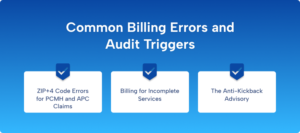
ZIP+4 Code Errors for PCMH and APC Claims
Article 28 clinics recognized under the Patient-Centered Medical Home (PCMH) or Advanced Primary Care (APC) Programs must include the USPS ZIP+4 code of the recognized clinic’s site-specific physical location where services were rendered. The ZIP+4 code submitted on the claim must reflect the actual service location, not the ZIP+4 code associated with the main facility or health system to which Medicaid payments are made.
A system edit (02068) withholds the PCMH or APC incentive payment when the ZIP+4 code submitted on the claim cannot be found on the provider’s rate file for the submitted rate code. The claim will still adjudicate, but the incentive payment will be withheld. Providers must resubmit a claim adjustment with the correct ZIP+4 code to receive the incentive payment.
Billing for Incomplete Services
When a patient receives treatment during a threshold clinic visit that cannot be completed due to administrative or scheduling problems, the facility may not bill additional clinic visits for completion of the service. Payment will only be made for one emergency room visit per day per patient unless the facility can document that additional visits were for different illnesses.
The Anti-Kickback Advisory
It is an unacceptable practice for clinical laboratories and diagnostic and treatment centers to provide or receive laboratory services at no charge. The federal anti-kickback statute (Stark Law) makes it a criminal offense to knowingly offer, pay, solicit, or receive any compensation to induce or reward referrals of services reimbursable by the State Medicaid Program.
New York State rules prohibit a laboratory from supplying employees, agents, or other fiduciaries to a referring health services purveyor to perform functions and duties in the facility of the health services purveyor. An exception applies when the purveyor is a hospital and the laboratory and hospital have entered into a contract for laboratory management services, including provision of technical services and employees for the performance of functions directly related to laboratory operations.
Credentialing and Contracting for Article 28 Clinics
Practitioner Credentialing Requirements
All practitioners must be credentialed. Managed care organizations (MCOs) may delegate credentialing to the provider, which is referred to as organizational credentialing. For any delegation of the plan’s obligation to credential its participating providers, the plan must ensure that the delegate’s credentialing process is consistent with generally accepted standards and DOH guidelines.
MCOs must re-credential participating providers a minimum of once every three years. The Department does not require providers to be re-credentialed more frequently than outlined in the Model Contract. However, the service profile will need to be updated.
School-Based Health Center Contracting
Managed care plans are required to offer a contract to all SBHCs operated by Article 28 facilities in their service area, and all five boroughs if servicing any part of New York City. Due to federally mandated reimbursement requirements, FQHCs may opt out of contracting with plans and would be reimbursed by the State pursuant to the Managed Care Supplemental Payment Program for FQHCs. Plans are not required to contract with out-of-network providers for non-SBHC services.
The contracted entity, usually the Article 28 facility rather than the SBHC site, will submit claims to the plans. Claims testing is required for all SBHC sites. If an operator submits claims on behalf of their sites, it is acceptable for plans to complete claims testing with the operator if the operator includes all of their sites in the testing.
Conclusion
Article 28 billing comes down to a few core rules. One threshold visit per patient per day. HCRA surcharges on every claim. Correct rate codes for each service type. Documentation for six years. Telehealth parity remains unresolved for Article 28 FQHCs, and the 2025-2026 safety net add-ons provide additional revenue for qualifying hospitals.