
Cardiac rehabilitation (CR) is one of those Medicare benefits that saves lives and money, but the billing rules around it are surprisingly detailed. If you run a hospital outpatient department or a physician office-based program, you need to know who qualifies, what the program must include, how many sessions Medicare pays for, and what changed for 2026.
Qualifying Diagnoses for Cardiac Rehabilitation
Medicare covers cardiac rehabilitation only for patients who have experienced one of the following seven events or conditions.
- Acute myocardial infarction within the preceding 12 months
- Coronary artery bypass graft (CABG) surgery
- Current stable angina pectoris
- Heart valve repair or replacement
- Percutaneous transluminal coronary angioplasty (PTCA) or coronary stenting
- Heart or heart-lung transplant
- Stable, chronic heart failure is defined as a left ventricular ejection fraction (LVEF) of 35% or less and New York Heart Association (NYHA) class II to IV symptoms, despite being on optimal heart failure therapy for at least six weeks
The CDC defines qualifying events slightly more narrowly, but these seven are the standard Medicare coverage criteria. For heart failure patients, “stable” means no recent (≤6 weeks) or planned (≤6 months) major cardiovascular hospitalizations or procedures.
Required Components of a CR/ICR Program
Medicare does not pay for exercise alone. A covered cardiac rehabilitation program must include all six of the following components.
- Physician-prescribed exercise must be provided each day CR services are furnished. The prescription must be established by a physician and includes aerobic exercise combined with other types such as strengthening or stretching as determined appropriate for each patient.
- Cardiac risk-factor modification includes education, counseling, and behavioral intervention tailored to the patient’s individual needs. This must occur at least once during the program.
- Nutritional services are bundled into the CR benefit. You cannot bill medical nutrition therapy codes (97802-97804) separately for the same patient encounter.
- Psychosocial assessment means an evaluation of the patient’s mental and emotional functioning as it relates to rehabilitation. This includes assessment of family and home situation factors that affect rehabilitation treatment, plus a psychosocial evaluation of the patient’s response to and rate of progress under the treatment plan.
- Outcomes assessment must be performed at the start and conclusion of the program. It includes patient-centered outcomes measured by the physician, objective clinical measures including exercise performance, and self-reported measures of exertion and behavior.
- An individualized treatment plan must be written and tailored to each patient. It must include a description of the patient’s diagnosis, the type, amount, frequency, and duration of services furnished, and the goals set for the patient. The plan must be established, reviewed, and signed by a physician every 30 days.
Session Limits: CR vs. ICR
Medicare covers two types of cardiac rehabilitation programs with different session limits.
Standard Cardiac Rehabilitation (CR)
Standard CR sessions are limited to a maximum of two 1-hour sessions per day, up to 36 sessions furnished over a period of up to 36 weeks. Medically necessary additional sessions may be approved for an additional 36 sessions (72 total) over an extended period of time. There is no lifetime limit on the number of CR sessions a patient can receive. A patient who experiences a new qualifying event after completing a course of CR may be eligible for another series of sessions.
Intensive Cardiac Rehabilitation (ICR)
ICR programs are more intensive, allowing up to six 1-hour sessions per day. However, total ICR sessions are capped at 72 one-hour sessions delivered over a period of up to 18 weeks.
Switching Between Programs
Once a patient begins standard CR, they may not switch to ICR. However, a patient may switch from ICR to CR. If a patient experiences multiple qualifying indications simultaneously, they are entitled to a single series of sessions. For example, a patient who had a myocardial infarction within 12 months and currently has stable angina gets one series of up to 36 CR sessions (with option for additional 36) or one series of up to 72 ICR sessions.
Virtual Supervision and Telehealth: 2026 Updates
Two major changes took effect for 2026 that affect how cardiac rehabilitation programs can be delivered.
Permanent Virtual Direct Supervision
Virtual direct supervision of CR, ICR, and pulmonary rehabilitation by a physician or non-physician practitioner is now permanent. This applies to both hospital outpatient provider departments (HOPDs) and physician office-based programs.
This means supervising practitioners do not need to be physically present in the same room or even the same building as the patient or staff during sessions. They can supervise via real-time, continuous audio-visual communication technology.
Telehealth Delivery Limited to Physician Offices
CR, ICR, and PR codes are now permanently listed on the Medicare telehealth services list. However, this applies only to physician office-based programs. Hospital outpatient provider departments still cannot provide these services virtually. That would require a statutory fix from Congress.
For telehealth delivery, the program must use real-time, continuous audio-visual communication technology. Phone-only and audio-only communication are not acceptable.
Billing Codes and Bundling Rules
Cardiac rehabilitation services are billed under two primary CPT codes:
- 93797 — Physician services for cardiac rehabilitation program, without continuous ECG monitoring
- 93798 — Physician services for cardiac rehabilitation program, with continuous ECG monitoring
What You Cannot Bill Separately
Several services are bundled into the cardiac rehabilitation benefit and cannot be billed separately for the same patient encounter.
- Evaluation and management (E/M) codes are not separately reportable unless a significant, separately identifiable E/M service is performed and documented. In that case, use modifier 25.
- Medical nutrition therapy (97802-97804) is included in CR services and cannot be billed separately for the same encounter. However, MNT provided under the Medicare benefit for diabetes or chronic renal failure at a separate patient encounter on the same date may be reported separately.
- Physical or occupational therapy services performed at the same patient encounter as CR are included and are not separately reportable. If PT or OT is performed at a separate, medically reasonable and necessary encounter on the same date, both types of services may be reported using an NCCI PTP-associated modifier.
Documentation Requirements
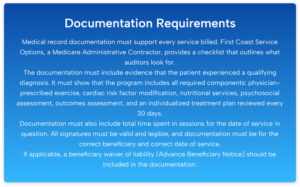
Medical record documentation must support every service billed. First Coast Service Options, a Medicare Administrative Contractor, provides a checklist that outlines what auditors look for.
The documentation must include evidence that the patient experienced a qualifying diagnosis. It must show that the program includes all required components: physician-prescribed exercise, cardiac risk factor modification, nutritional services, psychosocial assessment, outcomes assessment, and an individualized treatment plan reviewed every 30 days.
Documentation must also include the total time spent in sessions for the date of service in question. All signatures must be valid and legible, and documentation must be for the correct beneficiary and the correct date of service.
If applicable, a beneficiary waiver of liability (Advance Beneficiary Notice) should be included in the documentation.
Role of Non-Physician Practitioners
Non-physician practitioners (NPPs), including nurse practitioners, physician assistants, and clinical nurse specialists, have specific roles they can and cannot perform in Medicare CR programs.
NPPs may provide direct supervision of CR, ICR, and PR services, either in person or virtually. This is a significant change that allows programs to leverage clinical staff more flexibly.
However, NPPs cannot order CR/ICR services, sign treatment plans, or serve as medical directors. CMS maintains that only physicians may establish, review, and sign individualized treatment plans based on statutory language. The CR and PR statutes require “physician-prescribed exercise” as part of an “individualized treatment plan” that must be “established, reviewed, and signed by a physician”. CMS has interpreted this strictly.
The Department of Veterans Affairs and some commercial payers may have different rules, but for Medicare, this restriction stands.
PR vs. CR: Key Differences to Know
While this guide focuses on cardiac rehabilitation, providers should understand key differences between CR and pulmonary rehabilitation (PR) to avoid confusion.
PR is allowed for only two diagnoses: COPD and post-COVID-19. PR has a lifetime limit of 72 sessions since January 1, 2010, including all codes ever used for PR and for both diagnoses. CR has no lifetime limit.
Both allow up to two billed sessions per day. For CR, if two sessions are billed, exercise must be performed in at least one of those sessions. For PR, exercise must be performed in each session that is billed.
What’s Changing: 2026 Final Rules
Two final rule changes apply to CR, ICR, and PR for 2026.
Virtual direct supervision by a physician or non-physician practitioner is now permanent for both HOPD and physician office-based programs. CR/ICR/PR codes are now permanently listed on the Medicare telehealth services list, but this applies only to physician office-based programs. HOPDs still cannot provide these services virtually.
Reimbursement rates for 2026 include a small increase across most service lines and locations, with the exception of outpatient respiratory services code G0239, which declined slightly.
Frequently Asked Questions
How many cardiac rehabilitation sessions does Medicare cover?
Medicare covers up to 36 standard CR sessions over 36 weeks, with the option for an additional 36 sessions (72 total) if medically necessary. ICR covers up to 72 sessions over 18 weeks.
What is the difference between CR and ICR?
Standard CR allows up to two 1-hour sessions per day over 36 weeks. ICR allows up to six 1-hour sessions per day over 18 weeks. ICR is more intensive but capped at 72 total sessions with no extension option.
Can a nurse practitioner order cardiac rehabilitation?
No. Only a physician can order CR/ICR services and sign the individualized treatment plan. NPPs may provide direct supervision but cannot order services, sign plans, or serve as medical directors.
Can cardiac rehabilitation be delivered via telehealth?
Yes, but only from physician office-based programs. Hospital outpatient departments cannot provide CR virtually. Telehealth delivery requires real-time, continuous audio-visual communication. Phone-only is not allowed.
Does Medicare cover maintenance cardiac rehabilitation?
No. Medicare covers CR only for patients with qualifying diagnoses who need skilled rehabilitation services. Maintenance programs or ongoing exercise without skilled supervision are not covered.
Need Help With Cardiac Rehabilitation Billing?
Managing Medicare cardiac rehabilitation billing can be challenging due to strict documentation requirements, evolving telehealth regulations, and complex reimbursement rules. At RCM Xpert Medical Billing Company, our experienced billing specialists help cardiology practices, hospitals, and rehabilitation programs maximize reimbursements while maintaining full Medicare compliance.
Our Services Include:
✔ Cardiology Billing & Coding
✔ Cardiac Rehabilitation Billing (93797 & 93798)
✔ Medicare Claims Management
✔ Denial Prevention & Appeals
✔ Revenue Cycle Management
✔ Eligibility Verification & Authorization Support
✔ Compliance Audits & Documentation Reviews
Partner with RCM Xpert to reduce claim denials, improve cash flow, and ensure accurate reimbursement for every cardiac rehabilitation service provided.
📞 740-766-6083
📧 info@rcmxpert.com
🌐 www.rcmxpert.com
Contact RCM Xpert today for a free billing consultation and discover how our experts can streamline your cardiology and cardiac rehabilitation billing processes.