
PMHNP CPT codes are the procedure codes psychiatric mental health nurse practitioners use to bill diagnostic evaluations (90791, 90792), psychotherapy (90832, 90834, 90837), combined medication management and therapy visits (an E/M code plus add-on 90833, 90836, or 90838), medication-only visits (99212 to 99215), crisis care (90839, 90840), and psychological testing evaluation (96130, 96131). Most PMHNP claims come down to about a dozen codes, three time thresholds, and two modifiers, and most PMHNP denials come down to getting one of those wrong.
This guide covers every code family a psychiatric NP bills in 2026, the documented-minute ranges that separate them, the modifier and place-of-service rules that quietly change what you are paid, and the January 2026 changes, including the G-codes that replaced the Collaborative Care Model family, that are already generating automatic denials for practices billing last year’s codes.
Diagnostic Evaluation Codes
90791: Psychiatric Diagnostic Evaluation (Without Medical Services)
This code is your initial assessment tool when evaluating a patient, but not performing a medication evaluation. It covers gathering patient history, assessing clinical concerns, conducting a mental status exam, formulating a diagnosis, and making treatment recommendations.
The documentation should include presenting problems, relevant history (including collateral information from family or other sources), a mental status examination, diagnostic impressions, and initial treatment recommendations. Time spent consolidating and synthesizing clinical information to establish a diagnosis counts toward the service time.
Who can bill this code? PMHNPs, psychiatrists, psychologists, clinical social workers, marriage and family therapists, and licensed professional counselors.
Key rules: Do not bill 90791 on the same day as 90792, 90839 (crisis therapy), 90847 (family therapy), or 90853 (group therapy) by the same provider for the same patient.
90792: Psychiatric Diagnostic Evaluation (With Medical Services)
This code is the same as 90791 but includes medical services. The medical services component typically refers to a medication evaluation. A medication evaluation involves assessing the patient’s medication history and current needs in addition to the psychiatric evaluation.
Who can bill this code? The medical services component means the provider must have prescriptive authority. PMHNPs, psychiatrists, physician assistants, and clinical nurse specialists are eligible. This code is not available to master’s-level therapists who cannot prescribe.
Limit: One psychiatric diagnostic interview exam is allowed per client, per provider, per calendar year.
Psychotherapy Codes
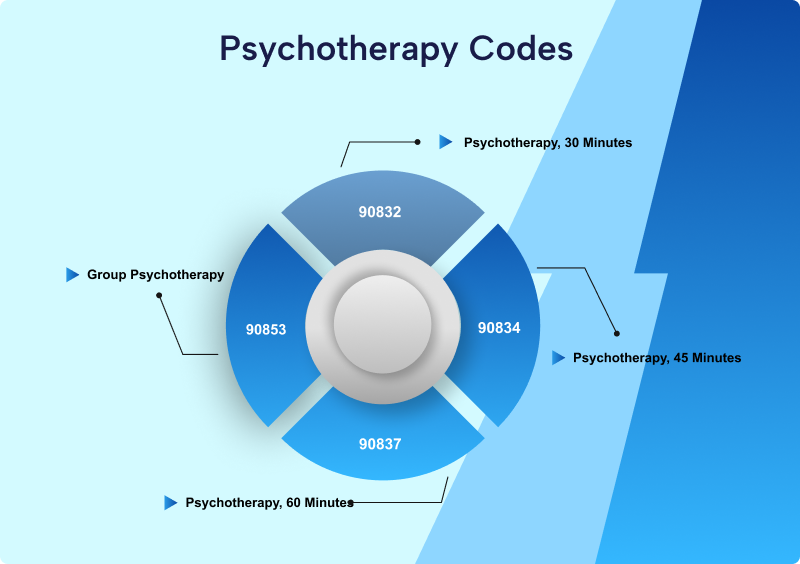
These codes capture the therapy you provide in a session. Use them when your visit is primarily focused on therapeutic intervention.
90832: Psychotherapy, 30 Minutes
This code covers 16 to 37 minutes of face-to-face time with the patient and/or family member. It is for a brief therapy session.
90834: Psychotherapy, 45 Minutes
This is for sessions lasting 38 to 52 minutes. This is the most common therapy code for a standard 45–50-minute session.
90837: Psychotherapy, 60 Minutes
This code is for sessions lasting 53 minutes or more. Use this code for extended individual therapy sessions.
90853: Group Psychotherapy
Use this code for group therapy sessions. It covers the treatment of two or more patients in a group setting.
Family Therapy Codes
- 90846: Family psychotherapy without the patient present.
- 90847: Family psychotherapy with the patient present.
Psychotherapy with E/M (Add-on Codes)
This is where billing for PMHNPs can get tricky. When you provide both medication management (an E/M service) and therapy in the same encounter, you do not bill separate E/M and therapy codes. Instead, you bill an E/M code for the medication management plus an add-on code for the therapy.
This is a critical distinction. The add-on codes exist because payers recognize you are providing two distinct services, medication evaluation and psychotherapy in a single visit. They are not primary codes. They must be billed in conjunction with an appropriate E/M code.
The Add-On Codes
- 90833: Psychotherapy, 30 minutes with E/M service (16-37 minutes of therapy)
- 90836: Psychotherapy, 45 minutes with E/M service (38-52 minutes of therapy).
- 90838: Psychotherapy, 60 minutes with E/M service (53+ minutes of therapy).
| Let us say you see an established patient for 60 minutes. The patient has been stable on their current medication, but you also perform a 45-minute therapy session focusing on coping skills and processing a recent life event.
You would bill one unit of an E/M code (for the medication management) and one unit of the appropriate add-on code. Your documentation must capture both the medication management and the therapy components of the visit, and the time for each service must be clearly documented. The primary E/M code (e.g., 99212-99215) captures the medication management component, and the add-on code captures the psychotherapy component. |
The chart below shows how provider time maps to the add-on codes:
| Add-On Code | Therapy Time Required |
| 90833 | 16-37 minutes |
| 90836 | 38-52 minutes |
| 90838 | 53+ minutes |
E/M Codes for Medication Management
When you are focused on medication management, you use the standard E/M codes for office or other outpatient visits. Selection is based on either Medical Decision Making (MDM) or total time on the date of the encounter. You are not required to document a separate therapy code when the visit is purely for medication management.
Established Patient Codes
| Code | Typical Time | MDM Level |
| 99212 | 10-19 min | Straightforward |
| 99213 | 20-29 min | Low |
| 99214 | 30-39 min | Moderate |
| 99215 | 40-54 min | High |
For a typical medication management visit (e.g., checking side effects and refilling a stable medication), 99212 or 99213 is often appropriate. However, you must document the time or meet the MDM criteria to support the level you bill.
Crisis Codes
90839: Psychotherapy for Crisis, First 60 Minutes
This code is for a crisis psychotherapy session. It requires an urgent assessment and history of the crisis state, a mental status exam, and a disposition. It is used for patients in immediate distress where the focus is on stabilizing the crisis and preventing deterioration.
90840: Crisis Psychotherapy, Each Additional 30 Minutes
Use this add-on code for each additional 30 minutes of crisis psychotherapy beyond the first hour.
Psychological Testing (96130) for PMHNPs
Did you know PMHNPs can bill for reviewing and interpreting a psychological test battery? Many providers are missing this revenue opportunity. If you use a tool like MindMetrix or other standardized instruments with your patients, you may be able to bill for the time you spend interpreting the results.
What is CPT 96130?
CPT 96130 covers the first hour of psychological testing evaluation services performed by a physician or qualified healthcare professional (QHP) . The work includes:
- Reviewing test results
- Integrating patient data and collateral information
- Interpreting standardized test scores
- Clinical decision-making and differential diagnosis
- Treatment planning based on assessment findings
- Documentation and report writing
- Providing interactive feedback
Time Threshold: This is a time-based code. The minimum threshold is 31 minutes of total time. This includes both face-to-face time and non-face-to-face time, like reviewing a report before the appointment.
Documentation for 96130
Your documentation must support the time. You should document the total time spent on the evaluation service, specifying the start and end times, or the cumulative time spent on the date of the service.
Related Code: 96127
If 96130 is not covered by a particular payer, CPT 96127 is an alternative. It covers brief emotional or behavioral assessments using standardized instruments. It does not have the 31-minute minimum. Reimbursement is typically much lower ($7–$12 per unit), but it is broadly accepted and can be used as a fallback when a longer test battery is not appropriate.
Key Billing Rules for PMHNPs
Know Your Payer
The rules are not universal. Payer contracts vary significantly.
- Medicare: Generally, follows CMS guidelines for the 85% reimbursement rule for NPs. Medicare may have specific coverage policies for certain codes. For psychological testing codes, some Medicare contractors may have stricter requirements for the QHP definition.
- Commercial Payers: Each payer—Aetna, Blue Cross Blue Shield, Optum, and others—has its own coverage policies. Some may not recognize 96130 for master ‘s-level clinicians, while others will. Always verify coverage and reimbursement rates before billing a new code.
- Medicaid: State Medicaid programs have their own fee schedules and coverage rules. The guidance in this sheet is general; you must check your state’s specific requirements.
Time-Based Codes
For time-based codes, document the total time spent on the service. The time does not have to be continuous, but it must be on the date of the encounter. For 96130, preparation time counts toward the 31-minute minimum.
Modifiers
Modifier 95 (Synchronous Telemedicine Service) indicates the service was rendered via a real-time, interactive audio and video telecommunications system. Use it when billing telehealth visits. There are other modifiers for asynchronous (store-and-forward) telehealth, but these are less common.
Conclusion
This reference sheet gives you the foundation for PMHNP billing. Understand your scope of practice. Know the difference between diagnostic evaluations (90791/90792), psychotherapy (90832-90837), and psychotherapy with E/M add-on codes (90833, 90836, 90838). Master the E/M codes (99212-99215) for medication management. And remember to check payer contracts before billing psychological testing codes (96130) to ensure you are covered.
Use this guide as a starting point, but always verify rules with each specific payer and consult your coding and billing resources for the most current information.
At RCM Xpert, we understand the specific rules that apply to psychiatric-mental health nurse practitioners. We know the difference between 90834 and 90837. We know when to use 90791 versus 90792. We understand the add-on codes and how to document for both therapy and medication management in a single visit.
We do not just process claims. We review your documentation. We identify missed revenue opportunities. We handle denials and appeals. We ensure you get paid for every service you provide, so you can focus on your patients.
Get Your Free Billing Assessment Today
Frequently Asked Questions
What is the difference between 90791 and 90792?
90791 is a psychiatric diagnostic evaluation without medical services. Use it when you evaluate the patient and develop a treatment plan, but do not perform a medication evaluation. 90792 includes medical services, which means you are assessing the patient’s medication history and current needs alongside the psychiatric evaluation. Since 90792 includes a medication component, only providers with prescriptive authority, like PMHNPs, can bill it.
Can I bill an E/M code and a therapy code for the same patient on the same day?
Yes, but not as separate codes. You must bill the E/M code for the medication management portion, plus one of the add-on therapy codes: 90833 (30 min therapy), 90836 (45 min therapy), or 90838 (60 min therapy). This combination tells the payer you delivered two distinct services in the same visit. Never bill a stand-alone therapy code (90832-90837) with a stand-alone E/M code on the same day.
How do I decide between 90834 and 90837?
The difference is time. 90834 is for sessions lasting 38 to 52 minutes. 90837 is for sessions of 53 minutes or longer. Document your start and stop times clearly. One minute can be the difference between codes. If you go over 52 minutes, you must bill 90837.
What counts toward billable time for time-based codes?
For psychotherapy codes, billable time is face-to-face time spent with the patient. For 96130 (psychological testing evaluation), billable time includes both face-to-face and non-face-to-face time on the date of the encounter, such as reviewing a psychological test report before the session. The total time must be documented. For the psychotherapy with E/M add-on codes (90833, 90836, 90838), the therapy time must be distinct and documented separately from the E/M service time.
What is a common reason for PMHNP claim denials?
One of the most common reasons is choosing the wrong billing code due to inadequate documentation. If your note does not support the level of service you billed, the claim will be denied. Another common reason is failing to document time accurately for time-based codes. Incomplete or vague notes are a major trigger for audits. Always ensure your documentation clearly establishes medical necessity.
Can I bill for reviewing a psychological test report as a PMHNP?
Yes. CPT 96130 covers the first hour of psychological testing evaluation services performed by a qualified healthcare professional, which includes PMHNPs in many states and for many payers. This code covers the time spent reviewing test results, integrating patient data, interpreting scores, and developing a treatment plan. It is a time-based code with a minimum threshold of 31 minutes. Always verify coverage with each specific payer before billing.
How does medical necessity affect my billing?
Medical necessity is the foundation of all billing. You must demonstrate that the service was reasonable and necessary for the diagnosis and treatment of the patient’s condition. Your documentation must clearly link the service to the patient’s diagnosis, functional impairment, and the specific intervention provided. Without a clear medical necessity, your claim will be denied, regardless of the code you use.
Stop Losing Revenue Between 90834 and 90837
You trained to manage complex psychiatric patients, not to argue with a payer about modifier 25 or track which POS code your telehealth claims went out under. RCM Xpert is a New York based medical billing and revenue cycle management company serving psychiatric and behavioral health providers in all 50 states, and PMHNP billing is work we do every day: the E/M plus add-on structure, the 53-minute threshold, the 96130 modifier logic, incident-to compliance, and the 2026 G-code transition that is already denying claims for practices that missed it.
We verify the carve-out before your first claim, code from your documentation, work every viable denial by root cause, and reconcile every payment against your fee schedule so underpayments surface instead of disappearing.
Get a free billing audit. We will review a sample of your PMHNP claims and show you exactly where revenue is leaking, what the 2026 changes cost you so far, and what you can recover.
Call 740-766-6083 or request your free billing audit at rcmxpert.com.