What Is the HCFA 1500 Form? A Complete Medical Billing Guide for 2026
Healthcare providers submit millions of insurance claims every year, and every claim starts with accurate documentation. For physicians, therapists, psychologists, chiropractors, nurse practitioners, and many other healthcare professionals, one document remains central to the medical billing process: the HCFA 1500 Form.
Although healthcare billing has become largely electronic, the HCFA 1500 Form continues to serve as the industry standard for submitting professional medical claims. Whether a claim travels electronically or on paper, the same information collected on this form helps payers determine eligibility, process reimbursement, and maintain accurate patient records.
If you are new to medical billing or want to improve your claim accuracy, understanding this form is essential. Even a small mistake can lead to claim denials, payment delays, or requests for additional information.
What Is the HCFA 1500 Form?
The HCFA 1500 Form, officially known today as the CMS-1500 Claim Form, is the standard health insurance claim form used by noninstitutional healthcare providers to bill Medicare, Medicaid, commercial insurance companies, and many other third-party payers for professional healthcare services.
The form captures the essential information needed to process a medical claim, including:
Patient demographics
Insurance information
Provider information
Diagnosis codes
Procedure codes
Dates of service
Place of service
Charges for services rendered
Insurance companies use this information to determine whether the service is covered, calculate reimbursement, and issue payment in accordance with the patient’s health plan.
Today, most providers submit claims electronically. However, electronic claims follow the same data elements established by the CMS-1500 claim form and the HIPAA 837P electronic transaction standard.
Did you know?
The official paper version currently accepted by Medicare and most commercial insurers is the CMS-1500 (02/12) form, which the National Uniform Claim Committee (NUCC) maintains and updates as needed.
Why Is It Called the HCFA 1500 Form?
Many healthcare professionals still refer to the form as the HCFA 1500, even though the official name changed more than two decades ago.
Originally, the Health Care Financing Administration (HCFA) managed Medicare and Medicaid. In 2001, the federal government renamed the agency the Centers for Medicare & Medicaid Services (CMS).
After the name change, the claim form officially became the CMS-1500 Claim Form. Despite this update, the term HCFA 1500 remains widely used throughout the healthcare industry because many providers, billers, coders, and practice managers have used the original name for decades.
Today, both terms generally refer to the same claim form.
For clarity and consistency, most payer manuals, Medicare publications, and the National Uniform Claim Committee use the official term CMS-1500.
Who Uses the HCFA 1500 Form?
The CMS-1500 Form is designed for professional healthcare services provided by individual practitioners and group practices rather than hospitals or institutional facilities.
Healthcare professionals who commonly use this form include:
Physicians
Family medicine providers
Internal medicine physicians
Specialists
Nurse Practitioners (NPs)
Physician Assistants (PAs)
Clinical Psychologists
Licensed Clinical Social Workers (LCSWs)
Professional Counselors
Physical Therapists
Occupational Therapists
Speech-Language Pathologists
Chiropractors
Podiatrists
Optometrists
Independent Diagnostic Testing Facilities (IDTFs)
Durable Medical Equipment (DME) suppliers, when applicable
Ambulance suppliers, when applicable
Rural Health Clinics for certain professional services, when permitted by payer rules
Many outpatient clinics, private practices, behavioral health organizations, rehabilitation centers, and specialty clinics also use the CMS-1500 Form to report professional services.
Who Should Not Use the HCFA 1500 Form?
The CMS-1500 Form is not intended for institutional facility billing.
Hospitals and other healthcare facilities typically use the UB-04 (CMS-1450) claim form instead.
Examples include:
Acute care hospitals
Critical access hospitals
Skilled nursing facilities
Inpatient rehabilitation facilities
Hospice facilities
Home health agencies
Hospital outpatient departments
Comprehensive outpatient rehabilitation facilities, when billing institutional services
These organizations bill facility charges using the UB-04 because institutional claims require different billing information than professional claims.
Using the wrong claim form can result in claim rejection before the payer even begins processing the claim.
Why the HCFA 1500 Form Matters
The HCFA 1500 Form provides the essential patient, provider, diagnosis, and billing information insurance companies need to process professional medical claims efficiently.
Every field on the CMS-1500 Form plays an important role in claim processing.
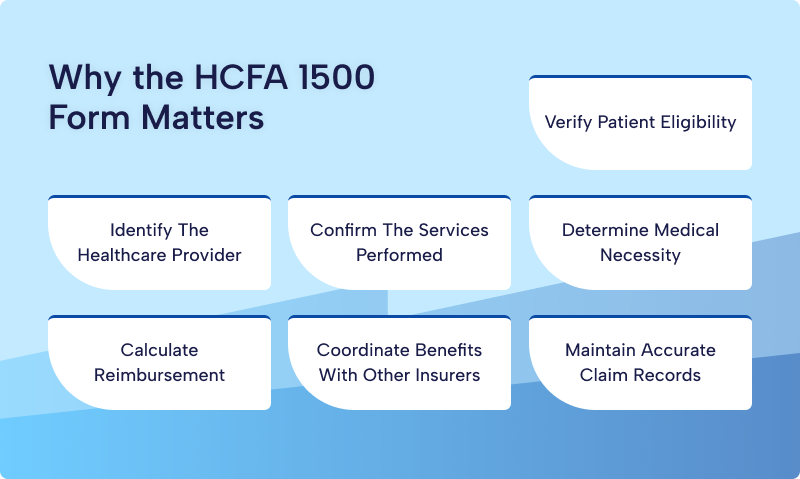
Insurance companies rely on the information reported on the form to:
Verify patient eligibility
Identify the healthcare provider
Confirm the services performed
Determine medical necessity
Calculate reimbursement
Coordinate benefits with other insurers
Maintain accurate claim records
If any required information is missing or inaccurate, the payer may reject the claim, deny payment, or request additional documentation.
For this reason, successful medical billing begins with accurate claim preparation and careful attention to detail.
HCFA 1500 Form vs. UB-04: What’s the Difference?
One of the most common mistakes new medical billers make is confusing the CMS-1500 (HCFA 1500) claim form with the UB-04 (CMS-1450) claim form.
Although both forms help providers bill insurance companies, they serve different purposes. Using the wrong form can lead to claim rejections, payment delays, and unnecessary rework.
The easiest way to remember the difference is this:
CMS-1500 bills professional services provided by individual healthcare professionals or group practices.
UB-04 bills facility services provided by hospitals and other institutional healthcare organizations.
Understanding when to use each form helps you submit clean claims and improve your reimbursement process.
CMS-1500 vs. UB-04 Comparison
Feature
CMS-1500 (HCFA 1500)
UB-04 (CMS-1450)
Primary Purpose
Bills professional services
Bills institutional or facility services
Used By
Physicians, therapists, psychologists, chiropractors, nurse practitioners, physician assistants, and other noninstitutional providers
Hospitals, skilled nursing facilities, home health agencies, hospice providers, rehabilitation facilities, and other institutional providers
Medicare Part B, Medicaid, commercial insurance, workers’ compensation, and many other payers
Medicare Part A, Medicaid, commercial insurance, and institutional payers
When Should You Use the CMS-1500 Form?
Use the CMS-1500 claim form whenever you bill for professional healthcare services provided by an individual practitioner or a group practice.
Common examples include:
Office visits
Behavioral health services
Physical therapy
Occupational therapy
Speech-language pathology
Chiropractic services
Diagnostic testing performed by independent providers
Telehealth services billed by professional providers
Preventive care visits
Evaluation and management (E/M) services
Most physician offices and outpatient clinics submit claims using the CMS-1500 format.
When Should You Use the UB-04 Form?
The UB-04 claim form supports billing for facility-based services rather than professional services.
Healthcare organizations that commonly use the UB-04 include:
Acute care hospitals
Critical access hospitals
Skilled nursing facilities
Inpatient rehabilitation facilities
Psychiatric hospitals
Home health agencies
Hospice organizations
Hospital outpatient departments
Ambulatory surgery centers, when required by payer guidelines
These claims often include room charges, facility fees, supplies, medications, and other institutional services that do not belong on the CMS-1500 form.
Why Choosing the Correct Claim Form Matters
Insurance companies process professional and institutional claims through different systems.
If you submit a professional claim on a UB-04 or submit a facility claim on a CMS-1500, the payer will usually reject the claim before adjudication begins. That means you must correct the claim and submit it again, which delays payment and increases administrative work.
Using the correct claim form from the beginning helps you:
Reduce claim rejections
Speed up reimbursement
Improve first-pass claim acceptance
Minimize billing errors
Strengthen revenue cycle performance
Understanding the CMS-1500 Claim Form Layout
The CMS-1500 claim form contains 33 numbered fields, also called boxes. Each box captures specific information that insurance companies need to process your claim accurately.
These fields fall into several major categories:
Patient Information
This section identifies the patient and the insured individual.
It includes information such as:
Patient name
Date of birth
Sex
Address
Insurance identification number
Relationship to the insured
Insurance Information
This section identifies the payer responsible for processing the claim.
It includes:
Insurance type
Policy number
Group number
Other health insurance information, when applicable
Clinical Information
This portion explains why the patient received care.
This section identifies the healthcare provider who performed and billed for the service.
It includes:
Billing provider information
National Provider Identifier (NPI)
Tax Identification Number (TIN) or Employer Identification Number (EIN)
Service facility location, when different from the billing address
Each field must match your documentation, payer requirements, and coding guidelines. Even a small data entry error can trigger claim edits or payment delays.
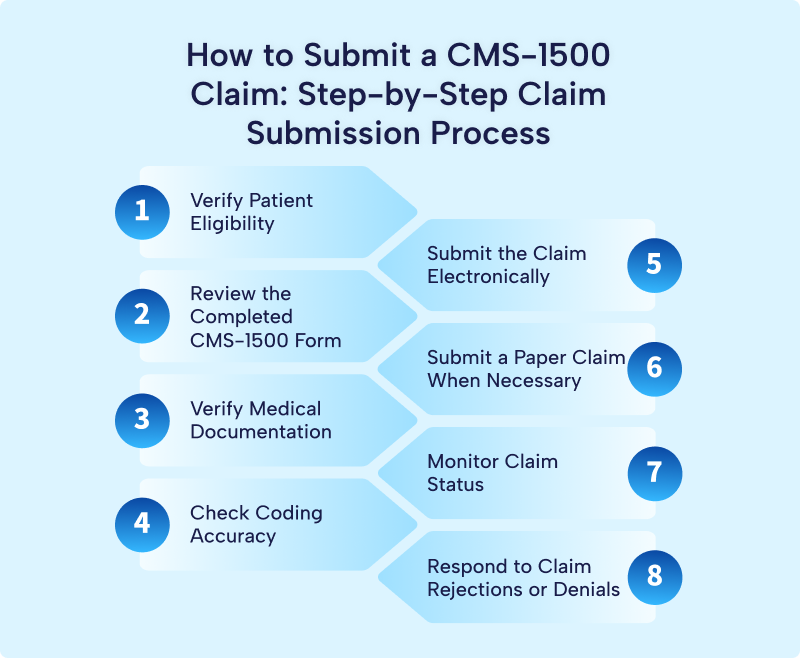
How to Submit a CMS-1500 Claim: Step-by-Step Claim Submission Process
The CMS-1500 claim submission workflow helps healthcare providers reduce billing errors, improve clean claim rates, and accelerate insurance reimbursement.
Completing the CMS-1500 form accurately is only one part of the medical billing process. After preparing the claim, you must verify the information, submit it through the appropriate channel, and monitor its status until you receive payment.
Following a structured claim submission process helps reduce errors, improve first-pass acceptance rates, and minimize reimbursement delays.
Step 1: Verify Patient Eligibility
Before submitting the claim, confirm that the patient’s insurance coverage was active on the date of service.
Verify the following information:
Patient eligibility
Member ID
Effective coverage dates
Copayment, deductible, and coinsurance
Prior authorization requirements
Coordination of benefits, if applicable
Eligibility verification helps prevent denials for inactive coverage or incorrect insurance information.
Step 2: Review the Completed CMS-1500 Form
Carefully review every section of the claim before submission.
Pay close attention to:
Patient demographics
Insurance information
Provider information
ICD-10-CM diagnosis codes
CPT or HCPCS procedure codes
Modifiers, when applicable
Place of Service (POS) code
Dates of service
Charges and units
Even a small typo can result in a rejected claim.
Step 3: Verify Medical Documentation
Your documentation should fully support every service reported on the claim.
Review the patient’s medical record to ensure it includes:
Chief complaint
Relevant history
Assessment
Diagnosis
Treatment provided
Medical necessity
Provider signature, when required
If your documentation does not support the billed services, the payer may deny the claim during review or audit.
Step 4: Check Coding Accuracy
Before submitting the claim, verify that all diagnosis and procedure codes accurately reflect the services performed.
National Correct Coding Initiative (NCCI) edits, when applicable
Using outdated, incomplete, or incorrect codes is one of the leading causes of claim denials.
Step 5: Submit the Claim Electronically
Most healthcare providers submit claims electronically because electronic claims process faster than paper claims and typically contain fewer errors.
Electronic professional claims use the HIPAA 837 Professional (837P) transaction, which contains the same information collected on the CMS-1500 claim form.
Providers typically submit electronic claims through:
A medical billing software system
A clearinghouse
A payer’s secure provider portal, when available
Many clearinghouses perform automated edits before transmitting claims to the payer, helping identify missing or incorrect information.
Step 6: Submit a Paper Claim When Necessary
Although electronic submission is the standard, some situations still require a paper claim.
If you submit a paper CMS-1500 form:
Use the official red-ink CMS-1500 (02/12) form.
Type or print clearly in black ink.
Do not staple, fold, or highlight the form.
Follow the payer’s mailing instructions.
Keep a copy for your records.
Always verify that the payer accepts paper claims before mailing them.
Step 7: Monitor Claim Status
Submitting the claim does not end the billing process.
Track the claim until the payer issues a final decision.
You can monitor claim status through:
Your practice management system
Your clearinghouse
The payer’s provider portal
Electronic Remittance Advice (ERA)
Explanation of Benefits (EOB)
Monitoring claims regularly allows you to identify and resolve issues before they affect your cash flow.
Step 8: Respond to Claim Rejections or Denials
If the payer rejects or denies the claim, review the reason carefully before taking action.
Depending on the issue, you may need to:
Correct missing or inaccurate information.
Submit additional documentation.
Correct coding errors.
Resubmit the claim.
File an appeal if you believe the denial was incorrect.
Address claim issues promptly to avoid timely filing problems.
Common CMS-1500 Billing Mistakes to Avoid
Even experienced billers occasionally make mistakes. Fortunately, most errors are preventable with a thorough review process.
Here are some of the most common issues that delay payment.
Incorrect Patient Information
Misspelled names, incorrect birth dates, or invalid member ID numbers often result in immediate claim rejections.
Always compare the claim with the patient’s insurance card before submission.
Incorrect Diagnosis or Procedure Codes
Using outdated ICD-10-CM, CPT®, or HCPCS codes can delay reimbursement or lead to denials.
Keep your coding resources current and verify every code before billing.
Missing Modifiers
Some services require modifiers to accurately describe how the service was performed.
Missing or incorrect modifiers may result in reduced payment or claim denial.
Report modifiers only when supported by official coding guidelines and payer policies.
Invalid National Provider Identifier (NPI)
An incorrect or inactive NPI prevents the payer from identifying the billing or rendering provider.
Always verify provider enrollment information before submitting claims.
Incorrect Place of Service Code
Selecting the wrong Place of Service code can affect reimbursement and may trigger claim edits.
Ensure the POS code accurately reflects where the service occurred.
Submitting a claim without the required authorization may lead to denial, even when the service is medically necessary.
Incomplete Documentation
Every billed service should have supported documentation in the patient’s medical record.
Incomplete records increase the risk of denials, audits, and payment recoupments.
Expert Tips for Faster Claim Processing
Successful medical billing begins long before claim submission.
These best practices can improve your clean claim rate and reduce administrative work.
Verify insurance eligibility before every visit.
Review documentation before coding the encounter.
Use the most current ICD-10-CM, CPT®, and HCPCS code sets.
Confirm provider enrollment information regularly.
Review claims before submission.
Monitor claim status frequently.
Address payer requests promptly.
Keep thorough documentation for every patient encounter.
Train billing staff regularly on coding and payer updates.
Small improvements in your billing workflow can significantly increase reimbursement accuracy and reduce avoidable denials.
Final Thoughts
The HCFA 1500 Form, officially known as the CMS-1500 Claim Form, remains one of the most important documents in medical billing. Whether you submit claims electronically through the HIPAA 837P transaction or use the paper CMS-1500 form in limited situations, the same principles apply: accuracy, complete documentation, and compliance with payer requirements.
Understanding how each field works, verifying patient and insurance information, using accurate diagnosis and procedure codes, and reviewing claims before submission can help your practice reduce denials, improve first-pass claim acceptance, and accelerate reimbursement.
Although completing the CMS-1500 form may seem complex at first, it becomes much easier once you understand the purpose of each section and establish a consistent billing workflow. Investing time in proper claim preparation not only improves your revenue cycle but also allows you to spend less time correcting errors and more time focusing on patient care.
Frequently Asked Questions
Is the HCFA 1500 form the same as the CMS-1500 form?
Yes. The form was originally called the HCFA 1500 because the Health Care Financing Administration managed Medicare and Medicaid. After the agency became the Centers for Medicare & Medicaid Services (CMS) in 2001, the form’s official name changed to the CMS-1500 Claim Form. Many healthcare professionals still use the term HCFA 1500.
What is the current version of the CMS-1500 form?
The current paper version accepted by Medicare and most commercial insurers is the CMS-1500 (02/12) form.
Who uses the CMS-1500 form?
Noninstitutional healthcare providers use the CMS-1500 form to bill for professional services. This includes physicians, therapists, psychologists, chiropractors, nurse practitioners, physician assistants, and many other healthcare professionals.
What is the difference between the CMS-1500 and the UB-04?
The CMS-1500 form is used for professional services provided by individual practitioners or group practices. The UB-04 claim form is used for institutional or facility services billed by hospitals, skilled nursing facilities, home health agencies, and other healthcare facilities.
Are paper CMS-1500 claims still accepted?
Yes. Some payers continue to accept paper claims in specific situations. However, most healthcare providers submit claims electronically using the HIPAA 837 Professional (837P) transaction because it is faster, more efficient, and reduces data entry errors.
Can I complete the CMS-1500 form by hand?
Most payers recommend typing the form or generating it through billing software. If you submit a paper claim, use the official CMS-1500 (02/12) form and follow the payer’s formatting requirements to help ensure accurate scanning and processing.
A Free Billing Audit reviews your recent claims and identifies where revenue is being lost. New York based, serving all 50 states. No cost, no contract.