

A provider can hold an active California license, have a valid NPI, and work for an established medical practice, yet still face Medi Cal billing problems when enrollment and credentialing records do not match.
A missing service location, outdated NPI information, inactive enrollment, incorrect group affiliation, expired documentation, or an unresolved credentialing record can create claim problems. These issues become especially important for providers who serve Medi Cal members through managed care plans, or MCPs.
California uses both Medi Cal Fee for Service and managed care. DHCS manages Fee for Service provider enrollment through its Provider Enrollment Division, while Medi Cal managed care plans contract with network providers and follow state and federal screening, enrollment, credentialing, and recredentialing requirements.
That means practices need to manage more than one relationship.
A provider may need an active Medi Cal enrollment, an MCP network contract, completed credentialing, accurate provider data, and correct billing setup before claims can move through the system without unnecessary problems.
This guide explains the credentialing gaps that commonly disrupt Medi Cal and MCP billing in California, how to find them, and what your practice can do to fix them.
What Is a Credentialing Gap?
A credentialing gap occurs when required provider information becomes missing, outdated, inconsistent, incomplete, or disconnected from the payer records that support participation and reimbursement.
Examples include:
- An expired professional license
- An outdated practice address
- A missing service location
- An incorrect NPI
- A taxonomy mismatch
- An inactive Medi Cal enrollment
- An incorrect group affiliation
- Missing malpractice insurance information
- An incomplete credentialing file
- An expired credential
- A provider who completed credentialing but never completed the required enrollment process
- A provider who appears in one payer system but not another
- A mismatch between the provider’s legal name and enrollment records
- A provider who changed groups without updating payer records
These problems may look administrative, but they can affect claims.
DHCS maintains the Medi Cal Provider Master File, which supports the claims payment process. DHCS also requires Medi Cal providers to keep enrollment information current.
Why Credentialing Matters for Medi Cal Billing
Credentialing and enrollment serve different purposes.
DHCS explains that MCP screening and enrollment remain separate from credentialing and recredentialing. Screening and enrollment verify that providers meet applicable enrollment requirements, while credentialing evaluates professional qualifications and competence.
A practice therefore should not treat these processes as interchangeable.
For example, a physician may complete credentialing with a Medi Cal managed care plan. That does not automatically mean every enrollment requirement has been satisfied.
Likewise, a provider can hold Medi Cal enrollment but still need a contract with an MCP before serving members through that plan.
DHCS states that providers who enroll through a state level enrollment pathway can participate in Medi Cal Fee for Service and contract with an MCP if the MCP chooses to contract with them. A provider who enrolls only through an MCP cannot participate in Medi Cal Fee for Service.
This distinction matters when your billing team investigates a rejected or denied claim.
Medi Cal Enrollment vs MCP Credentialing
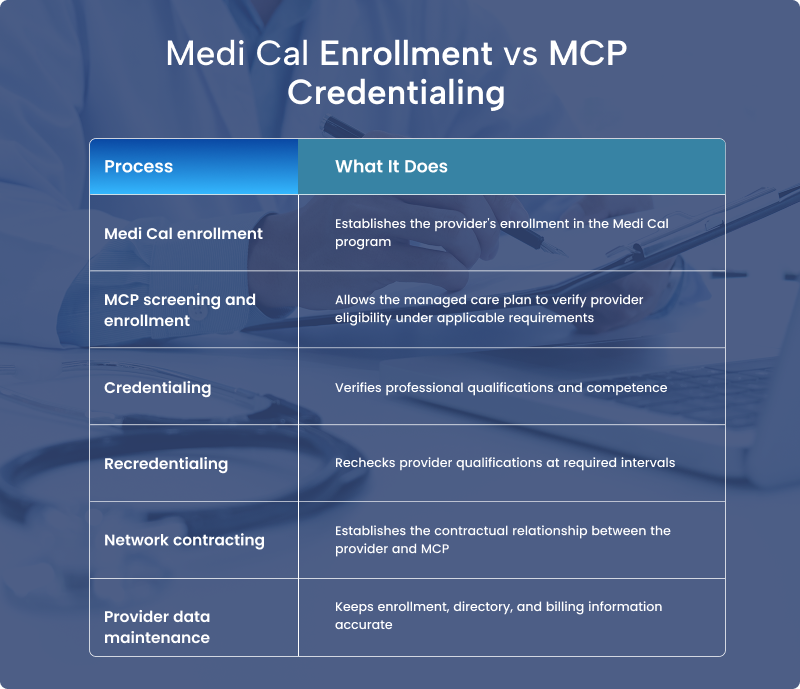
A useful way to understand California’s system is to separate the major pieces.
| Process | What It Does |
| Medi Cal enrollment | Establishes the provider’s enrollment in the Medi Cal program |
| MCP screening and enrollment | Allows the managed care plan to verify provider eligibility under applicable requirements |
| Credentialing | Verifies professional qualifications and competence |
| Recredentialing | Rechecks provider qualifications at required intervals |
| Network contracting | Establishes the contractual relationship between the provider and MCP |
| Provider data maintenance | Keeps enrollment, directory, and billing information accurate |
DHCS requires MCPs to screen and enroll network providers under applicable federal and state requirements. MCPs must also maintain credentialing and recredentialing processes.
A billing team that checks only one of these areas can miss the actual cause of a claim problem.
The Most Common Credentialing Gaps That Affect California Medi Cal Billing
Provider Enrollment Has Not Been Completed
One of the biggest problems occurs when a practice assumes an MCP contract alone establishes Medi Cal enrollment.
California’s current policy requires MCP network providers who have a state level enrollment pathway to enroll in the Medi Cal program. MCPs can use a state level pathway or, when permitted, operate their own screening and enrollment process that meets DHCS requirements.
This creates an important checkpoint.
Before billing Medi Cal managed care members, determine:
- Whether the provider needs state level Medi Cal enrollment
- Whether the provider completed the enrollment
- Whether the enrollment remains active
- Whether the MCP has completed its required process
- Whether the provider has an active network relationship with the MCP
Do not rely on the statement, “The provider is credentialed.”
Ask whether the provider has completed every required enrollment and contracting step.
The Provider’s NPI Information Does Not Match
The NPI connects provider identity across multiple healthcare systems.
DHCS requires providers to submit NPI information as part of applicable enrollment processes. For certain ordering, referring, and prescribing providers, DHCS specifically requires the individual Type 1 NPI and says the name and practice address on submitted documents must exactly match the NPI record.
A mismatch can occur when:
- The NPI record uses an old address
- The practice uses a different legal name
- The payer has an outdated taxonomy
- The provider joined a new group
- The provider uses a different service location
- The billing system contains an old NPI record
Your credentialing team should compare NPPES, Medi Cal enrollment, MCP records, CAQH where applicable, and your practice management system.
Do not assume that one database automatically updates the others.
A New Practice Location Never Reached the Payer
Providers often add offices faster than their credentialing teams update payer records.
That creates a serious problem.
A provider may have an active Medi Cal enrollment at one address but provide services at another location that the payer has not approved or loaded.
DHCS specifically requires MCPs to screen applications that involve a new practice location.
When a provider opens another office, check:
- Service address
- Billing address
- NPI location
- Medi Cal enrollment
- MCP participation
- Provider directory
- Group affiliation
- Tax identification information
- Practice management system
A new location should trigger a credentialing review instead of simply adding the address to the scheduling system.
Group Affiliation Does Not Match
Group affiliation creates another common billing problem.
Suppose a nurse practitioner leaves Group A and joins Group B.
The provider may have:
- An active license
- An active NPI
- A valid Medi Cal enrollment
- Completed credentialing
But the claim can still encounter problems if the payer has not linked the provider to the correct group.
DHCS requires group providers to submit group and applicable rendering provider applications through PAVE. DHCS defines a group provider as two or more rendering providers doing business together under a group provider number at the same business address.
Your practice should review group affiliation whenever a provider:
- Joins the practice
- Leaves the practice
- Changes ownership
- Changes tax identification information
- Moves between locations
- Changes specialty
- Changes employment status
License Information Has Expired
Medical Credentialing teams should never treat professional licenses as one-time documents.
A provider may remain employed while the license approaches expiration or changes status.
If the payer cannot verify an active license, the practice may face credentialing or participation problems.
DHCS requires applicable providers to meet state licensing requirements, and its managed care screening rules require MCPs to verify licensure and other enrollment requirements.
Create a credentialing calendar that tracks:
- License expiration date
- DEA expiration date when applicable
- Board certification
- Professional liability coverage
- Other applicable certifications
- Recredentialing dates
Start renewal work before expiration.
Malpractice Insurance Information Is Outdated
Professional liability coverage can become another credentialing gap.
DHCS’s rendering provider requirements list professional liability insurance among the documents that applicable rendering providers may need to submit through PAVE. DHCS specifies minimum coverage requirements for those providers under its current instructions.
Your credentialing team should update insurance information whenever the practice:
- Renews its policy
- Changes carriers
- Changes coverage
- Adds a provider
- Changes the insured entity
Keep the current certificate easy to retrieve.
The Provider Completed Credentialing but Never Reached the Billing System
Sometimes the credentialing department completes its work, but the billing department never receives the updated information.
That creates a disconnect.
For example:
The payer approves Dr. Smith.
The credentialing team records the approval.
The billing system still uses an old provider status.
Claims then leave the practice with outdated information.
Create a handoff process between credentialing and billing.
When enrollment or credentialing changes, billing should receive:
- Provider name
- NPI
- Taxonomy
- Group
- Service location
- Effective date
- Payer
- Network
- Participation status
- Billing instructions
This simple handoff can prevent repeated claim problems.
Credentialing Is Complete, but the Effective Date Has Not Started
A provider may receive an approval message and assume the provider can immediately bill as participating.
The effective date matters.
Your billing team should confirm the actual participation date before changing claim setup.
Use the effective date when deciding:
- When to bill under the network contract
- When to update payer records
- When to change patient eligibility workflows
- When to expect contracted reimbursement
- When to review claims submitted around the transition
Do not use the application date as the participation date.
Recredentialing Gets Missed
Credentialing does not end when the initial application receives approval.
MCPs must maintain credentialing and recredentialing processes under DHCS requirements.
A missed recredentialing cycle can create problems even when the provider continues practicing normally.
Your internal credentialing tracker should show:
| Provider | Payer | Credentialing Date | Next Review | Status |
| Provider A | MCP 1 | Date | Date | Active |
| Provider B | MCP 2 | Date | Date | Pending |
| Provider C | MCP 3 | Date | Date | Renewal needed |
Review this list every month.
Provider Directory Information Becomes Outdated
Provider directory accuracy now carries even more importance.
DHCS says federal requirements require Medicaid and CHIP Fee for Service programs and contracted managed care plans to maintain searchable provider directories. California implemented additional Fee for Service provider directory requirements effective July 1, 2025.
For applicable Fee for Service providers, DHCS requires information such as:
- Office phone number
- Website when available
- Whether the provider accepts new Medicaid patients
- Whether the provider accepts new CHIP patients
- Cultural and language capabilities
- Disability accommodations
- Telehealth availability
DHCS requires providers to review this information at least quarterly, with updates due by the end of January, April, July, and October when applicable.
Although directory requirements and claim enrollment serve different purposes, outdated information can signal a broader provider data management problem.
Taxonomy Information Does Not Match
Taxonomy codes help identify a provider’s classification and specialty.
A mismatch between taxonomy information across NPPES, Medi Cal, MCP records, and billing software can create confusion during enrollment and claim processing.
Review taxonomy whenever a provider:
- Changes specialty
- Adds a specialty
- Changes group affiliation
- Changes practice type
- Updates NPI information
Do not choose a taxonomy simply because it looks close to the provider’s specialty.
Use the taxonomy that accurately reflects the provider’s qualifications and payer enrollment requirements.
California recently updated its Medi Cal requirements for certain ordering, referring, and prescribing providers.
Effective July 23, 2026, providers who order, refer, or prescribe services to Medi Cal members and who enroll in Medicare must also enroll separately in Medi Cal for that purpose. Medicare enrollment alone does not satisfy the California Medi Cal requirement. DHCS says claims can deny when the ordering, referring, or prescribing provider’s NPI does not connect to an active Medi Cal enrollment.
This change matters for practices that rely on outside physicians and non physician practitioners.
Your billing team should review ordering, referring, and prescribing providers when a claim depends on their NPI.
A Provider’s Enrollment Status Changes Without the Billing Team Knowing
Medical Credentialing teams often manage payer records separately from billing teams.
That creates a communication gap.
If a provider becomes inactive, changes groups, loses a credential, or receives an enrollment denial, billing may continue submitting claims as if nothing changed.
Create a formal process for credentialing to notify billing about material status changes.
The notification should include:
- Provider
- Payer
- Change
- Effective date
- Reason
- Required billing action
- Follow up date
Incomplete PAVE Applications
PAVE, or Provider Application and Validation for Enrollment, handles many Medi Cal provider enrollment processes.
DHCS describes PAVE as its web-based enrollment application system. Providers can use it to submit applications, upload documents, respond to requests, track progress, and report changes to existing enrollment.
An incomplete application can slow the process.
Before submission, check:
- Provider identity
- NPI
- License
- Practice address
- Ownership information
- Supporting documents
- Required signatures
- Insurance information
- Group information
- Applicable permits
- Other provider type specific requirements
DHCS notes that complete and correct applications help reduce processing delays.
Key California Medi Cal Credentialing Rules to Remember
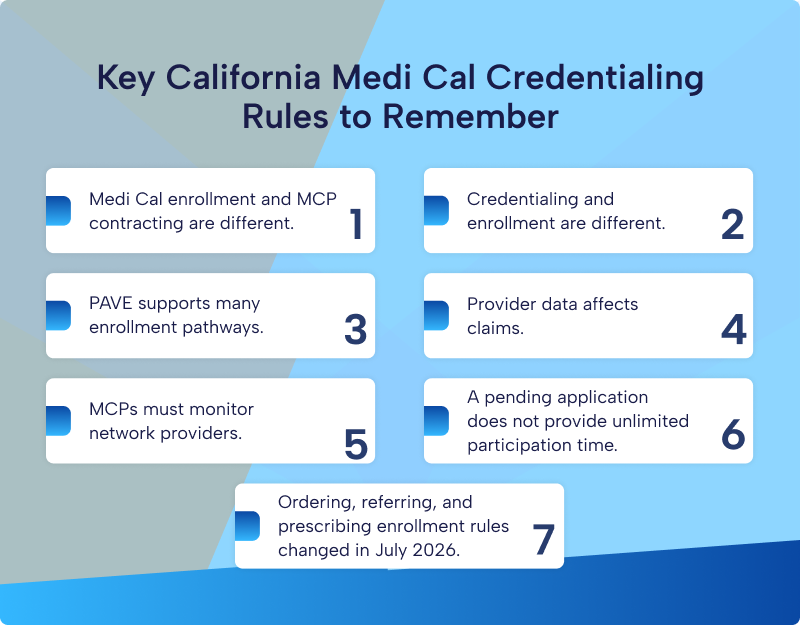
Several rules deserve special attention.
Medi Cal enrollment and MCP contracting are different.
A provider may need state enrollment and an MCP contract depending on the provider’s participation pathway.
Credentialing and enrollment are different.
DHCS explicitly separates MCP screening and enrollment from credentialing and recredentialing.
PAVE supports many enrollment pathways.
The specific pathway depends on the provider type.
Provider data affects claims.
DHCS maintains provider information in the Provider Master File used in claims payment.
MCPs must monitor network providers.
MCPs have ongoing screening, enrollment, credentialing, and recredentialing responsibilities.
A pending application does not provide unlimited participation time.
DHCS allows certain pending providers to participate for up to 120 calendar days under the conditions described in APL 22 013.
Ordering, referring, and prescribing enrollment rules changed in July 2026.
Certain providers now need separate Medi Cal enrollment even when they already participate in Medicare.
When Should a Practice Outsource Credentialing?
Outsourcing can make sense when the practice has:
- Multiple Medi Cal providers
- Several MCP contracts
- Frequent provider turnover
- Multiple locations
- A growing provider roster
- Repeated enrollment denials
- Credentialing backlogs
- High provider data maintenance demands
- Recurring provider related claim denials
An outside credentialing team can monitor enrollment status, maintain documentation, follow up with payers, and coordinate updates with billing.
The practice should still maintain oversight.
Ask the credentialing partner for:
- Application status reports
- Payer follow up logs
- Credential expiration reports
- Enrollment effective dates
- Denial reports
- Provider roster reconciliation
- Outstanding task reports
That gives management visibility into the process.
How to Measure Credentialing Performance
Don’t judge credentialing only by how many applications the team submits.
Track results.
| Metric | What It Shows |
| Days to enrollment | Speed of provider onboarding |
| Days to credentialing | Credentialing efficiency |
| Missing document rate | Application quality |
| Enrollment denial rate | Application accuracy |
| Credential expiration rate | Preventive management |
| Provider data error rate | Record accuracy |
| Credentialing related denials | Billing impact |
| Claims affected by provider status | Revenue risk |
| First pass claim rate | Downstream billing quality |
| Payer follow up aging | Outstanding enrollment work |
These metrics connect credentialing performance to revenue cycle performance.
California Medi Cal Credentialing Checklist
Before treating Medi Cal managed care patients, review this checklist.
Provider
☐ Active California license
☐ Correct NPI
☐ Correct taxonomy
☐ Correct specialty
☐ Current professional liability coverage
☐ Required certifications
☐ Required permits
Medi Cal
☐ Active Medi Cal enrollment when required
☐ Correct provider type
☐ Correct group affiliation
☐ Correct service location
☐ Correct enrollment information
MCP
☐ Network participation confirmed
☐ Credentialing completed
☐ Contract completed when required
☐ Effective date confirmed
☐ Provider loaded into payer system
Billing
☐ Rendering provider loaded correctly
☐ Billing provider loaded correctly
☐ Correct group loaded
☐ Correct service location loaded
☐ Correct payer selected
☐ Ordering and referring providers checked when applicable
Ongoing maintenance
☐ Credential expiration monitored
☐ Enrollment status monitored
☐ Group changes reported
☐ Location changes reported
☐ Directory information reviewed
☐ Recredentialing tracked
Frequently Asked Questions
Is Medi Cal enrollment the same as credentialing?
No. DHCS treats screening and enrollment as separate from credentialing and recredentialing. Enrollment establishes participation under applicable Medi Cal requirements, while credentialing evaluates professional qualifications and competence.
Does an MCP contract automatically enroll a provider in Medi Cal?
Not necessarily. DHCS requires network providers with an available state level enrollment pathway to enroll in Medi Cal. An MCP may also operate an approved screening and enrollment pathway in certain circumstances.
What is PAVE in Medi Cal enrollment?
PAVE stands for Provider Application and Validation for Enrollment. DHCS uses PAVE for many provider enrollment processes, including applications, document submission, status tracking, responses to requests, and certain enrollment changes.
How long can an MCP allow a pending provider to participate?
Under DHCS APL 22 013, an MCP may allow certain providers with pending enrollment applications to participate for up to 120 calendar days while the application remains under review. The provider must meet the applicable conditions, and the MCP cannot continue participation indefinitely while enrollment remains unresolved.
Can a provider bill Medi Cal after an enrollment denial?
A provider should not continue billing under the assumption that the denial does not affect participation. DHCS says a provider whose enrollment receives a denial cannot continue participation in the MCP network under the pending enrollment arrangement.
What happens when a provider changes practice locations?
The practice should update the applicable enrollment and MCP records and confirm that the payer recognizes the new service location. DHCS requires MCPs to screen applications involving new practice locations under its provider screening rules.
Does every Medi Cal provider use PAVE?
No. DHCS provides several enrollment pathways depending on provider type. Many provider types use PAVE, while some use other state processes or specialized pathways.
Do NPs need Medi Cal enrollment?
Yes, when they participate through applicable Medi Cal enrollment pathways. DHCS identifies nurse practitioners among non physician medical practitioners and provides specific enrollment pathways for them.