
For a growing therapy practice, billing can quietly become one of the biggest administrative expenses. At first, keeping billing in-house may seem like the obvious choice. You hire a biller, give that person access to your practice management system, and keep the entire process under your control.
But the salary is only one part of the equation.
You also pay for benefits, payroll taxes, billing software, clearinghouse fees, training, staff coverage, management time, and the revenue lost when claims sit unresolved. Outsourcing creates a different cost structure. Instead of maintaining a billing department, you pay a medical billing company based on collections, claims, or an agreed monthly fee.
For therapy practices, the decision becomes even more important because physical therapy, occupational therapy, speech therapy, behavioral therapy, and other rehabilitation services can involve authorization requirements, visit limits, payer-specific rules, recurring claims, modifier requirements, and frequent follow-up.
Current 2026 industry estimates place outsourced therapy and medical billing commonly around 4% to 9% of collections, although actual pricing depends on specialty, claim volume, payer mix, and services included. Some PT-focused sources place outsourced RCM around 5% to 8%.
So which option saves more?
For many small and growing therapy practices, outsourcing can cost less when you compare the fully loaded cost of in-house billing with the actual revenue performance of both models. But a larger practice with high claim volume and an efficient internal team may find that in house billing makes more financial sense.
The right answer comes from your numbers.
What Does In-House Therapy Billing Really Cost?
The biggest mistake practice owners make involves comparing an employee’s salary with an outsourcing percentage.
Those numbers don’t represent the same thing.
Suppose you hire a therapy biller for $55,000 per year.
Your actual cost could include:
- Salary
- Payroll taxes
- Health benefits
- Paid time off
- Retirement contributions
- Billing software
- Clearinghouse fees
- Computer equipment
- Training
- Continuing education
- Management time
- Recruiting
- Employee turnover
- Temporary coverage
- Claim errors
- Denial rework
Current 2026 industry estimates suggest that a fully loaded in house biller can cost roughly $72,000 to $92,000 annually after accounting for salary and additional expenses.
Physical therapy focused estimates also place fully loaded in house RCM around 8% to 12% of collections, although actual costs vary significantly by practice structure and volume.
Example of the True Cost
Imagine a therapy practice pays its billing employee:
$55,000 salary
Now add:
| Expense | Example |
| Salary | $55,000 |
| Benefits and payroll taxes | $15,000 |
| Billing software | $5,000 |
| Clearinghouse | $3,000 |
| Training and education | $1,500 |
| Equipment | $2,000 |
| Management time | $4,000 |
| Turnover and recruitment allowance | $3,500 |
| Estimated total | $89,000 |
This represents an illustration, not a universal cost.
The important point is that $55,000 isn’t the actual cost of keeping billing in house.
How Much Does Outsourced Therapy Billing Cost?
Most outsourced billing companies use one of three major pricing structures.
Percentage of Collections
This model charges a percentage of the money collected.
For example:
$100,000 monthly collections × 6% = $6,000 monthly billing fee
That equals:
$72,000 annually
Industry sources commonly place outsourced medical billing around 4% to 10% of collections, with many practices falling in the middle of that range. Therapy specific estimates commonly fall around 5% to 8%.
Per Claim Pricing
The vendor charges a set amount for each submitted claim.
This can work for practices with predictable claim volume, but you need to understand exactly what the fee includes.
Does the vendor charge separately for:
- Denial appeals?
- Payment posting?
- Patient statements?
- Secondary claims?
- Corrected claims?
- AR follow up?
A low per claim rate can become expensive when you add multiple extra charges.
Flat Monthly Pricing
Some billing companies charge a fixed monthly amount.
This creates predictable expenses, but you should check whether the fee changes when your practice adds providers or claim volume increases.
Why Therapy Billing Costs Differ from General Medical Billing
Therapy billing has its own operational challenges.
Depending on the specialty and payer, your billing team may need to manage:
- Authorization requirements
- Visit limits
- Referral requirements
- Therapy modifiers
- Timed services
- Units
- Plan of care requirements
- Progress documentation
- Medical necessity
- Corrected claims
- Secondary claims
- Coordination of benefits
- Denials related to authorization
- Payer specific reimbursement rules
For physical therapy, occupational therapy, and speech language pathology, the billing team must also understand how timed and untimed services affect claim submission.
That means a general biller without experience in therapy may not deliver the same results as someone who regularly handles therapy claims.
The Hidden Costs of In-House Therapy Billing
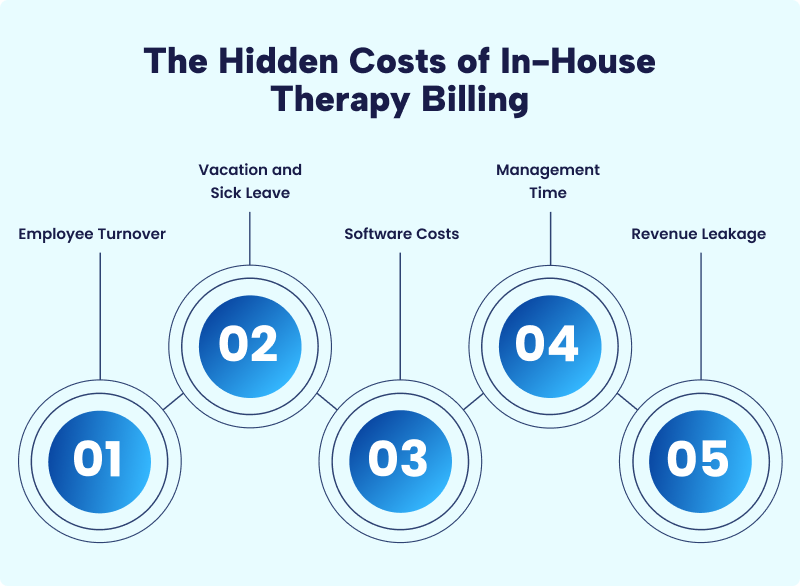
Salary isn’t the only expense.
Several costs can quietly reduce your margins.
Employee Turnover
If your only experienced biller leaves, your practice loses more than a staff member.
You may also lose knowledge about:
- Payer behavior
- Open AR accounts
- Denial history
- Authorization issues
- Patient balances
- Claim follow up
- Contractual adjustments
Recruiting and training a replacement takes time.
More importantly, unpaid claims can continue aging while the transition happens.
Vacation and Sick Leave
A small therapy practice may rely heavily on one billing employee.
When that person takes vacation or becomes unavailable, claim follow up can slow down.
Outsourced teams can usually distribute work across multiple people.
Software Costs
Your practice may need:
- Practice management software
- Clearinghouse services
- Claim scrubbing
- Eligibility tools
- Reporting software
- Coding resources
- Patient payment systems
Some outsourced billing arrangements include these services.
Others don’t.
Compare the complete package before making a decision.
Management Time
Someone must supervise your internal billing team.
That person may spend time reviewing:
- AR reports
- Denials
- Staff productivity
- Claim volume
- Payment posting
- Payer problems
- Training needs
That management time has a cost even if you don’t record it as a billing expense.
Revenue Leakage
This can become the most expensive hidden cost.
A billing team can submit claims while still leaving money behind through:
- Missed charges
- Incorrect modifiers
- Incorrect units
- Authorization problems
- Eligibility errors
- Timely filing failures
- Unworked denials
- Underpayments
- Poor AR follow up
A practice that saves $20,000 on staffing but loses $50,000 in collectible revenue hasn’t actually saved money.
Outsourced Therapy Billing Has Costs Too
Outsourcing doesn’t eliminate every financial concern.
A good comparison needs to consider the disadvantages as well.
Percentage Fees Increase With Collections
If your practice grows, the billing company’s fee may grow too.
Suppose you collect:
$500,000 annually at 6% = $30,000
If collections grow to:
$1,000,000 annually at 6% = $60,000
Your billing cost doubles.
That doesn’t necessarily make outsourcing a bad deal. Your collections also doubled.
But practices should understand this relationship before signing a percentage based contract.
Less Direct Control
Your billing team doesn’t sit in your office.
You may need to rely on:
- Reports
- Account managers
- Scheduled meetings
- Shared systems
- Escalation procedures
A strong reporting process can make this manageable.
Vendor Quality Matters
Outsourcing only works when the billing company performs well.
Ask about:
- Therapy billing experience
- Coding expertise
- Denial management
- AR follow up
- Authorization workflows
- Reporting
- HIPAA compliance
- Business Associate Agreement
- Staff qualifications
- Contract terms
Don’t choose a vendor solely because it offers the lowest percentage.
A Cost Comparison for a Growing Therapy Practice
Let’s use a simple example.
Imagine a therapy practice collects:
$1,000,000 per year
Option 1: In House
Assume the fully loaded billing department costs:
$90,000 annually
That equals:
9% of annual collections
Option 2: Outsourced
Suppose the billing company charges:
6% of collections
Annual cost:
$1,000,000 × 6% = $60,000
At first glance:
In house = $90,000
Outsourced = $60,000
Potential direct difference:
$30,000 annually
But there’s another issue.
What if the outsourced team also improves collections?
That changes the calculation.
Why Collection Performance Matters More Than the Billing Fee
A practice shouldn’t ask only:
“How much does the billing company charge?”
It should also ask:
“How much revenue does the billing operation actually collect?”
Consider a practice with $1 million in collectible charges.
If poor billing processes result in $850,000 collected, the practice leaves significant revenue unresolved.
If improved billing processes help the practice collect $950,000, the financial difference far exceeds the billing fee.
Current industry comparisons emphasize this point: the percentage charged matters less than the net revenue recovered after billing costs and revenue leakage.
That is why you should compare:
Billing cost + revenue performance
rather than billing cost alone.
Key Therapy Billing Metrics to Compare
Before choosing between in house and outsourced billing, review your current numbers.
| KPI | What It Tells You |
| Clean claim rate | How often claims go through without correction |
| Initial denial rate | How many claims encounter payment problems |
| Net collection rate | How effectively the practice collects earned revenue |
| Days in AR | How quickly money moves into the practice |
| AR over 90 days | How much revenue remains seriously delayed |
| Authorization denial rate | Whether authorization workflows work |
| Timely filing denials | Whether claims reach payers on time |
| Payment posting turnaround | How quickly payments enter the system |
| Charge capture | Whether all billable services reach claims |
| Underpayment rate | Whether payers reimburse according to contract |
| Cost to collect | What the billing operation actually costs |
If your practice doesn’t track these numbers, start there.
You can’t compare two billing models accurately without knowing your baseline.
In House vs. Outsourced Therapy Billing: Performance Comparison
| Area | In House | Outsourced |
| Staffing | Practice manages employees | Vendor manages team |
| Therapy coding | Depends on staff | Can use specialized coders |
| Denial follow up | Limited by workload | Dedicated RCM resources |
| AR management | Internal responsibility | Usually included |
| Authorization follow up | Internal | Can be included |
| Scalability | Requires hiring | Easier to scale |
| Coverage | Vulnerable to staff absence | Team based coverage |
| Management | Practice handles it | Vendor provides management |
| Reporting | Depends on system | Usually included |
| Direct oversight | High | Requires vendor reporting |
A therapy practice with one biller may struggle when claim volume suddenly increases.
An outsourced billing team can generally add capacity without requiring the practice to recruit another full time employee.
When Should a Therapy Practice Outsource Billing?
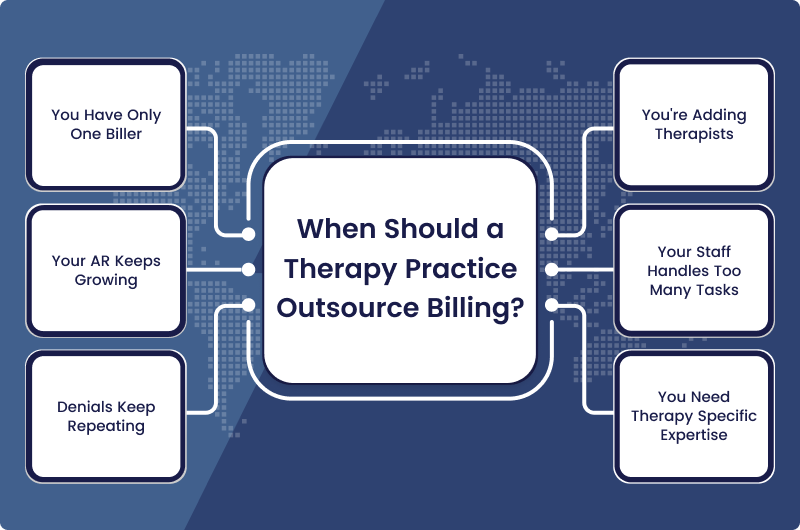
Outsourcing deserves serious consideration when:
You Have Only One Biller
A single employee creates a major operational dependency.
Your AR Keeps Growing
If accounts receivable continues to age, your team may lack the time or expertise to work claims properly.
Denials Keep Repeating
Repeated authorization, eligibility, coding, or documentation denials often point to workflow problems.
You’re Adding Therapists
More therapists mean more claims.
Outsourcing can let billing capacity grow alongside the practice without constant hiring.
Your Staff Handles Too Many Tasks
If your biller also handles:
- Front desk work
- Scheduling
- Patient calls
- Eligibility
- Authorizations
- Billing
then billing follow up may receive less attention.
You Need Therapy Specific Expertise
A billing company that understands PT, OT, SLP, behavioral therapy, or other rehabilitation billing can bring specialized knowledge without requiring you to build that expertise internally.
Hybrid Therapy Billing Model
You don’t have to choose between doing everything yourself and outsourcing everything.
A hybrid model can work well for growing practices.
You could keep:
- Scheduling
- Patient communication
- Insurance verification
- Authorization coordination
inside the practice.
Then outsource:
- Coding
- Claim submission
- Payment posting
- Denial management
- AR follow up
- Underpayment review
This gives the practice direct control over patient facing tasks while bringing specialized RCM support into the back office.
For practices that aren’t ready for a complete transition, this can provide a practical middle ground.
How to Calculate Your True In House Billing Cost
Use this formula:
Total In House Billing Cost =
Salaries
- Benefits
- Payroll taxes
- Software
- Clearinghouse
- Training
- Equipment
- Management time
- Recruiting
- Turnover
- Billing related revenue leakage
Then calculate:
True Billing Cost Percentage = Total Billing Cost ÷ Annual Collections × 100
Example
Annual collections:
$1,200,000
Total billing expenses:
$108,000
Calculation:
$108,000 ÷ $1,200,000 × 100 = 9%
Your internal billing operation effectively costs 9% of collections.
Now compare that with an outsourced company charging 6%.
The difference becomes much easier to evaluate.
How to Calculate Outsourced Therapy Billing Cost
For percentage based billing:
Annual Outsourcing Cost = Annual Collections × Billing Percentage
Example:
Annual collections:
$1,200,000
Billing fee:
6%
Annual cost:
$1,200,000 × 0.06 = $72,000
Then add any fees excluded from the contract.
Look carefully for charges related to:
- Setup
- Credentialing
- Coding
- Patient statements
- Clearinghouse
- Old AR
- Appeals
- Secondary claims
- Data conversion
- Contract termination
A vendor’s advertised percentage doesn’t tell you the complete cost.
How Outsourcing May Save Your Therapy Practice Money
Outsourcing may make financial sense when:
- Your practice doesn’t have enough volume to justify a full time billing department.
- Your internal staff costs more than the proposed vendor fee after benefits and overhead.
- Denials consume too much staff time.
- Your AR continues to age.
- Your practice is adding providers.
- You need specialized therapy billing expertise.
- Your team lacks time for consistent AR follow up.
The goal isn’t simply to replace employees.
The goal is to reduce the cost of collecting revenue while improving the amount and speed of revenue collected.
Final Verdict
Outsourcing often makes financial sense for small and growing therapy practices because it replaces several fixed costs with a variable expense and gives the practice access to specialized billing resources.
In house billing can still win for larger organizations with high claim volume, experienced employees, strong technology, and effective management.
The biggest mistake is comparing:
Biller salary vs. outsourcing percentage
Instead, compare:
Fully loaded in house cost vs. total outsourced cost vs. net collections
Then look at your actual billing performance.
If your internal team costs 8% of collections but produces strong clean claims, low denials, healthy AR, and reliable collections, there may be little reason to change.
If your internal billing costs 10% and your practice still struggles with denials, authorization problems, aging AR, and missed revenue, outsourcing could provide a much stronger financial outcome.
In other words, the cheapest billing model isn’t necessarily the one with the lowest bill. It’s the one that leaves your practice with the most money after the cost of collecting it.
Stop Losing Therapy Practice Revenue to Billing Gaps
Your therapy practice should spend its time treating patients, not chasing unpaid claims. RCM Xperts helps therapy practices manage the billing process from claim submission through payment, denial resolution, and AR follow up.
Whether you’re expanding your therapy practice or struggling with an in-house billing workload, RCM Xperts can help you build a billing process that keeps pace with your growth.
Request a free therapy billing assessment from RCM Xperts today
FAQs
Is outsourced therapy billing cheaper than in house billing?
It can be. Small and growing therapy practices often find outsourcing less expensive after accounting for salaries, benefits, software, training, management, and staff turnover. Industry estimates commonly place outsourced billing around 4% to 9% of collections, but your actual rate depends on volume, specialty, and services included.
How much does therapy billing outsourcing cost?
Many outsourced therapy billing arrangements charge a percentage of collections. Current estimates commonly fall around 5% to 8% for therapy and rehabilitation practices, although some vendors may charge more or less. Per claim and fixed monthly pricing also exist.
What is included in outsourced therapy billing?
A full service arrangement may include coding, charge entry, claim submission, payment posting, denial management, AR follow up, appeals, reporting, and patient billing. Always confirm the exact scope because vendors structure contracts differently.
Is it better to outsource physical therapy billing?
Outsourcing can work well for physical therapy practices that lack specialized billing staff or struggle with authorization, visit limits, coding, denials, and AR follow up. A high-volume PT practice with an efficient internal team may find that in house billing remains competitive.
Can a small therapy practice afford an in-house biller?
It depends on claim volume and collections. A small practice may find that a full-time employee creates more fixed overhead than its revenue cycle can justify. A part time employee, shared administrative role, or outsourced billing arrangement may make more financial sense.
Does outsourcing improve therapy collections?
It can, particularly when the billing company improves claim accuracy, denial management, authorization follow up, and AR recovery. But outsourcing itself doesn’t guarantee higher collections. The vendor’s expertise, workflow, technology, and performance reporting matter.
How do I know whether my therapy practice should outsource billing?
Calculate your fully loaded internal billing cost, then compare it with outsourcing quotes. Review your clean claim rate, denial rate, days in AR, AR over 90 days, net collection rate, and revenue leakage. If your internal team costs more while delivering weaker results, outsourcing deserves serious consideration.