

Aetna’s timely filing limit specifies how long providers have to submit a claim after the date of service. There isn’t one universal Aetna deadline for every claim. The applicable period can vary by plan, provider agreement, claim type, and applicable state or federal requirements.
For that reason, providers should check the member’s plan documents and the Aetna provider agreement rather than applying a single deadline to every Aetna claim.
What Is Aetna’s Timely Filing Limit?
Aetna’s timely filing limit is the period in which a provider must submit a claim to Aetna for consideration.
The clock generally starts from the date of service, although certain claim types and circumstances can use different dates or rules.
For example, a practice may see a patient on January 10 and submit the claim weeks later. If the applicable filing window expires before Aetna receives the claim, the payer may deny it as a timely filing denial.
The important word here is applicable.
Aetna administers multiple products and plan types, so providers should not assume that one filing deadline applies across its entire network.
Aetna Timely Filing Limit at a Glance
| Item | What providers should know |
| Payer | Aetna |
| Rule | Claim submission must meet the applicable timely filing requirement |
| Universal deadline | No single deadline applies to every Aetna claim |
| Starting point | Usually tied to the date of service, subject to the applicable plan or contract |
| Claim type | Professional, institutional, corrected, and other claims may have different rules |
| Out of network claims | Requirements can differ |
| Corrected claims | May have a separate submission window |
| Appeals | Follow the applicable appeal deadline, which differs from initial claim filing |
| Best source | Provider agreement, member plan, and Aetna’s current provider guidance |
Aetna’s provider materials direct participating providers to use its provider resources and plan specific information for applicable claim and administrative requirements.
Why Aetna Timely Filing Rules Can Be Confusing
A claim does not always follow the same path.
Consider these situations:
A participating physician submits a routine professional claim.
The provider follows the timely filing requirement in the applicable agreement.
A claim gets rejected before adjudication.
The provider may need to correct and resubmit it within the applicable filing period.
A claim gets denied for another reason.
The provider follows the payer’s correction or appeal process rather than treating the denial as a brand-new claim.
A patient has a Medicare Advantage plan administered by Aetna.
Medicare Advantage rules can apply in addition to Aetna’s administrative processes.
That is why a billing team should identify the patient’s exact plan before deciding whether a claim remains timely.
What Starts the Timely Filing Clock?
For many claims, the relevant date begins with the date of service.
However, providers should pay attention to exceptions.
Examples can include:
- Coordination of benefits situations
- Secondary claims
- Retroactive eligibility
- Corrected claims
- Claims affected by another payer
- Newborn claims
- Workers’ compensation situations
- Claims involving accident or liability coverage
- Medicare crossover claims
The applicable contract or plan document determines the rule.
Don’t automatically count from the date your staff created the claim in the practice management system.
The date that matters for timely filing may differ from the date the billing team worked the account.
What Happens If an Aetna Claim Misses the Filing Deadline?
Aetna may deny the claim because the provider did not submit it within the applicable timely filing period.
A timely filing denial can be especially frustrating because the underlying service may have been medically necessary and correctly coded.
The problem isn’t necessarily the care.
The problem may simply be when the payer received the claim.
For a practice, that distinction matters because the next step should focus on proving timely submission or establishing a valid exception.
Aetna Timely Filing Denial Example
Imagine a primary care practice submits an Aetna claim electronically.
The clearinghouse rejects the claim because of an invalid payer ID.
The billing team notices the rejection several weeks later and corrects the payer information.
The corrected claim reaches Aetna after the applicable filing deadline.
Aetna denies it for timely filing.
The billing team shouldn’t simply write off the balance.
First, determine:
- When did the practice originally submit the claim?
- What caused the clearinghouse rejection?
- Did the clearinghouse provide a rejection report?
- Did the payer ever receive the original claim?
- Does Aetna recognize the original submission as proof of timely filing?
- Does the provider agreement establish a different rule?
- Does the payer permit an exception under the circumstances?
The electronic submission report can become critical evidence.
Proof of Timely Filing
When a payer says a claim arrived late, the provider may need evidence showing that it submitted the claim on time.
Useful records can include:
- Clearinghouse acceptance reports
- Electronic claim acknowledgments
- Payer claim acceptance reports
- Transmission reports
- Rejection reports
- Claim control numbers
- Original claim data
- Payer correspondence
- Corrected claim records
- Documentation showing another payer processed the claim first
Keep these records with the account.
A billing note that says “submitted on time” carries little weight without supporting evidence.
Clearinghouse Acceptance vs Payer Acceptance
This distinction causes frequent confusion.
A clearinghouse may accept a claim for transmission.
That doesn’t necessarily mean Aetna accepted the claim into its adjudication system.
For example:
Practice → Clearinghouse: Accepted
does not automatically mean:
Aetna → Claim received and accepted
If a claim later disappears from the payer’s system, the billing team needs to determine what happened between those two points.
That is why claim tracking should continue until the payer confirms receipt or adjudication.
How to Avoid Aetna Timely Filing Denials
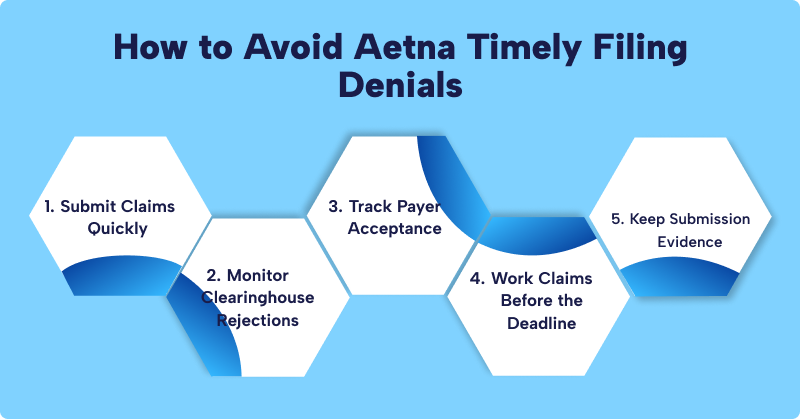
Submit Claims Quickly
Don’t build your billing schedule around the maximum filing window.
A practice that submits claims several days after each encounter has much more room to correct rejected claims than one that waits until the last week.
Monitor Clearinghouse Rejections
A rejected claim hasn’t completed the billing journey.
Create a daily work queue for rejected claims.
Staff should identify:
- Payer ID errors
- Subscriber ID errors
- Invalid patient information
- Missing required fields
- Provider enrollment issues
- Coding problems
- Invalid diagnosis codes
- Invalid modifiers
Then resubmit promptly.
Track Payer Acceptance
Don’t stop at clearinghouse acceptance.
Confirm that the claim reaches the payer.
Work Claims Before the Deadline
Set an internal cutoff earlier than the payer’s deadline.
For example, if the applicable filing period gives your practice several months, don’t let accounts sit untouched until the final few weeks.
Your internal deadline should create enough time to investigate a rejected or missing claim.
Keep Submission Evidence
Store electronic claim reports in a way that staff can retrieve them quickly.
When a timely filing denial arrives, the billing team shouldn’t have to search through months of clearinghouse files.
Corrected Claims and Timely Filing
A corrected claim isn’t necessarily treated the same way as an original claim.
The billing team needs to determine:
- Why the original claim needs correction
- Whether Aetna received the original claim
- Whether the correction falls within the applicable window
- Whether Aetna requires a specific corrected claim indicator
- Whether the payer requires the original claim number
- Whether the issue requires an appeal instead
For example, changing a diagnosis or correcting a modifier can require a corrected claim.
But if the payer already denied the claim for a substantive reason, the correct route may involve reconsideration or appeal rather than simply resubmitting the claim as a new claim.
Follow Aetna’s current instructions for the member’s plan.
What If Aetna Was Not the Primary Payer?
Coordination of benefits can change the filing situation.
Suppose a patient has:
- Primary payer: Blue Cross Blue Shield
- Secondary payer: Aetna
The provider submits the claim to the primary payer first.
After the primary payer adjudicates the claim, the provider sends the secondary claim to Aetna.
The secondary filing deadline may depend on the applicable plan and coordination of benefits rules.
Keep the primary payer’s EOB or electronic remittance information because it can establish when the secondary billing process began.
What If the Patient’s Insurance Information Was Wrong?
Patient registration errors can create timely filing problems.
For example, a patient provides an old insurance card at check-in.
The practice submits the claim to the wrong payer.
The claim is rejected.
Weeks later, staff discovers that Aetna should have received the claim.
Now the billing team must determine whether the claim remains within the applicable filing window and whether the circumstances qualify for an exception.
This is why eligibility verification matters before claim submission.
Verify These Details
Before billing Aetna, confirm:
- Member ID
- Patient name
- Date of birth
- Group number when applicable
- Payer information
- Subscriber relationship
- Coverage dates
- Provider participation
- Plan type
- Coordination of benefits
A small registration error can become a large accounts receivable problem.
What If the Provider Was Not Credentialed?
A provider enrollment problem can complicate timely filing.
For example, a new physician starts seeing Aetna members before the payer completes the provider’s enrollment.
The practice waits for credentialing to finish before submitting certain claims.
By the time the provider becomes active, some claims may approach or exceed the applicable filing deadline.
The practice should understand the payer’s rules for newly credentialed providers before services begin.
Credentialing and claims submission need to work together.
Aetna Timely Filing and New Providers
When a new provider joins a practice, the billing team should track:
- Credentialing status
- Contract status
- Effective date
- Provider loaded with payer
- Practice location linked
- Claims billing status
This prevents a common mistake: allowing the provider to see insured patients while the billing team assumes enrollment will resolve itself later.
How to Appeal an Aetna Timely Filing Denial
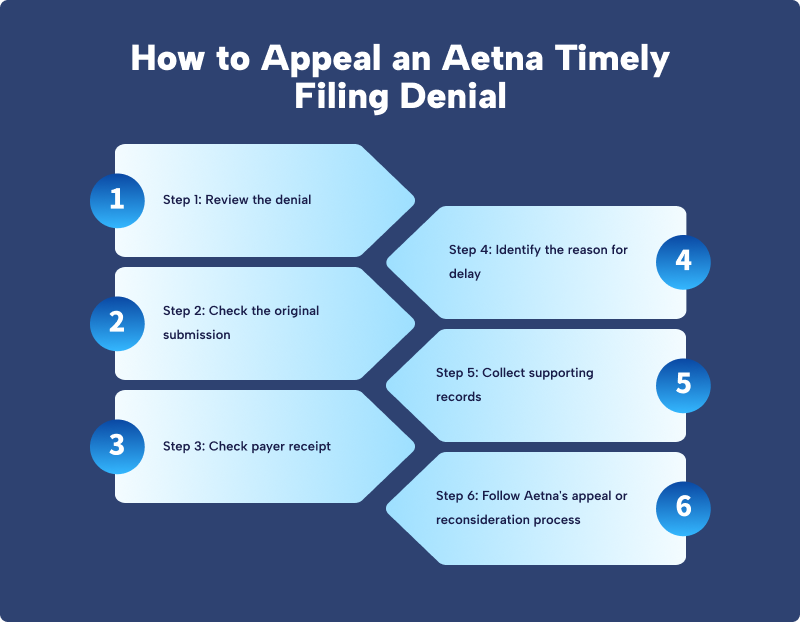
If Aetna denies a claim for timely filing, first determine whether the denial is accurate.
Don’t appeal simply because the denial looks unfair.
Build the case around evidence.
Step 1: Review the denial
Identify the exact reason and applicable claim.
Step 2: Check the original submission
Find the clearinghouse transmission and acceptance information.
Step 3: Check payer receipt
Determine whether Aetna received the claim.
Step 4: Identify the reason for delay
Examples include:
- Clearinghouse rejection
- Payer system issue
- Incorrect insurance information
- Coordination of benefits
- Retroactive eligibility
- Enrollment issue
- Other documented circumstances
Step 5: Collect supporting records
Attach relevant evidence.
Step 6: Follow Aetna’s appeal or reconsideration process.
Use the current instructions for the member’s specific plan.
Don’t send an appeal to an outdated address simply because an old billing guide lists it.
What Should a Timely Filing Appeal Include?
A strong appeal should make the timeline easy to understand.
For example:
Date of service: January 8
Original claim submitted: January 15
Clearinghouse accepted claim: January 15
Payer rejection received: January 16
Corrected claim submitted: January 17
Payer denial: Timely filing
Then explain what happened and attach the evidence.
The reviewer shouldn’t have to reconstruct the timeline from dozens of unrelated documents.
Final Thoughts
A timely filing denial often looks like a simple deadline problem, but the underlying cause can start much earlier. A registration error, clearinghouse rejection, payer enrollment issue, or missing follow up can leave a claim sitting untouched until the filing window closes.
The safest approach is to verify the applicable Aetna rule, submit claims early, monitor both clearinghouse and payer acceptance, and preserve the evidence that proves when each claim entered the system.
When a denial does occur, work from the claim timeline rather than guessing. That gives your billing team a much stronger basis for correction, reconsideration, or appeal.
Don’t Let Aetna Timely Filing Denials Cost You Collectible Revenue
A missed deadline can turn a clean Aetna claim into an avoidable write off.
RCM Xperts helps providers track claim submission timelines, resolve rejected claims, manage timely filing denials, and handle appeals with the right documentation.
Get a Free A/R Review from RCM Xperts
Frequently Asked Questions
What is Aetna’s timely filing limit?
Aetna does not have one universal timely filing deadline that applies to every provider and plan. The applicable period can depend on the provider agreement, plan type, claim type, and other circumstances. Providers should verify the specific requirement before assuming a deadline.
Does Aetna’s timely filing limit apply to corrected claims?
Corrected claims can have separate submission requirements. Providers should follow the applicable Aetna instructions and determine whether the claim needs correction, reconsideration, or appeal.
Can Aetna waive the timely filing limit?
An exception may apply in certain circumstances, but providers should not assume that Aetna will waive the deadline. The practice should document the reason for late submission and provide supporting evidence when requesting an exception.
What proof can I use for a timely filing appeal?
Clearinghouse acceptance reports, payer acknowledgments, electronic transmission records, claim control numbers, and other records showing when the claim entered the billing process can help establish timely submission.
Does a clearinghouse acceptance prove Aetna received the claim?
Not necessarily. Clearinghouse acceptance confirms that the claim passed the clearinghouse’s acceptance process. It does not automatically prove that Aetna received and accepted the claim.
What happens when Aetna denies a claim for timely filing?
Review the claim history first. If the practice submitted the claim within the applicable filing period, gather the transmission evidence and follow Aetna’s current reconsideration or appeal process.
Does timely filing differ for Medicare Advantage?
Medicare Advantage plans operate under Medicare rules and plan specific administrative requirements. Providers should check the applicable Aetna Medicare Advantage guidance rather than automatically applying a commercial Aetna rule.