
Abdominal pain looks simple on the surface, but coding it correctly requires more than selecting an R10 code from the diagnosis list. The location, clinical findings, confirmed diagnosis, encounter purpose, and services performed all affect how the claim should look.
For example, right upper quadrant pain, epigastric pain, generalized abdominal pain, and unspecified abdominal pain do not use the same ICD 10 CM code. The 2026 ICD-10-CM classification places abdominal and pelvic pain within category R10, with more specific codes available for different locations and clinical presentations.
For billing teams, the larger issue involves matching the diagnosis to the documentation and the service performed. A claim for an office visit, abdominal imaging study, laboratory service, ultrasound, CT scan, endoscopy, or colonoscopy may require a diagnosis that supports medical necessity under the applicable payer policy.
This guide explains the most commonly used abdominal pain ICD 10 codes, when to use symptom codes versus confirmed disease codes, what providers should document, how to link diagnoses to CPT codes, and what billing teams should check before submitting the claim.
What Is the ICD 10 Code for Abdominal Pain?
There is no single ICD 10 CM code for every type of abdominal pain.
The appropriate code depends on the documented location and nature of the pain.
Common abdominal pain codes include:
| ICD 10 CM code | Description |
| R10.0 | Acute abdomen |
| R10.10 | Upper abdominal pain, unspecified |
| R10.11 | Right upper quadrant pain |
| R10.12 | Left upper quadrant pain |
| R10.13 | Epigastric pain |
| R10.21 | Pelvic and perineal pain, right side |
| R10.22 | Pelvic and perineal pain, left side |
| R10.23 | Pelvic and perineal pain, bilateral |
| R10.24 | Suprapubic pain |
| R10.30 | Lower abdominal pain, unspecified |
| R10.31 | Right lower quadrant pain |
| R10.32 | Left lower quadrant pain |
| R10.33 | Periumbilical pain |
| R10.83 | Colic |
| R10.84 | Generalized abdominal pain |
| R10.85 | Abdominal pain of multiple sites |
| R10.9 | Unspecified abdominal pain |
CMS materials list these abdominal pain codes among the diagnoses used to support various diagnostic and procedural services.
Abdominal Pain ICD 10 R10.9
R10.9, Unspecified abdominal pain, applies when the documentation establishes abdominal pain but does not provide enough information to assign a more specific location or type.
Do not automatically use R10.9 simply because abdominal pain represents the chief complaint.
If the provider documents a specific location, the coder should look for the corresponding code.
For example:
“Patient reports pain in the right lower quadrant.”
This supports R10.31, assuming the provider documents the condition as a clinical diagnosis or symptom relevant to the encounter.
Using R10.9 when the record clearly supports a more specific code can reduce coding accuracy and may create problems when the diagnosis needs to support a diagnostic service.
Generalized Abdominal Pain ICD 10
The code for generalized abdominal pain is:
R10.84, Generalized abdominal pain
Use this code when the provider documents pain involving the abdomen generally rather than one localized area.
Do not confuse generalized abdominal pain with pain occurring at multiple distinct sites.
The ICD 10 CM classification also includes:
R10.85, Abdominal pain of multiple sites
That distinction can matter when the documentation describes separate abdominal locations rather than diffuse or generalized pain. CMS lists R10.84 and R10.85 separately in its coding materials.
Right Upper Quadrant Abdominal Pain ICD 10
The code for right upper quadrant pain is:
R10.11, Right upper quadrant pain
The right upper quadrant contains several structures, including the liver and gallbladder. A patient may present with pain in this area because of many different conditions.
The important coding point involves the diagnosis actually established by the provider.
If the provider evaluates the patient for right upper quadrant pain but does not establish a definitive underlying disease, R10.11 may appropriately represent the documented symptom.
If the provider establishes a definitive condition, the final diagnosis may take precedence according to ICD 10 CM coding rules and the circumstances of the encounter.
Left Upper Quadrant Abdominal Pain ICD 10
The code is:
R10.12, Left upper quadrant pain
Documentation should clearly establish that the pain occurs in the left upper quadrant.
A vague statement such as “abdominal discomfort” does not support R10.12.
Epigastric Pain ICD 10
The code is:
R10.13, Epigastric pain
Epigastric pain refers to pain in the upper central portion of the abdomen.
Providers frequently document epigastric pain during evaluations involving gastrointestinal symptoms.
The diagnosis may support additional diagnostic testing when the payer’s coverage policy recognizes the symptom as a medical indication.
CMS lists R10.13 among the abdominal pain diagnoses used in coverage and billing policies for diagnostic services.
Lower Abdominal Pain ICD 10
Several codes apply to lower abdominal pain.
- 30, Lower abdominal pain, unspecified
- 31, Right lower quadrant pain
- 32, Left lower quadrant pain
- 33, Periumbilical pain
The coder should select the most specific code supported by the provider’s documentation.
For example, if the note states:
“Pain localized to the left lower quadrant for three days.”
The appropriate symptom code may be R10.32 when the provider has not established a more definitive diagnosis.
If the provider documents diverticulitis as the confirmed condition responsible for the patient’s symptoms, the coder needs to evaluate whether the confirmed condition should replace the symptom code.
Acute Abdominal Pain ICD 10
When the provider documents an acute abdomen, the applicable code is:
R10.0, Acute abdomen
This code differs from simply documenting that abdominal pain started recently.
“Acute abdominal pain” and “acute abdomen” do not automatically mean the same thing.
The coder should follow the provider’s actual diagnostic statement and the ICD 10 CM classification.
Do not infer acute abdomen from the duration of pain alone.
Abdominal Pain of Multiple Sites ICD 10
Use:
R10.85, Abdominal pain of multiple sites
when the documentation supports pain involving multiple abdominal locations.
This code can be useful when the provider describes several distinct areas rather than one generalized area.
The documentation needs to support the distinction.
Abdominal Pain With Tenderness
Pain and tenderness represent different clinical findings.
The patient may report pain, while the provider may identify tenderness during the physical examination.
ICD 10 CM includes specific codes for abdominal tenderness.
Examples include:
| ICD 10 CM | Description |
| R10.811 | Right upper quadrant abdominal tenderness |
| R10.812 | Left upper quadrant abdominal tenderness |
| R10.813 | Right lower quadrant abdominal tenderness |
| R10.814 | Left lower quadrant abdominal tenderness |
| R10.815 | Periumbilic abdominal tenderness |
| R10.816 | Epigastric abdominal tenderness |
| R10.817 | Generalized abdominal tenderness |
| R10.819 | Abdominal tenderness, unspecified site |
CMS lists these codes in its diagnostic imaging billing guidance.
Reimbursement depends on the service, payer policy, documentation, and applicable coverage requirements.
Abdominal Pain With Rebound Tenderness
ICD 10 CM also distinguishes rebound abdominal tenderness.
Examples include:
- 821, Right upper quadrant rebound abdominal tenderness
- 822, Left upper quadrant rebound abdominal tenderness
- 823, Right lower quadrant rebound abdominal tenderness
- 824, Left lower quadrant rebound abdominal tenderness
- 825, Periumbilic rebound abdominal tenderness
- 826, Epigastric rebound abdominal tenderness
- 827, Generalized rebound abdominal tenderness
- 829, Rebound abdominal tenderness, unspecified site
CMS includes these codes in its abdominal imaging coding resources.
The provider should document the examination finding rather than leaving the coder to infer it from other symptoms.
Symptom Code or Definitive Diagnosis: Which Should You Report?
This represents one of the most important decisions in abdominal pain coding.
A patient may arrive with abdominal pain, but the physician may eventually identify:
- Appendicitis
- Cholecystitis
- Gallstones
- Diverticulitis
- Gastritis
- Peptic ulcer disease
- Pancreatitis
- Gastroesophageal reflux disease
- Irritable bowel syndrome
- Constipation
- Urinary tract disease
- Kidney stones
- Another gastrointestinal or abdominal condition
When the provider establishes a definitive diagnosis, coding should follow the applicable ICD 10 CM rules rather than automatically reporting the presenting symptom.
The symptom remains important when the provider has not established the underlying condition.
Example
The patient presents with right lower quadrant pain.
The physician evaluates the patient and documents suspected appendicitis but does not establish appendicitis as the diagnosis.
The coder should not independently convert a symptom into confirmed appendicitis.
The provider’s documented diagnostic conclusion controls the coding decision.
That distinction protects the accuracy of the medical record and the claim.
Abdominal Pain Documentation Requirements
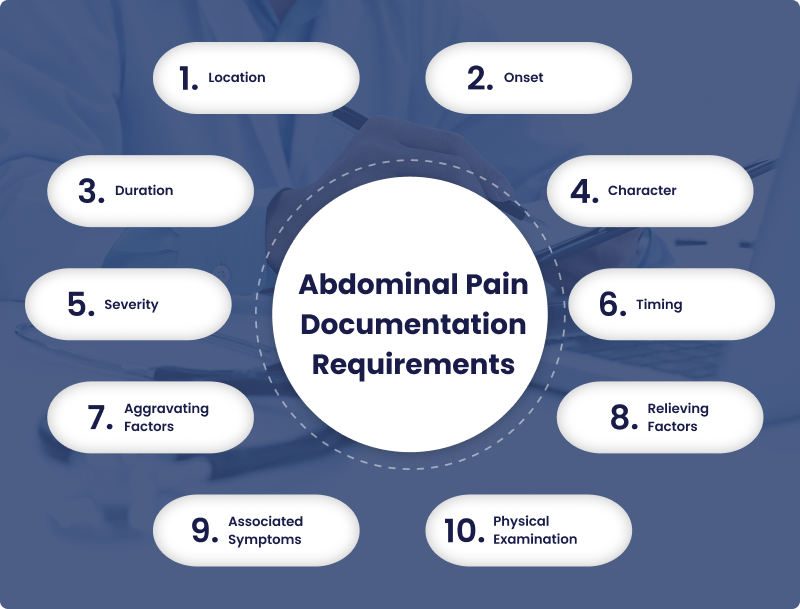
The documentation should tell the story of the complaint and the medical decision making surrounding it.
A useful abdominal pain history includes:
Location
Document where the pain occurs.
Examples:
- Right upper quadrant
- Left upper quadrant
- Epigastric
- Periumbilical
- Right lower quadrant
- Left lower quadrant
- Generalized
- Multiple locations
- Pelvic or suprapubic region
Onset
Document when the pain began.
Examples:
- Started this morning
- Started three days ago
- Gradual onset over two weeks
- Intermittent symptoms for several months
Duration
Document how long episodes last.
Character
Describe the quality when clinically relevant.
Examples include:
- Cramping
- Burning
- Sharp
- Dull
- Pressure
- Stabbing
- Aching
- Colicky
Severity
A pain score can provide useful information, particularly when the provider tracks change over time.
For example:
“Pain 7 out of 10 before medication, now 4 out of 10.”
Timing
Document whether the pain remains constant or comes and goes.
Aggravating Factors
Examples include:
- Eating
- Movement
- Coughing
- Defecation
- Urination
- Specific foods
- Position
- Physical activity
Relieving Factors
Examples include:
- Rest
- Bowel movement
- Medication
- Changing position
- Avoiding meals
Associated Symptoms
Depending on the clinical situation, document relevant symptoms such as:
- Nausea
- Vomiting
- Diarrhea
- Constipation
- Fever
- Chills
- Bloating
- Abdominal distention
- Blood in stool
- Urinary symptoms
- Weight loss
- Loss of appetite
- Jaundice
Physical Examination
The provider should document relevant findings.
This may include:
- Abdominal tenderness
- Location of tenderness
- Guarding
- Rebound tenderness
- Distention
- Mass
- Bowel sounds
- Other relevant examination findings
CMS billing policies repeatedly emphasize that medical records should substantiate the diagnosis and support the medical reasonableness and necessity of diagnostic services.
How to Document Abdominal Pain for Medical Necessity
A diagnosis code does not carry the entire medical necessity argument.
Consider a patient with chronic abdominal pain.
A weak note might state:
“Patient has chronic abdominal pain. CT abdomen ordered.”
That leaves several questions unanswered.
- Why does the patient need the CT?
- Where is the pain?
- How long has it existed?
- What symptoms accompany it?
- What did the examination show?
- What previous evaluation occurred?
- What clinical concern prompted the imaging?
A stronger record might state:
“Patient reports persistent right lower quadrant abdominal pain for six weeks, occurring daily and increasing after meals. Patient also reports reduced appetite and intermittent nausea. Examination reveals localized right lower quadrant tenderness without documented rebound tenderness. Symptoms have persisted despite conservative management. CT abdomen and pelvis ordered to evaluate the persistent localized pain and associated gastrointestinal symptoms.”
The exact documentation must reflect the actual encounter.
The point is not to add words for billing.
The point is to document the clinical reasoning that supports the service.
Abdominal Pain ICD 10 and Evaluation and Management Coding
Abdominal pain commonly leads to an office or outpatient E/M service.
The diagnosis code explains the condition or symptom evaluated.
The CPT code represents the service provided.
These two parts must work together.
CMS maintains current guidance for office and outpatient E/M services under the Medicare Physician Fee Schedule.
For office and outpatient E/M services, medical decision making or total time can determine the appropriate level under current E/M rules.
The record should support the reported service.
For an abdominal pain visit, documentation may include:
- History relevant to the complaint
- Relevant examination findings
- Assessment
- Diagnostic evaluation
- Review of results
- Medication management when applicable
- Differential diagnosis
- Treatment decisions
- Follow up planning
- Referral decisions
The coder should never select an E/M level simply because the patient’s diagnosis appears serious.
The level must correspond to the applicable E/M rules and the work documented.
Abdominal Pain and Diagnostic Imaging Billing
Abdominal pain frequently appears as a diagnosis linked to imaging.
Examples include:
- Abdominal ultrasound
- CT abdomen
- CT abdomen and pelvis
- MRI
- Other diagnostic imaging services
The payer’s medical necessity policy determines whether a particular abdominal pain diagnosis supports the service.
For example, CMS has specific billing guidance for CT abdomen and pelvis that lists numerous R10 codes, including localized abdominal pain, generalized abdominal pain, abdominal pain at multiple sites, and abdominal tenderness.
This does not mean every R10 code automatically guarantees payment.
The payer may apply:
- Coverage criteria
- Medical necessity requirements
- Prior authorization rules
- Frequency limitations
- Site of service rules
- Diagnosis restrictions
- Documentation requirements
The billing team should check the applicable payer policy before assuming that an R10 code supports a procedure.
Abdominal Pain ICD 10 for Ultrasound
Ultrasound may help evaluate certain abdominal complaints.
Depending on the payer and service, the diagnosis should establish the clinical reason for the study.
For example, a provider may document right upper quadrant pain and order an abdominal ultrasound to evaluate a suspected hepatobiliary problem.
The diagnosis should accurately reflect the provider’s documented assessment.
Do not add a suspected disease merely because the imaging study commonly evaluates that disease.
The medical record must support the diagnosis reported.
Abdominal Pain ICD-10 for CT Scan
CT abdomen and pelvis claims require careful diagnosis linkage.
CMS guidance lists multiple R10 codes as potential supporting diagnoses for CT abdomen and pelvis services. It also lists specific abdominal tenderness and rebound tenderness codes.
The documentation should show why the provider ordered the scan.
For example:
- Persistent localized pain
- Abdominal tenderness
- Suspected inflammatory process
- Change in bowel habits with relevant findings
- Other documented clinical indication
- The actual indication must match the record.
A coder should not choose a diagnosis simply because it appears on a payer’s covered diagnosis list.
Abdominal Pain ICD 10 for Colonoscopy
Abdominal pain can also serve as a clinical indication for colonoscopy in appropriate circumstances.
However, coverage depends on the patient’s symptoms, clinical history, previous treatment or evaluation, age and screening status when relevant, payer policy, and other criteria.
CMS specifically warns that chronic abdominal pain used to justify a colonoscopy requires appropriate clinical documentation. CMS also states that the medical record should support the medical reasonableness, necessity, and frequency of diagnostic services.
This distinction matters because abdominal pain does not automatically turn a colonoscopy into a covered diagnostic procedure.
The record must establish why the procedure is clinically appropriate.
Abdominal Pain and CPT Diagnosis Linking
When submitting a claim, the diagnosis should connect logically to the CPT or HCPCS service.
For example:
| Service | Possible clinical diagnosis |
| Office E/M | Documented abdominal pain or confirmed underlying condition |
| Abdominal ultrasound | Appropriate documented abdominal or related clinical indication |
| CT abdomen | Appropriate documented pain, tenderness, or confirmed condition |
| CT abdomen and pelvis | Clinical indication documented in the record |
| Colonoscopy | Documented symptom or confirmed condition that meets payer criteria |
| Laboratory testing | Diagnosis supporting the medical necessity of the test |
These examples do not establish universal coverage.
Payers can apply different policies.
The billing team should verify the applicable Medicare Administrative Contractor or commercial payer policy before submitting services that require specific diagnosis support.
Common Abdominal Pain Coding Errors
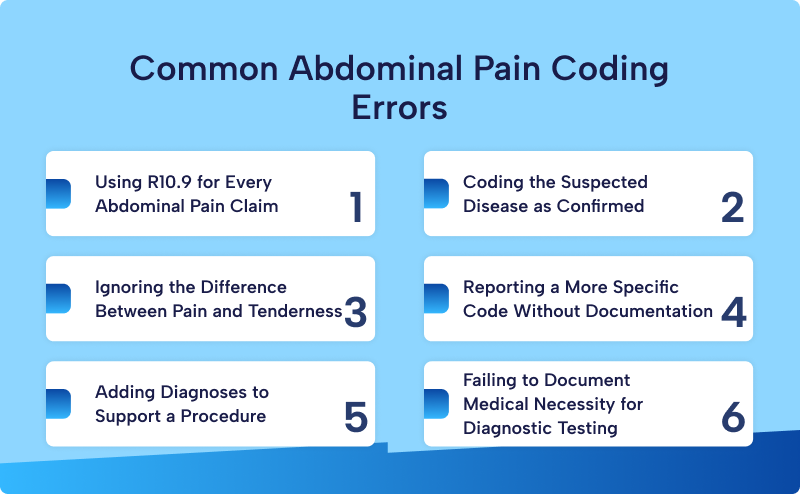
Using R10.9 for Every Abdominal Pain Claim
This approach ignores the specificity available in the ICD 10 CM classification.
If the provider clearly documents right lower quadrant pain, the coder should evaluate R10.31 rather than defaulting to R10.9.
Coding the Suspected Disease as Confirmed
Coders should not turn clinical suspicion into a confirmed diagnosis without appropriate provider documentation and applicable coding rules.
Ignoring the Difference Between Pain and Tenderness
Patient reported pain and provider observed tenderness represent different findings.
The record should distinguish them.
Reporting a More Specific Code Without Documentation
Specificity improves coding only when the documentation supports it.
Do not guess the location.
Adding Diagnoses to Support a Procedure
This can create serious compliance problems.
The diagnosis should reflect the actual clinical record.
Do not select a diagnosis merely because it produces a better reimbursement outcome.
Failing to Document Medical Necessity for Diagnostic Testing
The claim should make sense when someone compares the diagnosis, clinical note, and ordered test.
CMS states that medical records must substantiate the diagnosis reported on the claim and support the medical reasonableness and necessity of diagnostic services.
Abdominal Pain Billing and Reimbursement
Reimbursement does not depend on the ICD-10 code alone.
Payment can depend on:
- CPT or HCPCS code
- ICD-10-CM diagnosis
- Modifier
- Place of service
- Payer
- Patient benefit plan
- Medical necessity
- Authorization
- Provider participation status
- Fee schedule
- National or local coverage policy
- Claim submission accuracy
- Timely filing
- Documentation
- Correct coding
For Medicare, payment for physician services generally follows the applicable Medicare Physician Fee Schedule and related payment policies. CMS maintains current E/M and Physician Fee Schedule information for providers and billing professionals.
Commercial payers can use different contracted rates and policies.
Therefore, there is no universal reimbursement amount for an abdominal pain diagnosis.
R10.9 is an ICD-10-CM diagnosis code, not a procedure code with a fixed payment amount.
The diagnosis helps explain the patient’s condition.
The CPT or HCPCS code generally represents the billable service.
For example, the same R10.9 diagnosis could appear on claims involving different services, and those services can have very different allowed amounts.
How to Reduce Abdominal Pain Claim Denials
A billing team can reduce avoidable errors by checking the claim before submission.
Verify the Diagnosis
Confirm that the ICD 10 code matches the provider’s documentation.
Check Specificity
If the provider documents a specific location, make sure the diagnosis reflects that information when appropriate.
Review Procedure Linkage
Make sure the diagnosis connects logically to the CPT or HCPCS service.
Check Authorization
Verify whether the payer requires prior authorization.
Review Payer Policy
Check the applicable medical necessity criteria.
Confirm Documentation
Make sure the medical record supports the diagnosis and service.
Check Modifiers
Use modifiers only when the documentation and coding rules support them.
Monitor Denial Patterns
If the practice repeatedly receives denials for abdominal imaging, endoscopy, or office visits, review the denial codes and determine whether the problem involves diagnosis selection, authorization, documentation, coding, or claim configuration.
Final Thoughts
Abdominal pain coding isn’t about choosing the broadest R10 code and moving on. The diagnosis should reflect what the provider actually documented, including the pain’s location, clinical findings, and any confirmed underlying condition. The medical record should also support the service billed, whether it’s an office visit, diagnostic imaging, laboratory testing, or another procedure.
Accurate diagnosis selection helps prevent mismatches between clinical documentation and claims. A billing team should also verify payer coverage, authorization requirements, coding rules, timely filing limits, and diagnosis-to-procedure linkage before submission. When providers and billers keep these pieces aligned, they give payers a clear reason to process the claim and reduce avoidable reimbursement problems.
Don’t Let an R10 Code Turn Into a Reimbursement Roadblock
Abdominal pain claims can run into problems when documentation lacks specificity, diagnosis codes don’t match the assessment, or the billed service doesn’t connect clearly with the reported diagnosis.
RCM Xperts helps healthcare practices manage the billing work behind the clinical encounter. From coding review and claim submission to denial management, payment follow-up, eligibility checks, and accounts receivable, our team helps practices address the issues that can delay reimbursement.
Want fewer coding errors and cleaner claims?
Talk to RCM Xperts
Frequently Asked Questions
What is the ICD-10 code for abdominal pain?
The appropriate code depends on the location and type of pain. Common codes include R10.9 for unspecified abdominal pain, R10.84 for generalized abdominal pain, R10.11 for right upper quadrant pain, R10.12 for left upper quadrant pain, R10.13 for epigastric pain, R10.31 for right lower quadrant pain, and R10.32 for left lower quadrant pain.
What is R10.9 used for?
R10.9, Unspecified abdominal pain, applies when the medical record establishes abdominal pain but does not provide sufficient specificity to assign a more specific abdominal pain code.
What is the ICD-10 code for right lower quadrant abdominal pain?
R10.31, right lower quadrant pain, is the ICD-10-CM code for right lower quadrant pain. If the provider establishes a definitive condition causing the pain, the coding may need to reflect that confirmed diagnosis instead.
Can abdominal pain be used as the diagnosis for a CT scan?
It can support CT medical necessity in circumstances covered by the applicable payer policy. CMS’s CT abdomen and pelvis billing guidance includes several R10 codes among diagnoses used for the service. However, the medical record must support the diagnosis and the medical reason for the CT.
Can I code abdominal pain when the physician suspects appendicitis?
Do not independently code suspected appendicitis as a confirmed diagnosis. Review the provider’s documented diagnostic conclusion and apply the applicable ICD 10 CM coding guidelines for the encounter.