
Eighteen revenue cycle functions, run by one accountable team, for practices in all 50 states. Take the whole cycle or the two stages that are costing you the most.
Slow collections and write-offs rarely come from one major failure – they’re usually the result of dozens of small breakdowns across the cycle. We treat the entire revenue cycle as one connected operation, so every stage is identified and solved at its point of origin.
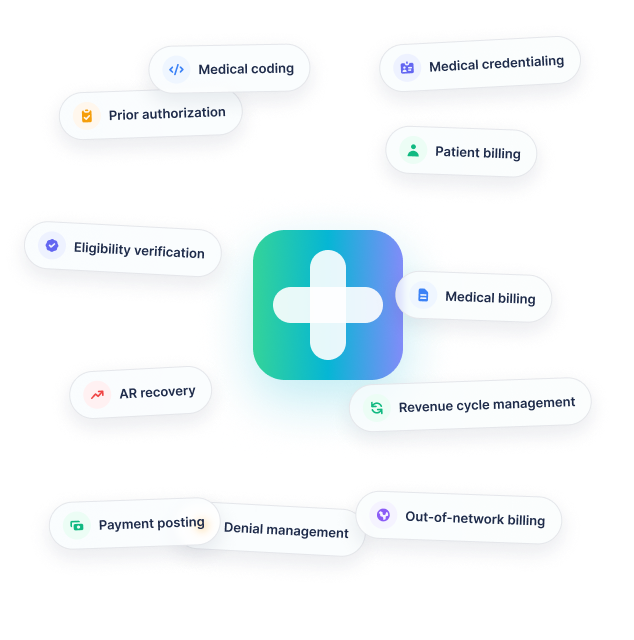

Revenue cycle management services cover every financial step between a patient booking an appointment and the account reaching a zero balance: eligibility, authorization, credentialing, coding, charge entry, claim submission, payment posting, denial work, appeals, and patient collections.
Most practices do not outsource all of it. They outsource the stages where the work exceeds the staff available to do it, and those stages differ by specialty, payer mix, and practice size. A surgical group loses money to authorization delays and implant coding. A therapy practice loses it to visit limits and modifier rules. A pediatric practice loses it to vaccine component counting and Medicaid eligibility churn.


Revenue loss in a medical practice divides into two kinds, and only one of them is visible.
The visible kind produces an artifact. A claim rejects, a denial code posts, an appeal deadline appears on a worklist. Every practice sees these; most practices work them, and the ones that do not are usually short staffed rather than unaware.
The invisible kind produces nothing at all. A charge is never posted because the encounter never made it onto the charge worklist. A vaccine administration unit is undercounted, so the claim pays cleanly and pays short. A fee schedule goes stale, so the payer pays its contracted rate and the practice never learns the rate moved. An add on code is left off, so a service that was performed and documented is simply never billed. None of these generate an error message. None appear on a denial report. There is no worklist for revenue that was never claimed.
Front end failures are the cheapest to prevent and the most expensive to discover late. A coverage problem found at check in costs a phone call. The same problem found after adjudication costs a denial, an appeal, and sixty days of aging, and if the cause was a credentialing gap the revenue is often not recoverable at all.


This is the stage that produces losses without producing errors. A miscounted unit, a missing add on code, a charge that never reached the worklist, or a fee schedule that has not been updated since the contract escalated: each of these pays cleanly and pays short. Nothing on a denial report will ever tell you they happened.

reconsideration window, and a claim that crosses one stops being a collections problem and becomes a permanent loss. Work at this stage is prioritized by what expires soonest, not by what is largest.

No contracted rate - allowable established through benefit research, negotiation, and appeal rather than a fee schedule.
State fee schedules, state-specific forms and filing deadlines - not commercial payer contracts.
Good faith estimates, open negotiation, and IDR filing with qualifying payment amount analysis.
NPP billed under supervising physician NPI at full fee schedule rate when Medicare conditions are met.
Primary/secondary order, birthday rule, and coverage-unknown denials cleared with documentation.
MIPS performance across quality, cost, improvement activities, and promoting interoperability.

That is the question the audit answers. We review recent claims, denial categories, AR aging, and fee schedules against contracts, then tell you where revenue is going. You get the findings whether or not you move your billing to us.
Practices lose revenue in patterns, and the pattern is usually a function of size and service mix rather than specialty alone. Five shapes cover most of what we see.

One person usually owns billing alongside three other jobs. The failure mode is capacity: denials go unworked not because nobody understands them but because there is no time in the day. We take the queue, not the decisions.

The failure mode is inconsistency. Each provider documents differently, each front desk verifies differently, and billing outcomes vary by provider rather than by payer. We standardize the process across the group and report performance by provider so the variance becomes visible.

Different service lines run on different coding standards, payer rules, and documentation requirements. The failure mode is a single billing process applied to service lines that need different ones. We assign specialty matched coders per line rather than treating the group as one payer mix.

The failure mode is limits and modifiers: visit caps, authorization renewals, therapy threshold tracking, discipline specific modifiers, and behavioral carve outs that route claims away from the medical payer. These are rule heavy, high volume, low dollar claims where small errors compound quickly.

The failure mode is authorization and bundling: prior authorization delays that push procedures, global period rules, implant and device coding, assistant surgeon modifiers, and professional versus technical component splits. Individual claims are large enough that a single recurring error is material.
Most billing companies publish the same six percentages, and almost none of them publish how those percentages are calculated. A first pass rate means nothing until you know whether rejected claims were counted, and a net collection rate means nothing until you know what was excluded from the denominator.These are the measures worth asking any billing partner about, including us, with the definition each one should carry.
Claims accepted by the payer on first submission with no edit, rejection, or manual intervention, divided by total claims submitted
Claims paid on first submission with no rework, divided by total claims submitted. Distinct from clean claim rate, which measures acceptance rather than payment
Claims denied, divided by claims adjudicated in the same period. Rejections at the clearinghouse are not denials and should be reported separately
Total accounts receivable divided by average daily charges. The averaging period must be stated, because a ninety day average and a twelve month average produce different numbers from the same ledger
Payments received divided by charges minus contractual adjustments. This measures how much of the collectible amount was actually collected, which is the only figure that reflects underpayment
Days between date of service and charge posting. The leading indicator for both days in AR and timely filing risk, and the metric practices are least likely to be tracking

Every service on this page runs differently depending on what you practice. Vaccine component counting matters in pediatrics and nowhere else. Therapy threshold tracking matters in physical and occupational therapy and nowhere else. Authorization frequency limits matter in psychological testing and nowhere else.
The risk in changing billing companies is not the new team. It is the handover: claims in flight, appeals with deadlines running, and legacy AR that the outgoing team has no incentive to work. Onboarding is built around protecting those three things.

We review recent claims, denial categories, AR aging, payer mix, fee schedules, and your practice management setup, and record the starting position so improvement is measurable against something.


Every open claim is aged and checked against its payer's timely filing and appeal windows. Claims still inside a window are worked. Claims outside every window are identified as such, and nothing is written off without your approval.


We connect to your existing EHR and practice management system and verify that every billing provider is actively enrolled with every payer you bill, because a credentialing gap discovered during onboarding is far cheaper than one discovered through denials.


New claims move to our workflow while legacy AR continues to be worked, so there is no submission gap between the outgoing team stopping and the new one starting.


You receive the six measures defined above, plus denial categories by payer and reason, on a fixed schedule from the first full period.

RCM Xpert provides eighteen revenue cycle services across four stages: front end (eligibility verification, prior authorization, credentialing), encounter to claim (coding, charge entry, claim submission, medical billing), payment and recovery (payment posting, denial management, AR recovery, patient billing), and payer specific work including out of network, workers compensation, No Surprises Act and IDR, incident-to, coordination of benefits, and MIPS reporting.
Medical billing is one function inside revenue cycle management. Billing covers producing, submitting, and following up on claims. Revenue cycle management covers everything from patient registration and eligibility through credentialing, coding, billing, denials, and patient collections to a zero balance. A practice can outsource billing alone, but revenue leaks upstream of billing will remain.
Yes. Most engagements start with one or two stages rather than the full cycle, usually the stage with the largest backlog or the highest denial volume. Services integrate with the staff and systems already in place. Practices commonly begin with denial management, AR recovery, or credentialing, then expand once reporting shows where the remaining loss is.
Legacy AR is aged and checked against each payer’s timely filing and appeal window before any work begins. Claims still inside a window are worked alongside new submissions. Claims outside every window are identified as unrecoverable and reported as such. Nothing is written off without written approval from the practice.
It depends on system access, payer enrollment status, and the size of the legacy AR. The sequence is fixed: audit and baseline, legacy AR triage, system access and credentialing verification, a parallel run so no submission gap occurs, then the reporting cadence begins. Ask for a schedule specific to your practice during the audit.
Yes. RCM Xpert works inside the system the practice already uses rather than requiring a migration. Charge capture, documentation, and scheduling stay where they are. If the system limits what can be extracted for reporting, that constraint is identified during the audit rather than after onboarding.
Yes. A Business Associate Agreement is executed before any protected health information is exchanged, as HIPAA requires of any vendor handling PHI on a covered entity’s behalf. Access is limited to the systems and records needed to perform the contracted services.
RCM Xpert bills across primary care, behavioral health, therapy disciplines, surgical and procedural specialties, and multi specialty groups, with coders assigned by specialty rather than by availability. Specialty pages set out the coding rules, payer behavior, and denial patterns for each. If your specialty is not listed, ask during the audit.
PLACEHOLDER. Pricing model, rate range, contract length, and any trial period require written client confirmation before this answer is published. Do not draft this answer speculatively. If confirmation is not available before launch, replace the question with one on reporting frequency and reduce the FAQ block to nine.
CMS has proposed several CY2027 Physician Fee Schedule changes affecting orthopedic services, including proposed work RVU changes for CPT 23470, 23472, 27130, and 27447 and a proposed 50 percent payment reduction for certain separately reported same day E/M services. CMS has also finalized the Ambulatory Specialty Model, with performance years beginning January 1, 2027.

Copyright 2026 RCM Xpert. All rights reserved
A Free Billing Audit reviews your recent claims and identifies where revenue is being lost. New York based, serving all 50 states. No cost, no contract.