
Depression does not have one universal ICD-10-CM code.
The correct code depends on what the provider actually diagnosed and documented. The record may describe depression without establishing major depressive disorder. It may identify a single episode, recurrent episodes, severity, psychotic features, or remission. Each detail can change the code.
A claim with F32.A does not communicate the same diagnosis as a claim with F32.9. Likewise, F33.1 tells a payer something very different from F32.1 because F33 identifies recurrent major depressive disorder.
For providers, coders, and behavioral health billers, the safest approach starts with the clinical documentation and then moves through diagnosis, episode pattern, severity, psychotic features, and remission status.
This guide explains the major depression ICD-10-CM codes, including F32.A, F32.9, F33.0 through F33.9, related depressive disorders, documentation requirements, coding examples, billing considerations, and common mistakes.
What Is the ICD 10 Code for Depression?
The answer depends on the diagnosis documented by the provider.
| Documentation | ICD 10 CM code |
| Depression, unspecified | F32.A |
| Major depressive disorder, single episode, unspecified | F32.9 |
| Major depressive disorder, single episode, mild | F32.0 |
| Major depressive disorder, single episode, moderate | F32.1 |
| Major depressive disorder, single episode, severe without psychotic features | F32.2 |
| Major depressive disorder, single episode, severe with psychotic features | F32.3 |
| Major depressive disorder, recurrent, mild | F33.0 |
| Major depressive disorder, recurrent, moderate | F33.1 |
| Major depressive disorder, recurrent, severe without psychotic features | F33.2 |
| Major depressive disorder, recurrent, severe with psychotic symptoms | F33.3 |
| Major depressive disorder, recurrent, unspecified | F33.9 |
CMS lists F32.A as depression, unspecified. It separately lists F32.9 as major depressive disorder, single episode, unspecified. The F33 family represents recurrent major depressive disorder.
F32.A vs F32.9: The Difference Billers Need to Know
F32.A and F32.9 often cause confusion because both can appear when the chart does not contain detailed severity information.
They do not mean the same thing.
F32.A: Depression, unspecified
Use F32.A when the provider documents depression or a depressive disorder but does not establish major depressive disorder or provide enough information to assign a more specific depressive diagnosis.
Examples include:
| Provider documentation | Likely code |
| Depression | F32.A |
| Depression, unspecified | F32.A |
| Depressive disorder, unspecified | F32.A |
| Unspecified depression | F32.A |
Do not automatically turn a simple statement of depression into major depressive disorder.
The diagnosis must come from the provider.
F32.9: Major depressive disorder, single episode, unspecified
F32.9 applies when the provider documents major depressive disorder as a single episode but does not document the severity.
For example:
Assessment: Major depressive disorder, single episode, unspecified.
The appropriate code is F32.9.
The distinction becomes important when a practice uses F32.9 for nearly every depression encounter. If the provider later documents moderate or severe MDD, the more specific code should replace the unspecified diagnosis when supported by the record.
CMS lists F32.9 as major depressive disorder, single episode, unspecified and F32.A as depression, unspecified.
Complete F32 Depression ICD 10 CM Code List
The F32 family includes single episode major depressive disorder and several other depressive conditions.
| Code | Description |
| F32.0 | Major depressive disorder, single episode, mild |
| F32.1 | Major depressive disorder, single episode, moderate |
| F32.2 | Major depressive disorder, single episode, severe without psychotic features |
| F32.3 | Major depressive disorder, single episode, severe with psychotic features |
| F32.4 | Major depressive disorder, single episode, in partial remission |
| F32.5 | Major depressive disorder, single episode, in full remission |
| F32.81 | Premenstrual dysphoric disorder |
| F32.89 | Other specified depressive episodes |
| F32.9 | Major depressive disorder, single episode, unspecified |
| F32.A | Depression, unspecified |
CMS includes these diagnoses within its current mental health billing and coding references.
Complete F33 Depression ICD 10 CM Code List
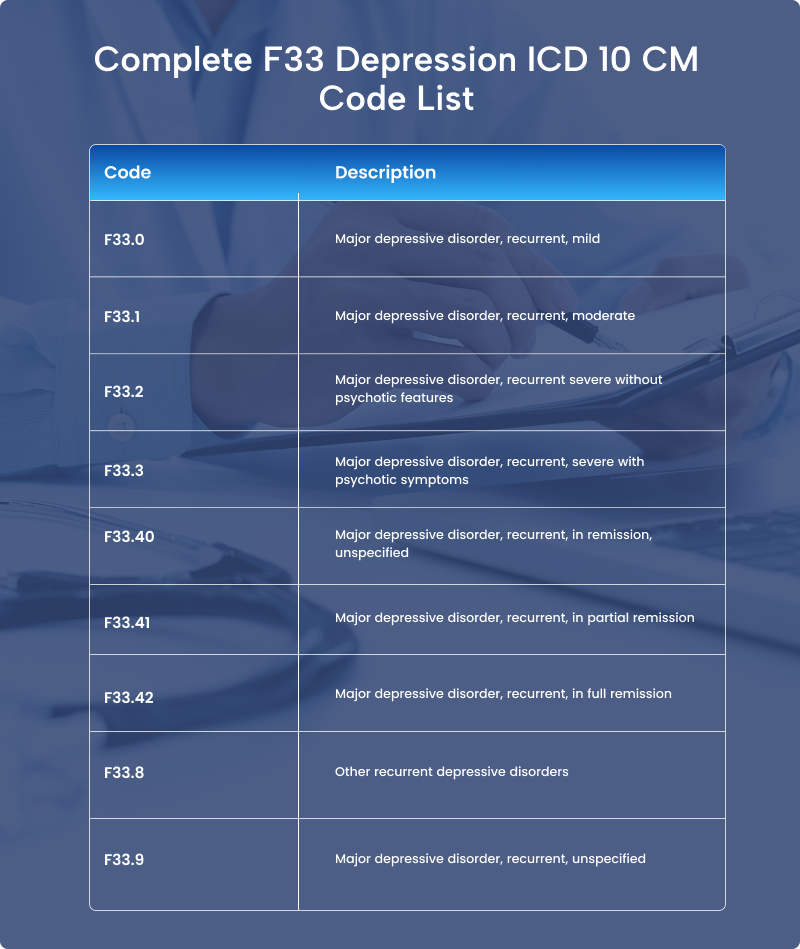
The F33 family applies to recurrent major depressive disorder.
| Code | Description |
| F33.0 | Major depressive disorder, recurrent, mild |
| F33.1 | Major depressive disorder, recurrent, moderate |
| F33.2 | Major depressive disorder, recurrent severe without psychotic features |
| F33.3 | Major depressive disorder, recurrent, severe with psychotic symptoms |
| F33.40 | Major depressive disorder, recurrent, in remission, unspecified |
| F33.41 | Major depressive disorder, recurrent, in partial remission |
| F33.42 | Major depressive disorder, recurrent, in full remission |
| F33.8 | Other recurrent depressive disorders |
| F33.9 | Major depressive disorder, recurrent, unspecified |
The current CMS code listings confirm the F33 severity and remission categories.
What Does F33 Mean?
F33 identifies recurrent major depressive disorder.
The key word is recurrent.
A provider should document the recurrent nature of the disorder rather than having the coder infer it simply because the patient has received depression treatment before.
For example:
Assessment: Major depressive disorder, recurrent, moderate.
Code:
F33.1
Another example:
Assessment: Major depressive disorder, recurrent, severe without psychotic features.
Code:
F33.2
If the provider documents recurrent MDD but does not specify severity or remission status, F33.9 may apply.
F32 vs F33: Single Episode or Recurrent?
This is one of the most important decisions in depression coding.
Think of the two families this way:
| Clinical documentation | Code family |
| Single episode MDD | F32 |
| Recurrent MDD | F33 |
The coder should not decide that a patient has recurrent MDD simply because the patient has visited the practice several times.
Multiple therapy visits do not automatically mean multiple depressive episodes.
The provider needs to establish the diagnosis and episode pattern.
Example
A patient begins treatment with:
Major depressive disorder, single episode, moderate
Use:
F32.1
Months later, the provider documents:
Major depressive disorder, recurrent, moderate
Use:
F33.1
The change reflects the provider’s current diagnosis.
Depression Severity and ICD 10 Coding
Severity determines the final code within the F32 and F33 families when the provider documents major depressive disorder.
Mild MDD
Single episode:
F32.0
Recurrent:
F33.0
Moderate MDD
Single episode:
F32.1
Recurrent:
F33.1
Severe MDD without psychotic features
Single episode:
F32.2
Recurrent:
F33.2
Severe MDD with psychotic features
Single episode:
F32.3
Recurrent:
F33.3
The presence of psychotic symptoms changes the code.
The provider should clearly document the relevant clinical findings rather than leaving the distinction for the coder to interpret.
What Does F32.2 Mean?
F32.2 means major depressive disorder, single episode, severe without psychotic features.
The record should support:
- Major depressive disorder
- Single episode
- Severe severity
- No psychotic features
If the provider documents severe MDD with hallucinations or delusions, F32.3 may apply instead.
What Does F33.2 Mean?
F33.2 represents major depressive disorder, recurrent, severe without psychotic features.
It combines two important elements:
- Recurrent MDD
- Severe current episode without psychotic features
Do not confuse F33.2 with F33.3.
F33.3 applies when recurrent MDD is severe and psychotic symptoms are documented.
F33.3: Recurrent Severe Depression With Psychotic Symptoms
F33.3 identifies major depressive disorder that is:
- Recurrent
- Severe
- Associated with psychotic symptoms
The documentation should support the diagnosis and the presence of psychotic symptoms.
A claim should not use F33.3 simply because the patient’s depression appears serious.
Severity alone does not establish psychotic features.
The provider needs to document the relevant clinical findings.
Depression in Remission: F32 and F33 Codes
Depression coding does not stop when symptoms improve.
ICD 10 CM includes remission codes for major depressive disorder.
For single episode MDD:
| Status | Code |
| Partial remission | F32.4 |
| Full remission | F32.5 |
For recurrent MDD:
| Status | Code |
| Remission, unspecified | F33.40 |
| Partial remission | F33.41 |
| Full remission | F33.42 |
The provider should document remission status clearly.
A statement such as “doing better” does not automatically establish full remission.
What Is the Difference Between Depression and MDD?
Depression can describe a symptom, a clinical diagnosis, or a broader condition depending on the documentation.
Major depressive disorder represents a specific psychiatric diagnosis.
That distinction matters for coding.
Consider these two assessments:
Assessment 1: Depression.
This may support F32.A when no further diagnosis has been established.
Assessment 2: Major depressive disorder, single episode, moderate.
This supports F32.1.
A coder should not upgrade the first assessment to the second without provider documentation.
CMS outpatient coding guidelines state that uncertain diagnoses such as probable or suspected conditions should not receive definitive diagnosis coding in the outpatient setting. Instead, coding should reflect the highest level of certainty supported by the encounter.
How to Select the Correct Depression ICD 10 Code
Use this sequence when reviewing a depression encounter.
Identify the documented diagnosis
Start with the provider’s assessment.
Ask:
- Is the diagnosis depression?
- Is it major depressive disorder?
- Is another depressive disorder documented?
Do not begin with the codebook and then work backward from symptoms.
Determine whether the provider documented MDD
If the record only states depression, do not assume MDD.
If the provider documents major depressive disorder, continue to the next step.
Determine episode pattern
If the provider documents a single episode, review the F32 family.
If the provider documents recurrent MDD, review the F33 family.
Check severity
Look for:
- Mild
- Moderate
- Severe without psychotic features
- Severe with psychotic features
If the provider does not document severity, an unspecified MDD code may apply.
Check remission status
If the provider documents remission, determine whether the record supports:
- Partial remission
- Full remission
- Unspecified remission when applicable
Check for another diagnosis
Before finalizing F32 or F33, make sure the documentation does not point to:
- Bipolar disorder
- Persistent depressive disorder
- Adjustment disorder
- Substance induced depressive disorder
- Premenstrual dysphoric disorder
- Postpartum depression
The code family can change completely.
Depression Diagnoses That Should Not Automatically Use F32 or F33
Depressive symptoms can occur in several psychiatric conditions.
Correct coding requires more than matching the word “depression” to an F32 code.
| Condition | Common ICD 10 CM code | Coding consideration |
| Depression, unspecified | F32.A | Use when the provider documents unspecified depression |
| MDD, single episode | F32 family | Select severity or remission when documented |
| Recurrent MDD | F33 family | Provider must document recurrent MDD |
| Persistent depressive disorder | F34.1 | Separate diagnosis from episodic MDD |
| Adjustment disorder with depressed mood | F43.21 | Depression occurs within an adjustment disorder diagnosis |
| Adjustment disorder with mixed anxiety and depressed mood | F43.23 | Do not replace the documented adjustment disorder with MDD |
| Bipolar disorder | F31 family | Depressive episodes occur within bipolar disorder |
| Unspecified mood disorder | F39 | Use when the provider documents this diagnosis |
Depression and Bipolar Disorder
This distinction deserves special attention.
A patient may present with depressive symptoms while having bipolar disorder.
If the provider documents bipolar disorder with a current or most recent depressive episode, the coder should not automatically assign an F32 or F33 code.
The bipolar diagnosis belongs in the F31 family.
The patient’s treatment history and provider assessment matter.
A history of mania or hypomania can change the diagnosis completely.
Depression vs Persistent Depressive Disorder
Persistent depressive disorder, also called dysthymic disorder, has its own ICD 10 CM code:
F34.1
Do not automatically code F33 because the provider describes depression as chronic.
“Chronic depression” alone may require clarification.
If the provider documents persistent depressive disorder, F34.1 applies.
If the provider documents recurrent MDD, use the appropriate F33 code.
Depression With Anxiety
Depression and anxiety may occur together.
If the provider documents both as separate diagnoses, each condition may require coding according to the documentation.
For example:
Major depressive disorder, recurrent, moderate
Generalized anxiety disorder
The depression may support F33.1, while generalized anxiety disorder may support F41.1.
Do not invent a combined diagnosis simply because the patient reports both anxiety and depressive symptoms.
Postpartum Depression Coding
Postpartum depression requires careful review of the provider’s documentation and the ICD 10 CM coding instructions.
F53.0 is associated with postpartum depression.
However, pregnancy and postpartum encounters can involve additional coding considerations. The record, timing, diagnosis, and applicable tabular instructions should guide code assignment.
Do not apply one postpartum rule to every patient who reports depression after childbirth.
Premenstrual Dysphoric Disorder
Premenstrual dysphoric disorder has its own code:
F32.81
It should not be confused with ordinary major depressive disorder.
The diagnosis and clinical pattern need to support the condition.
Treatment Resistant Depression
ICD 10 CM does not provide a single standalone code called treatment resistant depression.
The provider should code the underlying documented depressive disorder.
For example, if the provider documents recurrent moderate MDD with inadequate response to several treatments, F33.1 may represent the MDD diagnosis.
The treatment history, medication trials, response, and clinical reasoning belong in the medical record.
Do not create a nonexistent ICD 10 CM diagnosis simply because the patient has failed previous treatments.
History of Depression vs Active Depression
A previous history of depression does not automatically mean the patient currently has active MDD.
The coder should review the current assessment.
- If the provider documents active MDD, use the applicable F32 or F33 code.
- If the provider documents MDD in remission, review the appropriate remission code.
- If the patient has only a past history and no current active condition, the appropriate history coding may differ.
The documentation must establish the current clinical status.
Depressed Mood Is Not Automatically a Depression Diagnosis
A patient may report feeling sad, discouraged, or down.
That symptom alone does not allow the coder to assume major depressive disorder.
The provider may ultimately diagnose depression, adjustment disorder, another psychiatric condition, or no depressive disorder.
The diagnosis should follow the provider’s clinical assessment.
This protects both the medical record and the claim.
DSM 5 and ICD 10 CM: How They Work Together
Clinicians often use DSM 5 diagnostic criteria while medical claims use ICD 10 CM diagnosis codes.
These systems serve different purposes.
DSM 5 provides diagnostic criteria and clinical descriptions.
ICD 10 CM provides the diagnosis classification used for reporting and billing in the United States.
The clinical diagnosis should guide the ICD 10 CM code selection.
For example, a provider may document:
Major depressive disorder, recurrent, moderate, with anxious distress
The ICD 10 CM code for the documented MDD diagnosis may be:
F33.1
The clinical record can retain the additional clinical description even when the ICD 10 CM code does not independently capture every DSM 5 specifier.
Depression ICD 10 Documentation Requirements
Strong documentation does more than list the diagnosis.
For depression encounters, the record should support the condition being treated and the service provided.
Depending on the encounter, useful documentation may include:
Diagnosis
Document the actual psychiatric diagnosis.
Example:
Major depressive disorder, recurrent, moderate
Episode pattern
When relevant, identify whether the condition represents a single or recurrent episode.
Severity
Document mild, moderate, or severe when clinically established.
Psychotic features
When the diagnosis involves severe depression with psychotic features, document the relevant symptoms.
Remission
If the patient is in remission, document whether the provider considers the condition partially or fully in remission when supported.
Symptoms
Document clinically relevant symptoms that support the assessment.
Functional impact
Describe how the condition affects work, school, relationships, self care, sleep, concentration, or other meaningful areas when relevant to the encounter.
Treatment plan
Document the treatment provided or planned.
Examples include:
- Psychotherapy
- Medication management
- Behavioral interventions
- Safety planning when clinically indicated
- Follow up
Medical necessity
The record should explain why the service was necessary for the patient’s condition.
PHQ 9 Does Not Choose the ICD 10 Code by Itself
Depression screening tools can provide useful clinical information.
They do not independently establish the final ICD 10 CM diagnosis.
A PHQ 9 score should not automatically determine whether the claim receives F32.0, F32.1, F32.2, or another code.
The provider’s clinical assessment remains central to diagnosis coding.
This distinction prevents a common billing mistake: treating a screening score as though it were the provider’s final diagnosis.
Depression Diagnosis and Psychotherapy Billing
The diagnosis code does not replace the procedure code.
A behavioral health claim normally needs the diagnosis that supports the service along with the appropriate CPT code for the service actually provided.
For Medicare, CMS identifies 90832, 90834, and 90837 as psychotherapy codes without medical evaluation and management. CMS also identifies 90833, 90836, and 90838 as psychotherapy add on codes used with qualifying evaluation and management services.
The diagnosis should support medical necessity for the service.
For example, a psychotherapy encounter for a patient with documented recurrent moderate MDD may use F33.1 as the diagnosis when the record supports that diagnosis and the service.
The procedure code still depends on the service delivered and applicable payer rules.
Common Psychotherapy CPT Codes Used With Depression Treatment
| CPT code | General service |
| 90791 | Psychiatric diagnostic evaluation |
| 90792 | Psychiatric diagnostic evaluation with medical services |
| 90832 | Psychotherapy, approximately 30 minutes |
| 90834 | Psychotherapy, approximately 45 minutes |
| 90837 | Psychotherapy, approximately 60 minutes |
| 90833 | Psychotherapy add on with E/M |
| 90836 | Psychotherapy add on with E/M |
| 90838 | Psychotherapy add on with E/M |
| 90846 | Family psychotherapy without patient present |
| 90847 | Family psychotherapy with patient present |
| 90853 | Group psychotherapy |
CMS explains that psychotherapy codes 90832 through 90838 represent psychotherapy services and that the psychotherapy add on codes require an appropriate evaluation and management service.
Depression Diagnosis Does Not Automatically Guarantee Payment
A valid ICD 10 CM code does not guarantee reimbursement.
The claim must satisfy the payer’s requirements.
A payer may review:
- Diagnosis support
- Procedure code
- Provider eligibility
- Patient eligibility
- Authorization requirements
- Place of service
- Modifier requirements
- Medical necessity
- Documentation
- Frequency limits
- Telehealth requirements
- Timely filing
A clean diagnosis code helps, but the entire claim must make sense.
Medical Necessity for Depression Treatment
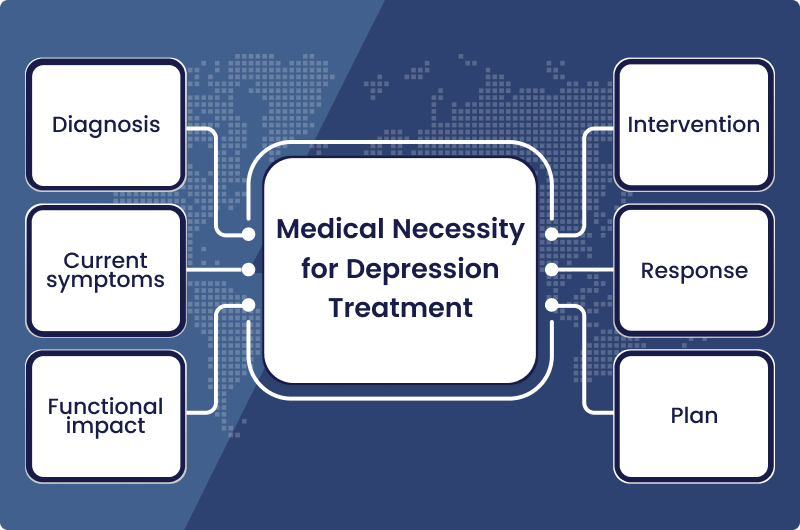
Medical necessity documentation should connect the diagnosis to the service.
A strong psychotherapy note can show:
Diagnosis
What condition is being treated?
Current symptoms
What symptoms remain active?
Functional impact
How do those symptoms affect the patient’s daily functioning?
Intervention
What did the clinician do during the encounter?
Response
How did the patient respond?
Plan
What happens next?
The exact documentation requirements depend on the payer, service, provider type, and clinical circumstances.
How Unspecified Depression Codes Can Affect Claims
Unspecified codes are not inherently incorrect.
Sometimes the provider genuinely has not established greater specificity.
The problem occurs when the chart repeatedly uses an unspecified diagnosis even though the provider’s assessment clearly supports a more specific diagnosis.
For example:
Visit one:
Depression, unspecified
F32.A may fit.
Later visits:
MDD, recurrent, moderate
Continuing to report F32.A without reviewing the updated diagnosis creates a mismatch between the current clinical assessment and the claim.
Coders should compare the diagnosis on the claim with the provider’s current assessment.
When Should a Coder Query the Provider?
A query may help when the documentation contains clinically relevant information but does not clearly establish the diagnosis needed for accurate coding.
Examples include:
- The note describes depression but does not identify whether the provider means MDD
- The provider documents MDD but does not clarify single versus recurrent episode
- The record supports a severe condition but the assessment lacks severity
- The provider documents psychotic symptoms but the diagnosis does not clarify whether psychotic features apply
- The record describes remission but the assessment does not identify the remission status
The coder should never use a query as a way to push the provider toward a more favorable reimbursement code.
The purpose is accurate clinical documentation and coding.
Common Depression Coding Errors
Small documentation differences can create major coding problems.
Using F32.9 for every depression claim
F32.9 means major depressive disorder, single episode, unspecified.
It does not mean every type of depression.
If the provider documents only unspecified depression, F32.A may be more appropriate.
Assuming recurrent MDD
A patient receiving therapy for months does not automatically have recurrent MDD.
Treatment duration does not establish recurrence.
Guessing severity
Coders should not assign moderate or severe MDD simply because symptoms appear extensive.
The provider’s diagnosis should support the severity code.
Ignoring psychotic features
F32.2 and F32.3 differ because F32.3 includes psychotic features.
The same distinction exists between F33.2 and F33.3.
Missing remission status
When the provider documents remission, review the appropriate remission code instead of continuing an active episode code without review.
Coding bipolar depression as F32 or F33
If the provider documents bipolar disorder, review the F31 family.
Confusing chronic depression with recurrent MDD
Chronic depressive symptoms may represent persistent depressive disorder.
The provider’s diagnosis determines the correct code family.
Coding symptoms as a confirmed psychiatric diagnosis
Do not turn depressed mood into MDD without provider documentation.
Final Takeaway
Depression coding requires more than choosing an F32 code because the patient has depression.
The key is to follow the provider’s documented diagnosis.
Use F32.A when the provider documents unspecified depression without establishing MDD.
Use F32 codes for single episode MDD.
Use F33 codes for recurrent MDD.
Then look for severity, psychotic features, and remission status.
The most common distinctions include:
- F32.A: Depression, unspecified
- F32.9: Major depressive disorder, single episode, unspecified
- F32.1: Major depressive disorder, single episode, moderate
- F33.1: Major depressive disorder, recurrent, moderate
- F33.9: Major depressive disorder, recurrent, unspecified
The right diagnosis code should tell the same clinical story as the provider’s assessment.
When that connection remains clear, coding becomes more defensible and the billing team has a stronger foundation for claim submission and denial prevention.
Turn Depression Coding Errors Into a Revenue Cycle Fix
Depression claims can look simple until the diagnosis, documentation, psychotherapy service, payer policy, and medical necessity requirements all intersect.
RCM Xperts can help behavioral health practices review the complete billing workflow rather than focusing only on the ICD 10 field.
Our team can support:
- Depression diagnosis coding review
- F32 and F33 code selection
- Behavioral health claim submission
- Psychotherapy billing
- Documentation review
- Medical necessity checks
- Claim correction
- Denial management
- Payer follow up
- Accounts receivable management
- Coding audits
If your practice sees repeated denials related to diagnosis specificity, medical necessity, psychotherapy billing, or documentation gaps, a focused billing review can identify where those claims are breaking down.
Do not let a small diagnosis mismatch create another unpaid behavioral health claim.
Talk with RCM Xperts
Frequently Asked Questions
What is the most common ICD 10 code for depression?
There is no single code that applies to every depression diagnosis. F32.A represents depression, unspecified. F32.9 represents major depressive disorder, single episode, unspecified. Recurrent MDD falls under F33.
What is F33.9?
F33.9 represents major depressive disorder, recurrent, unspecified.
Use it when the provider documents recurrent MDD but does not provide the specificity required for a more detailed F33 code.
What is F33.3?
F33.3 represents major depressive disorder, recurrent, severe with psychotic symptoms.
The record should support recurrent MDD, severe severity, and psychotic symptoms.
Can a coder change F32.A to F32.9?
Not simply because F32.9 appears more specific.
F32.9 requires documentation of major depressive disorder, single episode.
If the provider only documents depression without establishing MDD, the coder should not independently upgrade the diagnosis.
Can depression and anxiety both be coded?
Yes, when the provider documents both conditions as diagnoses and the record supports them. Each condition should receive the applicable ICD 10 CM code.
Does a PHQ 9 score determine the depression ICD 10 code?
No.
A screening score can support clinical assessment, but it does not independently establish the final ICD 10 CM diagnosis.
Does recurrent mean the patient has attended therapy more than once?
No.
Repeated treatment visits do not automatically establish recurrent MDD.
The provider should document the recurrent diagnosis.
What code applies to depression in remission?
The code depends on whether the MDD is single episode or recurrent and whether remission is partial or full.
Examples include F32.4, F32.5, F33.40, F33.41, and F33.42.
Is there a separate ICD 10 code for treatment resistant depression?
No single standalone ICD 10 CM code represents treatment resistant depression.
Code the underlying documented depressive disorder and retain the treatment history and clinical response in the medical record.
Which CPT codes can accompany a depression diagnosis?
The CPT code depends on the service provided. Medicare identifies psychotherapy codes including 90832, 90834, and 90837, along with psychotherapy add on codes 90833, 90836, and 90838 when the applicable evaluation and management service also occurs.