

When a patient does not pay a medical bill, the problem does not end with an unpaid statement. The balance moves into the healthcare organization’s accounts receivable, affects cash flow, increases staff workload, and can eventually turn into bad debt.
For a physician practice, hospital, ambulatory facility, or billing department, the real question is not simply “How do we collect an unpaid medical bill?” It is “How do we make sure the balance is accurate, communicate the patient’s responsibility clearly, and collect it through an appropriate process?”
That distinction matters.
Many unpaid medical bills start with legitimate patient responsibility. Others result from eligibility problems, incorrect insurance information, coding errors, missed authorizations, claim denials, coordination of benefits issues, or inaccurate statements. Sending every unpaid balance straight to a collection agency can therefore create unnecessary compliance, patient experience, and revenue problems.
A well-managed patient collections process starts much earlier.
This guide explains what happens when patients fail to pay, how providers can manage patient balances, when to use internal collections or an outside agency, how hospitals should approach bad debt, and which RCM metrics can help reduce unpaid medical accounts.
What Are Unpaid Medical Bills?
An unpaid medical bill represents an amount that remains due after the healthcare provider has completed its billing process and determined that the patient or guarantor has financial responsibility.
The balance may come from:
- A deductible
- Coinsurance
- Copayment
- Noncovered service
- Remaining balance after insurance payment
- Self pay services
- Uninsured care
- A denied claim that legitimately becomes patient responsibility
- Services that fall outside the patient’s benefit coverage
However, a balance appearing on a patient statement does not automatically mean the patient owes it.
The provider must first confirm that the organization billed the correct payer, applied the payer’s response correctly, posted payments accurately, and calculated patient responsibility according to the applicable contract, benefit plan, and billing rules.
That verification protects both the organization and the patient.
What Happens When a Patient Does Not Pay a Medical Bill?
Most healthcare organizations follow a series of steps before they transfer an account to external collections.
A typical workflow looks like this:
Patient responsibility identified → statement generated → payment reminder → follow up → financial assistance or payment plan review → internal collections → final notice → external collections or bad debt treatment
The exact timeline varies by organization, payer contracts, state requirements, facility policies, and the type of account.
The important point is that collections should represent the later stage of the revenue cycle, not the first response to an unpaid balance.
Before collection activity begins, the billing team should answer several questions:
- Did insurance process the claim correctly?
- Did the payer assign the balance to patient responsibility?
- Did the organization post the insurance payment correctly?
- Did the provider bill the correct patient or guarantor?
- Did the statement contain accurate information?
- Does the account qualify for financial assistance?
- Does the patient need a payment plan?
- Has the organization met its internal collection requirements?
- Does the account require special handling because of its patient or service type?
- Can the organization legally and appropriately refer the balance to an outside collection agency?
This process prevents avoidable medical debt from entering collections.
Patient Responsibility vs. Insurance Responsibility
One of the biggest sources of confusion in healthcare billing involves patient responsibility.
After a claim processes, the payer may assign some or all of the remaining amount to the patient. The provider then posts the insurance payment and contractual adjustments and bills the patient for the remaining eligible balance.
For example:
| Claim amount | Amount |
| Provider charges | $1,000 |
| Insurance allowed amount | $700 |
| Insurance payment | $500 |
| Contractual adjustment | $200 |
| Patient responsibility | $200 |
In this example, the provider should not simply bill the patient for the original $1,000.
The billing system must reflect the payer’s adjudication correctly.
Patient responsibility can include deductible, coinsurance, copayment, or another amount that the payer assigns to the patient under the benefit plan.
Incorrect posting can inflate patient balances.
Suppose a payer sends an explanation of benefits showing a $125 deductible, but the practice accidentally posts $250 to the patient account. The resulting statement creates an incorrect medical bill.
The problem then looks like a collections issue.
It actually started as a payment posting or claims processing issue.
That is why effective healthcare collections depend on accurate front end and back end billing.
What Should a Provider Do Before Sending a Patient Balance to Collections?
A healthcare organization should establish a defined pre collections workflow.
The process should generally include the following stages.
Verify the Account
The billing team reviews the account for:
- Patient demographics
- Guarantor information
- Insurance coverage
- Claim status
- Payment posting
- Adjustments
- Denials
- Refunds
- Outstanding payer balances
- Previous statements
- Financial assistance status
- Payment arrangements
The team should correct account errors before pursuing the patient.
Confirm True Patient Responsibility
The organization should verify that the outstanding amount actually belongs to the patient.
This becomes especially important when the account involves:
- Multiple insurance plans
- Coordination of benefits
- Secondary insurance
- Workers’ compensation
- Auto accident claims
- Medicaid
- Medicare
- Commercial insurance
- Out of network services
- Noncovered services
Resolve Insurance Problems First
A patient should not receive a statement for an amount that the provider can still recover from an insurance company.
Billing teams should investigate:
- Unprocessed claims
- Rejected claims
- Denied claims
- Incorrect payer information
- Missing authorizations
- Coding issues
- Modifier problems
- Medical necessity denials
- Timely filing problems
- Coordination of benefits errors
- Incorrect claim submission
This step can recover revenue that otherwise would become unnecessary patient debt.
How Incorrect Claims Create Avoidable Patient Balances
Not every unpaid medical bill reflects an inability to pay.
Some balances originate from preventable revenue cycle errors.
Consider this example.
A patient receives a covered procedure. The practice submits the claim with an incorrect modifier. The payer denies the claim. The billing team does not appeal the denial and eventually moves the amount to patient responsibility.
The patient receives a $600 bill.
From the patient’s perspective, the provider charged $600.
From the provider’s perspective, the account remains unpaid.
But the underlying problem started with claim submission and denial management.
The organization may have had an opportunity to recover the $600 from the payer.
This illustrates an important RCM principle:
Do not treat an insurance denial as patient debt until the billing team determines who actually holds financial responsibility.
Strong denial management can reduce unnecessary patient balances before they ever reach the collections stage.
Patient Statement and Follow Up Process
Once the organization confirms patient responsibility, it should communicate the balance clearly.
A patient statement should provide enough information for the guarantor to understand:
- Date of service
- Provider or facility
- Service information
- Insurance payments or adjustments where appropriate
- Amount due
- Payment options
- Financial assistance information when applicable
- Contact information for billing questions
- Available payment plan options
- Clear statements can reduce billing calls and help patients understand why they owe money.
Follow-up should follow a defined schedule
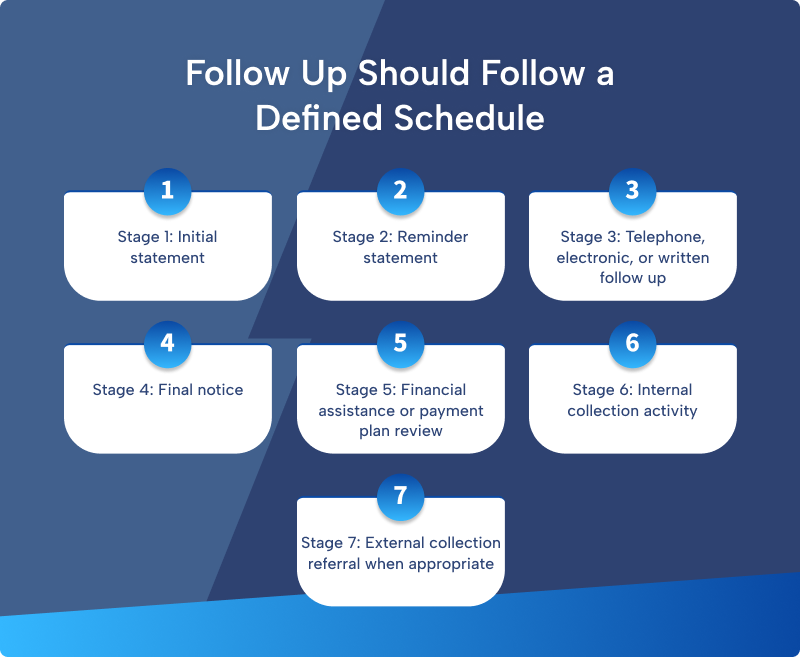
Healthcare organizations should create a written patient collection policy.
For example, an organization might establish:
- Stage 1: Initial statement
- Stage 2: Reminder statement
- Stage 3: Telephone, electronic, or written follow-up
- Stage 4: Final notice
- Stage 5: Financial assistance or payment plan review
- Stage 6: Internal collection activity
- Stage 7: External collection referral when appropriate
The organization should adjust the timing to comply with applicable laws, payer requirements, facility policies, and its financial assistance obligations.
Internal Collections vs. External Collection Agencies
Healthcare organizations generally have two broad options for managing unpaid patient accounts.
They can manage collection activity internally or refer qualifying accounts to an outside collection agency.
Neither approach works equally well for every organization.
Internal Patient Collections
Internal collections keep account management within the practice or facility.
Staff may handle:
- Statements
- Phone calls
- Payment reminders
- Payment plans
- Financial counseling
- Account questions
- Balance disputes
- Final notices
Internal collection gives the organization more control over the patient relationship.
It also allows staff to resolve billing questions quickly because they can access the patient account and billing history.
This approach often works well for physician practices and smaller healthcare organizations with manageable patient A/R.
Internal collections require staff time.
Billing employees may spend significant hours calling patients, answering billing questions, processing payment arrangements, and documenting collection activity.
That can take attention away from claims, denials, payment posting, coding, and other RCM functions.
External Medical Debt Collection
Healthcare organizations may refer eligible unpaid accounts to third-party collection agencies after completing their internal process.
An outside agency can handle collection activity according to its agreement with the provider and applicable law.
However, the provider should conduct appropriate due diligence before selecting an agency.
The organization should evaluate:
- Healthcare collection experience
- Compliance program
- Consumer communication practices
- Data security
- HIPAA considerations
- Complaint history
- Reporting capabilities
- Account placement procedures
- Payment processing
- Dispute handling
- Recall procedures
- Fee structure
The lowest collection fee does not necessarily make an agency the best choice.
A healthcare facility also needs to consider how the agency interacts with patients.
The provider’s reputation can suffer when an outside collector communicates poorly with patients.
When Should a Medical Account Go to Collections?
There is no universal collection date that applies to every healthcare organization.
Instead, providers should create a documented policy based on the organization’s financial, operational, and legal requirements.
Before referring an account, the billing department should generally confirm:
- Insurance processing has finished
- Patient responsibility remains valid
- The statement went to the correct address or communication channel
- The organization gave the patient reasonable opportunities to resolve the balance
- The patient does not have an unresolved billing dispute
- Financial assistance screening has occurred where applicable
- A payment plan has not already been established
- Required notices have been provided
- The account meets the organization’s collection criteria
- Applicable federal and state requirements allow the planned collection activity
The organization should document each stage.
Good documentation gives the RCM team a clear account history and helps management audit collection practices.
Financial Assistance and Charity Care
Healthcare organizations should not treat every unpaid balance as a collection opportunity.
Some patients cannot reasonably afford their medical bills.
Hospitals, particularly nonprofit hospitals, may have financial assistance obligations that affect how they handle certain patient accounts.
Financial assistance programs can include:
- Full charity care
- Partial charity care
- Discounted balances
- Sliding scale assistance
- Payment plans
- Other hardship programs
The organization should establish clear eligibility criteria and train staff to explain available options.
For hospitals, financial assistance policies also require careful attention to applicable federal requirements and the facility’s own written policy.
A patient who qualifies for financial assistance may require different account treatment from a patient who simply has not paid a valid balance.
Payment Plans and Financial Counseling
Payment plans can help healthcare organizations collect legitimate patient balances without immediately escalating an account to external collections.
A structured payment arrangement may include:
- Minimum monthly payment
- Defined payment period
- Automatic payment option
- Written agreement
- Clear balance information
- Rules for missed payments
The organization should make its terms easy to understand.
Financial counseling can also help patients understand insurance coverage, deductibles, financial assistance, and available payment options.
For hospitals, financial counselors can play an important role in preventing accounts from becoming long outstanding A/R.
Bad Debt in Healthcare
Healthcare bad debt generally refers to amounts that an organization cannot collect and ultimately recognizes as an expense or loss according to its accounting policies.
Bad debt can arise from:
- Patients who never pay
- Uncollectible self pay accounts
- Failed payment arrangements
- Accounts that remain unpaid after collection efforts
- Financial hardship situations, depending on accounting treatment and organizational policy
Bad debt directly affects the financial performance of a healthcare organization.
That makes patient A/R management an important part of revenue cycle management.
However, organizations should not measure success simply by how aggressively they pursue patients.
A strong RCM operation tries to maximize appropriate collections while reducing the number of accounts that become patient responsibility unnecessarily.
Hospital Billing Collections Require Additional Controls
Hospitals often manage much larger and more complicated patient accounts than small physician practices.
A single hospital encounter may involve:
- Emergency department services
- Hospital facility charges
- Physician services
- Laboratory services
- Radiology
- Surgery
- Anesthesia
- Pharmacy
- Durable medical equipment
- Multiple insurance plans
This complexity creates more opportunities for billing discrepancies.
Hospitals should therefore coordinate patient billing across departments and affiliated providers where appropriate.
They also need clear financial assistance policies and collection procedures that account for applicable federal and state requirements.
Hospital Collection Compliance
Hospitals should pay particular attention to rules governing:
- Financial assistance
- Emergency care
- Patient communications
- Debt collection practices
- Credit reporting
- Collection lawsuits
- Extraordinary collection actions
- Required notices
- Nonprofit hospital requirements
Organizations should have legal and compliance professionals review policies where necessary rather than relying on a generic collections workflow.
Credit Reporting and Medical Debt
Healthcare organizations and collection agencies should treat credit reporting as a compliance issue, not simply another collection tactic.
Medical debt reporting has changed significantly in recent years, and federal and state requirements can affect what organizations and collection agencies may report.
Providers should therefore verify current requirements before using credit reporting as part of a patient collection strategy.
They should also maintain accurate account records.
Reporting an incorrect balance can create significant regulatory, financial, and reputational risk.
Legal Considerations in Healthcare Collections
Medical debt collection involves more than sending statements.
Organizations may need to consider:
- Federal debt collection requirements
- Consumer protection laws
- State collection laws
- Hospital specific requirements
- Financial assistance rules
- Privacy obligations
- Contractual payer requirements
- Rules governing credit reporting
- Lawsuit and judgment requirements
- Patient communication restrictions
Requirements can vary by state and account type.
Healthcare organizations should have counsel review their collection policies when they plan major changes, use outside collection agencies, pursue legal action, or operate across multiple states.
How RCM Teams Can Reduce Unpaid Patient Balances
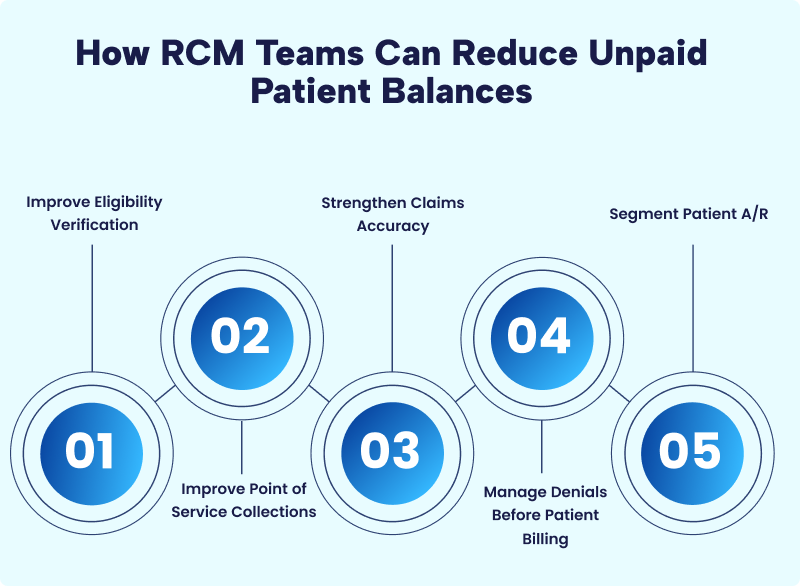
Reducing patient debt starts before the statement reaches the mailbox or inbox.
A strong revenue cycle program should address the entire patient financial journey.
Improve Eligibility Verification
Verify coverage before services whenever possible.
Confirm:
- Active coverage
- Deductible
- Coinsurance
- Copayment
- Benefit limitations
- Network status
- Prior authorization requirements
Accurate information at registration helps patients and staff understand expected responsibility earlier.
Improve Point of Service Collections
When appropriate, organizations can collect known copayments, deductibles, and other patient responsibility at or around the time of service.
This can reduce later A/R.
Staff should communicate amounts carefully and avoid presenting estimates as guaranteed final balances.
Strengthen Claims Accuracy
Clean claims improve payer reimbursement and reduce balances that eventually move to patients.
Review:
- Patient demographics
- Insurance information
- CPT and HCPCS coding
- ICD 10 coding
- Modifiers
- Place of service
- Authorization information
- Provider credentials
- Claim attachments
Manage Denials Before Patient Billing
The denial team should determine whether the payer or patient holds financial responsibility.
This single control can prevent significant amounts of avoidable patient debt.
Segment Patient A/R
Do not treat every account the same.
Segment accounts by:
- Balance
- Age
- Insurance status
- Patient history
- Financial assistance status
- Payment arrangement
- Service type
- Collection status
- Dispute status
Segmentation helps RCM teams focus staff time where it can produce the greatest return.
Patient Collections KPIs Healthcare Organizations Should Track
Healthcare organizations should monitor patient collections separately from overall A/R.
Useful KPIs include:
| KPI | What It Shows |
| Patient A/R | Outstanding patient responsibility |
| Patient A/R aging | How long balances remain unpaid |
| Self pay collection rate | Percentage of collectible self pay revenue collected |
| Point of service collection rate | Amount collected before or around service |
| Bad debt rate | Patient revenue that becomes uncollectible |
| Statement to payment rate | How often statements result in payment |
| Collection agency placement rate | Accounts transferred externally |
| Financial assistance rate | Accounts receiving approved assistance |
| Payment plan utilization | Use of structured payment arrangements |
| Patient balance accuracy | Frequency of billing corrections |
| Denial to patient rate | Denied claims shifted toward patient responsibility |
The organization should analyze these metrics by payer, location, specialty, provider, and service line when the data supports it.
For example, if one department produces significantly higher patient A/R than another, management should investigate the cause rather than simply increase collection calls.
How RCM Xperts Helps Reduce Unpaid Medical Bills
RCM Xperts helps healthcare providers and facilities manage the revenue cycle from claim submission through A/R follow up and patient responsibility.
Our approach focuses on more than collecting aging balances.
We look at why those balances exist in the first place.
RCM Xperts can support healthcare organizations with:
- Medical billing
- Insurance eligibility verification
- Claims submission
- Payment posting
- Denial management
- A/R follow up
- Patient responsibility review
- Self pay A/R management
- Medical billing audits
- Revenue cycle reporting
- Credentialing and enrollment support
- Specialty specific billing
For practices and facilities struggling with growing medical accounts receivable, the first step should involve identifying where revenue gets stuck.
Request an RCM review from RCM Xperts