

A medical claim can contain the correct CPT code and still fail.
The patient’s insurance may be active, yet the claim can be rejected. The diagnosis may support the procedure, yet the payer may deny it. The provider may have performed every service correctly, but one missing modifier, incorrect payer ID, invalid NPI, incompatible code combination, or unit error can delay payment.
That is where claim scrubbing comes in.
Claim scrubbing gives medical practices, hospitals, physician groups, laboratories, ambulatory surgery centers, and other healthcare organizations a final opportunity to identify claim problems before sending them to a payer or clearinghouse.
A strong claim scrubbing process does more than check whether required fields contain data. It evaluates claims against coding rules, payer requirements, claim formatting standards, units, modifiers, provider information, and other rules that can affect claim acceptance and reimbursement.
For healthcare organizations, the objective is straightforward:
Find the problem before the payer finds it.
This guide explains what claim scrubbing means, where it fits into medical billing, what a claim scrubber checks, which errors it can prevent, where automated scrubbing falls short, and how RCM teams can use claim editing to improve clean claim performance.
What Is Claim Scrubbing in Medical Billing?
Claim scrubbing is the process of reviewing a healthcare claim for errors, missing information, coding conflicts, and payer specific requirements before submitting the claim for reimbursement.
The review can involve automated software, clearinghouse edits, billing staff, certified coders, or a combination of these controls.
A claim scrubber may examine:
- Patient demographics
- Insurance information
- CPT codes
- HCPCS codes
- ICD 10 CM diagnosis codes
- Modifiers
- Units of service
- Place of service
- Provider NPI
- Tax identification information
- Payer ID
- Diagnosis procedure relationships
- Code combinations
- National Correct Coding Initiative edits
- Medically Unlikely Edits
- Payer specific rules
- Required claim fields
- Authorization information
- Referral requirements
- Billing provider information
- Rendering provider information
- Facility claims requirements
The exact checks depend on the software, payer, claim type, specialty, and organization.
A claim scrubber therefore acts as a pre submission quality control layer within the revenue cycle.
It does not replace medical coding or denial management. It works alongside them.
Why Claim Scrubbing Matters to Healthcare Providers
Every claim that leaves a practice with an avoidable error creates additional work somewhere in the revenue cycle.
The claim may:
- Reject at the clearinghouse.
- Return to the billing queue.
- Require correction.
- Go back through claim submission.
- Wait for payer processing.
- Deny after adjudication.
- Require staff review.
- Require an appeal or corrected claim.
- Delay reimbursement.
- Increase accounts receivable.
That process consumes staff time.
It also makes revenue less predictable.
The financial impact becomes much larger when an organization submits thousands of claims each month.
Consider a practice that submits 10,000 claims monthly.
If 4% require correction after submission, the billing team must deal with approximately 400 problematic claims every month.
Now imagine reducing that avoidable volume before submission.
That is the central value of claim scrubbing.
Where Does Claim Scrubbing Fit into the Medical Billing Process?
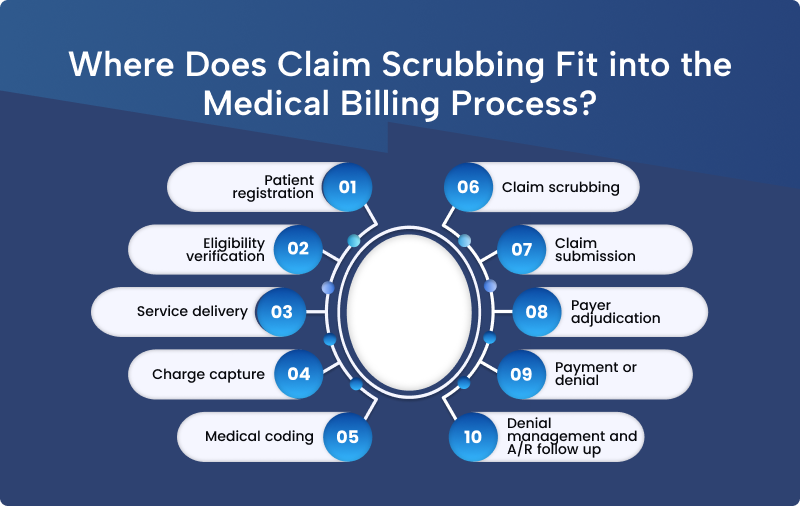
Claim scrubbing sits between medical coding and claim submission.
A simplified revenue cycle looks like this:
- Patient registration
- Eligibility verification
- Service delivery
- Charge capture
- Medical coding
- Claim scrubbing
- Claim submission
- Payer adjudication
- Payment or denial
- Denial management and A/R follow-up
Claim scrubbing does not replace the earlier stages.
If registration records the wrong insurance information, the scrubber may identify an invalid payer relationship, but it cannot always determine which insurance should actually pay.
If the provider documents the wrong clinical information, the scrubber cannot simply rewrite the medical record.
If a procedure requires prior authorization and the organization never obtained one, a claim scrubber may flag an authorization requirement if its rules support that check. It cannot create an authorization after the fact.
That distinction matters.
Claim scrubbing prevents certain problems. It does not guarantee payment.
Claim Scrubbing vs Medical Coding
These two functions often overlap in discussions about clean claims, but they serve different purposes.
Medical coding
A coder reviews clinical documentation and assigns appropriate diagnosis and procedure codes according to applicable coding guidelines.
The coder asks:
What service did the provider document and how should the encounter be represented with codes?
Claim scrubbing
The scrubber evaluates the resulting claim before submission.
It asks:
Does this claim contain an error or conflict that could prevent processing or reimbursement?
For example, a coder may correctly report two CPT codes based on documentation.
The claim scrubber may then identify an NCCI procedure to procedure edit between those codes.
CMS describes NCCI procedure to procedure edits as rules designed to prevent improper payment when incorrect code combinations appear on Medicare claims. CMS also maintains separate MUE edits for units of service.
The billing team can then review the edit and determine whether the claim requires correction, a valid modifier, additional documentation, or another action.
Claim Scrubbing vs Claim Editing
The terms claim scrubbing and claim editing often appear interchangeably, but organizations can use them differently.
Claim editing generally refers to applying individual rules to a claim.
Claim scrubbing usually describes the broader pre submission process that checks the claim against multiple rules.
A modern claim scrubbing workflow may therefore include:
- Basic data validation
- Coding edits
- Payer edits
- NCCI edits
- MUE checks
- Modifier edits
- Medical policy checks
- Provider enrollment checks
- Authorization checks
- Claim format validation
The terminology varies by billing platform and clearinghouse.
The important question for an RCM manager is not what the software calls the feature.
The important question is:
What does the system check?
What Does a Medical Claim Scrubber Check?
A good claim scrubbing system should evaluate claims across multiple layers.
Patient Information
The system may check:
- Patient name
- Date of birth
- Member ID
- Subscriber information
- Relationship to subscriber
- Address
- Gender when required for the claim or payer
- Insurance information
A small demographic mismatch can cause a claim rejection or prevent the payer from matching the claim to the correct member.
Payer Information
The scrubber may check whether the claim contains:
- Correct payer ID
- Correct payer routing
- Member number
- Group number
- Subscriber details
- Primary versus secondary payer information
- Claim filing information
A claim sent to the wrong payer can create unnecessary delays before the billing team even reaches the denial stage.
Provider Information
Provider data can create another group of claim problems.
A scrubber may validate information such as:
- Rendering provider NPI
- Billing provider NPI
- Taxonomy
- Tax ID
- Place of service
- Provider enrollment information
- Payer specific provider requirements
This becomes especially important for organizations with multiple providers, locations, specialties, and billing entities.
CPT and HCPCS Codes
The system checks whether reported procedure and service codes meet applicable edit rules.
Potential issues include:
- Invalid codes
- Inactive codes
- Incorrect code combinations
- Missing required relationships
- Procedure conflicts
- Incorrect units
- Add on code issues
- Payer specific edits
Code sets change.
That means claim scrubbing rules need regular maintenance.
An outdated rules engine can create a false sense of security.
ICD-10-CM Diagnosis Codes
Diagnosis codes provide clinical context for the services reported on the claim.
A claim scrubber may identify:
- Invalid diagnosis codes
- Inactive codes
- Incorrect code formatting
- Diagnosis procedure conflicts
- Payer-specific diagnosis requirements
However, organizations should not assume that a basic diagnosis check proves medical necessity.
Medical necessity depends on the applicable payer policy and the clinical documentation.
Modifiers
Modifiers can have a major effect on claim processing.
A scrubber can flag situations involving:
- Missing modifiers
- Potentially incompatible modifiers
- Incorrect modifier combinations
- Modifier requirements associated with specific code pairs
- Duplicate services that may require clarification
CMS NCCI guidance includes specific rules involving modifiers such as 59 and the X{EPSU} modifiers. Providers should apply modifiers only when the documentation and coding circumstances support their use.
A scrubber should identify an issue for review.
It should not encourage billing staff to add a modifier simply to force payment.
That distinction protects coding accuracy and compliance.
NCCI Procedure-to-Procedure Edits
The National Correct Coding Initiative, or NCCI, represents one of the most important edit categories in Medicare claim processing.
CMS developed the NCCI program to promote correct coding and reduce improper payments.
NCCI procedure-to-procedure edits identify code pairs that generally should not be reported together for the same beneficiary, provider, or supplier, and date of service under the applicable rules.
A claim scrubber can compare reported procedure codes against applicable NCCI edits before submission.
If the system finds a conflict, the billing team can review the documentation and determine the appropriate action.
Not every NCCI edit means the claim contains an error.
Some code pairs may qualify for an appropriate modifier when the circumstances meet the applicable requirements.
That is why automated edits should trigger review, not automatic code changes.
Medically Unlikely Edits
MUE stands for Medically Unlikely Edit.
CMS uses MUEs to identify excessive units of service reported for a CPT or HCPCS code for the same beneficiary and provider or supplier on the same date of service.
CMS describes an MUE as the maximum number of units reported on the vast majority of appropriately reported claims under the applicable circumstances.
For example, if a billing system reports an unusually high number of units for a service, the scrubber can flag the claim before submission.
The billing team then investigates.
The system should not automatically assume that every claim exceeding an edit represents fraud or incorrect billing.
Some services legitimately exceed common unit patterns.
The team needs to review the documentation and applicable rules.
CMS updates NCCI and MUE files periodically, so organizations need processes for maintaining current edit data.
Place of Service
Place of service codes tell the payer where the service occurred.
Examples include:
- Office
- Inpatient hospital
- Outpatient hospital
- Emergency department
- Ambulatory surgical center
- Skilled nursing facility
- Patient home
An incorrect POS can affect reimbursement and claim adjudication.
A claim scrubber may compare the procedure, provider type, payer, and place of service to identify potential inconsistencies.
This becomes particularly important for organizations billing across multiple locations.
Units of Service
Unit errors can create avoidable claim problems.
The scrubber can check whether:
- Units appear unusually high
- Units conflict with code rules
- Units exceed applicable MUE limits
- Units do not match billing patterns
- Duplicate lines create an unexpected total
Unit validation can help identify simple data entry mistakes before they reach the payer.
Duplicate Claims and Duplicate Services
A strong claim workflow should identify potential duplicates.
For example, the same service may accidentally appear twice because:
- The charge entered twice
- A corrected charge created another line
- Two systems transmitted the same encounter
- A claim resubmitted incorrectly
Duplicate claim detection helps reduce unnecessary rejections and payment problems.
Authorization and Referral Requirements
Some payers require authorization or referral for specific services.
Depending on the organization’s system and payer data, claim scrubbing can flag:
- Missing authorization numbers
- Missing referral information
- Services requiring authorization
- Mismatched authorization data
However, the best place to prevent authorization problems remains before the patient receives the service.
Claim scrubbing should function as a secondary control, not the primary authorization process.
Payer-Specific Rules
A generic scrubber can catch common errors.
A strong payer-specific configuration goes further.
Different payers may apply different requirements involving:
- Claim formatting
- Modifiers
- Authorization
- Provider enrollment
- Diagnosis requirements
- Coverage rules
- Documentation
- Timely filing
- Medical policies
- Telehealth billing
- Specialty specific services
Healthcare organizations should therefore ask whether their claim scrubbing system supports payer specific edits.
A claim that passes a generic edit engine may still fail a payer’s own requirements.
Facility Claim Scrubbing
Claim scrubbing does not apply only to physician claims.
Hospitals and healthcare facilities also need pre submission claim validation.
Facility billing can involve:
- UB 04 claims
- Revenue codes
- CPT codes
- HCPCS codes
- ICD 10 CM codes
- ICD 10 PCS codes where applicable
- Condition codes
- Occurrence codes
- Value codes
- Patient status
- Type of bill
- Provider information
- Payer-specific requirements
Facility claims often contain more data elements than professional claims.
That makes systematic pre-submission review particularly valuable.
Claim Rejection vs. Claim Denial
Understanding this distinction helps RCM teams determine where a claim failed.
Claim Rejection
A rejection generally occurs before the payer completes adjudication.
The claim may fail because of:
- Missing information
- Invalid data
- Formatting problems
- Invalid payer information
- Incorrect identifiers
- Structural errors
The billing team usually corrects the issue and resubmits the claim.
Claim Denial
A denial generally occurs after the payer evaluates the claim and determines that it will not pay the claim as submitted.
Possible reasons include:
- Medical necessity
- Coverage limitations
- Authorization issues
- Coding problems
- Duplicate services
- Bundling
- Benefit exclusions
- Documentation issues
- Timely filing
Claim scrubbing can reduce both categories, but it cannot eliminate every denial.
That is because some denials depend on information that becomes available only during payer adjudication.
What Claim Scrubbing Cannot Catch
This section matters because some billing companies make claim scrubbing sound like a complete denial prevention solution.
It is not.
A scrubber cannot guarantee that a payer will pay a claim.
It may not detect:
- Every medical necessity issue
- Every payer policy interpretation
- Incorrect clinical documentation
- Services that lack adequate supporting documentation
- Payer post payment reviews
- Coverage changes that occur after eligibility verification
- Certain authorization problems
- Complex coordination of benefits issues
- Incorrect clinical assumptions
- Every payer specific edit
The scrubber works best as one control within a larger revenue cycle process.
Does Claim Scrubbing Prevent Denials?
It can reduce preventable denials, but the result depends on the quality of the rules and the organization’s workflow.
A scrubber can catch errors before submission.
That gives the billing team a chance to correct them without waiting for payer adjudication.
However, not every denial originates from an error that a pre submission scrubber can detect.
For example, a payer may deny a service because its medical policy does not support the reported service for the patient’s diagnosis.
A basic claim scrubber may not know enough about the patient’s clinical circumstances to resolve that issue.
That denial requires a different RCM control.
This is why organizations should measure claim scrubbing alongside:
- Denial management
- Coding accuracy
- Eligibility verification
- Prior authorization
- Documentation quality
- A/R management
- Payment posting
The Best Claim Scrubbing Workflow
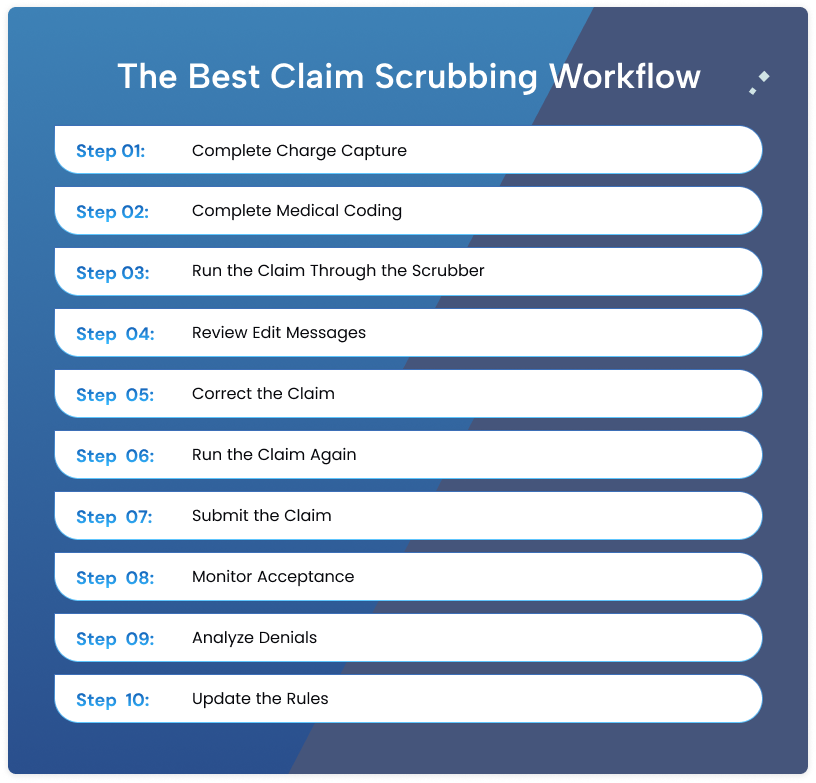
A practical workflow looks like this:
Step 1: Complete Charge Capture
Make sure the organization captures all billable services accurately.
Step 2: Complete Medical Coding
Assign diagnosis and procedure codes based on documentation and applicable coding rules.
Step 3: Run the Claim Through the Scrubber
Apply general, coding, structural, and payer-specific edits.
Step 4: Review and Edit Messages
Do not automatically override every warning.
Determine why the system flagged the claim.
Step 5: Correct the Claim
Update the claim only when the correction reflects the medical record and applicable billing rules.
Step 6: Run the Claim Again
Confirm that the correction resolves the edit.
Step 7: Submit the Claim
Send the claim through the appropriate electronic pathway.
Step 8: Monitor Acceptance
Track clearinghouse and payer responses.
Step 9: Analyze Denials
Study the claims that still fail.
Step 10: Update the Rules
Use recurring denial patterns to improve future claim edits.
This final step often gets overlooked.
A claim scrubbing program should learn from the organization’s denial data.
If the same payer rejects the same type of claim every month, the billing team should investigate whether it can add a preventive edit.
How to Build a Better Claim Scrubbing Strategy
Software alone does not create an effective claim scrubbing program.
Healthcare organizations should build controls around the software.
Keep Edit Rules Current
CMS periodically updates NCCI and MUE files. CMS currently publishes updated files for Medicare services and maintains quarterly update information.
Your billing team should have a process for reviewing and implementing relevant updates.
Maintain Payer-Specific Rules
Do not rely entirely on generic edits.
Build rules around the payers that generate significant claim volume.
Review False Positives
A scrubber that flags too many legitimate claims can slow the revenue cycle.
Track how often staff override each edit.
High override rates may indicate a poorly configured rule.
Track Recurring Errors
If staff repeatedly correct the same issue, identify its source.
The solution may involve:
- Registration training
- Coding education
- EHR configuration
- Charge capture changes
- Authorization workflow changes
- Payer rule updates
- Provider education
Connect Scrubbing with Denial Management
Denial teams should send recurring denial trends back to the claim editing team.
This creates a feedback loop:
Denial → Root cause → Preventive edit → Pre-submission correction → Fewer future denials
That approach creates much more value than simply working the same denial repeatedly.
Claim Scrubbing KPIs Healthcare Organizations Should Track
Do not judge claim scrubbing by how many edits the software generates.
That number can actually mislead management.
Instead, track whether the process improves claim performance.
| KPI | What It Measures |
| Clean claim rate | Percentage of claims accepted without avoidable correction |
| First pass acceptance rate | Claims accepted on the first submission |
| Claim rejection rate | Claims rejected before adjudication |
| Initial denial rate | Claims denied after payer adjudication |
| Edit rate | Percentage of claims flagged before submission |
| Edit resolution time | Time required to resolve flagged claims |
| Rework rate | Claims requiring correction and resubmission |
| Top edit categories | Most frequent pre submission errors |
| Override rate | Frequency with which staff bypass edits |
| Preventable denial rate | Denials linked to errors the organization could have prevented |
| A/R days | Effect of claim quality on reimbursement timing |
The most useful KPI depends on the organization’s baseline.
A hospital with high edit volume but few downstream denials may have a strong preventive process.
A practice with very few edits but frequent coding and demographic denials may have a scrubber that simply does not check enough.
What Is a Good Clean Claim Rate?
There is no single universal clean claim target that fits every provider, specialty, payer mix, and claim type.
Some organizations cite rates in the mid to high 90% range as an operational benchmark, but management should establish targets using its own historical performance and payer data.
The important point is consistency.
Track the same definition every month.
For example:
Clean claim rate = clean claims ÷ total submitted claims × 100
Do not mix clearinghouse acceptance, payer acceptance, first pass payment, and clean claim rate as though they mean the same thing.
They measure different points in the revenue cycle.
Should You Use a Claim Scrubber or Clearinghouse Edits?
In many cases, healthcare organizations use both.
A clearinghouse can provide important claim validation before forwarding a claim to the payer.
An internal or dedicated claim scrubber can provide additional checks earlier in the workflow.
The right configuration depends on:
- Claim volume
- Specialty
- Payer mix
- EHR
- Practice management system
- Clearinghouse
- Facility requirements
- Internal billing resources
- Denial patterns
The question should not be:
“Do we have a claim scrubber?”
Ask:
“How many preventable errors reach the payer despite our current controls?”
That answer tells you much more about the effectiveness of your process.
Common Claim Scrubbing Mistakes and How to Avoid Them
Claim scrubbing can catch many problems before a claim reaches the payer, but only when the billing team configures, maintains, and reviews the process correctly. A poorly managed scrubber can create false edits, delay clean claims, or give staff a false sense of security.
Here are some of the most common claim scrubbing mistakes healthcare organizations make and practical ways to prevent them.
Using Outdated Claim Editing Rules
Coding and billing rules change. CMS updates NCCI procedure to procedure edits and MUE files at least quarterly, and the current 2026 files include updates effective October 1, 2026.
If a practice continues using outdated rules, the scrubber may miss current edits or flag claims based on rules that no longer apply.
How to avoid it:
Create a formal rule maintenance schedule. Review CMS updates, payer bulletins, clearinghouse changes, and relevant coding updates on a regular basis. Assign responsibility to a specific RCM or coding team rather than assuming the software vendor handles every payer requirement.
Treating Every Scrubber Alert as a Billing Error
An edit does not automatically mean the claim contains an error.
For example, an NCCI edit may identify two procedure codes that generally should not appear together. In certain circumstances, an appropriate modifier may allow separate reporting when the documentation supports it. CMS specifically distinguishes NCCI coding edits from medical necessity review.
How to avoid it:
Have a qualified coder or trained billing specialist review significant edits. Do not automatically delete a code, change a modifier, or alter units simply to make the claim pass the scrubber.
Adding Modifiers Just to Bypass an Edit
This creates a serious compliance risk.
A modifier should describe what actually happened during the encounter. Staff should never add modifier 59, XE, XP, XS, XU, or another modifier simply because the software flags a code combination.
How to avoid it:
Require documentation support for modifier changes. Train coders and billing staff on NCCI modifier rules and audit frequently overridden edits.
Ignoring MUEs and Unit Errors
Incorrect units can cause avoidable claim problems. CMS uses MUEs to identify the maximum units of service reported on the vast majority of appropriately reported claims for a code under specified circumstances.
A simple data entry error can turn 1 unit into 10, or cause duplicate service lines to inflate the total units.
How to avoid it:
Add unit validation to the pre submission workflow. When a claim exceeds an applicable MUE, review the medical record, code description, units, and applicable CMS or payer guidance before changing the claim.
Relying Only on Medicare Edits
Medicare NCCI rules matter, but commercial payers and Medicaid programs may apply different requirements.
CMS also notes that private insurers control their own implementation of NCCI methodologies.
How to avoid it:
Build payer specific edits into your workflow. Maintain separate rules for major commercial payers, Medicare, Medicaid plans, workers’ compensation, and other significant payer categories where appropriate.
Focusing Only on Coding Edits
A claim can contain perfectly valid CPT and ICD 10 codes and still fail.
Problems can involve:
- Patient demographics
- Member ID
- Payer ID
- Provider NPI
- Place of service
- Authorization
- Referral information
- Subscriber details
- Coordination of benefits
- Claim formatting
How to avoid it:
Use layered claim validation. Combine coding edits with demographic, eligibility, authorization, provider, payer, and structural checks.
Confusing Claim Scrubbing With Medical Necessity Review
NCCI edits do not determine medical necessity. CMS specifically states that NCCI is a correct coding program, not a medical necessity or prior authorization program.
How to avoid it:
Keep medical necessity review as a separate RCM control. Use payer medical policies, authorization workflows, documentation review, and denial analysis to address those issues.
Ignoring Facility Claim Requirements
Physician claims and institutional claims do not contain the same information.
Hospitals and healthcare facilities may need to validate:
- Type of bill
- Revenue codes
- HCPCS codes
- CPT codes
- Condition codes
- Occurrence codes
- Value codes
- Patient status
- Diagnosis codes
- Provider information
How to avoid it:
Configure separate claim editing workflows for professional and institutional claims. Do not assume a scrubber designed around physician billing will adequately address hospital claims.
Not Reviewing False Positives
A scrubber that flags too many legitimate claims can create another problem.
Staff spend time investigating unnecessary alerts. Claims sit in work queues instead of going to the payer.
How to avoid it:
Track the edit override rate.
If staff repeatedly override the same edit, investigate why. The rule may need modification, better payer configuration, or clearer staff guidance.
Automatically Changing Claims to Pass the Scrubber
This shortcut can create inaccurate claims.
For example, changing a diagnosis, modifier, unit count, or procedure code simply because the scrubber rejects the original claim can introduce a coding error.
How to avoid it:
Use this sequence:
Edit → Review → Verify documentation → Correct when supported → Rescrub → Submit
The goal isn’t to make every claim pass the software.
The goal is to make every submitted claim accurate.
How RCM Xperts Can Help With Claim Scrubbing
Claim scrubbing works best when it connects with the rest of the revenue cycle.
RCM Xperts supports healthcare providers, medical practices, hospitals, and healthcare facilities with billing and revenue cycle operations designed to identify problems before they turn into prolonged A/R.
Our medical billing teams can support:
- Claim preparation
- Claim scrubbing
- Coding review
- Claims submission
- Eligibility verification
- Prior authorization support
- Denial management
- Corrected claims
- Appeals
- Payment posting
- A/R follow-up
- Revenue cycle audits
- Payer-specific billing workflows
A useful claim scrubbing program should do more than stop claims from leaving the billing system.
It should help your organization understand why claims fail and what needs to change upstream.
If your billing team continues to see the same rejections or denials, a review of your claim workflow can reveal whether the problem starts with registration, coding, authorization, charge capture, payer configuration, or claim submission.
Talk to RCM Xperts about reviewing your claim workflow and identifying preventable billing errors before they reach the payer.
Frequently Asked Questions About Claim Scrubbing
What is claim scrubbing?
Claim scrubbing is the pre-submission review of a medical claim for coding, demographic, structural, payer, modifier, unit, and other billing errors that could lead to rejection or denial.
What is a claim scrubber?
A claim scrubber is software or a rules-based system that evaluates claims before submission. It can apply general coding and billing edits as well as payer-specific rules, depending on the system.
Does claim scrubbing prevent all denials?
No. Claim scrubbing can reduce preventable errors, but it cannot eliminate every denial. Medical necessity, coverage decisions, documentation issues, authorization problems, and other payer determinations may require separate RCM controls.
What is the difference between a rejection and a denial?
A rejection generally occurs before the payer completes claim adjudication because the claim contains an error that prevents processing. A denial occurs after the payer evaluates the claim and determines that it will not pay it as submitted.
What are NCCI edits?
NCCI edits are CMS coding edits designed to prevent improper payment from incorrect code combinations and other coding situations. CMS maintains procedure to procedure edits and MUEs as part of the NCCI program.
What are MUEs in medical billing?
MUEs, or Medically Unlikely Edits, identify maximum units of service for many CPT and HCPCS codes under defined circumstances. CMS updates its published MUE files periodically.
Can claim scrubbing check payer-specific rules?
Yes, depending on the claim scrubber and its configuration. A more advanced system can apply payer-specific rules alongside general claim and coding edits.
Does claim scrubbing replace medical coding?
No. Coders interpret clinical documentation and assign appropriate codes. Claim scrubbing checks the resulting claim for potential errors before submission.
Can claim scrubbing reduce accounts receivable?
Yes, indirectly. Catching preventable claim errors before submission can reduce rejections, rework, avoidable denials, and payment delays, which can help keep A/R under control.
How often should claim scrubbing rules be updated?
Organizations should maintain an established update process. CMS publishes current NCCI information and periodic updates, while payer requirements can change separately.
Is claim scrubbing necessary for small medical practices?
It can be valuable even for small practices. A practice does not need thousands of claims per month to feel the impact of recurring rejections, coding errors, and payer-specific billing problems.