
BCBS timely filing limits determine how long a healthcare provider has to submit a claim to Blue Cross Blue Shield after providing a covered service. Missing the applicable deadline can result in a timely filing denial, leaving the provider without payment unless the payer accepts an exception, reconsideration, or appeal.
The important point for billing teams is that there is no single BCBS timely filing limit that applies to every Blue Cross Blue Shield claim nationwide. Blue Cross Blue Shield operates through independent local companies, and filing rules can vary by state, plan, product, provider contract, and claim type. The Blue Cross Blue Shield Association directs providers and members to their local BCBS company for plan and claim information.
For example, BCBS Illinois currently requires many participating commercial PPO providers to submit claims within 180 days, while specific facility and plan arrangements can have different requirements.
What Is the BCBS Timely Filing Limit?
The BCBS timely filing limit is the period allowed for a provider to submit a claim to the applicable Blue Cross Blue Shield plan.
The clock generally starts from a defined event, such as:
- Date of service
- Date of discharge
- Date the primary payer processed the claim
- Date the provider received the primary payer’s EOB
- Another date specified by the provider agreement or plan
The exact starting point depends on the claim type and applicable BCBS plan.
For example, BCBS Illinois states that participating professional PPO providers generally have 180 days following the date of service for non-inpatient services or the date of discharge or transfer for inpatient services. When BCBS Illinois acts as the secondary payer, the filing period can run from the provider’s receipt of the primary payer’s EOB.
This demonstrates why billing staff shouldn’t treat “BCBS timely filing” as one universal number.
Is the BCBS Timely Filing Limit 180 Days?
Often, but not universally.
The 180-day limit appears in several current BCBS Illinois provider requirements. BCBSIL states that participating providers must generally submit commercial non-HMO claims within 180 days. Its Medicare Advantage PPO manual also requires clean claims within 180 days of the date of service.
BCBS Community Health Plans also currently uses a 180-day first filing limit, although its rules specify different starting points for certain claim situations.
However, providers shouldn’t take the 180-day figure and apply it automatically to every BCBS claim.
The applicable BCBS company, member plan, provider agreement, product, claim type, and circumstances can change the deadline.
Why There Isn’t One Universal BCBS Timely Filing Limit
Blue Cross Blue Shield isn’t one single nationwide health plan that uses one provider contract.
The BCBS system includes independent local companies and licensees. The Blue Cross Blue Shield Association maintains a directory of these companies, including organizations such as Blue Cross and Blue Shield of Alabama, Premera Blue Cross and Blue Shield of Alaska, Blue Cross Blue Shield of Arizona, and Arkansas Blue Cross and Blue Shield.
Each local plan can maintain its own provider manuals, contracts, claim requirements, and administrative procedures.
The patient’s three letter BCBS prefix can also help identify the applicable Blue plan. BCBS provides a tool that lets users identify the appropriate local company using the member ID prefix or ZIP code.
For billing teams, this means the correct question isn’t:
“What is the BCBS timely filing limit?”
It is:
“What timely filing requirement applies to this specific BCBS member, product, provider agreement, and claim?”
BCBS Timely Filing Limit by Claim Type
The filing deadline can change depending on what you’re billing.
Professional Claims
Professional claims commonly use the CMS 1500 claim form or electronic 837P transaction.
The applicable filing limit may depend on:
- BCBS company
- Commercial plan
- Medicare Advantage plan
- Medicaid plan
- Provider participation status
- Employer group
- State
- Provider contract
For example, BCBS Illinois currently lists 180 days for many participating commercial professional claims.
Institutional Claims
Facility claims can follow different rules.
Don’t assume that a professional claim deadline applies to a hospital or facility claim.
BCBS Illinois, for example, publishes separate facility billing and reimbursement requirements. Its commercial provider materials state a different filing structure for facility providers than the 180-day professional PPO rule.
This distinction matters for hospitals, outpatient facilities, ambulatory surgery centers, and other institutional providers.
Medicare Advantage Claims
Medicare Advantage claims can have their own filing requirements.
BCBS Illinois currently states that Medicare Advantage claims must generally be submitted within 180 days of the date of service or discharge date.
The provider should still verify the specific Medicare Advantage product and current provider manual.
Medicaid Claims
BCBS Medicaid products can also use specific filing rules.
For example, BCBS Illinois currently requires BCCHP claims within 180 days of the date of service or discharge date.
Medicaid claims require particular attention because state and plan requirements can affect claim submission, correction, disputes, and appeals.
BCBS Timely Filing for Secondary Claims
Secondary claims require special attention.
Suppose another insurance company serves as the primary payer and BCBS serves as secondary.
The provider submits the claim to the primary payer first.
The primary payer processes the claim and sends an EOB.
The provider then submits the remaining claim information to BCBS.
In some BCBS arrangements, the timely filing clock for the secondary claim can relate to the provider’s receipt of the primary payer’s EOB rather than the original date of service.
BCBS Illinois, for example, specifies 180 days from the participating provider’s receipt of the primary payer’s EOB when BCBSIL serves as the secondary payer for certain commercial claims.
If the applicable BCBS rule gives the provider 180 days from receipt of the primary EOB, the billing team should calculate the deadline from February 25 rather than automatically counting 180 days from January 10.
The exact rule depends on the applicable BCBS plan and contract.
What Happens When a BCBS Claim Misses the Filing Deadline?
BCBS can deny a claim when the provider submits it after the applicable timely filing deadline.
The denial may identify the problem as:
- Timely filing
- Late claim
- Claim submitted after filing limit
- Provider filing limit exceeded
The financial impact can become significant.
A practice might have provided a legitimate service, documented it correctly, and submitted accurate codes. Yet the payer can still deny payment because the claim arrived outside the filing period.
BCBS Illinois explicitly states that claims received after the applicable timely filing deadline can be denied for payment. For certain participating providers, the provider cannot shift amounts denied solely because of failure to meet the filing requirement to the member.
Can Providers Bill Patients After a BCBS Timely Filing Denial?
Providers should not automatically transfer a timely filing denial to the patient.
Whether a provider can bill the patient depends on the applicable contract, plan, state law, reason for the denial, and circumstances surrounding the claim.
For participating BCBSIL providers, the payer states that when claims arrive after the timely filing deadline, providers may not seek reimbursement from members for amounts unpaid because of noncompliance with timely filing requirements.
This is why a billing team should never post:
Insurance denial = patient balance
Instead, staff should determine why the payer denied the claim and whether the amount remains collectible.
Common Reasons BCBS Claims Miss the Timely Filing Deadline
A late claim doesn’t always result from someone deliberately ignoring the deadline.
Several revenue cycle problems can cause a practice to miss it.
Delayed Charge Entry
The provider completes the encounter, but staff don’t enter the charge promptly.
The claim then sits in the practice management system.
Registration Errors
Incorrect insurance information can cause the claim to go to the wrong payer.
By the time staff identify the error, the filing deadline may have passed.
Eligibility Wasn’t Rechecked
The practice bills an outdated insurance plan because staff didn’t confirm coverage for the date of service.
Incorrect Payer ID
The clearinghouse may reject or misroute the claim because staff used incorrect payer information.
Clearinghouse Rejection
A claim can leave the practice management system but fail at the clearinghouse.
If nobody monitors the rejection, the payer never receives the claim.
Coordination of Benefits Problems
The provider bills BCBS before determining which insurance plan serves as primary.
The claim may then need additional processing after the primary payer responds.
Delayed Medical Records
A payer may request documentation, while internal staff delay responding.
The account then remains unresolved while the filing or dispute deadline approaches.
Staff Turnover
When experienced billing staff leave, new employees may not know payer specific filing rules.
Incorrect Deadline Tracking
Some practices track all BCBS claims under one generic deadline.
That approach can fail when different plans use different requirements.
How to Calculate a BCBS Timely Filing Deadline
The billing team should first identify the applicable starting date.
Then calculate the filing period specified by the plan.
For example, assume a plan gives the provider 180 days from the date of service.
Date of service:
March 1, 2026
Timely filing period:
180 days
The practice should calculate the deadline according to the payer’s counting rules and submit well before the final day.
Don’t build your workflow around the final deadline.
If the practice waits until day 179 and the claim encounters a clearinghouse rejection, the team may lose valuable time.
How to Prevent BCBS Timely Filing Denials
Submit Claims Quickly
Don’t wait weeks to submit routine claims.
A strong practice can establish internal submission targets that sit well inside the payer’s formal deadline.
Monitor Clearinghouse Rejections
A claim isn’t safely submitted just because someone clicked “send.”
The billing team needs to confirm whether the clearinghouse accepted the claim.
A rejected claim requires correction and resubmission.
Track Accepted Claims
Maintain a record of:
- Date of service
- Date submitted
- Clearinghouse acceptance date
- Payer receipt
- Claim number
- Claim status
- Denial date
- Appeal deadline
Build Payer Specific Rules
Create separate rules for major BCBS plans.
For example:
BCBS Illinois Commercial
180 days for many participating professional PPO claims.
BCBS Illinois Medicare Advantage
180 days for applicable Medicare Advantage claims.
BCBS Illinois Medicaid
180 days for BCCHP claims.
These examples demonstrate why your billing system should track the specific plan rather than simply storing “BCBS = 180 days.”
What Evidence Can Help with a Timely Filing Appeal?
When BCBS denies a claim for timely filing, the provider should investigate the claim history before giving up.
Useful evidence can include:
- Original claim submission record
- Clearinghouse acceptance report
- Clearinghouse rejection report
- Payer acknowledgement
- Claim control number
- Electronic claim transmission report
- Payer portal history
- EOB
- ERA
- Correspondence with BCBS
- Primary payer EOB for secondary claims
- Proof of corrected claim submission
- Documentation of payer system problems
- Evidence of circumstances outside the provider’s control
The goal is to show that the provider submitted the claim within the applicable period or that an exception applies.
What If the Clearinghouse Accepted the Claim but BCBS Says It Never Received It?
This situation requires careful investigation.
A clearinghouse acceptance doesn’t necessarily mean the BCBS payer adjudicated the claim.
The billing team should determine what the acceptance actually confirms.
Check:
- Was the claim accepted by the clearinghouse?
- Did the clearinghouse transmit it to the correct payer ID?
- Did the payer acknowledge receipt?
- Does the payer have a claim control number?
- Did the payer reject the claim after receipt?
- Was the claim routed to the correct BCBS company?
- Can the clearinghouse provide transmission evidence?
If you can establish that the claim reached the payer within the required period, that documentation may become important during reconsideration or appeal.
Corrected Claims and Timely Filing
Corrected claims can create another source of confusion.
A provider might submit an original claim on time but discover a coding or demographic error later.
The provider then submits a corrected claim.
The deadline for the corrected claim may differ from the original claim’s filing rules.
BCBS plans can establish specific requirements for replacement or corrected claims.
For example, BCBS Illinois BCCHP currently states that corrected or replacement claims must be submitted within 180 days from the date of service or date of discharge, whichever is later, under its applicable rules.
Never assume that correcting an original claim automatically gives the provider a new full filing period.
Timely Filing vs. Claim Appeal Deadline
These are not the same thing.
The timely filing limit controls how long the provider has to submit the original claim.
The appeal or dispute deadline controls how long the provider has to challenge a payer decision.
For example:
- Claim submission deadline: 180 days
- Claim denial date: August 1
- Appeal deadline: Could be a separate period established by the applicable plan.
A billing team that tracks only the original filing deadline can still miss an appeal deadline.
Some BCBS plans publish specific dispute periods. BCBS Illinois BCCHP, for example, currently gives providers 60 days from the denial or payment date for certain disputes.
BCBS Timely Filing Denial: What Should Billing Staff Do?
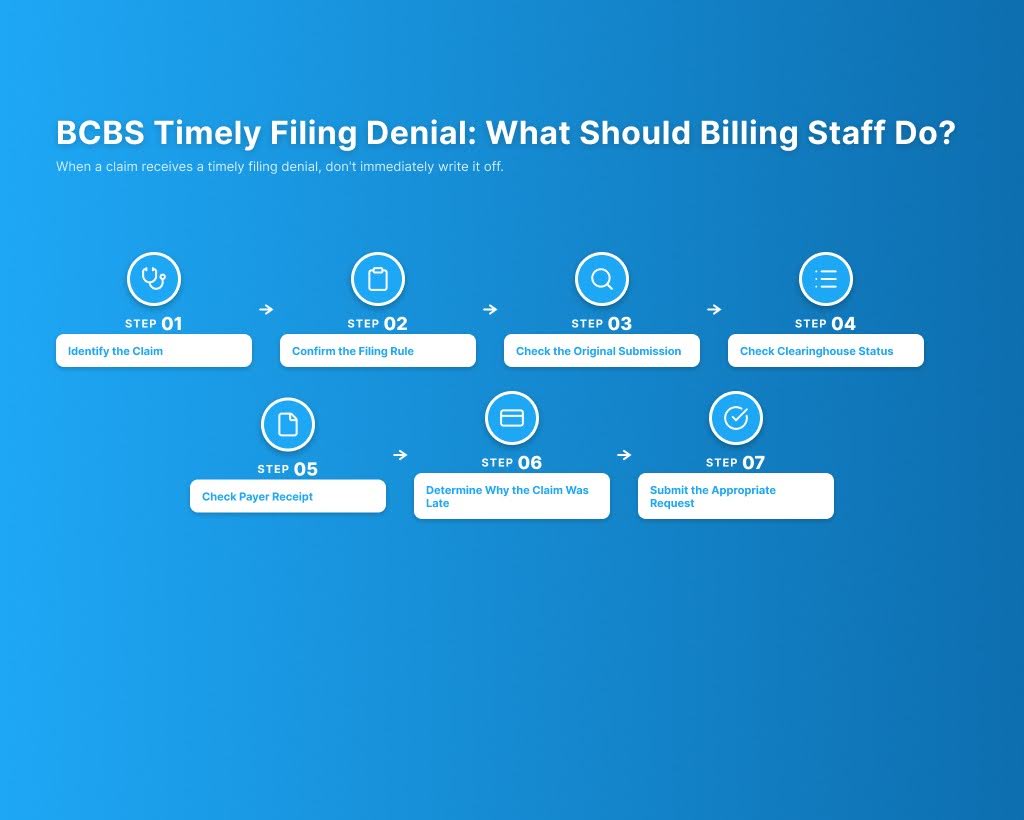
When a claim receives a timely filing denial, don’t immediately write it off.
Use a structured review.
Step 1: Identify the Claim
Confirm:
- Patient
- Member ID
- Date of service
- Provider
- Claim number
- BCBS plan
Step 2: Confirm the Filing Rule
Check the current provider manual, contract, or payer guidance.
Don’t rely on an old internal spreadsheet.
BCBS Illinois explicitly notes that provider manuals contain the detailed timely filing requirements and that the manuals receive updates.
Step 3: Check the Original Submission
Find the original claim transmission record.
Step 4: Check Clearinghouse Status
Determine whether the clearinghouse accepted or rejected the claim.
Step 5: Check Payer Receipt
Look for payer acknowledgement or claim status.
Step 6: Determine Why the Claim Was Late
Possible causes include:
- Internal delay
- Clearinghouse rejection
- Wrong payer
- Eligibility error
- Coordination of benefits
- System issue
- Payer error
- Circumstances outside provider control
Step 7: Submit the Appropriate Request
Depending on the situation, the provider may need to submit:
- Corrected claim
- Reconsideration
- Provider dispute
- Appeal
- Supporting documentation
Use the process required by the applicable BCBS company and plan.
BCBS Timely Filing Best Practices for Medical Billing Teams
A good timely filing system doesn’t depend on one employee remembering every payer rule.
Build the controls into the revenue cycle.
Create a Filing Limit Database
Maintain payer specific information for:
- Original claims
- Corrected claims
- Secondary claims
- Appeals
- Disputes
- Documentation requests
Set Internal Submission Targets
If a payer allows 180 days, don’t tell staff they have 180 days.
Set a much shorter internal target.
For example, a practice might require routine claims to leave the billing office within several business days after charge entry.
Create Aging Alerts
Flag claims that remain unsubmitted.
A claim sitting in the billing system for weeks should trigger an internal work queue.
Monitor Rejections Daily
Clearinghouse rejection reports should become part of the daily billing routine.
Review High Dollar Claims First
Large facility and surgical claims can create substantial financial exposure.
Don’t allow high value claims to sit unresolved.
Track Secondary Claims Separately
Secondary claims often depend on the primary payer’s adjudication.
Create a workflow that starts when the primary EOB arrives.
Audit Timely Filing Denials
Don’t treat each denial as an isolated event.
Look for patterns.
If 40 claims received timely filing denials because staff used an outdated payer ID, the practice has a process problem rather than 40 unrelated claim problems.
Conclusion
The BCBS timely filing limit isn’t one universal number.
Many BCBS programs use 180 days, but providers should never apply that figure automatically to every Blue Cross Blue Shield claim. The correct deadline can depend on the local BCBS company, product, provider contract, claim type, date of service, discharge date, secondary payer status, and other circumstances.
For billing departments, the safest approach is simple:
Identify the exact BCBS plan. Check the current filing rule. Submit early. Monitor clearinghouse acceptance. Confirm payer receipt. Track secondary claims separately. Keep transmission evidence. And investigate every timely filing denial before writing off the claim.
That process helps providers protect reimbursement and prevent avoidable revenue loss.
Don’t Let BCBS Filing Deadlines Cost Your Practice
A missed timely filing deadline can turn a correctly coded and documented claim into lost revenue. RCM Xpert helps providers stay ahead of payer deadlines with accurate claim submission, claim status tracking, denial follow-up, payment posting, appeals, and A/R management.
Our billing team keeps your claims moving and investigates problems before they become expensive write-offs. From BCBS and Medicare to commercial payers, we help your practice manage each stage of the revenue cycle with greater control.
Stop losing revenue to avoidable claim delays. Partner with RCM Xpert and take control of your medical billing.
Get Started With RCM Xpert Billing Today
FAQs
What is the standard BCBS timely filing limit?
There is no single standard that applies to every BCBS claim nationwide. 180 days is a common requirement in some BCBS plans, including several current BCBS Illinois provider programs, but other BCBS companies, products, provider contracts, and employer groups can use different deadlines. Providers should verify the requirement for the specific member and plan before relying on a particular number.
Is BCBS timely filing 90 days or 180 days?
It can be either, depending on the applicable BCBS plan and provider arrangement. Some BCBS programs use 180 days for initial claim submission, while other payer policies or specific products can establish different periods. The provider manual and provider agreement should control rather than a generic BCBS filing chart.
When does the BCBS timely filing clock start?
The starting date depends on the claim and plan. It can be the date of service, date of discharge, or, for certain secondary claims, the date the provider receives the primary payer’s EOB. BCBS Illinois provides all three examples in its current commercial provider guidance.
Can a provider appeal a BCBS timely filing denial?
A provider may have an opportunity to dispute or appeal a timely filing denial when the applicable BCBS process permits it. The billing team should first establish whether the claim actually missed the deadline and gather evidence such as clearinghouse acceptance records, payer acknowledgements, claim control numbers, and documentation supporting an exception.
Can providers bill patients for BCBS timely filing denials?
Providers shouldn’t automatically transfer a timely filing denial to the patient. The provider agreement and applicable law determine whether the balance can be collected. Some BCBS contracts specifically prohibit participating providers from seeking member payment for amounts denied because the provider failed to meet the timely filing requirement.
Does the BCBS timely filing limit apply to corrected claims?
Corrected claim deadlines can differ from original claim deadlines. Some BCBS programs specify a separate rule for replacement or corrected claims. For example, BCBS Illinois BCCHP currently specifies 180 days from the applicable date for corrected or replacement claims.
How can providers verify the correct BCBS filing deadline?
Start with the member’s BCBS company and plan. Then check the current provider manual, provider contract, payer portal, or provider services department. The BCBS Association maintains a directory of local BCBS companies, while individual companies publish their own provider requirements.