
The E78 ICD-10-CM category covers disorders of lipoprotein metabolism and other lipidemias, including hypercholesterolemia, hypertriglyceridemia, mixed hyperlipidemia, elevated lipoprotein(a), and unspecified hyperlipidemia. Healthcare practices should not report E78 by itself on a claim because E78 represents a category rather than a billable diagnosis. Coders must select the appropriate billable code under the category.
For providers, the biggest billing issue usually isn’t finding the E78 category. It involves documenting what type of lipid disorder the patient has, why the condition requires evaluation or treatment, and how the diagnosis supports the service billed.
What Does ICD-10 E78 Mean?
E78 belongs to the E00 to E89 range for endocrine, nutritional, and metabolic diseases and sits within the E70 to E88 metabolic disorders section. The category covers disorders involving lipoproteins and abnormal lipid levels.
Lipoproteins transport cholesterol and other lipids through the bloodstream. A patient may have elevated LDL cholesterol, elevated triglycerides, combined lipid abnormalities, familial hypercholesterolemia, or another documented lipid disorder.
From a billing perspective, the provider’s documentation should tell the coder which disorder the patient has rather than simply recording an abnormal laboratory result.
For example, these statements do not carry the same coding meaning:
“LDL 185 mg/dL.”
and
“Pure hypercholesterolemia. LDL remains elevated despite statin therapy.”
The second statement gives the coder a documented diagnosis and connects the condition to ongoing management.
Is E78 a Billable ICD-10 Code?
No. E78 is a non-billable category code.
The category contains more specific codes that practices can report on claims. The current FY 2026 classification includes categories for pure hypercholesterolemia, pure hypertriglyceridemia, mixed hyperlipidemia, hyperchylomicronemia, other hyperlipidemia, unspecified hyperlipidemia, lipoprotein deficiency, disorders of bile acid and cholesterol metabolism, other disorders of lipoprotein metabolism, and unspecified disorders of lipoprotein metabolism.
That distinction matters during claim submission.
A coder should not stop at:
E78, Disorders of lipoprotein metabolism and other lipidemias
Instead, the coder should review the provider’s documentation and assign the most specific supported code.
ICD 10 E78 Code List
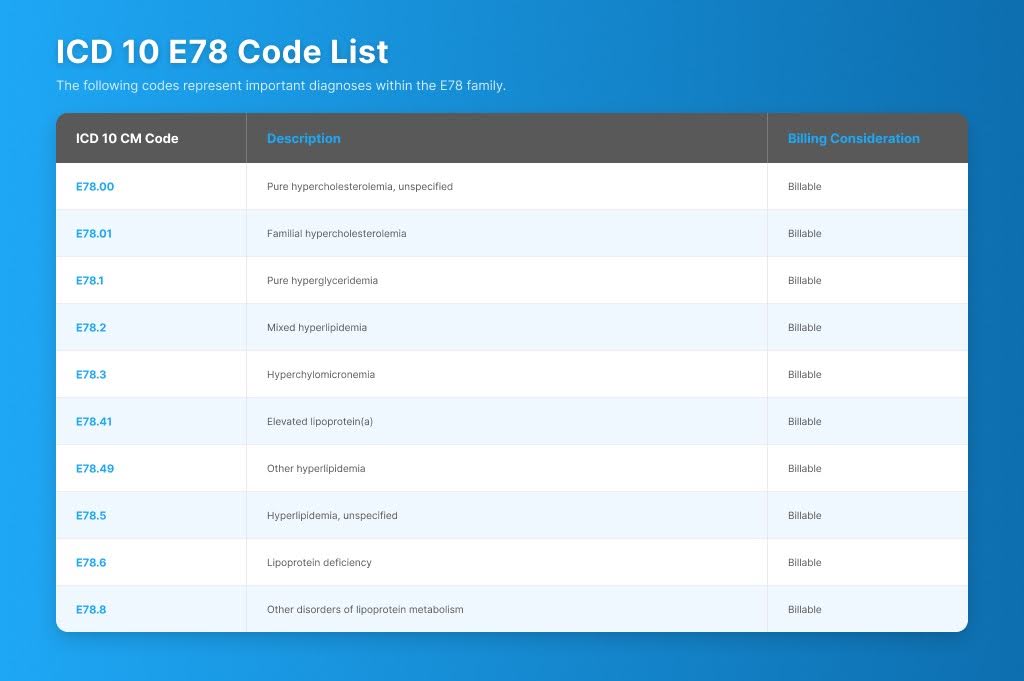
The following codes represent important diagnoses within the E78 family.
| ICD 10 CM Code | Description | Billing Consideration |
| E78.00 | Pure hypercholesterolemia, unspecified | Billable |
| E78.01 | Familial hypercholesterolemia | Billable |
| E78.1 | Pure hyperglyceridemia | Billable |
| E78.2 | Mixed hyperlipidemia | Billable |
| E78.3 | Hyperchylomicronemia | Billable |
| E78.41 | Elevated lipoprotein(a) | Billable |
| E78.49 | Other hyperlipidemia | Billable |
| E78.5 | Hyperlipidemia, unspecified | Billable |
| E78.6 | Lipoprotein deficiency | Billable |
| E78.8 | Other disorders of lipoprotein metabolism | Billable |
| E78.9 | Disorder of lipoprotein metabolism, unspecified | Billable |
The FY 2026 ICD-10-CM classification includes E78.01 for familial hypercholesterolemia and E78.41 for elevated lipoprotein(a), among other specific codes.
Important: E78.0 and E78.4 also function as non-billable parent categories because coders need to select a more specific child code. For example, E78.0 leads to E78.00 or E78.01, while E78.4 leads to E78.41 or E78.49.
E78.00: Pure Hypercholesterolemia, Unspecified
E78.00 describes pure hypercholesterolemia when the provider documents that diagnosis but does not specify familial hypercholesterolemia.
The code belongs under E78.0, pure hypercholesterolemia. It represents a more specific diagnosis than general hyperlipidemia.
Documentation should support:
- Provider diagnosis of pure hypercholesterolemia
- Relevant lipid findings
- Assessment and treatment plan
- Medication management when applicable
- Follow up or monitoring when clinically appropriate
A laboratory value alone does not automatically establish every possible lipid diagnosis. The provider should interpret the result and document the clinical diagnosis.
Example
The provider documents:
“Pure hypercholesterolemia. LDL remains elevated. Continue statin therapy and repeat lipid panel.”
The documentation supports the diagnosis and demonstrates why the practice continues to monitor the condition.
E78.01: Familial Hypercholesterolemia
E78.01 identifies familial hypercholesterolemia.
This diagnosis requires stronger documentation than simply recording a high cholesterol level. The medical record should support the provider’s diagnosis and, when documented, the relevant family or clinical history.
A useful note may include:
- Familial hypercholesterolemia diagnosis
- Family history relevant to the condition
- Previous lipid results
- Treatment history
- Response to lipid lowering therapy
- Current treatment plan
Do not assign E78.01 simply because a patient’s LDL appears very high. The provider needs to establish and document the diagnosis.
E78.1: Pure Hyperglyceridemia
E78.1 covers pure hyperglyceridemia.
This code applies when the provider documents an isolated triglyceride disorder rather than a mixed lipid abnormality.
The documentation should distinguish the triglyceride problem from other lipid disorders when the provider can make that distinction.
For billing purposes, the medical record should connect the diagnosis with the services performed, particularly when the practice bills laboratory monitoring or medication management.
E78.2: Mixed Hyperlipidemia
E78.2 describes mixed hyperlipidemia.
This diagnosis generally applies when the provider documents a combined lipid abnormality rather than a single isolated lipid problem. The current ICD 10 CM code remains billable for FY 2026.
A provider note might document:
“Mixed hyperlipidemia with elevated LDL and triglycerides. Continue lipid lowering therapy and repeat lipid panel.”
That documentation gives the coder a much clearer basis for assigning E78.2 than a laboratory report containing several abnormal values without provider interpretation.
E78.41: Elevated Lipoprotein(a)
E78.41 identifies elevated lipoprotein(a), commonly written as elevated Lp(a).
The current ICD 10 CM classification specifically includes elevated Lp(a) under E78.41.
When a provider evaluates or manages elevated Lp(a), the note should identify the condition and explain its relevance to the patient’s assessment and management.
Do not substitute E78.5 automatically when the provider clearly documents elevated lipoprotein(a).
E78.49: Other Hyperlipidemia
E78.49 covers other hyperlipidemia when the documentation supports a specific lipid disorder that does not fit the more narrowly defined codes.
The FY 2026 classification also identifies familial combined hyperlipidemia under E78.49.
Coders should review the full documentation before choosing this code. “Other” does not mean “unspecified.”
That distinction matters.
Other means the provider documents a condition that falls outside the named categories.
Unspecified means the documentation does not provide enough detail to identify the type.
E78.5: Hyperlipidemia, Unspecified
E78.5 is one of the most commonly recognized codes in this category. It describes hyperlipidemia when the provider does not specify the type. The code is billable under the FY 2026 ICD 10 CM code set.
Use E78.5 when the documentation genuinely supports unspecified hyperlipidemia.
Do not automatically choose E78.5 whenever a patient’s cholesterol is high.
For example:
Weak documentation:
“Cholesterol high.”
Better documentation:
“Hyperlipidemia, unspecified. Continue current therapy and repeat lipid panel.”
More specific documentation:
“Mixed hyperlipidemia with elevated LDL and triglycerides.”
The third example may support E78.2 when the provider documents that diagnosis.
E78.9: Disorder of Lipoprotein Metabolism, Unspecified
E78.9 covers a disorder of lipoprotein metabolism when the provider does not specify the particular disorder.
This differs from E78.5.
E78.5 describes hyperlipidemia, unspecified.
E78.9 describes an unspecified disorder of lipoprotein metabolism.
Coders should follow the provider’s documented diagnosis rather than selecting the code based only on laboratory values.
What Documentation Supports E78 Coding?
Good documentation makes E78 coding much easier.
The provider should document the diagnosis and show how the condition affects the patient’s care.
Document the specific lipid disorder
When the clinical information supports a specific diagnosis, document it.
Examples include:
- Pure hypercholesterolemia
- Familial hypercholesterolemia
- Pure hyperglyceridemia
- Mixed hyperlipidemia
- Elevated lipoprotein(a)
- Other hyperlipidemia
- Hyperlipidemia, unspecified
The more specific diagnosis allows the coder to move beyond broad or unspecified coding when the record supports it.
Document relevant laboratory findings
The provider does not need to copy an entire laboratory report into every progress note.
However, the record should contain relevant findings that support the assessment.
For example:
“LDL remains elevated at 172 mg/dL despite current therapy.”
The provider can then document the diagnosis and treatment decision.
Document treatment
Include the treatment plan when the provider manages the lipid disorder.
Documentation may include:
- Statin therapy
- Nonstatin lipid lowering medication
- Diet counseling
- Exercise recommendations
- Medication adjustment
- Follow up laboratory testing
- Monitoring for treatment response
Document clinical reasoning
A strong note explains why the provider continues to monitor or treat the condition.
For example:
“LDL remains above treatment goal despite current therapy. Continue medication and repeat lipid panel in three months.”
This connects the diagnosis, laboratory result, treatment, and follow up plan.
How Lipid Panel Documentation Supports Billing
Practices commonly bill lipid testing alongside an E78 diagnosis.
CPT 80061 describes a lipid panel. CMS lists lipid testing among services addressed by its Medicare coverage policy for lipid testing.
The diagnosis code should support the reason for the test.
For a patient with an established lipid disorder, the medical record should show why the provider ordered the test.
For example:
“Mixed hyperlipidemia. Repeat lipid panel to assess response to current therapy.”
That documentation provides a clear connection between the diagnosis and the laboratory service.
CMS states that documentation supporting medical necessity can include relevant signs, symptoms, or abnormal findings and that insufficient documentation can result in claim denial.
E78 Codes and Medical Necessity for Lipid Testing
Medical necessity plays a major role in laboratory reimbursement.
CMS’s National Coverage Determination for lipid testing states that tests must meet applicable reasonable and necessary requirements. The policy also notes that documentation should support the medical necessity of the test and that frequency beyond applicable expectations may require additional documentation.
This means a practice should not rely on the diagnosis code alone.
The medical record should answer three basic questions:
- Why does this patient need the test?
- What condition is the provider monitoring or evaluating?
- How will the result affect management?
A note that simply says “check cholesterol” gives the billing team much less support than a documented lipid disorder with a clear monitoring plan.
Documentation Example for an E78 Claim
Consider this visit:
A patient has a history of mixed hyperlipidemia. The provider reviews the latest lipid results, discusses medication adherence, continues therapy, and orders another lipid panel.
A stronger note could read:
Assessment: Mixed hyperlipidemia. LDL and triglycerides remain above the patient’s treatment goals. Patient reports taking current medication as prescribed. Continue current therapy. Repeat lipid panel to evaluate response.
This note gives the coder useful information:
- The provider documented the diagnosis
- The provider identified the specific lipid disorder
- The provider reviewed relevant laboratory findings
- The provider documented ongoing treatment
- The provider explained why repeat testing is necessary
That connection helps support coding accuracy and medical necessity.
E78 Coding and CPT 80061
When a practice bills a lipid panel, coders should confirm that the diagnosis supports the service and that the payer’s coverage rules apply.
CMS lists 80061, lipid panel, among the laboratory services addressed by its lipid testing policy.
The exact diagnosis to report depends on the patient’s documentation.
For example:
| Clinical Documentation | Potential ICD 10 CM Code |
| Pure hypercholesterolemia, unspecified | E78.00 |
| Familial hypercholesterolemia | E78.01 |
| Pure hyperglyceridemia | E78.1 |
| Mixed hyperlipidemia | E78.2 |
| Elevated lipoprotein(a) | E78.41 |
| Other hyperlipidemia | E78.49 |
| Hyperlipidemia, unspecified | E78.5 |
| Disorder of lipoprotein metabolism, unspecified | E78.9 |
The coder must confirm the current code set, payer policy, and provider documentation before submitting a claim.
How E78 Coding Affects Reimbursement
E78 coding can affect reimbursement in several ways.
The diagnosis helps the payer understand why the service occurred. When the diagnosis, documentation, laboratory service, and treatment plan tell the same story, the claim has stronger support.
When they do not match, the practice may face:
- Medical necessity denials
- Requests for medical records
- Claim delays
- Rework
- Incorrect patient balances
- Payment reductions
- Appeals
For example, a practice might submit a lipid panel with an E78 diagnosis, but the progress note contains no assessment, no documented lipid disorder, and no reason for repeat testing.
The code may look correct.
The documentation still creates a problem.
Common E78 Billing and Coding Mistakes
Reporting E78 Instead of a Billable Child Code
E78 represents the category and cannot serve as the final billable diagnosis.
How to avoid it: Review the documentation and select the appropriate specific code under E78.
Using E78.5 for Every Hyperlipidemia Case
E78.5 means hyperlipidemia, unspecified. It does not mean “use this whenever cholesterol is high.”
How to avoid it: Check whether the provider documented pure hypercholesterolemia, mixed hyperlipidemia, familial hypercholesterolemia, elevated Lp(a), or another specific disorder.
Coding From Laboratory Results Without Provider Documentation
A high LDL or triglyceride value does not automatically tell the coder which diagnosis to assign.
How to avoid it: Code the provider’s documented diagnosis and query the provider when the clinical record does not provide enough information.
Billing Lipid Testing Without Medical Necessity Support
A practice may perform a clinically reasonable test but still encounter a coverage problem when the claim lacks adequate supporting documentation.
CMS states that inadequate documentation of medical necessity can result in denial.
How to avoid it: Document the condition being evaluated or monitored, relevant findings, treatment status, and reason for testing.
Ignoring Testing Frequency
Repeated lipid testing can create payer questions when the frequency does not match the applicable coverage policy.
CMS’s lipid testing policy addresses frequency and states that more frequent testing may require documentation supporting the medical need.
How to avoid it: Check the applicable Medicare NCD, LCD, payer policy, and patient history before ordering or billing repeated tests.
Frequently Asked Questions
Is E78 a billable ICD 10 code?
No. E78 is a category code for disorders of lipoprotein metabolism and other lipidemias. It is not the final billable code. The coder must select a more specific code within the E78 family based on provider documentation.
What is the ICD 10 code for hyperlipidemia?
The appropriate code depends on the documented type. E78.5 represents hyperlipidemia, unspecified. Other patients may require E78.00 for pure hypercholesterolemia, E78.01 for familial hypercholesterolemia, E78.1 for pure hyperglyceridemia, E78.2 for mixed hyperlipidemia, or another specific E78 code.
Can a coder assign E78.5 from a high cholesterol laboratory result?
A laboratory result alone should not replace the provider’s diagnostic documentation. The provider should interpret the finding and document the diagnosis. If the record does not provide enough information for specific coding, the coder should follow applicable coding guidelines and query the provider when appropriate.
What CPT code is commonly used for a lipid panel?
CPT 80061 represents a lipid panel. CMS includes 80061 among the laboratory services addressed by its lipid testing coverage policy. The diagnosis reported with the service must support the reason for the test under the applicable payer policy.
Can E78.2 support lipid testing?
E78.2 identifies mixed hyperlipidemia and can support a lipid testing claim when the provider documents that diagnosis and the service meets the applicable payer’s medical necessity and coverage requirements. The diagnosis alone does not guarantee payment.
Why do E78 related laboratory claims get denied?
Common reasons include insufficient medical necessity documentation, unsupported testing frequency, diagnosis and service mismatch, incorrect code selection, or failure to meet payer-specific coverage requirements. CMS specifically warns that inadequate documentation of medical necessity can result in denial.
How can providers improve E78 documentation?
Providers should name the specific lipid disorder when they can establish it, document relevant laboratory findings, explain active treatment or monitoring, and state why follow-up testing is necessary. Clear documentation gives coders enough information to select the most specific supported code and helps the billing team support medical necessity.