
Anxiety disorders affect nearly one in five American adults each year, making them the most common mental health conditions encountered in clinical practice.
For providers, accurate ICD-10 coding for anxiety is far more than an administrative formality.
The code you select determines whether claims get paid, whether treatment plans align with payer expectations, and whether your documentation withstands audit scrutiny.
From generalized anxiety disorder (F41.1) to unspecified anxiety (F41.9), each code carries specific documentation requirements and reimbursement implications.
This guide examines the anxiety code family, the clinical documentation needed to support each diagnosis, and practical strategies to prevent denials and protect your revenue cycle.
Understanding the Anxiety Code
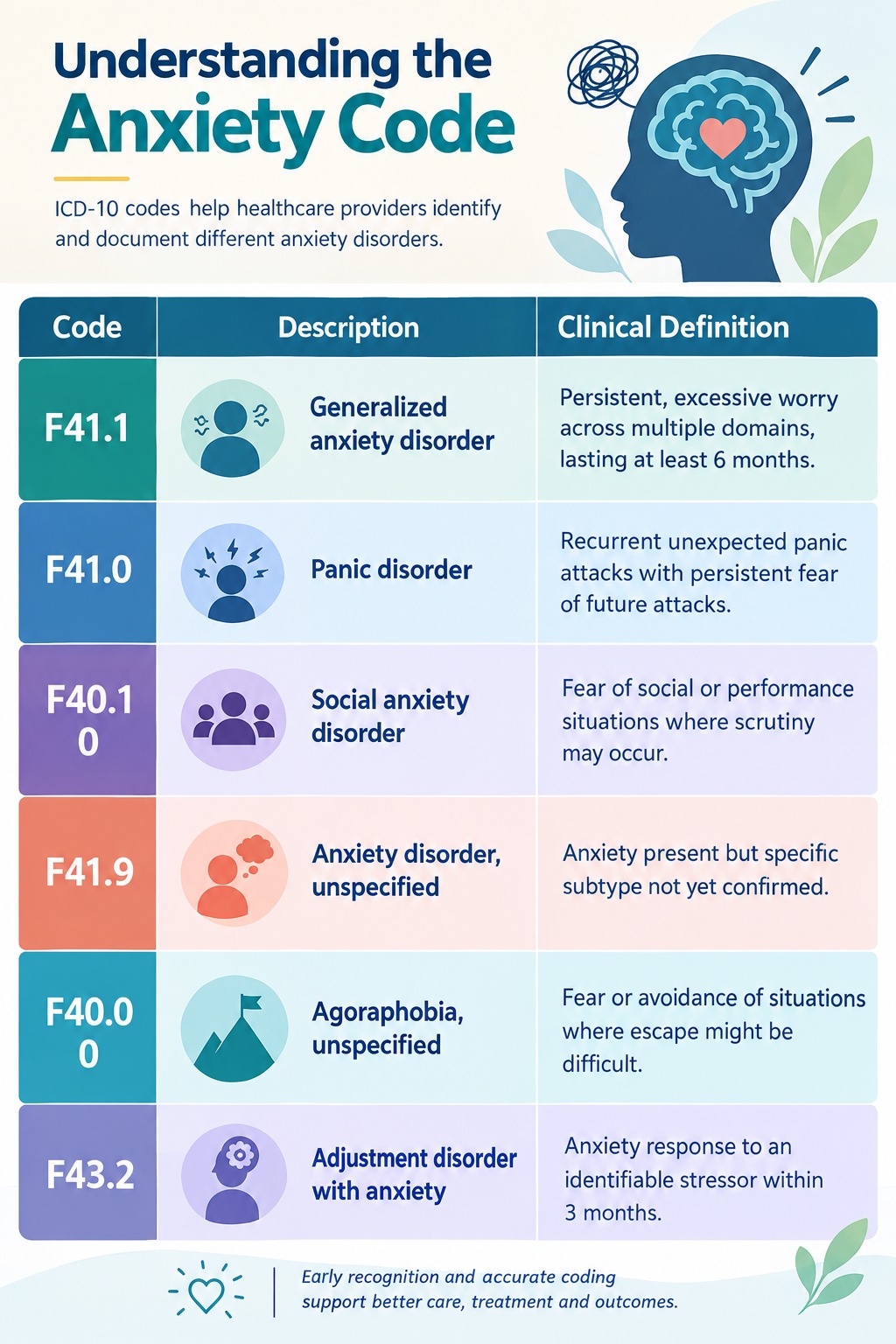
Anxiety-related diagnoses in ICD-10-CM reside in the F40 to F48 block, which covers anxiety, dissociative, stress-related, somatoform, and other nonpsychotic mental disorders. The most frequently used codes for anxiety conditions include:
CMS maintains the official ICD-10-CM code set, which is updated annually on October 1 . Providers should verify they are using current codes based on the applicable service date.
General Anxiety Disorder: F41.1
F41.1 is the ICD-10-CM code for generalized anxiety disorder. This diagnosis requires documentation of excessive worry lasting at least six months, difficulty controlling the worry, and the presence of at least three of six associated symptoms: restlessness, fatigue, difficulty concentrating, irritability, muscle tension, and sleep disturbance.
Documentation Requirements
To support F41.1 and withstand payer review, clinical notes must explicitly document all DSM-5 criteria. Missing the six-month threshold or the three-symptom count is the most common reason F41.1 claims are denied or downgraded to F41.9 on audit. Each note supporting an F41.1 claim should include:
- Persistent worry across multiple domains documented in the patient’s own words
- Duration of symptoms with clear onset date
- Associated symptoms with frequency and intensity
- Functional impairment affecting work, relationships, or daily activities
- Results of validated screening tools such as GAD-7 or PHQ-4
- Clinical reasoning for the diagnosis and treatment rationale
The AHA Coding Clinic guidance indicates that when documentation supports both GAD and major depressive disorder as separate conditions being managed, both codes should be assigned, such as F41.1 plus F32.x or F33.x. Do not default to F41.3 (other mixed anxiety disorders) when both conditions are separately documented.
Panic Disorder: F41.0
F41.0 represents panic disorder, also described as episodic paroxysmal anxiety. This code applies when the patient experiences recurrent, unexpected panic attacks accompanied by persistent fear of future attacks or behavioral changes related to the attacks.
Documentation Elements
For F41.0 to withstand audit scrutiny, documentation must capture more than a note stating the patient was anxious today. A single panic attack without recurrence or persistent concern does not meet criteria for panic disorder. Clinical notes should document:
- Recurrent panic attack symptoms with specific descriptions
- Sudden onset of intense fear or discomfort
- Physical symptoms such as palpitations, sweating, trembling, or shortness of breath
- Ongoing concern about having more attacks
- Behavioral changes or avoidance related to fear of attacks
When agoraphobia is also present, F40.01 (agoraphobia with panic disorder) is the more precise code than F41.0 alone.
Social Anxiety Disorder: F40.10
F40.10 is the ICD-10-CM code for social phobia, unspecified, which includes social anxiety disorder. This code covers fear of social or performance situations where scrutiny or negative evaluation may occur. Clinical notes should capture which social situations are feared, the degree of avoidance, and how the condition impairs daily functioning.
There is a documented coding discrepancy between DSM-5 and ICD-10-CM. While DSM-5 may point to F40.10 for social anxiety disorder, ICD-10-CM also includes F40.11 for generalized social phobia when the presentation is broader. Providers should ensure the code selected matches the specific clinical picture documented.
Specific Phobias: F40.2 Family
Specific phobias fall under the F40.2 code family, with more precise options available for different phobic triggers. F40.218 is not a blanket code for all specific phobias. It specifically means other animal type phobia. More precise options exist for conditions like arachnophobia, fear of thunderstorms, fear of blood, fear of injections, claustrophobia, and other situational phobias. Documentation should name the specific phobic object or situation rather than defaulting to a general code.
Anxiety Disorder, Unspecified: F41.9
F41.9 is the ICD-10-CM code for anxiety disorder, unspecified. It applies when anxiety is present but the evaluation is incomplete, the patient is still being assessed, or symptoms do not fit a specific category. This code is fully billable and valid for use as a principal diagnosis.
Appropriate Use Scenarios
F41.9 is clinically appropriate in several legitimate scenarios where diagnostic uncertainty exists:
First presentation visits. A patient presents for the first time with complaints of persistent worry, sleep disruption, muscle tension, and irritability. You complete a clinical intake and administer a GAD-7, which scores in the moderate range. However, you have not yet completed a full structured diagnostic interview or ruled out medical causes. F41.9 is appropriate here.
Diagnostic overlap situations. Anxiety frequently overlaps with depression, PTSD, ADHD, and medical conditions like hyperthyroidism. When the presentation is ambiguous and you cannot yet distinguish GAD from a trauma response or a mood disorder, F41.9 serves as the correct holding code while you gather more clinical data.
Referral documentation. Primary care physicians who refer patients to psychiatrists or psychologists often use F41.9 as a referral diagnosis. This is appropriate because the PCP is communicating that anxiety symptoms are present without making a specialist-level diagnosis.
Assessment-phase visits. Many practices conduct multi-session intake assessments before arriving at a DSM-5 diagnosis. During these visits, F41.9 is appropriate as long as it is updated once the diagnostic picture becomes clear.
When F41.9 Should Not Be Used
Using F41.9 outside of genuine diagnostic uncertainty creates billing and compliance problems. Avoid using this code in these situations:
- When the patient clearly meets full DSM-5 criteria for GAD, panic disorder, or social anxiety disorder
- As a permanent or chronic diagnosis code when more specific codes apply
- When clinical notes reflect a confirmed diagnosis but you default to F41.9 for convenience
- To avoid documenting a stigmatized diagnosis such as PTSD or OCD
Documentation Requirements for F41.9
For F41.9 to withstand audit, the clinical record needs specific documentation elements:
- The patient’s own description of anxiety symptoms in behavioral terms
- Duration, frequency, and intensity of symptoms
- At least one functional domain affected, such as work, relationships, or sleep
- Brief notation of which specific anxiety disorders were assessed and why criteria were not met
- A direct statement explaining why unspecified is appropriate, such as diagnostic formulation pending full evaluation
- A plan to revisit and refine the diagnosis, typically within 30 to 90 days
- Explicit clinical reasoning for why a more specific code cannot yet be assigned
The last two points are the ones most often missing from clinical notes. Without them, F41.9 claims are vulnerable to denial.
The Audit Risk of F41.9
CMS and Recovery Audit Contractors can identify providers with unusually high F41.9 utilization rates. If your practice shows a pattern of using F41.9 for the majority of anxiety-related visits over extended periods, it can trigger a targeted audit. Unspecified codes without documented rationale are a common audit flag, and partial hospitalization or intensive outpatient authorization requires stronger medical necessity justification when F41.9 is the primary diagnosis.
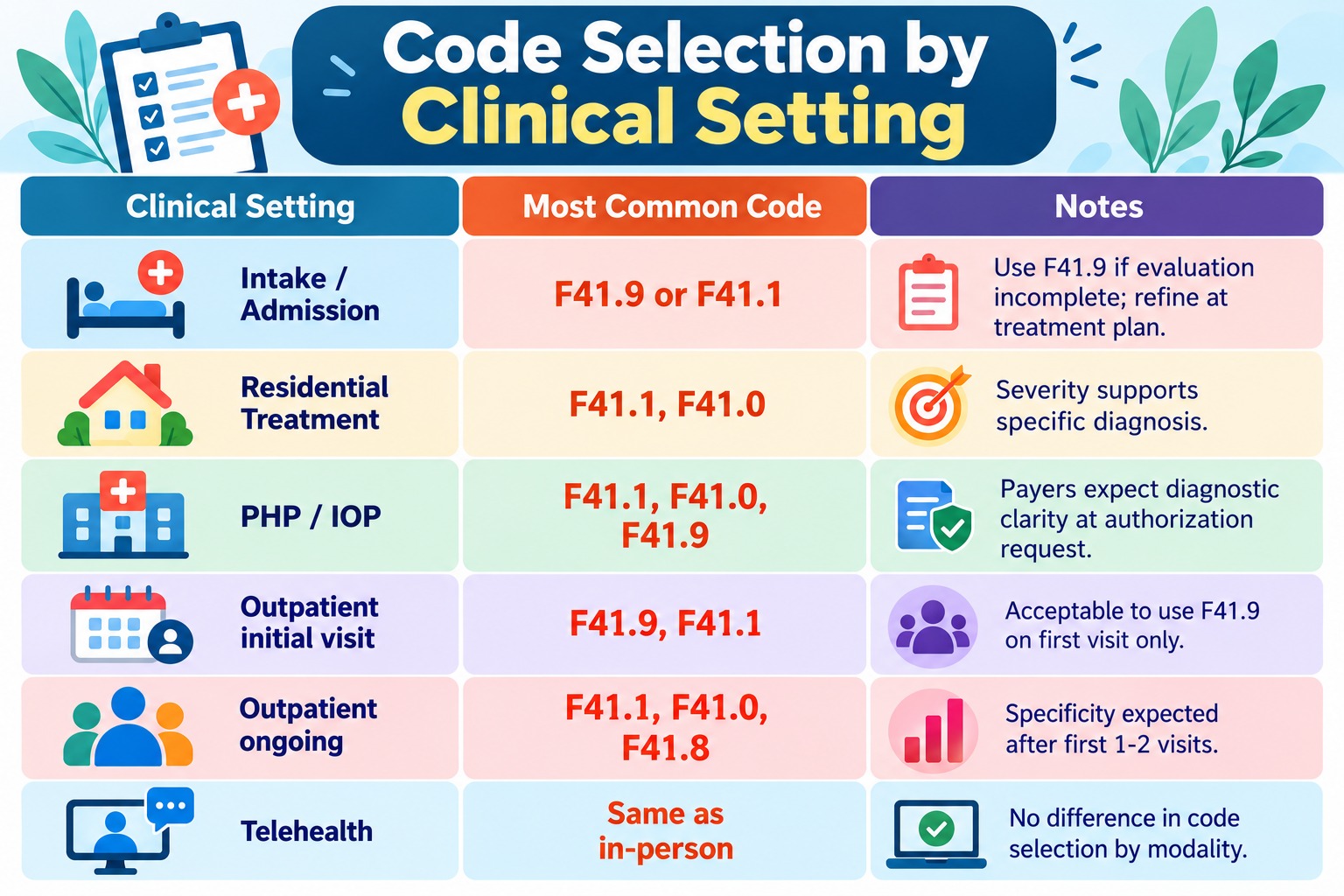
Code Selection by Clinical Setting
Different care settings typically use different anxiety codes based on the stage of evaluation and level of care:
Comorbid Coding Considerations
Anxiety and depression frequently co-occur. When both are independently present and meet diagnostic criteria, code both separately :
| Comorbidity | ICD-10 Codes |
| GAD + MDD, single episode, moderate | F41.1 + F32.1 |
| GAD + MDD, recurrent, severe | F41.1 + F33.2 |
| Panic disorder + persistent depressive disorder | F41.0 + F34.1 |
The AHA Coding Clinic advises that when documentation supports both GAD and MDD as separate conditions being managed, both codes should be assigned. Use F41.3 (other mixed anxiety disorders) only when neither predominates and they are not separately diagnosed.
Do not use F41.9 when the depressive component is significant enough to warrant its own code. Sequence the diagnosis driving the visit as the primary code.
Another common error involves coding F41.9 when anxiety is a response to a specific identifiable stressor within the last three months. If the stressor is identifiable and the anxiety resolves when it does, F43.22 (adjustment disorder with anxiety) is more accurate than F41.9.
Common Denial Reasons and Prevention
| Denial Reason | Code at Issue | Prevention Strategy |
| Diagnosis not specific enough | F41.9 | Document rationale; plan to refine code |
| Medical necessity not established | F41.9, F41.3 | Strengthen functional impairment documentation |
| Diagnosis does not support level of care | F41.9 at PHP/IOP | Add severity specifiers; consider F41.1 if criteria met |
| Missing diagnostic criteria | F41.1 | Explicitly document all DSM-5 criteria in notes |
| Diagnosis inconsistent with treatment | Any F41.x | Ensure treatment plan goals align with coded diagnosis |
| Duplicate diagnosis | F41.1 + F41.9 | Never code both simultaneously; choose one |
Across anxiety claims, denials frequently trace back to one recurring gap: the medical necessity criteria were never documented. Claims coded F41.1 for GAD are often denied because notes never documented the six-month duration criterion, causing payers to question whether GAD was justified.
Treatment Planning and Code Alignment
Payers now look for a clear link between the coded diagnosis, the treatment plan’s goals, and the interventions documented in clinical notes. A treatment plan for anxiety is the roadmap that guides the care team in helping the patient manage their condition. It documents the diagnosis with its ICD-10 code, treatment goals, interventions, a review timeline, and how progress will be measured. Many payers, Medicaid programs, and accrediting bodies treat a completed, individualized treatment plan as a hard compliance requirement.
Goals should be Specific, Measurable, Achievable, Relevant, and Time-bound so both the care team and patient can track progress. Three goal areas appear in virtually every anxiety treatment plan: reducing the frequency and intensity of anxiety symptoms, increasing the patient’s ability to manage anxiety through skill development, and reducing avoidance behaviors.
If a practice codes panic disorder, the treatment plan should carry goals and interventions that target it, such as panic management or interoceptive exposure. A missing or out-of-date treatment plan for anxiety is one of the fastest ways to get a claim denied for insufficient medical necessity.
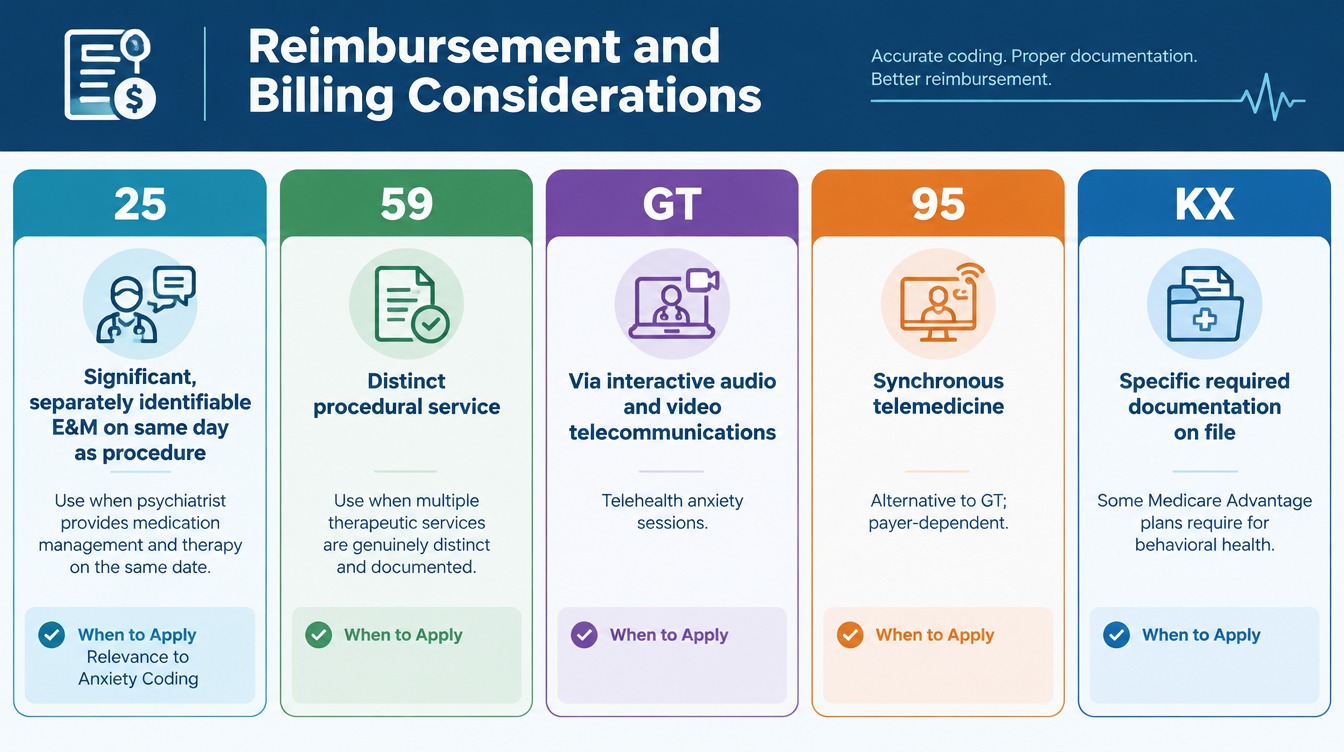
Reimbursement and Billing Considerations
Modifier Usage
Payer-Specific Considerations
| Payer Type | Notes on Anxiety Coding |
| Commercial / PPO | Generally accept F41.x codes; specificity improves authorization approval rates |
| Medicaid | State-specific; many states have behavioral health carve-outs with specific criteria |
| Medicare | Anxiety disorders covered under Medicare Part B; medical necessity documentation critical |
| Medicare Advantage | Varies by plan; some apply commercial behavioral health criteria |
| TRICARE | Follows DSM-5 criteria; specific codes preferred over unspecified |
Coding Resources
The FY 2026 ICD-10-CM files apply from October 1, 2025 through September 30, 2026, with an April 2026 update. Providers should consult the ICD-10-CM Official Guidelines for Coding and Reporting, which state that the medical record must support complete and accurate code assignment. For outpatient services, uncertain diagnoses such as rule out, probable, or suspected should not be coded as confirmed conditions. Providers should code the highest level of certainty instead.
Conclusion
Selecting the right ICD-10 code for anxiety requires clinical precision and documentation discipline. F41.9 serves a legitimate purpose during diagnostic evaluation, but it should never become a permanent placeholder. When the clinical picture supports a specific diagnosis like F41.1 for generalized anxiety or F41.0 for panic disorder, the code must be updated to reflect that clarity. Documentation must always support the code assigned, and the treatment plan must align with the coded diagnosis. Providers who document thoroughly, select codes based on clinical evidence, and maintain individualized treatment plans protect their practices from denials, recoupment demands, and payer scrutiny. Accurate coding protects both clinical integrity and financial stability.
Optimize Your Anxiety Coding and Billing
Anxiety-related claims are among the most frequently audited and denied behavioral health codes.
RCM Xpert helps providers navigate the complexity of ICD-10 coding for anxiety disorders with precision and compliance.
review your documentation patterns, identify recurring issues like overuse of F41.9, and build workflows that prevent denials before they happen.
Practices working with RCM Xpert see denial rates drop by 15 to 25 percent and reimbursement timelines improve within months.
Frequently Asked Questions
What is the ICD-10 code for generalized anxiety disorder?
F41.1 is the ICD-10-CM code for generalized anxiety disorder. This diagnosis requires documentation of excessive worry lasting at least six months, difficulty controlling the worry, and the presence of at least three of six associated symptoms: restlessness, fatigue, difficulty concentrating, irritability, muscle tension, and sleep disturbance.
When should I use F41.9 for unspecified anxiety?
F41.9 is appropriate when anxiety is present but the evaluation is incomplete, the patient is still being assessed, or symptoms do not fit a specific category. It should be treated as a temporary holding code and refined to a more specific diagnosis once the clinical picture becomes clear.
Can I code both anxiety and depression together?
Yes. When both conditions are independently present and meet diagnostic criteria, both codes should be assigned. For example, F41.1 for GAD plus F32.1 for major depressive disorder, single episode, moderate. The AHA Coding Clinic guidance supports coding both when separately documented.
What documentation is needed to support F41.1?
Clinical notes must explicitly document all DSM-5 criteria including the six-month duration threshold, at least three associated symptoms, functional impairment, results of validated screening tools, and clinical reasoning for the diagnosis. Missing the six-month threshold is the most common reason F41.1 claims are denied on audit.
Why do anxiety claims get denied?
Across anxiety claims, denials frequently trace back to one recurring gap: the medical necessity criteria were never documented. Claims coded F41.1 for GAD are often denied because notes never documented the six-month duration criterion. Other common reasons include diagnosis not specific enough, missing diagnostic criteria, and diagnosis inconsistent with treatment goals.