

Medicare behavioral health billing often involves services delivered by different clinicians, separate treatment sessions, and multiple procedure codes on the same date. When a claim includes two services that Medicare’s National Correct Coding Initiative (NCCI) edits bundle ordinarily, the billing team must determine whether the services qualify for separate reporting.
This is where modifier 59 and the X modifiers XE, XP, XS, and XU become relevant. These modifiers identify specific circumstances in which services that normally should not be reported together may qualify as distinct services. However, they do not automatically make two behavioral health services separately payable.
For behavioral health organizations, correct modifier use requires more than adding a code to a claim. The billing team must confirm the applicable NCCI procedure-to-procedure (PTP) edit, review its modifier indicator, examine the clinical record, and select the modifier that accurately describes the circumstances.
This guide explains the differences between modifier 59 and the four X modifiers, how they apply to behavioral health billing, what documentation supports their use, and which claim errors can lead to denials or compliance concerns.
What Is the Difference Between Medicare Modifier 59 and XE, XP, XS, and XU?
Modifier 59 means Distinct Procedural Service. It identifies a service that is distinct or independent from another service that would ordinarily not be reported with it on the same date. Providers should use modifier 59 only when the documented circumstances support separate reporting and no more specific modifier describes the situation.
CMS introduced the X modifiers to provide greater specificity for certain circumstances previously reported with modifier 59. When one of the X modifiers accurately describes the service, Medicare guidance directs providers to use that more specific modifier rather than defaulting to modifier 59.
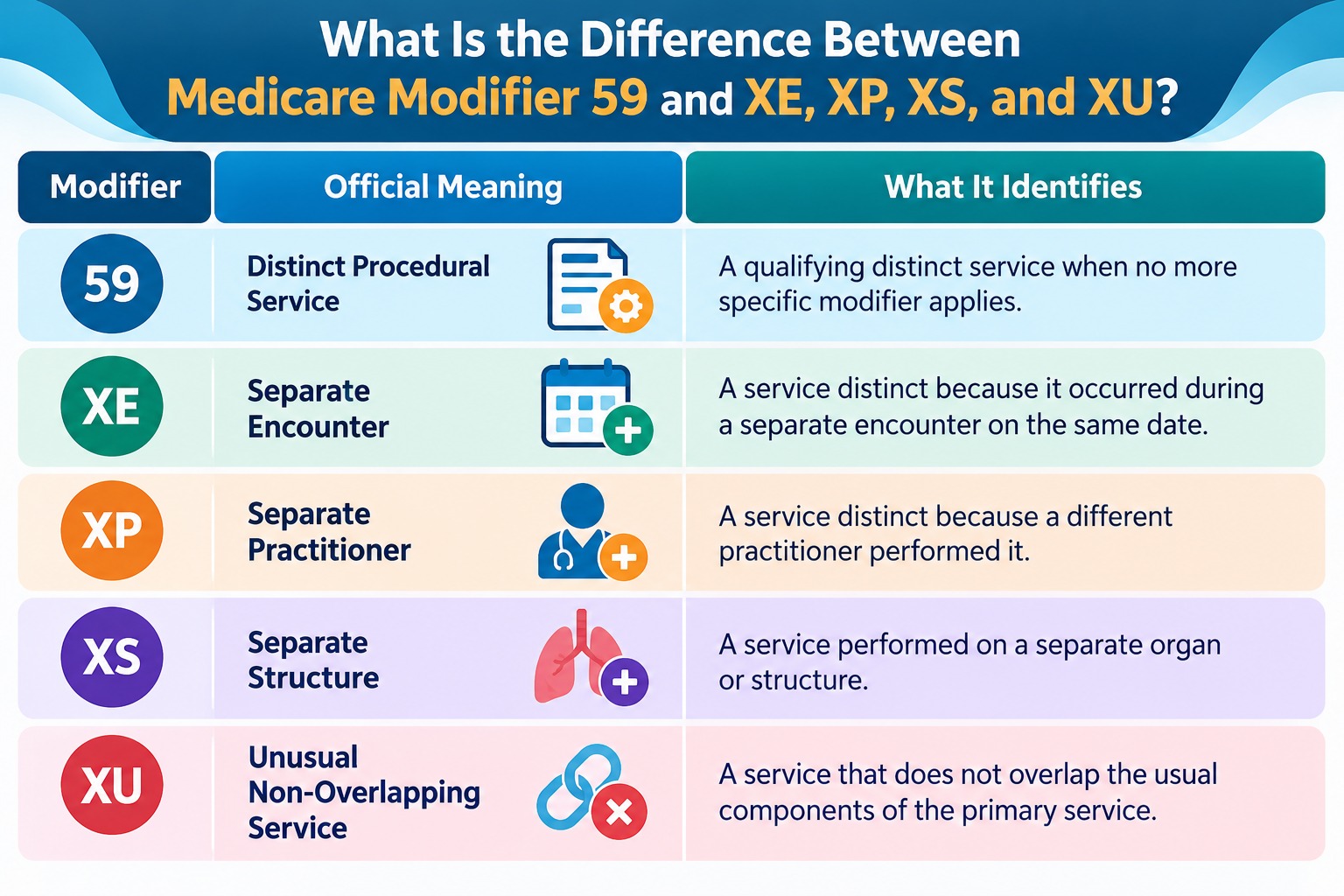
Behavioral health providers should not select a modifier simply because a claim contains two codes. They must establish that the services qualify for separate reporting under the applicable NCCI rules.
How Medicare NCCI Edits Affect Behavioral Health Claims
CMS developed the NCCI program to prevent improper payment when providers report code combinations that should not ordinarily be billed together. NCCI includes PTP edits that identify certain code pairs that may be incompatible under usual circumstances.
These edits can affect professional claims and certain facility claims. The applicable edit files and policies depend on the billing setting, claim type, and date of service.
For behavioral health organizations, the first step is to identify the exact code pair that triggered the edit. Do not assume that every combination of psychotherapy, psychiatric diagnostic evaluation, psychological testing, or other behavioral health services follows the same rule.
What is a PTP edit?
A PTP edit identifies two codes that Medicare generally does not allow together under the circumstances described by the edit. One code appears in Column One and the other in Column Two. If the edit permits an appropriate modifier, the second service may be separately reportable when the provider meets the requirements.
The edit’s Correct Coding Modifier Indicator (CCMI) determines whether an NCCI-associated modifier can be used to bypass the edit:
- CCMI 0: The edit does not allow an NCCI-associated modifier to bypass it.
- CCMI 1: A modifier may bypass the edit when the clinical circumstances meet the applicable requirements.
A CCMI of 1 does not guarantee payment. It means that a qualifying exception may exist. The medical record must support that exception, and all other coverage, coding, and medical necessity requirements still apply.
Why behavioral health billing teams should check the exact code pair
A behavioral health claim may include multiple services because a patient received treatment from more than one clinician or received services in separate sessions. Those facts may be relevant to modifier selection, but they do not independently establish that Medicare permits separate payment.
Before adding modifier 59 or an X modifier, the billing team should:
- Identify the exact CPT or HCPCS code pair.
- Confirm the applicable NCCI PTP edit for the date of service and billing setting.
- Review the edit’s CCMI.
- Determine whether the documented circumstances meet the requirements for a distinct service.
- Select the most specific appropriate modifier, if the edit permits one.
- Confirm the payer’s remaining billing and coverage requirements.
If the edit has a CCMI of 0, adding modifier 59 or XE, XP, XS, or XU does not make the code combination acceptable under that edit.
When Should Behavioral Health Providers Use Modifier 59?
Modifier 59 may be appropriate when two services that are ordinarily bundled are genuinely distinct, the relevant NCCI edit permits a modifier, and none of the more specific X modifiers accurately describes the circumstances.
CMS identifies circumstances such as a different session or encounter, a different procedure, a different site or organ system, a separate lesion, or a separate injury as examples of situations that may support modifier 59 when applicable to the services being reported.
Behavioral health billing teams should apply these principles carefully. The examples in CMS guidance often involve procedural or anatomical services. A behavioral health provider should not assume that a separate diagnosis, treatment goal, or CPT code automatically meets the criteria for modifier 59.
Behavioral health example: Two services that require a distinct-service review
Suppose a Medicare beneficiary receives a behavioral health service and a second service on the same date. The billing system flags the code combination under an NCCI PTP edit.
The billing team must determine whether the services were distinct under the specific edit and whether the record supports an exception. If the circumstances meet the applicable criteria and no more descriptive X modifier fits, modifier 59 may be appropriate.
The team should not append modifier 59 merely because the services involved different diagnoses or because the provider documented two separate entries in the clinical note.
When modifier 59 is not appropriate
Do not use modifier 59 simply to:
- Override an NCCI edit that does not permit a modifier.
- Obtain payment for services that the code definitions or applicable policies treat as included.
- Report duplicate or overlapping work as separate services.
- Distinguish services only because they have different diagnosis codes.
- Compensate for incomplete documentation.
- Bypass a payer denial without confirming the underlying coding rule.
Modifier 59 describes the circumstances of a service. It does not replace medical necessity, documentation, or the applicable code-pair rules.
Modifier XE: Separate Encounter on the Same Date
Modifier XE identifies a distinct service because it occurred during a separate encounter. CMS limits XE to separate encounters on the same date of service.
This modifier may be relevant when a patient receives two qualifying services during genuinely separate encounters, and the specific NCCI edit allows the services to be reported separately.
Behavioral health example
A patient receives a behavioral health service during one encounter and later returns for a separate encounter on the same date. The provider performs another service that triggers an NCCI edit with the first service.
The billing team should review the nature of both services, the applicable PTP edit, and the documentation showing that the encounters were separate. If the edit allows a modifier and the circumstances meet the requirements, XE may be the appropriate choice.
This example is illustrative. It does not mean that every morning and afternoon appointment qualifies for XE or that Medicare permits every same-day combination.
What documentation supports XE?
The record should make it possible to identify the separate encounters. Depending on the circumstances, relevant information may include:
- The start and end of each encounter.
- The service performed during each encounter.
- The clinical reason for each service.
- Separate encounter or session records where applicable.
- The identity of the rendering practitioner.
- Evidence that the services were not merely different components of one continuous encounter.
A scheduling gap alone does not establish a separate encounter. The clinical circumstances and applicable coding guidance must support the distinction.
Modifier XP: Separate Practitioner
Modifier XP identifies a service that is distinct because a different practitioner performed it. In behavioral health settings, several qualified professionals may participate in a patient’s care. However, the fact that two practitioners contributed to care does not automatically justify XP.
The provider must confirm that the specific services qualify for separate reporting under the relevant NCCI edit and that the services were distinct under the applicable rules.
Behavioral health example
A patient receives a service from one behavioral health practitioner and another service from a different practitioner on the same date. The claim contains a code pair subject to an NCCI edit.
The billing team should confirm the identity of each rendering practitioner, the service each practitioner performed, the relevant code-pair rule, and whether the record supports separate reporting. If the edit allows a modifier and the different-practitioner circumstance meets the applicable criteria, XP may be appropriate.
The organization should not assume that two clinicians working within the same practice automatically qualify for XP. The specific code pair and billing circumstances still control.
What documentation supports XP?
The claim and medical record should accurately identify the practitioners involved. The supporting documentation should show:
- Which practitioner performed each service.
- What each practitioner did.
- Whether the services were distinct under the applicable code-pair policy.
- Why the services qualify for separate reporting.
- Whether the relevant NCCI edit permits a modifier.
Do not use XP merely because a supervising clinician reviewed a note, a second clinician signed documentation, or several team members participated in a single service. Those circumstances do not independently establish a separately reportable service.
Modifier XS: Separate Structure
Modifier XS identifies a service performed on a separate organ or structure. Its use is primarily relevant when the distinction between services involves separate anatomical structures.
Behavioral health example
This modifier has limited direct application to many behavioral health services because psychotherapy and psychiatric evaluation generally do not involve separate anatomical structures in the way that certain procedural services do.
Behavioral health billing teams should therefore avoid using XS simply because two services address different symptoms, diagnoses, treatment goals, or areas of psychological functioning.
When should a behavioral health biller consider XS?
Consider XS only when the services and the applicable code-pair guidance genuinely involve separate structures and the documentation supports that distinction. The organization should also confirm that another more appropriate anatomical modifier does not apply.
A different mental health diagnosis is not a separate anatomical structure. Neither is a different therapy objective. If the claim involves only psychological or psychiatric services without a relevant structural distinction, XS will generally not describe the reason for separate reporting.
Modifier XU: Unusual Non-Overlapping Service
Modifier XU identifies a service that is distinct because it does not overlap the usual components of the primary service. It may be relevant when a service falls outside the usual components of another service, and the specific NCCI edit permits separate reporting under the documented circumstances.
For behavioral health providers, the central question is whether the second service represents distinct work that the relevant coding rules permit the provider to report separately. Different service descriptions do not prove that the work does not overlap.
Behavioral health example
A claim includes two services on the same date, and the second service appears to involve work that may fall outside the usual components of the first. The billing team should examine the code definitions, the NCCI edit rationale, and the clinical documentation.
If the record establishes a qualifying non-overlapping service and the applicable edit allows the modifier, XU may be appropriate. If the second service duplicates work already included in the first, XU is not justified.
Documentation considerations
The record should identify the services performed and establish why the second service did not overlap the usual components of the first. The organization should not rely on a generic statement such as “separate service provided” without documenting the underlying facts.
XU is not a general-purpose modifier for any two services performed on the same day. It must match the circumstances described by CMS guidance and the applicable edit.
Modifier 59 vs. XE, XP, XS, and XU: How to Choose
The most reliable approach is to start with the facts of the service and the applicable NCCI edit, rather than selecting a modifier based on which one seems most likely to obtain payment.
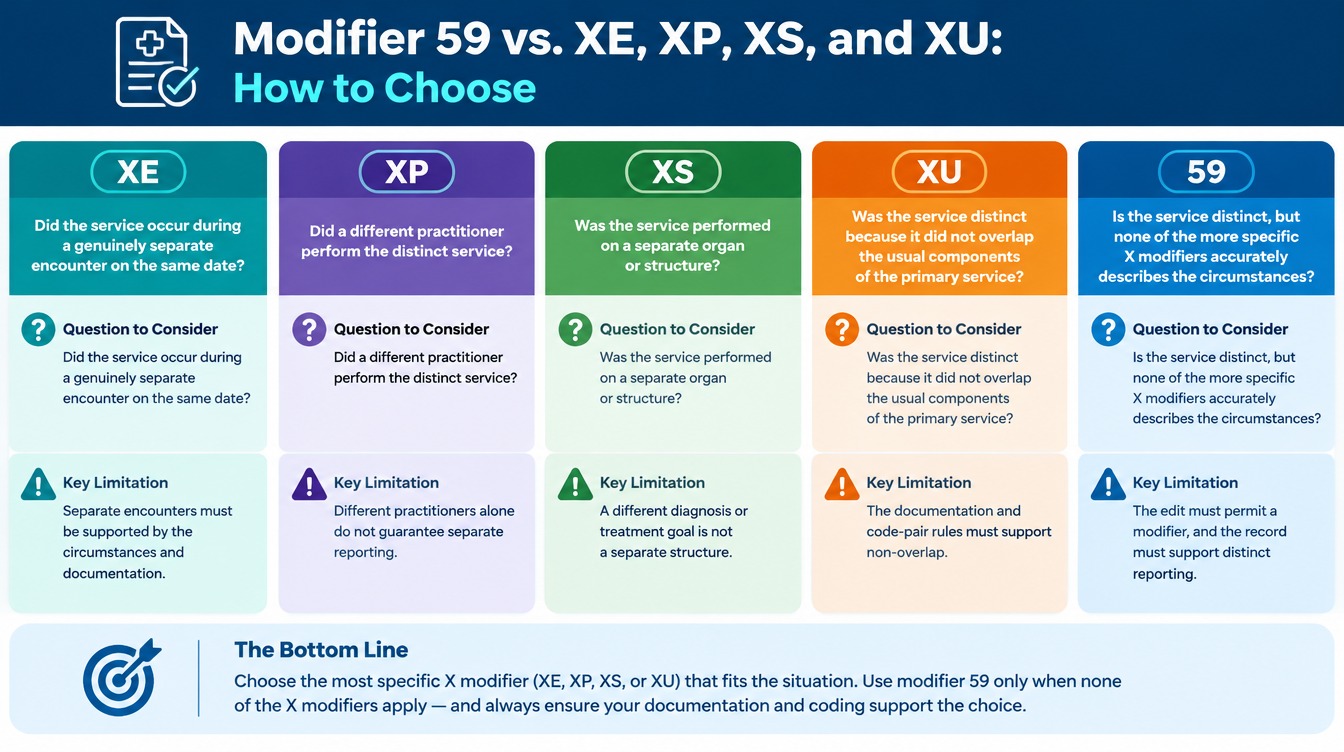
The X modifiers are not a checklist in which the billing team selects whichever one fits loosely. Each modifier has a specific meaning. If none accurately describes the documented circumstances, the organization should not use one merely to bypass the edit.
Modifier 59 and X Modifiers Are Not the Same as Modifier 25
Behavioral health billers should distinguish modifier 59 and the X modifiers from modifier 25.
Modifier 25 identifies a significant, separately identifiable evaluation and management (E/M) service performed by the same physician or other qualified healthcare professional on the same day as another service, when the applicable requirements are met.
Modifier 59 and XE, XP, XS, and XU address distinct procedural services and NCCI-associated edit circumstances. CMS specifically states that modifier 59 should not be appended to an E/M service. When a separate E/M service qualifies under the applicable rules, modifier 25 may be relevant instead.
For example, a psychiatric practice should not use modifier 59 as a substitute for modifier 25 when reporting a separately identifiable E/M service with another service. The correct modifier depends on the type of service, the code combination, and the applicable coding guidance.
Common Behavioral Health Billing Errors
Adding modifier 59 to every denied claim
A denial involving an NCCI edit does not automatically mean the claim needs modifier 59. The edit may prohibit a modifier, or the services may not qualify for separate reporting.
How to avoid it: Review the exact code pair, the CCMI, and the documentation before correcting.
Using an X modifier without confirming the circumstances
A practice may choose XE because appointments occurred at different times or XP. After all, two clinicians were involved. Those facts alone may not establish that the services qualify as distinct under the relevant edit.
How to avoid it: Match the modifier to the specific circumstances and the requirements of the applicable code pair.
Treating different diagnoses as proof of separate services
Two diagnosis codes do not prove that the provider performed two distinct services. The work may still overlap or be included under the applicable coding rules.
How to avoid it: Review the services actually performed, not just the diagnoses on the claim.
Using XS for separate behavioral health concerns
Different psychological symptoms or treatment goals do not constitute separate organs or structures.
How to avoid it: Use XS only when the service involves a qualifying separate structure under the applicable coding guidance.
Using XU for services that overlap
XU does not permit separate billing simply because the provider used different code descriptions. The work must be distinct from the usual components of the primary service.
How to avoid it: Document the nature of each service and explain why the second service does not overlap the first, where the applicable rules permit separate reporting.
Ignoring the billing setting
The applicable NCCI edit files and policies can differ between practitioner claims and outpatient hospital claims.
How to avoid it: Verify the correct edit file for the claim type, setting, and date of service. Do not apply a professional-claim edit automatically to a facility claim.
Assuming a modifier guarantees reimbursement
Even when a modifier is appropriate, the claim must meet other applicable requirements. Coverage, medical necessity, code selection, documentation, and payer-specific rules remain relevant.
How to avoid it: Treat modifier selection as one part of the claim review, not as a guarantee of payment.
Conclusion
Medicare modifier 59 and the X modifiers XE, XP, XS, and XU help describe distinct services when an applicable NCCI edit would ordinarily prevent separate reporting. For behavioral health organizations, the correct choice depends on the documented circumstances, the specific code pair, the billing setting, and whether the edit permits a modifier.
Use XE for a qualifying separate encounter, XP for a qualifying different-practitioner service, XS for a qualifying separate structure, and XU for a qualifying non-overlapping service. Use modifier 59 only when the service meets the distinct-service requirements and no more specific modifier applies.
The most defensible workflow begins with the NCCI edit, not the modifier. Confirm the CCMI, review the record, choose the modifier that accurately describes the service, and verify all other billing requirements before submitting the claim. A modifier should never be used simply to bypass an edit or obtain payment for services that do not qualify for separate reporting.
Frequently Asked Questions
What is the difference between modifier 59 and XE?
Modifier 59 identifies a qualifying distinct procedural service when no more specific modifier applies. XE specifically identifies a service that is distinct because it occurred during a separate encounter on the same date. When XE accurately describes the circumstances, Medicare guidance generally favors it over modifier 59.
Can behavioral health providers use modifier 59?
Yes, when the relevant code pair is subject to an NCCI edit that permits a modifier, the services meet the requirements for separate reporting, and no more specific modifier describes the circumstances. A different diagnosis or service code alone does not justify modifier 59.
When should a behavioral health provider use XP?
XP may be appropriate when a different practitioner performed a distinct service and the applicable NCCI edit allows separate reporting. The record must support the circumstances. The involvement of multiple clinicians does not automatically justify XP.
Can XE be used when a patient sees two providers on the same day?
Possibly, but the provider identities alone do not establish XE. XE describes a separate encounter on the same date. If the relevant distinction is that a different practitioner performed the service, XP may be more relevant, provided the circumstances and NCCI rules support it.
Is XS commonly used in behavioral health billing?
XS has limited direct application to many behavioral health services because it describes a separate organ or structure. Different diagnoses, symptoms, or treatment goals do not establish a separate structure.
When is XU appropriate?
XU may be appropriate when a service is distinct because it does not overlap the usual components of the primary service, and the applicable NCCI edit permits a modifier. The record must support that distinction.
Can modifier 59 override any Medicare NCCI edit?
No. Some edits have a CCMI of 0, which does not allow an NCCI-associated modifier to bypass the edit. Even when the indicator is 1, the provider must meet the applicable criteria and document the circumstances.
Does using an X modifier guarantee payment?
No. The modifier only communicates the qualifying circumstances. Payment still depends on the code-pair edit, documentation, medical necessity, coverage rules, and other applicable claim requirements.
Can modifier 59 be used on an E/M code?
CMS states that modifier 59 should not be appended to an E/M service. When a significant, separately identifiable E/M service qualifies alongside another service on the same date, modifier 25 may apply under the relevant rules.
—————