

The 8 Minute Rule determines how many units a therapist can report for certain timed therapy services under Medicare. It matters most when a physical therapist, occupational therapist, or speech-language pathologist provides services measured in 15-minute increments.
The rule looks simple at first. If a therapist provides at least 8 minutes of a timed service, one unit may qualify. But Medicare billing becomes more complicated when the therapist provides several timed services during the same visit.
Therapy practices need to calculate the total timed treatment minutes, separate timed services from untimed services, assign units to the correct CPT codes, and document the actual treatment time. A few extra minutes can change the number of units on a claim.
For 2026, CMS continues to use the established Medicare timing thresholds for timed therapy services. CMS also updated several therapy policies, including the 2026 KX modifier thresholds of $2,480 for physical therapy and speech-language pathology combined and $2,480 for occupational therapy.
What Is the 8 Minute Rule?
The Medicare 8 Minute Rule applies to timed therapy services that use 15-minute units.
Medicare generally requires at least 8 minutes of a timed service to report one unit when the service qualifies under the timed service rules.
The basic thresholds are:
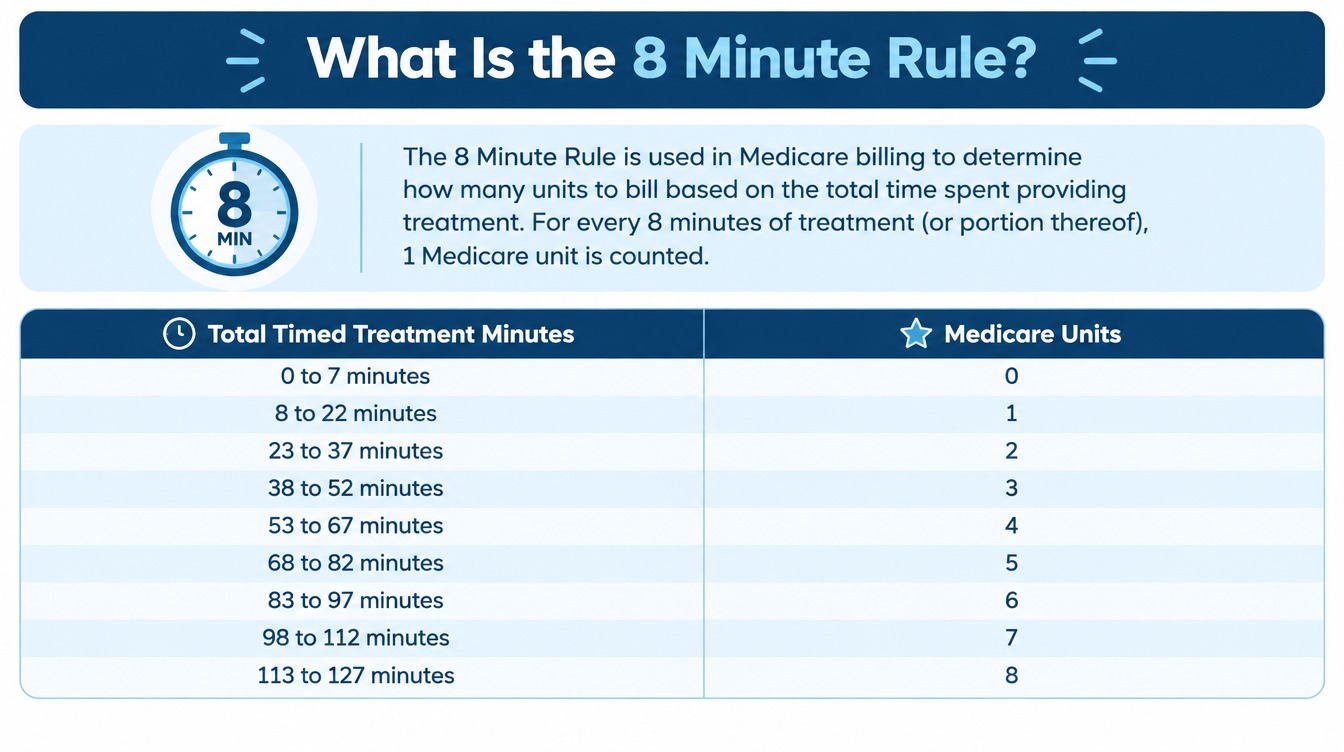
CMS confirms these thresholds in the Medicare Claims Processing Manual and related therapy billing guidance.
The important point is that the rule does not simply mean “8 minutes equals one unit.”
When a therapist provides several timed services on the same date, Medicare generally adds the billable timed minutes together to determine the total number of units. The billing team then allocates those units among the CPT codes based on the actual time spent on each service.
Why the 8 Minute Rule Matters in Therapy Billing
Therapy claims often contain several services during one treatment session.
A patient might receive:
- Therapeutic exercise
- Neuromuscular reeducation
- Therapeutic activities
- Manual therapy
- Self-care training
Many of these services use timed CPT codes.
A therapist may spend 20 minutes on one service and 25 minutes on another. The practice cannot simply calculate each service independently and add the resulting units without applying Medicare’s total time rules.
The billing team must calculate the total timed treatment minutes for that discipline on that date of service.
That calculation determines the maximum number of timed units Medicare permits.
A mistake can lead to overbilling, underbilling, claim edits, payment delays, or compliance concerns.
Which Therapy Services Use the 8 Minute Rule?
The rule applies primarily to Medicare therapy services reported with timed CPT codes measured in 15-minute units.
Common examples include:
- CPT 97110, therapeutic exercises
- CPT 97112, neuromuscular reeducation
- CPT 97116, gait training
- CPT 97140, manual therapy techniques
- CPT 97530, therapeutic activities
- CPT 97535, self-care and home management training
- Other therapy services that CPT defines using 15-minute units
The exact billing treatment depends on the CPT descriptor and current Medicare guidance.
Therapists should not assume that every therapy code follows the same timing structure.
Some services are untimed.
Timed vs Untimed Therapy Services
This distinction is essential.
Timed services
A timed service uses time as part of its CPT definition.
Many therapy codes use 15-minute units and require direct patient contact with the qualified professional or appropriate auxiliary personnel.
Medicare counts the actual treatment time when determining units.
Untimed services
An untimed service does not use a 15 minute time increment to determine units.
The practice generally reports the service based on the service performed rather than the number of minutes spent delivering it.
CMS states that minutes spent on untimed services do not count toward the timed treatment minutes used to determine timed units.
This creates an important billing separation.
If a patient receives an untimed evaluation followed by 40 minutes of timed treatment, the evaluation minutes do not become part of the 40 timed treatment minutes.
The Basic Medicare 8 Minute Rule Example
Suppose a physical therapist provides 20 minutes of therapeutic exercise using CPT 97110.
The therapist provided more than 8 minutes but less than 23 minutes.
The practice can report:
97110, 1 unit
Now suppose the therapist provides 30 minutes of therapeutic exercise.
The service falls into the 23 through 37 minute range.
The practice can report:
97110, 2 units
If the therapist provides 45 minutes, the practice can report:
97110, 3 units
The threshold applies to the total qualifying timed treatment minutes.
What Happens When Multiple Timed Services Occur?
This is where many billing mistakes occur.
Consider this example:
- 97110: 20 minutes
- 97530: 20 minutes
Total timed treatment:
40 minutes
Medicare’s timing table allows 3 units for 38 through 52 minutes.
The practice therefore reports 3 total timed units.
The practice cannot automatically report 1 unit of 97110 and 1 unit of 97530 simply because each service lasted more than 8 minutes.
It needs to account for the third unit and assign the units appropriately based on the actual time spent on each service.
CMS provides detailed guidance for allocating timed units among multiple therapy services.
The 15 Minute Block Method
A useful way to calculate multiple timed services involves separating each service into 15-minute blocks and then examining the remaining minutes.
Consider:
- 97110: 25 minutes
- 97530: 8 minutes
Total timed minutes:
33 minutes
Medicare allows 2 units for 23 through 37 minutes.
Start by assigning complete 15-minute blocks.
The 25 minutes of 97110 contain one complete 15-minute block plus 10 remaining minutes.
The 8 minutes of 97530 do not contain a complete 15-minute block, but they can contribute toward the additional unit because Medicare’s total time calculation reaches the required threshold.
The second unit goes to the service with the greater remaining time.
In this example, 97110 has 10 remaining minutes while 97530 has 8.
Therefore, the second unit goes to 97110.
The claim would report:
- 97110, 2 units
- 97530, 0 units
The service still needs to appear in the documentation, but the available timed units do not allow a separate billable unit for 97530.
CMS provides this type of allocation example in its outpatient therapy billing guidance.
Why You Cannot Simply Divide Total Minutes by 15
A common shortcut involves dividing total minutes by 15.
That shortcut can create incorrect claims.
For example:
40 minutes divided by 15 equals 2.67.
A practice might round that number to 3 units.
In this particular case, Medicare’s timing table also allows 3 units.
But other scenarios require proper allocation among individual services.
Suppose a therapist provides:
- 20 minutes of 97110
- 8 minutes of 97530
- The total equals 28 minutes.
- Medicare allows 2 units.
But the billing team still needs to decide which CPT codes receive those units.
The answer does not come from simply dividing 28 by 15.
The practice must allocate units according to Medicare’s timed service rules.
The 8 Minute Rule Is Not a General Therapy Minimum
Another common misunderstanding says that every therapy service becomes billable after 8 minutes.
That statement oversimplifies the rule.
The 8-minute threshold applies to Medicare’s method for calculating units for qualifying timed services.
The therapist still needs to provide a covered, medically necessary service that meets the requirements of the applicable CPT code.
The documentation also needs to support the service.
Eight minutes of a service does not automatically make an otherwise unsupported claim payable.
What Counts as Treatment Time?
Medicare counts qualifying treatment time during the actual delivery of the therapy service.
CMS describes this as intra-service care.
The patient should be ready for treatment, and the qualified professional or appropriate auxiliary personnel should provide the service.
CMS guidance states that pre-delivery and post-delivery activities do not count as timed treatment minutes. Waiting for equipment, waiting for treatment to begin, resting, toileting, and similar non-treatment time also should not enter the timed treatment calculation.
Example
A patient arrives at 9:00.
The therapist spends 5 minutes reviewing the schedule and preparing equipment.
Treatment starts at 9:05.
The therapist provides 20 minutes of therapeutic exercise.
The patient then waits 5 minutes for another piece of equipment.
The therapist provides 15 minutes of therapeutic activity.
The timed treatment minutes equal:
20 + 15 = 35 minutes.
The preparation and waiting periods do not count.
Medicare therefore allows 2 timed units.
Do Evaluation Minutes Count Toward the 8 Minute Rule?
Not when the evaluation represents an untimed service.
For example, an occupational therapist performs an evaluation and then provides timed therapeutic exercise.
The evaluation minutes do not become timed treatment minutes.
CMS specifically explains that untimed evaluation minutes should not enter the calculation for timed treatment units.
This distinction matters because therapy visits can contain both evaluation services and treatment services.
What About Rest Breaks?
Rest time does not count as treatment time when the patient is not receiving the skilled service.
For example, a therapist provides 15 minutes of therapeutic exercise, the patient rests for 10 minutes, and the therapist then provides another 15 minutes of therapeutic exercise.
The timed treatment total equals 30 minutes, not 40 minutes.
The 10-minute rest period does not create billable treatment time.
CMS specifically excludes time when the patient is not receiving treatment because of resting and similar activities.
What About Waiting for Equipment?
Waiting does not count.
Suppose a therapist schedules therapeutic exercise for 20 minutes, but the patient spends 6 minutes waiting for equipment.
The practice cannot report 20 minutes if the therapist only provides 14 minutes of qualifying treatment.
The record should reflect the actual treatment time.
Accurate time records protect both the practice and the patient.
Direct Patient Contact Matters
Many timed therapy services require direct one-on-one contact.
A therapist cannot automatically count time when a patient independently performs an activity.
For example, a patient may perform exercises independently using equipment while the therapist works with another patient.
The patient’s independent activity does not automatically become the therapist’s billable timed treatment.
CMS guidance states that supervision of a patient performing an activity defined as a timed service does not qualify as billable timed treatment when the service requires direct one-on-one contact.
The Important 22 Minute to 23 Minute Threshold
Therapy billing teams should pay close attention to the boundary between 22 and 23 minutes.
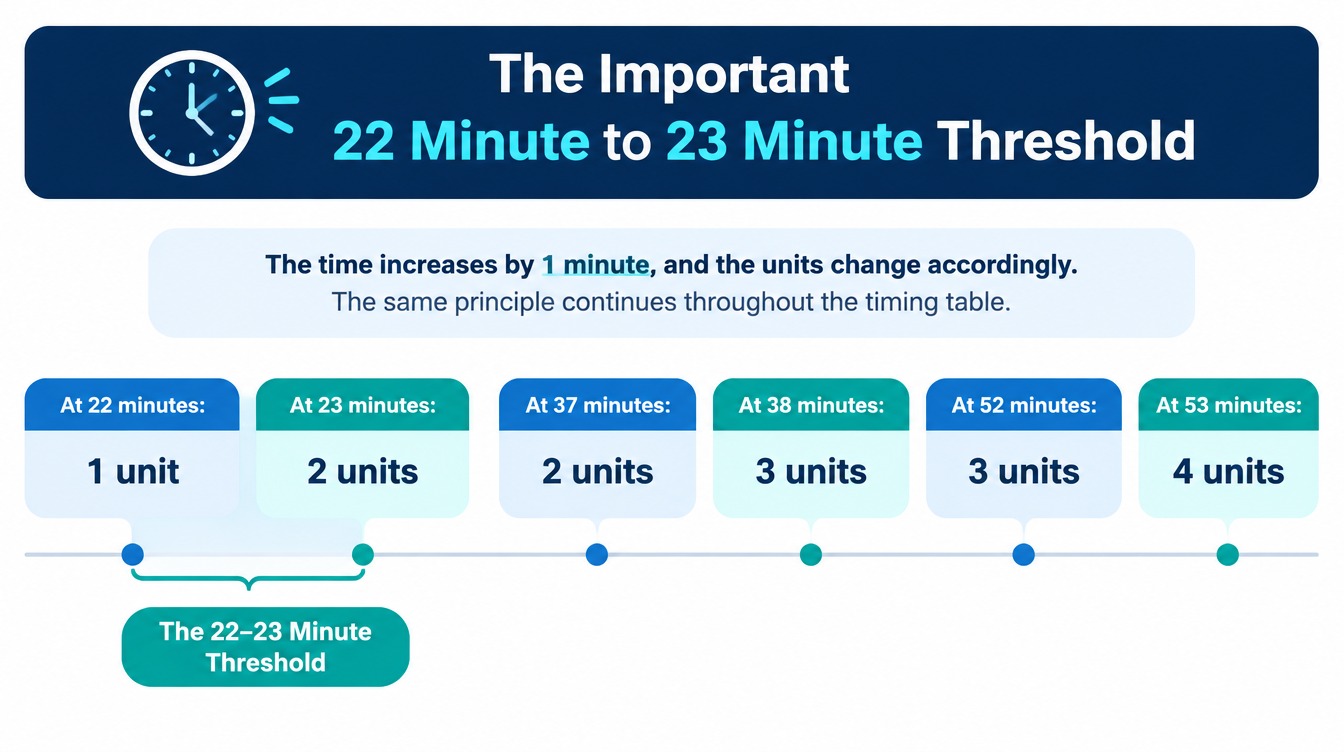
These thresholds make accurate treatment time documentation particularly important.
Documentation Requirements for the 8 Minute Rule
A therapy note should allow a reviewer to understand what the therapist did and how long the therapist provided the service.
A strong treatment note should identify:
- Date of service
- Patient
- Diagnosis or conditions treated
- Therapy discipline
- Specific services provided
- CPT codes when appropriate
- Treatment time for each timed service
- Total timed treatment minutes
- Total treatment time
- Therapist or qualified professional information
- Clinical response
- Progress toward treatment goals
- Skilled intervention provided
- Plan for continued treatment when applicable
The note should tell the same story as the claim.
If the claim reports 3 units but the record does not establish enough treatment time, the billing team faces a preventable problem.
Timed Code Minutes vs Total Treatment Time
These two terms should not become interchangeable.
Timed Code Treatment Minutes represent the minutes used to calculate timed service units.
Total Treatment Time may include services that do not contribute to the timed unit calculation.
For example:
35 minutes of evaluation
33 minutes of timed treatment
Total treatment time:
68 minutes
The evaluation remains separate from the timed treatment calculation.
CMS uses examples that distinguish total treatment time from timed code treatment minutes.
The 8 Minute Rule and Medical Necessity
Time alone does not establish medical necessity.
A therapist could document 30 minutes of treatment, but the claim still needs to meet Medicare’s coverage requirements.
The medical record should support why the skilled service was appropriate for the patient’s condition.
The therapist should connect treatment to the patient’s functional limitations, goals, clinical findings, and plan of care.
Billing teams should therefore review both:
Time
and
Medical necessity
A claim needs both when Medicare requires them.
The 8 Minute Rule and Modifiers
Therapy claims may involve several modifiers depending on the service, provider type, setting, and circumstances.
Common therapy-related modifiers include:
GP
Physical therapy services or services under a physical therapy plan of care.
GO
Occupational therapy services or services under an occupational therapy plan of care.
GN
Speech language pathology services or services under a speech-language pathology plan of care.
CQ
Services furnished in whole or in part by a physical therapist assistant under Medicare’s applicable policy.
CO
Services furnished in whole or in part by an occupational therapy assistant under Medicare’s applicable policy.
The practice should apply modifiers according to the specific service and Medicare requirements.
CMS currently maintains detailed guidance for CQ and CO modifier billing and the related de minimis policy.
The 8 Minute Rule and PTA or OTA Services
Medicare introduced specific payment rules for services furnished in whole or in part by PTAs and OTAs.
For applicable services, CMS uses the CQ and CO modifiers and applies the relevant payment reduction when the service meets the applicable assistant involvement threshold.
CMS also established exceptions involving the 8-minute Rule.
For example, when one final 15-minute unit remains and the PT or OT independently provides at least 8 minutes of that service, Medicare treats that final unit differently under the de minimis policy.
This makes assistant involvement another important consideration when calculating and assigning units.
Medicare’s 2026 Therapy Updates
Therapy billing rules can change from one calendar year to another.
For 2026, CMS lists several therapy updates.
The KX modifier threshold amounts are:
- Physical therapy and speech-language pathology combined: $2,480
- Occupational therapy: $2,480
CMS also updated its therapy code list and added three remote therapeutic monitoring codes to the codes identified as sometimes therapy services for 2026.
These updates do not replace the 8 Minute Rule.
They sit alongside the timing and coding requirements that therapy practices already need to follow.
KX Modifier vs 8 Minute Rule
Do not confuse the KX modifier threshold with the 8 Minute Rule.
They address different billing issues.
The 8 Minute Rule determines the number of units for qualifying timed services based on treatment time.
The KX modifier relates to Medicare’s therapy service threshold and the documentation of medical necessity beyond that threshold.
For 2026, CMS lists the KX threshold at $2,480 for occupational therapy and $2,480 for physical therapy and speech-language pathology combined.
A practice therefore needs to monitor both.
Common 8 Minute Rule Billing Errors
Counting the entire appointment as timed treatment
A patient may spend 75 minutes in the clinic.
That does not mean the therapist provided 75 minutes of timed treatment.
Waiting, preparation, rest periods, and untimed services may not count.
Adding evaluation minutes to treatment minutes
Untimed evaluation minutes should not enter the timed treatment unit calculation.
Billing every CPT code with one unit
A patient may receive three timed services, but that does not automatically mean three units.
The total timed minutes determine the available units.
Ignoring the 23-minute threshold
22 minutes supports one unit.
23 minutes supports two units.
Billing teams need accurate time records around these thresholds.
Billing independent exercise as skilled treatment
A patient performing an exercise independently does not automatically create billable one-on-one therapy time.
Rounding treatment time
Do not round 7 minutes up to 8.
Do not turn 22 minutes into 23.
The record should reflect the actual treatment time.
Reporting more units than the total minutes support
The claim should never exceed the number of units supported by the total timed treatment minutes.
Ignoring payer specific rules
Medicare provides the core rules, but the billing team still needs to consider the applicable Medicare contractor guidance, setting, service, and current coverage requirements.
How to Audit Therapy Claims for 8 Minute Rule Errors
A therapy practice can perform a simple internal audit.
Select a sample of recent Medicare therapy claims.
For each claim, compare:
Medical record with CPT codes with Timed minutes with Units billed
Then check whether:
- Timed services have documented treatment minutes
- Untimed services remain outside the timed minute calculation
- Total timed minutes support the billed units
- Units are assigned to the correct CPT codes
- Documentation supports direct patient contact
- The therapist documents skilled intervention
- Applicable modifiers appear correctly
- Assistant involvement follows Medicare rules
- The diagnosis supports the treatment
- The claim matches the medical record
This process can identify patterns before a payer audit identifies them.
Conclusion
The Medicare 8 Minute Rule gives therapy practices a clear method for calculating units for qualifying timed services, but correct billing requires more than memorizing the 8-minute threshold.
The billing team needs to separate timed and untimed services, record actual treatment time, calculate the total timed minutes, assign units correctly, and make sure the documentation supports the services reported.
The most important thresholds to remember are 8 minutes for the first unit, 23 minutes for the second, 38 minutes for the third, and 53 minutes for the fourth.
For multiple services, do not calculate every CPT code in isolation. Add the qualifying timed minutes first, determine the total units, and then allocate those units according to Medicare’s rules.
CMS continues to publish therapy-specific updates, code lists, billing guidance, and Medicare Claims Processing Manual instructions. Practices should verify the rules that apply to the date of service instead of relying on an old therapy billing chart.
Don’t Let Billing Minutes Turn into Lost Revenue
Therapy billing gets complicated when every minute matters. Incorrect unit calculations, missed modifiers, weak documentation, and Medicare billing errors can lead to underpayments and avoidable denials.
RCM Xperts helps physical therapy, occupational therapy, speech therapy, and rehabilitation practices manage billing from coding and 8 Minute Rule calculations to claim submission, payment posting, and denial follow up.
Let your therapists treat patients while our billing specialists handle the numbers behind every claim.
Frequently Asked Questions
What is the 8 Minute Rule in Medicare therapy billing?
The 8 Minute Rule determines how Medicare calculates units for qualifying timed therapy services measured in 15-minute increments. For total timed treatment between 8 and 22 minutes, one unit can qualify. Between 23 and 37 minutes, two units can qualify. The number of units increases according to Medicare’s established time ranges.
Is 8 minutes always enough to bill one therapy unit?
Eight minutes can support one unit of a qualifying timed service when the service meets Medicare’s other billing requirements. The practice also needs documentation showing that the therapist actually provided the service. The 8-minute threshold does not make an otherwise noncovered or unsupported service payable.
Do evaluation minutes count toward the 8 Minute Rule?
Generally, no, when the evaluation represents an untimed service. Medicare separates untimed services from timed treatment minutes. Evaluation time should not automatically become part of the timed treatment calculation.
How do you calculate multiple therapy codes under the 8 Minute Rule?
First, add the qualifying timed treatment minutes for the discipline on that date of service. Use the Medicare time table to determine the total number of units. Then allocate those units among the individual CPT codes based on the actual treatment time and Medicare’s allocation method.
Do rest periods count toward therapy treatment time?
No. Time when the patient rests instead of receiving treatment should not enter the timed treatment calculation. CMS specifically identifies rest and similar non-treatment periods as time that should not count toward timed therapy minutes.
Does the 8 Minute Rule apply to every therapy CPT code?
No. Therapy practices need to distinguish timed codes from untimed codes. The CPT descriptor and applicable Medicare guidance determine whether a service uses timed units.