
Self-pay medical billing applies when a patient pays a healthcare provider directly instead of having a health plan pay for the service. The patient may have no health insurance, may choose not to use an existing policy, or may need a service that their plan does not cover. In each situation, the provider must establish the correct payment arrangement, explain the expected charges, document the patient’s financial responsibility, and collect payment through a consistent process.
For medical practices, self-pay billing requires more than handing a patient an invoice after an appointment. Staff must confirm whether the patient is truly self-pay, determine whether federal or state pricing disclosures apply, prepare accurate estimates, explain payment policies, post payments correctly, and follow up on unpaid balances. A weak process can lead to patient complaints, delayed collections, inaccurate accounts receivable, and compliance exposure.
The No Surprises Act added important requirements for uninsured patients and people who choose not to use their commercial health insurance. Eligible patients generally have the right to receive a Good Faith Estimate (GFE) of expected charges. If a provider’s final bill is at least $400 above that provider’s estimate, the patient may qualify for the federal Patient-Provider Dispute Resolution process.
This guide explains self-pay in medical billing, including patient eligibility, self-pay pricing, Good Faith Estimates, patient agreements, payment collection, claim handling, refunds, financial assistance, denial management, and revenue cycle best practices.
What Is Self-Pay in Medical Billing?
Self-pay in medical billing refers to a payment arrangement in which the patient is responsible for paying the provider directly rather than relying on an insurance claim for the service.
The provider charges the patient according to its established self-pay fee schedule, payment policy, or agreed financial arrangement. The patient may pay before the appointment, at the time of service, or through an approved payment plan.
A patient may be classified as self-pay in several situations:
- The patient does not have health insurance.
- The patient has insurance but chooses not to use it for a particular service.
- The patient’s plan does not cover the service.
- The patient receives care from a provider outside the plan’s network and agrees to pay directly.
- The patient has exhausted a benefit limit and elects to pay for additional services.
- The patient requests a cash-pay arrangement for a service that the provider may legally furnish outside the insurance billing process.
The practice must not assume that every patient without an insurance card is automatically a self-pay patient. Staff should ask about coverage and determine whether the patient intends to use it for the scheduled service.
How Self-Pay Billing Works
In a typical self-pay transaction, the practice verifies the patient’s identity and payment status, explains the charges, provides an estimate when required, obtains any necessary financial acknowledgment, furnishes the service, and records the payment.
A standard workflow looks like this:
- The patient contacts the practice to schedule an appointment.
- Registration staff asks whether the patient has health coverage and whether they intend to use it.
- The practice identifies applicable self-pay and Good Faith Estimate requirements
- Staff prepare and provide an estimate of expected charges.
- The patient reviews the financial policy and payment options.
- The practice documents the patient’s payment arrangement.
- The provider furnishes the service.
- The billing team posts the payment and issues an itemized statement when appropriate.
- Staff reconcile the account and follow up on any outstanding balance.
The workflow should make the expected cost clear before care whenever the practice can reasonably determine it. A patient should not have to discover the practice’s self-pay rate after receiving the service.
Self-Pay vs. Uninsured vs. Out-of-Network Billing
These terms are related, but they describe different coverage and payment situations. Understanding the difference is important because the No Surprises Act uses specific definitions when determining Good Faith Estimate rights.
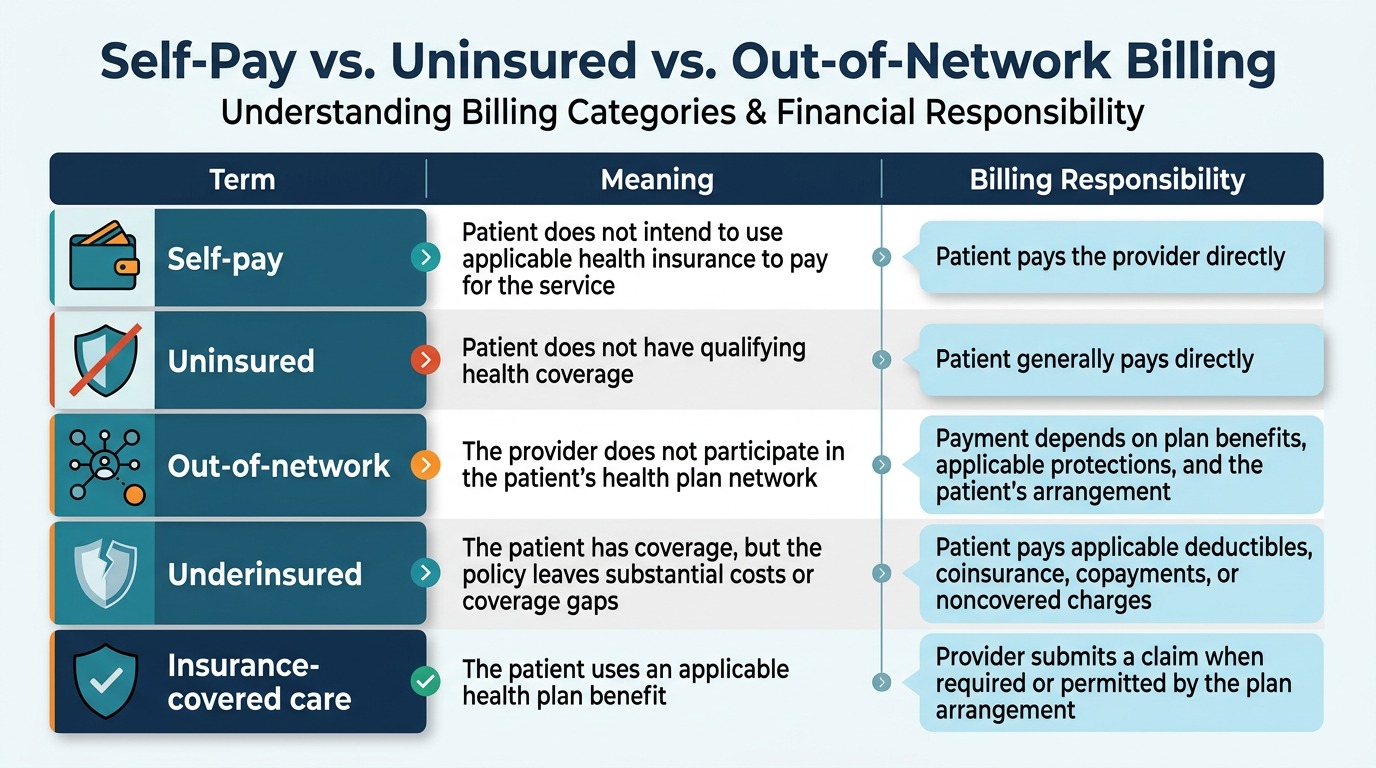
Self-Pay vs. Uninsured
An uninsured patient has no qualifying health coverage. A self-pay patient may have commercial insurance but decide not to use it for the service.
For example, a patient may have a high-deductible health plan and choose to pay directly for a routine consultation. Another patient may have no insurance and pay the practice’s cash rate for the same consultation.
Both patients may qualify as uninsured or self-pay individuals under the Good Faith Estimate provisions, provided they meet the applicable federal definition.
Self-Pay vs. Out-of-Network
Out-of-network status does not automatically mean that a patient is self-pay.
An out-of-network provider may still submit a claim to the patient’s plan if the provider and patient follow that arrangement. The plan may reimburse the patient or provider according to the out-of-network benefit.
By contrast, a patient who chooses not to use applicable commercial insurance for the service may be treated as self-pay for the No Surprises Act Good Faith Estimate requirements.
The provider should explain whether it will submit a claim, whether the patient must pay upfront, and whether the patient can seek reimbursement from the health plan. It should not promise reimbursement unless the plan has confirmed the benefit.
Self-Pay vs. Patient Responsibility After Insurance
A patient who receives an insurance-covered service and owes a deductible, copayment, or coinsurance is not automatically a self-pay patient for that service.
The provider has processed the claim through the plan, and the remaining balance represents the patient’s contractual or benefit-based responsibility.
The practice should keep these balances separate in its billing system. Combining insurance responsibility with cash-pay charges can distort collections reports and create problems when staff reviews patient statements.
When Can a Medical Practice Bill a Patient as Self-Pay?
A practice should establish the patient’s payment status before deciding how to bill. The answer depends on the patient’s coverage type, the service, payer contract terms, and applicable federal and state rules.
Patients Without Health Insurance
An uninsured patient generally pays the provider directly. The practice should explain its fee schedule, provide a Good Faith Estimate when required, and document the patient’s financial arrangement.
Staff should still check whether the patient may qualify for public coverage, financial assistance, or another payment option. The practice can explain available resources without making eligibility decisions on behalf of a government program.
Commercially Insured Patients Who Choose Not to Use Insurance
A patient with qualifying commercial coverage may choose not to submit an insurance claim for a particular service. For purposes of the No Surprises Act, the patient may qualify as a self-pay individual if the patient does not intend to have the claim submitted to the plan.
Before accepting direct payment, the practice should review its payer contracts. Some contracts require participating providers to submit claims for covered services or restrict the provider from charging a separate cash rate for services covered by the contract.
The patient’s preference alone does not override a provider’s contractual obligations. The practice should confirm that the direct-pay arrangement is permitted before collecting payment outside the insurance process.
Patients Receiving Noncovered Services
A patient may pay directly for a service that the plan excludes from coverage. Examples may include certain elective services, convenience services, or treatments that fall outside the policy’s covered benefits.
The practice should identify why the service is not covered and explain the expected charge before providing it. For Medicare patients, the practice must follow Medicare’s specific rules for noncovered services and beneficiary notices. A general cash-pay agreement does not replace those requirements.
Patients With High Deductibles
A patient may have insurance but still face substantial out-of-pocket costs because the deductible has not been met.
The practice should not automatically classify the patient as self-pay. If the service is being submitted to insurance, the practice should follow the payer’s billing and cost-sharing rules.
If the patient asks to pay directly without using the commercial plan, staff should review the payer contract and determine whether the arrangement is permitted. The practice should also explain that a direct payment may not count toward the patient’s deductible or out-of-pocket maximum.
Good Faith Estimate Requirements for Self-Pay Patients
The No Surprises Act requires providers and facilities to give uninsured or self-pay individuals a Good Faith Estimate of expected charges in specified circumstances.
A Good Faith Estimate is a written statement of the expected charges for scheduled healthcare items and services. It gives the patient an opportunity to understand the anticipated cost before receiving care.
The estimate is not a final bill, and it is not a guarantee that no additional services or charges will arise. However, the provider must prepare it in good faith based on the information reasonably available when it issues the estimate.
Who Is Eligible for a Good Faith Estimate?
A patient generally qualifies for a Good Faith Estimate when the patient:
- Does not have qualifying health coverage; or
- Has qualifying commercial coverage but does not intend to use that coverage for the scheduled service.
The federal definition does not treateveryonen outside a commercial insurance arrangement the same way. People enrolled in Medicare, Medicaid, TRICARE, Veterans Affairs healthcare, Indian Health Service, and other specified federal programs are not eligible for the federal uninsured or self-pay Good Faith Estimate process merely because they plan to pay directly.
Providers should not automatically classify a Medicare or Medicaid beneficiary as a self-pay patient under the No Surprises Act. Separate program rules govern when and how these beneficiaries may pay privately.
When Must the Practice Provide a Good Faith Estimate?
A provider or facility generally must provide a Good Faith Estimate when an eligible patient schedules a healthcare item or service at least three business days in advance or requests an estimate.
The federal timing rules depend on how far in advance the patient schedules the service.
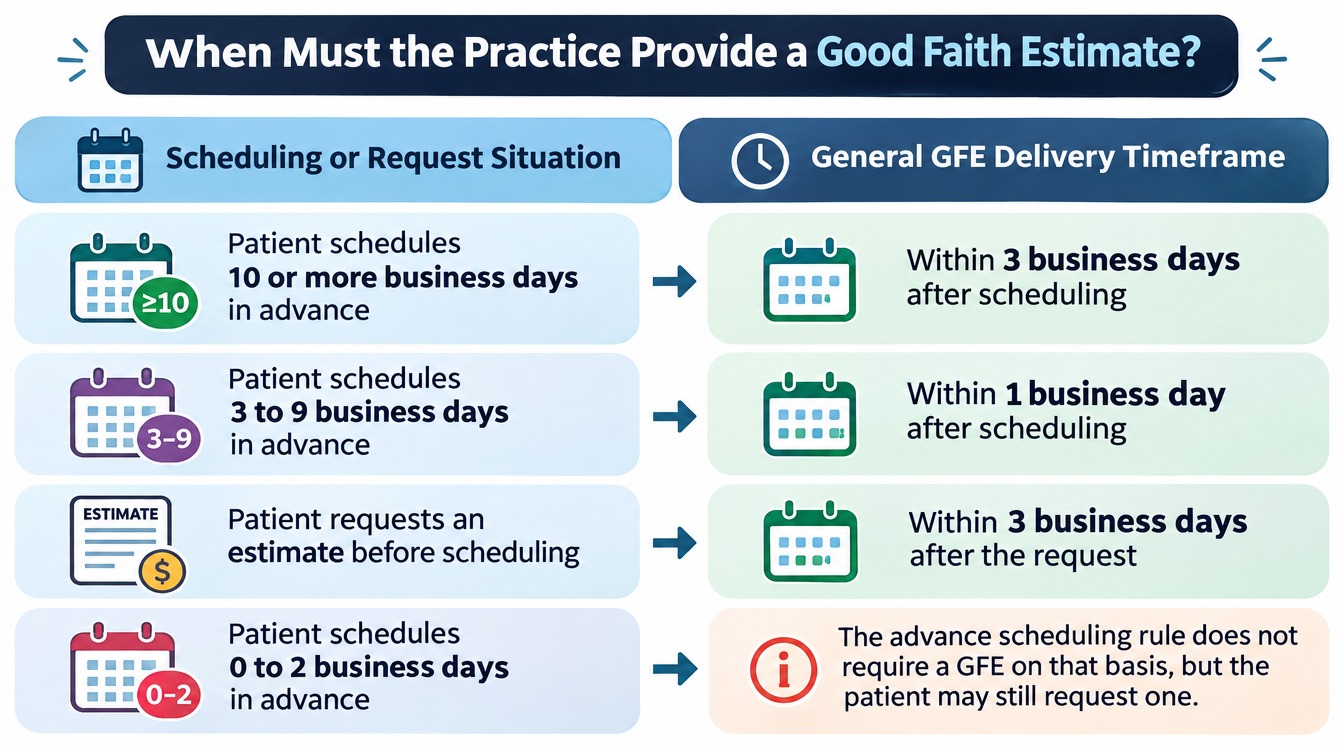
The practice should use the applicable federal rules when calculating business days and retain evidence of when it received the request and when it delivered the estimate.
Emergency services are not subject to the ordinary advance Good Faith Estimate process.
What Should a Good Faith Estimate Include?
The estimate should contain an itemized list of the healthcare items and services that the provider or facility reasonably expects to furnish.
Depending on the service, it may include:
- Patient name and date of birth
- Description of the scheduled service
- Diagnosis information, when available
- Expected service dates
- Applicable procedure or service codes
- Expected charges for each item or service
- Relevant facility or professional charges furnished by the estimating provider or facility
- Provider or facility contact information
- Required explanations and disclaimers
The estimate should use language the patient can understand. The practice should not rely on an unexplained list of CPT or HCPCS codes when a plain-language description would make the charges clearer.
A Good Faith Estimate generally reflects the expected charges of the provider or facility issuing it. A patient may receive separate estimates from different providers or facilities involved in the same course of care. The practice should not imply that its estimate automatically includes charges from independent clinicians, laboratories, imaging centers, or facilities that it does not control.
How to Prepare a Good Faith Estimate
A reliable GFE process requires coordination between scheduling, clinical staff, and billing.
Step 1: Identify the patient’s payment status.
Ask whether the patient has health coverage and intends to use it for the scheduled service. Record the response in the patient account.
Step 2: Confirm the service being scheduled.
Identify the expected consultation, procedure, treatment, supplies, and related services that the practice reasonably anticipates providing.
Step 3: Review the self-pay fee schedule.
Use the practice’s current approved rates. Do not rely on an outdated spreadsheet or a rate quoted by an employee who cannot verify the current price.
Step 4: Calculate expected charges.
Include the services reasonably expected to be furnished by the practice. If the treatment plan is not final, explain the limits of the estimate and identify services that may require a separate estimate.
Step 5: Deliver the estimate in writing.
Provide the estimate electronically or on paper according to the patient’s requested method. An electronic estimate should be available in a format the patient can save and print.
Step 6: Retain the estimate.
Keep a copy in the patient’s record. The federal rule treats the Good Faith Estimate as part of the patient’s medical record and requires providers to maintain it accordingly.
Step 7: Reconcile the final bill.
Compare the final charges with the estimate. If the service changes, document the reason and follow the applicable requirements for updating or issuing a revised estimate.
The $400 Patient-Provider Dispute Resolution Rule
The No Surprises Act gives eligible uninsured and self-pay patients access to a federal Patient-Provider Dispute Resolution (PPDR) process when a provider’s bill is substantially higher than the Good Faith Estimate.
A patient may generally initiate the process when the bill from a provider or facility is at least $400 more than the estimate issued by that same provider or facility.
For example, if a practice provides a Good Faith Estimate of $700 and later bills the patient $1,100 for the services covered by that estimate, the difference is $400. The patient may qualify to dispute the bill if the other eligibility requirements are met.
The patient generally must begin the process within 120 calendar days of receiving the initial bill.
What Happens During a Patient-Provider Dispute?
An independent dispute resolution entity reviews the estimate, the bill, and supporting information from the provider and patient. It determines an appropriate payment amount under the federal process.
The provider may need to submit:
- The Good Faith Estimate
- The final bill
- Supporting medical or billing records
- An explanation of why the charges exceeded the estimate
- Documentation of additional services or circumstances that affected the final amount
During the dispute process, the provider must follow the federal collection restrictions. It may not move the disputed bill into collections or threaten collection while the process is pending. If the bill is already in collections, the provider must pause collection activity. The provider also cannot charge late fees on the disputed amount or retaliate against the patient for using the process.
The provider and patient may continue discussing a settlement. If they reach an agreement, the provider must notify the dispute resolution entity within the required timeframe.
A practice should therefore route any PPDR notice to a designated billing or compliance contact immediately. Ordinary collection workflows should not continue on a disputed balance without checking the case status.
How to Set Self-Pay Rates in a Medical Practice
Self-pay pricing affects both patient affordability and practice revenue. A rate that is too high may discourage patients from scheduling care. A rate that is too low may fail to cover the cost of providing the service.
Practices should establish a documented fee schedule based on their operating costs, service mix, local market conditions, and financial goals.
Review the Cost of Providing Each Service
The practice should understand the resources required to deliver a service. Relevant costs may include:
- Clinician time
- Clinical support staff
- Medical supplies
- Equipment use
- Facility overhead
- Administrative labor
- Billing and payment processing
- Laboratory or diagnostic costs, when included
- Follow-up work included in the service
For example, a self-pay consultation may require more than the clinician’s face-to-face time. Staff may spend time on registration, record review, scheduling, documentation, payment collection, and follow-up.
A pricing model that ignores these costs can create a misleading picture of profitability.
Review Local Market Rates
Compare the practice’s self-pay rates with similar providers in the same geographic market and specialty.
The comparison should account for differences in service scope. A brief consultation should not be compared with a comprehensive evaluation simply because both providers use a similar service label.
Practices should also review how competitors describe their cash-pay services. Some may include follow-up visits, basic supplies, or care coordination in a package price, while others bill each service separately.
Establish Consistent Pricing Rules
A written fee schedule helps staff quote consistent rates and reduces disputes over different prices for similar services.
The policy should identify:
- Standard self-pay rates
- Discounted prompt-pay rates, if offered
- Package prices, if applicable
- Services excluded from discounts
- Deposit requirements
- Cancellation and no-show charges
- Payment plan eligibility
- Refund rules
- Circumstances requiring management approval
The practice should review the schedule periodically and update it when operating costs, service scope, or market conditions change.
Avoid Arbitrary Discounts
A practice may offer a self-pay discount when permitted by applicable law and payer contracts. However, it should establish a consistent policy rather than allowing employees to negotiate different prices without authorization.
Discounts should not conflict with commercial payer contracts, Medicare requirements, Medicaid rules, federal program restrictions, or state laws governing professional fees and patient billing.
For example, a participating provider should review the payer agreement before offering a cash rate for a service that the contract requires the provider to submit to the plan.
Self-Pay Medical Billing Workflow
A structured self-pay workflow helps the practice collect payment while keeping patient accounts accurate.
1. Patient Registration and Coverage Screening
Registration staff should collect the patient’s demographic information and ask whether the patient has health coverage.
If the patient has coverage, staff should ask whether the patient intends to use it for the scheduled service. The answer determines whether the practice should follow insurance billing procedures or evaluate a direct-pay arrangement.
The account should clearly identify the selected payment route. Staff should avoid leaving the insurance status blank or relying on a verbal note that other team members cannot find.
2. Service and Price Verification
The billing or front-office team should confirm the service, expected charge, and any additional fees that may apply.
If the practice cannot determine the final scope of care before the appointment, it should explain which charges are estimates and what circumstances may change the amount.
Staff should not quote a price for a service they cannot identify or verify.
3. Good Faith Estimate and Financial Policy
When the federal GFE rules apply, the practice should issue the estimate within the required timeframe.
The patient should also receive the practice’s financial policy. This document may explain when payment is due, accepted payment methods, deposit requirements, cancellation charges, payment plans, and refund procedures.
The Good Faith Estimate and financial policy serve different purposes. The estimate describes expected charges for the scheduled care. The financial policy explains how the practice handles payment.
4. Patient Acknowledgment and Consent
The practice should document that the patient received the estimate and understood the payment arrangement.
An acknowledgment should not be presented as a waiver of the patient’s federal rights. A patient cannot sign away the right to a Good Faith Estimate or the right to use the applicable dispute process.
For services involving separate consent requirements, the practice should obtain the appropriate clinical consent independently from the financial acknowledgment.
5. Collect Payment
The practice may collect payment before the service, at check-in, or after the service, depending on its policy and applicable law.
Common payment methods include:
- Credit and debit cards
- Cash
- Electronic bank transfers
- Patient payment portals
- Approved financing arrangements
- Payment plans
Staff should provide a receipt and record the payment against the correct patient account and service.
6. Post Payments and Reconcile Accounts
The billing team should post payments promptly and reconcile daily collections against the practice management system and payment processor.
If the patient pays a deposit, the deposit should remain identifiable until the practice applies it to the final charges. Staff should not record the same payment twice or leave unapplied credits in the account.
7. Issue the Final Statement
If the patient owes a remaining balance, the practice should issue an itemized statement that explains the services, charges, payments, adjustments, and remaining amount.
The statement should be easy to understand and should include contact information for billing questions.
8. Follow Up on Unpaid Balances
The practice should use a consistent follow-up schedule. Staff should verify that the statement reached the correct patient, check whether the patient disputes the charge, and offer approved payment arrangements where appropriate.
If the patient initiates a federal PPDR process, the practice must pause the collection activity covered by the applicable dispute rules.
Self-Pay Payment Collection Strategies
Self-pay accounts do not have an insurer processing the claim and issuing an explanation of benefits. The practice must manage the patient balance directly.
A collection process should make payment straightforward without pressuring patients or misrepresenting their obligations.
Collect Payment at the Time of Service
Collecting payment at the time of service reduces the number of outstanding patient accounts. It also gives staff an opportunity to resolve billing questions before the patient leaves.
However, the practice should not treat upfront collection as permission to charge amounts that it has not properly disclosed or that conflict with applicable requirements.
If the final service differs from the original estimate, the practice should explain the change and reconcile the account.
Offer Secure Online Payment
A patient portal or payment link allows patients to pay without calling the billing office.
The practice should use a payment platform that supports appropriate security controls and integrates with its practice management or accounting workflow.
Staff should avoid collecting card information through unsecured email or informal messaging channels.
Establish Payment Plans
Some patients cannot pay the full balance at once. A payment plan can make the balance manageable while giving the practice a defined collection schedule.
A written payment plan should specify:
- Total balance
- Initial payment, if any
- Installment amount
- Payment frequency
- Due dates
- Accepted payment methods
- What happens if a payment is missed
- How the patient can contact the billing office
The practice should apply payment plan criteria consistently and comply with applicable consumer protection and state laws.
Use Patient-Friendly Statements
A clear statement should identify the date of service, service description, charge, payment received, adjustments, and balance due.
Avoid sending a statement that displays only a single unexplained amount. Patients are more likely to question a bill when they cannot connect the charge to the care they received.
Create a Defined Follow-Up Schedule
The practice should assign responsibility for reviewing unpaid self-pay balances.
A reasonable internal process may include an initial statement, a follow-up reminder, and a final review before any permitted collection referral. The timing should reflect the practice’s written policy and applicable legal restrictions.
The practice should distinguish ordinary overdue balances from disputed Good Faith Estimate charges, billing errors, pending refunds, and accounts covered by a payment plan.
Self-Pay Billing for Medicare and Medicaid Patients
Self-pay arrangements involving government program beneficiaries require additional caution. A patient cannot always choose to bypass Medicare or Medicaid billing rules simply by agreeing to pay the provider directly.
Medicare Patients
Medicare has specific rules governing beneficiary liability, noncovered services, and provider opt-out arrangements.
A physician or other eligible practitioner who formally opts out of Medicare may enter into private contracts with Medicare beneficiaries for services covered by the opt-out rules. The provider must satisfy the applicable opt-out and private-contract requirements. Medicare generally does not pay for services furnished under a valid private contract.
A provider who has not opted out cannot use a general self-pay agreement to avoid Medicare billing rules for a covered service.
When a Medicare item or service is expected to be denied as not medically necessary or is otherwise excluded from coverage, the provider may need to issue an Advance Beneficiary Notice of Noncoverage (ABN) before furnishing the service. The ABN informs the beneficiary that Medicare may not pay and explains potential financial responsibility.
The practice should not use an ABN as a routine cash-pay form. It must meet the applicable Medicare notice requirements and reflect a valid reason for expecting noncoverage.
Medicare Advantage Patients
Medicare Advantage plans have their own provider network, authorization, and coverage arrangements. A provider should review the plan contract and applicable Medicare Advantage requirements before accepting direct payment for a service that may be covered.
A patient’s request to pay cash does not automatically remove the provider’s obligations under its agreement with the plan.
Medicaid Patients
Medicaid providers must follow federal and state program rules governing covered services, beneficiary cost sharing, and provider billing.
A Medicaid-enrolled provider generally cannot charge a beneficiary for a covered service beyond permitted cost sharing or other authorized circumstances. State rules may also restrict billing for services that Medicaid denies because of provider error or failure to follow program requirements.
Before accepting payment directly from a Medicaid beneficiary, the practice should check the state’s Medicaid provider agreement and billing rules. A signed self-pay acknowledgment does not automatically make an otherwise prohibited charge permissible.
Self-Pay Billing for Behavioral Health and Therapy Practices
Behavioral health practices frequently offer self-pay services. Patients may choose direct payment because they lack behavioral health coverage, prefer not to use their plan, or seek services outside their benefits.
The practice should apply the same core self-pay controls while accounting for the service structure and documentation requirements of behavioral health care.
Common Self-Pay Medical Billing Errors
Self-pay billing can create avoidable problems when the practice treats direct payment as a simple cash transaction rather than a regulated billing process.
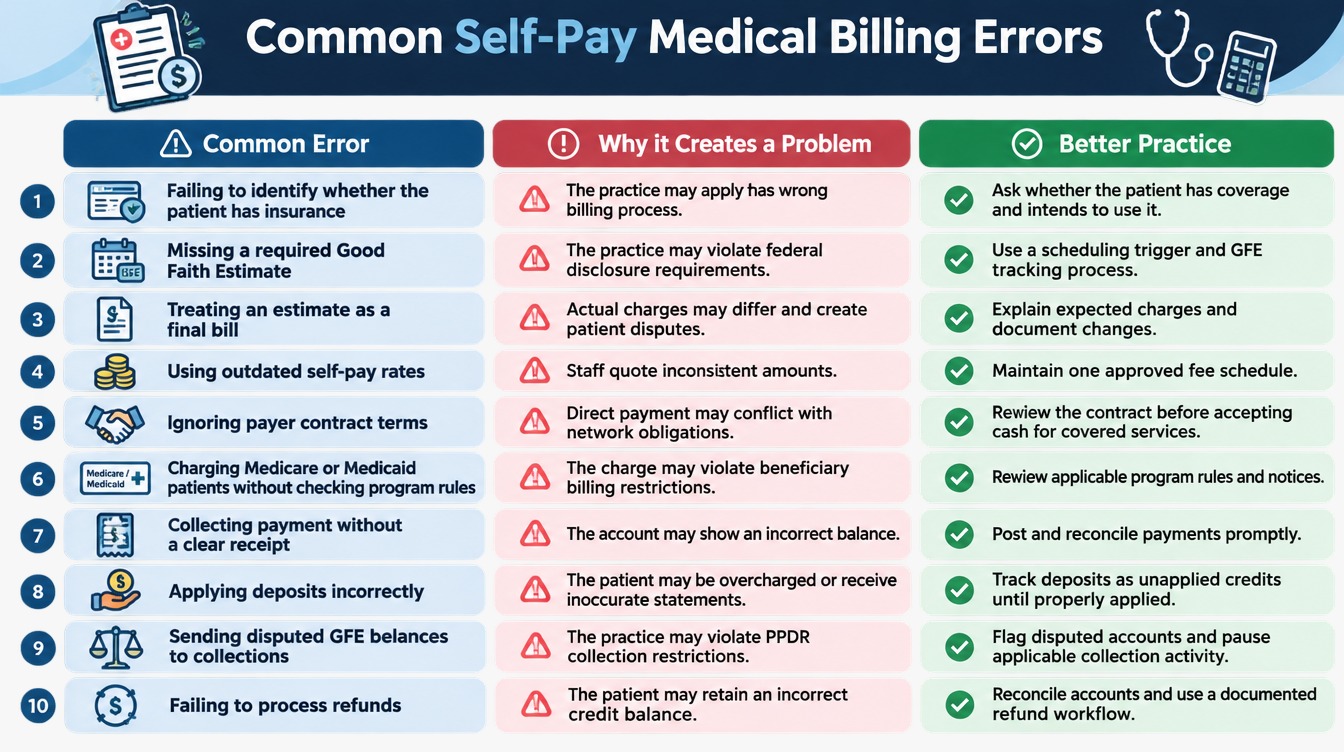
Key Performance Indicators for Self-Pay Medical Billing
A practice should monitor self-pay performance separately from insurance accounts. Insurance claims may remain unpaid because of payer processing or authorization delays, while self-pay balances depend more directly on the practice’s pricing, collection process, and patient payment arrangements.
| KPI | What it measures | Why it matters |
| Point-of-service collection rate | Payments collected at or before the appointment compared with expected patient charges | Shows how consistently the practice collects upfront |
| Self-pay collection rate | Payments received compared with self-pay charges due | Measures overall collection performance |
| Self-pay A/R days | Average time self-pay balances remain outstanding | Highlights slow patient collections |
| Self-pay A/R aging | Balances grouped by age | Identifies accounts requiring follow-up |
| Estimate-to-final variance | Difference between estimated and final charges | Helps identify pricing and estimate accuracy issues |
| Payment plan default rate | Share of payment plans that become delinquent | Shows whether payment terms are workable |
| Refund turnaround time | Time between identifying a credit and issuing the refund | Measures credit-balance management |
| Bad debt rate | Self-pay balances written off as uncollectible compared with the relevant charges | Shows the financial effect of unpaid patient accounts |
Point-of-Service Collection Rate
This metric shows how much of the expected patient payment the practice collects before or during the visit.
A practice can calculate it as:
Point-of-Service Collection Rate = Payments Collected at or Before Service ÷ Expected Self-Pay Charges × 100
For example, if a practice expects $8,000 in self-pay charges during a reporting period and collects $6,000 at or before the appointments, its point-of-service collection rate is 75%.
The practice should define the reporting period and denominator consistently. It should not count deposits twice or treat an estimate as a final charge when the service has not yet occurred.
Self-Pay A/R Aging
A/R aging shows how long patient balances remain unpaid. Common reporting categories include current, 1 to 30 days, 31 to 60 days, 61 to 90 days, and over 90 days.
Management should review older accounts to identify whether the balance reflects a patient dispute, incorrect statement, missing refund, payment plan, or collection issue.
Estimate-to-Final Variance
This metric compares the Good Faith Estimate with the final charges for the same provider or facility and service scope.
A large variance may indicate that the practice needs to improve service planning, estimate calculations, or communication about additional services. The practice should review whether the final bill triggers the federal patient-provider dispute process rather than treating every variance as an ordinary collection issue.
Best Practices for Improving Self-Pay Collections
A reliable self-pay process combines accurate pricing, clear communication, accessible payment methods, and disciplined account reconciliation.
- Maintain an approved fee schedule. Staff should quote rates from a controlled source rather than relying on memory or old documents.
- Identify self-pay status during scheduling. Ask whether the patient has coverage and whether they intend to use it for the service.
- Build Good Faith Estimate steps into scheduling. Use reminders and deadlines so staff do not overlook eligible patients.
- Explain charges before care. Tell patients what the quoted price includes and which services may create additional charges.
- Collect payments consistently. Apply the same approved policy across comparable patient accounts.
- Offer practical payment options. Secure online payments and written installment plans can help patients manage balances.
- Post payments promptly. Reconcile deposits, receipts, refunds, and patient credits before issuing statements.
- Separate disputed balances from ordinary A/R. A patient-provider dispute requires a different workflow from a routine overdue account.
- Review payer contracts and government program rules. Do not assume a patient can opt out of insurance billing or pay privately in every situation.
- Audit self-pay accounts. Periodically review estimates, payment records, fee adjustments, and refunds to identify recurring errors.
Final Takeaway
Self-pay medical billing gives patients a direct payment option and gives practices another way to manage services not billed to a health plan. However, direct payment does not remove the need for accurate pricing, clear financial communication, proper documentation, or compliance with federal and state billing requirements.
A sound self-pay process begins at scheduling. The practice identifies whether the patient intends to use insurance, checks whether the arrangement is permitted, provides a Good Faith Estimate when required, and explains the payment policy before care. After the service, staff post payments accurately, reconcile the final balance, and handle disputes and refunds through defined procedures.
For medical practices, the goal is not simply to collect more money at the front desk. It is to make patient responsibility understandable, keep financial records accurate, and prevent avoidable disputes from entering the accounts receivable cycle.