Medicare durable medical equipment billing involves more than selecting a Healthcare Common Procedure Coding System (HCPCS) code and submitting a claim. A supplier must establish Medicare enrollment, maintain the required accreditation and surety bond, verify coverage, obtain a valid order, retain clinical support, meet delivery requirements, apply the correct modifiers, and follow the billing rules for the specific equipment category.
A claim can include the correct HCPCS code and still fail if the supplier delivers an item before obtaining a required written order, bills a refill without confirming the beneficiary needs it, or submits a rental claim with the wrong modifier. These errors affect more than reimbursement. Repeated noncompliance can place a supplier’s Medicare billing privileges at risk.
The 2026 Medicare DME billing requirements also include significant program changes. CMS now requires more frequent DMEPOS accreditation surveys, expanded the list of items requiring a face-to-face encounter and a written order before delivery, and introduced probationary prior authorization for certain items furnished by newly enrolled suppliers and suppliers undergoing specified ownership changes.
This guide explains Medicare DME billing requirements for 2026, including supplier enrollment, medical necessity, Standard Written Orders, face-to-face encounters, HCPCS coding, modifiers, proof of delivery, prior authorization, recurring supplies, capped rentals, claim submission, reimbursement, and denial prevention.
What Are Medicare DME Billing Requirements?
Medicare DME billing requirements are the federal coverage, enrollment, documentation, coding, delivery, and claim-submission rules that suppliers must follow when they furnish durable medical equipment, prosthetics, orthotics, and supplies to Medicare beneficiaries.
Medicare generally processes covered DMEPOS claims under Part B. The equipment must meet the applicable Medicare benefit category and coverage criteria. A supplier must also satisfy the conditions for Medicare enrollment and maintain the records needed to support the claim.
DMEPOS includes several types of products:
- Durable medical equipment: Equipment such as hospital beds, wheelchairs, walkers, oxygen equipment, and continuous positive airway pressure (CPAP) devices.
- Prosthetics: Artificial limbs and other devices that replace a missing body part or function.
- Orthotics: Braces and other supportive devices used to support or correct a body structure.
- Medical supplies: Items such as diabetic testing supplies, surgical dressings, and certain disposable products.
- Related equipment and accessories: Components and supplies that support the use of covered equipment.
Not every product that a supplier sells qualifies for Medicare reimbursement. The item must meet the applicable Medicare coverage requirements, and the supplier must follow the documentation and coding instructions for that product.
Medicare DME Billing: The Main Requirements
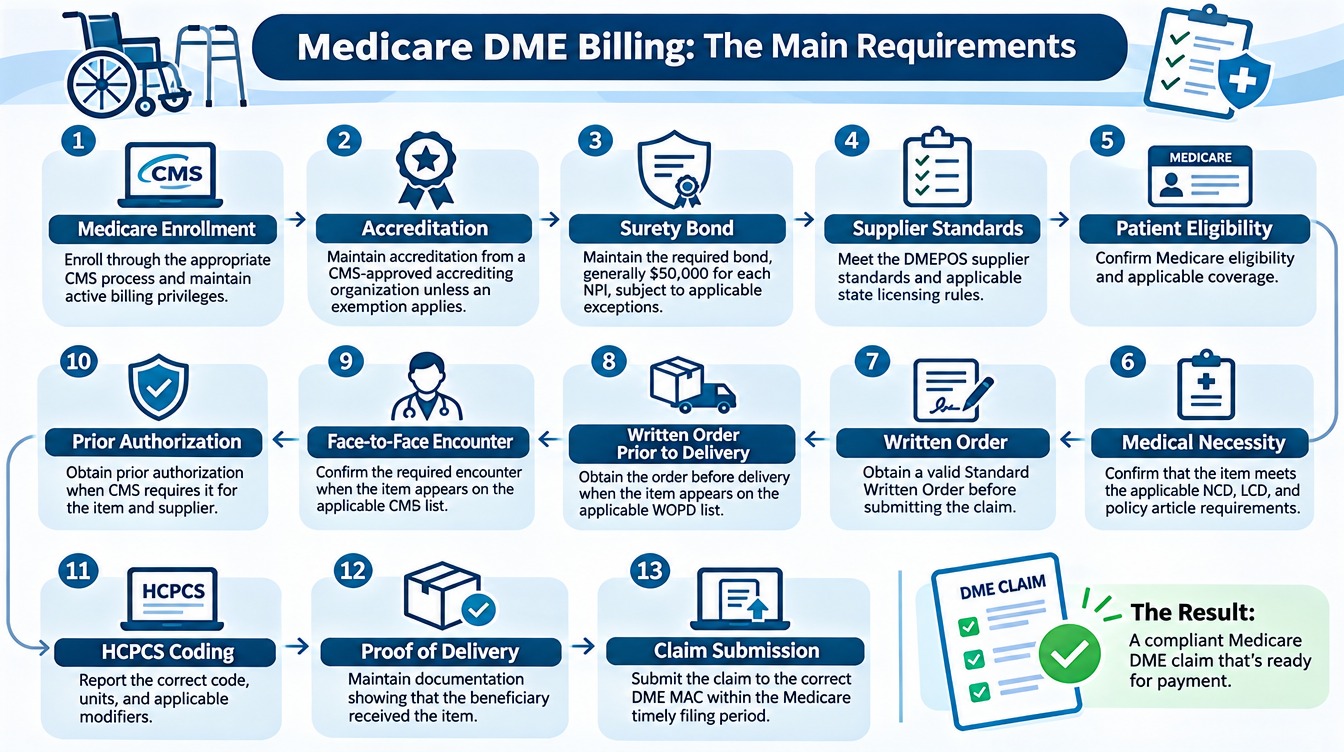
The supplier should review the relevant CMS coverage policy before furnishing an item. A general DME billing checklist cannot replace the specific Local Coverage Determination (LCD), policy article, National Coverage Determination (NCD), or prior authorization instructions that apply to a particular HCPCS code.
2026 Medicare DMEPOS Policy Changes Suppliers Need to Know
DME suppliers should not treat 2026 as a routine annual update. CMS introduced changes that affect accreditation, prior authorization, and documentation before delivery.
Annual DMEPOS Accreditation Surveys and Reaccreditation
CMS changed the DMEPOS accreditation survey and reaccreditation cycle from at least once every three years to at least once every 12 months. The revised requirement took effect January 1, 2026.
This change increases the frequency of accreditation reviews. Suppliers should maintain current policies, staff training records, equipment and inventory controls, complaint procedures, and other records required by the applicable DMEPOS Quality Standards.
A supplier should not wait until an accrediting organization schedules a survey to review its compliance. A location that fails to maintain required accreditation can face Medicare enrollment consequences, including revocation of billing privileges.
Certain professionals and supplier categories may qualify for accreditation exemptions. Suppliers should confirm whether an exemption applies to their organization and product category rather than assuming that every business follows the same accreditation rule.
Expanded Face-to-Face Encounter and Written Order Prior to Delivery List
CMS added more DMEPOS items to the Required Face-to-Face Encounter and Written Order Prior to Delivery List during 2026.
The January 2026 update added eight items involving oxygen and oxygen delivery systems. A Federal Register notice published July 30, 2026, added another 22 codes. As of October 28, 2026, CMS lists 105 items on the face-to-face encounter and WOPD list.
For an item on this list, the supplier must confirm that the treating practitioner completed the required face-to-face encounter and provided the written order before delivering the equipment.
The supplier should check the current CMS list by HCPCS code. A product category alone does not establish whether the WOPD rule applies.
Probationary Prior Authorization for Newly Enrolled Suppliers
CMS introduced a Probationary Prior Authorization (PPA) process beginning October 15, 2026.
The requirement applies to certain DMEPOS items billed by newly enrolled suppliers and suppliers undergoing qualifying changes of ownership. It does not automatically apply to every existing supplier.
Under this process, affected suppliers must submit a prior authorization request and receive a provisional affirmation before delivering an item included on the PPA list. The supplier must also include the applicable Unique Tracking Number (UTN) on the claim.
CMS established a one-year probationary period that begins when the supplier submits its first claim. The PPA requirement applies to the specified items during the applicable period.
An existing supplier should not assume that its prior enrollment history protects every new location. CMS explains that an additional location with a new PTAN generally enrolls separately and may be treated as a newly enrolled supplier for PPA purposes.
Updates to the Required Prior Authorization List
CMS also expanded the standard Required Prior Authorization List during 2026. The updated list includes additional orthoses, pressure-reducing support surfaces, and a manual wheelchair base.
For example, CMS lists the following October 28, 2026 implementation changes:
- Certain additional orthoses became subject to prior authorization nationwide.
- HCPCS code E0194 for a pressure-reducing support surface became subject to prior authorization nationwide.
- HCPCS code K0005, an ultralightweight wheelchair, became subject to prior authorization nationwide.
- Certain upper limb orthoses began a phased implementation, with additional states scheduled for January 26, 2027, and nationwide implementation scheduled for April 26, 2027.
These requirements apply according to the specific code and implementation schedule. Suppliers should verify the current Required Prior Authorization List before delivery.
Medicare DMEPOS Supplier Enrollment Requirements
A supplier must have the appropriate Medicare enrollment before billing Medicare for covered DMEPOS items. Selling medical equipment or holding a general business license does not automatically grant Medicare billing privileges.
CMS requires DMEPOS suppliers to complete the applicable enrollment process and meet the supplier standards under 42 CFR § 424.57.
Steps to Enroll as a Medicare DMEPOS Supplier
Step 1: Obtain the required accreditation
Most DMEPOS suppliers must obtain accreditation from a CMS-approved accrediting organization before submitting their enrollment application. Accreditation confirms that the supplier meets the applicable DMEPOS Quality Standards.
The accreditation must cover the relevant locations and product categories. A supplier should verify that its accreditation information reaches the appropriate National Provider Enrollment (NPE) contractor.
Step 2: Obtain an NPI for each applicable location
CMS generally requires a National Provider Identifier (NPI) for each practice location. The supplier should ensure that the NPI information matches the enrollment records and the location where it furnishes the equipment.
The NPI identifies the supplier in Medicare transactions. It does not replace the Medicare Provider Transaction Access Number (PTAN), which identifies the supplier’s Medicare enrollment.
Step 3: Submit the Medicare enrollment application
DMEPOS suppliers generally enroll through the Provider Enrollment, Chain, and Ownership System (PECOS) using the CMS-855S enrollment application.
The application must contain accurate ownership, location, business, contact, and operational information. Incomplete or inconsistent enrollment information can delay processing.
Step 4: Complete the Electronic Funds Transfer authorization
Suppliers must provide the required banking information through the CMS-588 Electronic Funds Transfer Authorization Agreement so Medicare can issue payments electronically.
Step 5: Pay the application fee when required
The supplier must pay the applicable Medicare enrollment application fee when CMS requires one. The amount may change, so the supplier should check the current CMS fee instructions before submitting the application.
Step 6: Obtain the required surety bond
CMS generally requires a DMEPOS supplier to maintain a $50,000 surety bond for each NPI. The bond must meet CMS requirements and remain valid.
Some supplier types may qualify for exceptions. Suppliers should confirm their status with the appropriate enrollment contractor.
Step 7: Maintain accurate enrollment information
Suppliers must report specified changes to their enrollment information within 30 days. Examples include:
- Change in ownership
- Change in practice or business location
- Adverse legal action
- Other reportable changes to enrollment information
A supplier should update PECOS or submit the applicable enrollment documentation promptly. Delayed reporting can create compliance problems and place billing privileges at risk.
DMEPOS Accreditation Is Not the Same as Medicare Enrollment
Accreditation and Medicare enrollment serve different purposes.
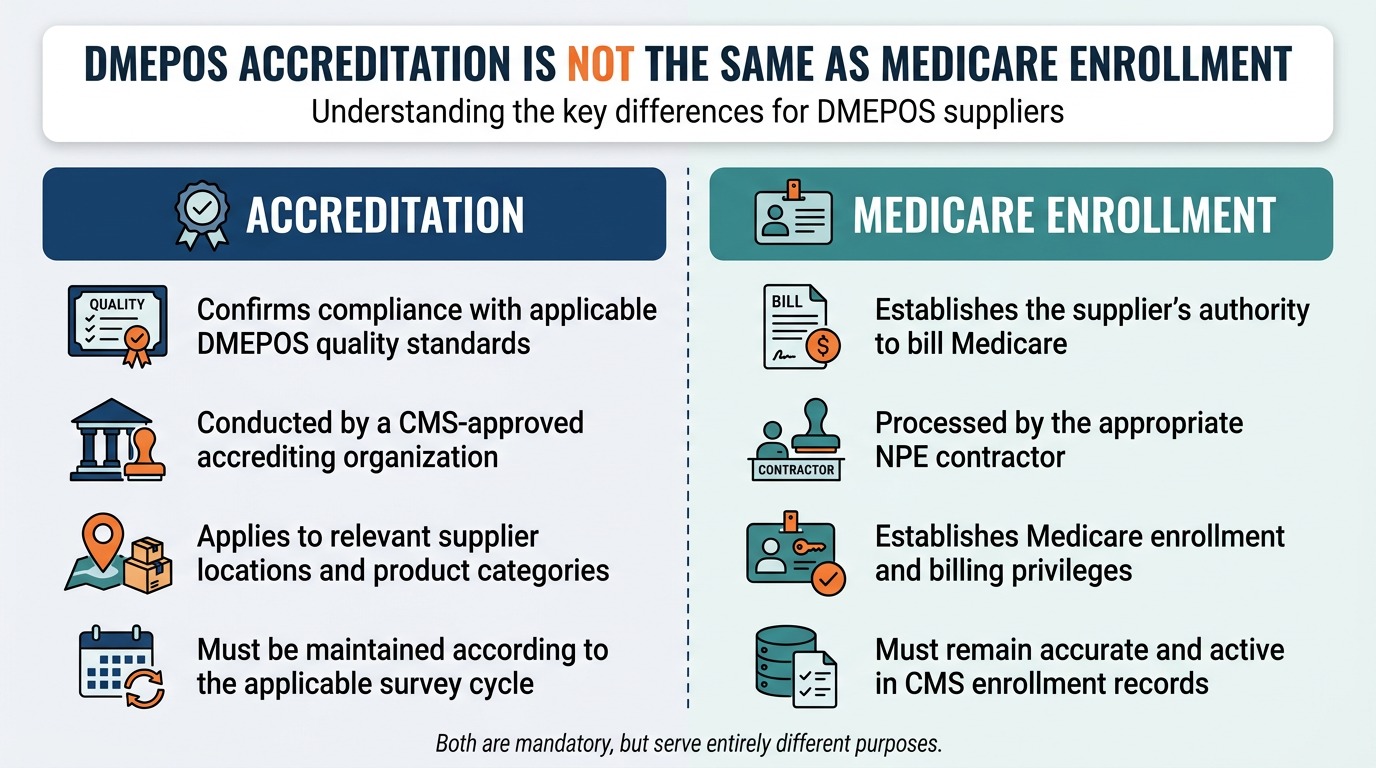
A supplier should maintain both requirements when both apply. Accreditation does not automatically activate Medicare billing privileges, and an active PTAN does not excuse a supplier from maintaining required accreditation.
Medicare DME Medical Necessity Requirements
Medicare does not pay for DME simply because a practitioner prescribed it. The item must meet the applicable coverage criteria and qualify under the Medicare benefit category.
Medical necessity must be supported by the beneficiary’s clinical record. The supplier should compare the documentation with the applicable LCD, policy article, or NCD before billing.
What Must the Medical Record Establish?
The supporting record should demonstrate why the beneficiary needs the equipment and how the item meets the relevant coverage requirements.
Depending on the product and policy, the record may need to show:
- The beneficiary’s diagnosis or medical condition
- Symptoms, functional limitations, or physical impairments
- Clinical findings that support the need for the equipment
- Why the requested item is appropriate for the beneficiary
- The expected use or treatment purpose
- Relevant test results or measurements
- The treating practitioner’s evaluation and plan
- Continued medical need and use for recurring or rented equipment, when required
The exact documentation varies by item. A power mobility device, oxygen system, CPAP device, and surgical dressing do not have identical coverage criteria.
For this reason, suppliers should not rely on a generic medical necessity statement. They should identify the specific policy requirements associated with the HCPCS code.
Medical Necessity and the LCD
A Local Coverage Determination explains whether Medicare covers a service or item in a particular DME MAC jurisdiction and describes the applicable coverage criteria.
The related policy article may contain additional coding, documentation, and billing instructions.
Before submitting a claim, the supplier should confirm:
- Whether Medicare covers the item.
- Whether the beneficiary meets the clinical criteria.
- Whether the requested item meets the applicable product definition.
- Whether the supplier must obtain a face-to-face encounter or WOPD.
- Whether prior authorization applies.
- Whether the claim requires specific modifiers or additional documentation.
A valid order does not guarantee payment. The medical record must still support the item under the applicable Medicare policy.
Standard Written Order Requirements for Medicare DME
Medicare requires a written order or prescription from the treating practitioner for DMEPOS claims. The standardized order is known as a Standard Written Order (SWO).
The SWO must contain the required information before the supplier submits the claim. The supplier should keep the order on file and make it available to the DME Medicare Administrative Contractor (MAC) upon request.
What Information Must an SWO Include?
A Standard Written Order must contain:
| Required element | Description |
| Beneficiary name or MBI | The patient’s name or Medicare Beneficiary Identifier |
| Item description | A general description of the equipment or supply |
| Quantity | The quantity, when applicable |
| Treating practitioner name or NPI | Identifies the practitioner responsible for the order |
| Order date | The date the practitioner created the order |
| Treating practitioner signature | The practitioner’s valid signature |
The item description may use a general description, HCPCS code, HCPCS code narrative, or brand name and model number, as permitted by CMS requirements.
The supplier should check the applicable policy for additional product-specific information. Some items require more than the general SWO elements.
Does Medicare Require an SWO Before Delivery?
Not for every DMEPOS item.
The supplier must obtain the SWO before submitting the claim. However, CMS requires a Written Order Prior to Delivery for items included on the Required Face-to-Face Encounter and Written Order Prior to Delivery List.
This distinction matters. A supplier that treats every SWO as a WOPD may create unnecessary delivery delays. A supplier that treats a WOPD item like an ordinary order may deliver equipment before meeting a condition of payment.
SWO vs. WOPD
| Standard Written Order | Written Order Prior to Delivery |
| General written order requirement for DMEPOS claims | Additional timing requirement for specified items |
| Must be obtained before claim submission | Must be obtained before delivery |
| Applies to covered DMEPOS claims | Applies only to items on the applicable CMS list |
| Must contain the required SWO elements | Must satisfy the SWO requirements and be received before delivery |
Suppliers should use the current CMS list to determine which HCPCS codes require a WOPD. They should not assume that all items in a broad product family have the same order timing requirement.
Are Certificates of Medical Necessity Still Required?
CMS eliminated Certificates of Medical Necessity (CMNs) and DME Information Forms (DIFs) for claims with dates of service on or after January 1, 2023, under the applicable Medicare changes.
Suppliers should use the current SWO requirements and maintain the supporting medical record. They should not continue using an outdated CMN workflow as a substitute for the current order and documentation rules.
Face-to-Face Encounter Requirements for DMEPOS
Certain DMEPOS items require a face-to-face encounter between the beneficiary and the treating practitioner. The encounter must meet CMS timing and documentation requirements.
For items on the applicable face-to-face and WOPD list, the encounter generally must occur within the six months before the written order. The supplier must also receive the written order before delivering the item.
The supplier should verify the applicable code on the current CMS list because the requirement does not apply uniformly to every DMEPOS product.
What Should the Face-to-Face Record Include?
The treating practitioner’s record should support the beneficiary’s need for the requested equipment. Depending on the item, the record may need to describe:
- The beneficiary’s medical condition
- Relevant examination findings
- Functional limitations
- The reason the equipment is necessary
- The type of equipment required
- Clinical information that supports the applicable LCD criteria
The supplier should not assume that a brief statement such as “patient needs wheelchair” satisfies the coverage requirements for a complex mobility device.
Supplier Responsibilities
The supplier should verify the encounter date, practitioner information, written order, and required clinical documentation before delivery.
If the item requires a WOPD, the supplier must not deliver it first and request the order afterward. A later signature does not correct a failure to meet a pre-delivery condition.
Medicare DME Prior Authorization Requirements in 2026
Prior authorization is a condition of payment for DMEPOS items included on the applicable Required Prior Authorization List. The supplier must submit the required documentation and receive the applicable decision before furnishing the item when the program requires pre-delivery authorization.
CMS uses prior authorization to determine whether an item meets Medicare coverage, payment, and coding requirements before delivery.
Standard DMEPOS Prior Authorization
The supplier should identify whether the HCPCS code appears on the current Required Prior Authorization List. If it does, the supplier must prepare and submit a Prior Authorization Request (PAR).
The request generally includes:
- Beneficiary name and Medicare number
- Beneficiary date of birth and address
- Place of service
- Diagnosis code
- Supplier name and NPE number
- Supplier NPI and address
- Requestor information, when applicable
- Standard Written Order or WOPD, as required
- Face-to-face encounter records, when required
- Medical records supporting medical necessity
- Additional product-specific documentation
CMS and the DME MAC review the submitted information and issue a decision. A provisional affirmation indicates that the submitted documentation supports the applicable requirements at the time of review. It does not remove the supplier’s responsibility to submit a correct claim or maintain the required records.
What Is a Unique Tracking Number?
A Unique Tracking Number (UTN) identifies the prior authorization decision. When CMS requires a UTN for the item, the supplier must report it correctly on the claim.
A supplier should not submit the claim before receiving the required authorization information. CMS warns that claims submitted before the UTN is available may be automatically denied and may require a formal reopening request.
Probationary Prior Authorization for New Suppliers
The 2026 PPA process adds another layer of review for certain newly enrolled suppliers and suppliers with qualifying changes of ownership.
The supplier should determine whether it falls within the program before furnishing an item on the PPA list. The requirement applies to the specified HCPCS codes and the applicable one-year probationary period.
CMS currently identifies 40 codes on the PPA list, including 38 orthoses and two osteogenesis stimulators. The list may change, so suppliers should check the CMS page before relying on an older code list.
A supplier should pay particular attention when it:
- Receives a new Medicare enrollment approval on or after October 15, 2026.
- Completes a qualifying change of ownership.
- Opens an additional location with a new PTAN.
- Furnishes an item included on the PPA list.
The PPA process does not replace the standard prior authorization program. A supplier may need to comply with both programs when the applicable item and supplier circumstances trigger the requirements.
Can a Supplier Qualify for a Prior Authorization Exemption?
CMS established a supplier exemption process for certain prior authorization requirements. A supplier may qualify when it submits at least 10 prior authorization requests and achieves a provisional affirmation rate of at least 90% during the applicable annual assessment.
The exemption generally lasts one year, unless CMS withdraws it. Suppliers should review their exemption notice and effective dates before deciding whether a PAR is required.
An exemption from one prior authorization process does not automatically remove other applicable requirements, including PPA or face-to-face and WOPD rules.
HCPCS Coding for Medicare DME Claims
Medicare uses HCPCS Level II codes to identify DMEPOS items on claims. Each code describes a specific product, equipment category, supply, or service.
The supplier must select a code that accurately represents the item furnished. A code that appears similar to the product name may still be incorrect if the item does not meet the code description or applicable coding instructions.
Before billing, the supplier should:
- Identify the exact product furnished.
- Review the current HCPCS Level II code description.
- Check the applicable LCD and policy article.
- Confirm whether the code requires prior authorization.
- Review any product-specific modifiers.
- Verify units, rental periods, and billing frequency.
- Confirm that the documentation supports the selected code.
Suppliers should review CMS HCPCS updates and DME MAC coding articles regularly. A code change, deleted code, or revised descriptor can affect claim submission.
HCPCS Coding Must Match the Product Delivered
The code on the claim should describe the item the beneficiary actually received. Suppliers should not select a higher-paying code simply because the beneficiary’s condition appears complex.
For products with different configurations, accessories, or performance levels, the supplier should confirm that the documentation supports the specific billed code.
A mismatch between the product, order, delivery record, and claim can result in a coding denial or medical review.
Medicare DME Billing Modifiers and Their Uses
DMEPOS modifiers communicate information about the equipment, purchase or rental arrangement, replacement circumstances, and other billing conditions. The correct modifier depends on the HCPCS code and the specific transaction.
The supplier should not apply modifiers based only on a general list. Each modifier must be valid for the item and supported by the claim circumstances.
| Modifier | General meaning | When it is used |
| NU | New equipment | Identifies new equipment when applicable |
| UE | Used equipment | Identifies used equipment when applicable |
| RR | Rental | Identifies equipment furnished as a rental |
| NR | New when rented | Used when equipment that was new at the time of rental is subsequently purchased |
| KH | Initial claim for purchase or first month rental | Used for applicable capped rental or related billing categories |
| KI | Second or third month rental | Used for applicable capped rental items |
| KJ | Fourth through fifteenth month rental | Used for applicable capped rental or specified equipment categories |
| BP | Beneficiary elected purchase | Indicates that the beneficiary was informed of purchase and rental options and chose to purchase |
| BR | Beneficiary elected rental | Indicates that the beneficiary was informed of purchase and rental options and chose to rent |
| BU | Beneficiary has not made a decision | Indicates that the beneficiary was informed of the options but did not decide within 30 days |
| EY | No physician or other licensed health care provider order for the item or service | Used when the applicable order requirement is not met |
| GA | Waiver of liability statement issued as required by payer policy | Used when the required waiver is on file |
| GZ | Item or service expected to be denied as not reasonable and necessary, with no required waiver on file | Used in applicable circumstances |
| KX | Requirements specified in the medical policy have been met | Used when required by the applicable policy |
| RA | Replacement of a DME item | Used for an applicable replacement item |
| RB | Replacement of a part of a DME item furnished as part of a repair | Used for an applicable replacement part |
Some modifiers apply only to particular equipment categories or billing situations. For example, KH, KI, and KJ have specific uses in capped rental billing. They are not general-purpose rental modifiers for every DMEPOS item.
Rental vs. Purchase Modifiers
The supplier must identify whether the beneficiary is purchasing or renting the equipment.
For applicable items, the BP modifier indicates that the beneficiary chose to purchase after receiving information about the purchase and rental options. BR indicates that the beneficiary chose rental. BU indicates that the beneficiary did not communicate a decision within 30 days after receiving the required information.
RR identifies rental equipment. NU and UE distinguish new and used equipment when applicable.
The supplier should check the HCPCS code and Medicare billing instructions before combining modifiers. A modifier that is appropriate for one equipment category may not be valid for another.
Capped Rental Modifiers
Certain DME items fall under Medicare’s capped rental payment category. These items have specific monthly billing rules and may transition to beneficiary ownership after the applicable rental period.
For applicable capped rental items, the supplier may need to use:
- KH: Initial claim or first month rental
- KI: Second or third month rental
- KJ: Fourth through fifteenth month rental
The supplier must track the rental month accurately. Incorrect month sequencing can result in claim processing problems and payment delays.
Not every rented DME item follows the capped rental method. Other payment categories may apply, including inexpensive or routinely purchased equipment, oxygen equipment, and equipment requiring frequent and substantial servicing. Suppliers should verify the payment category before setting up the billing schedule.
Proof of Delivery Requirements for Medicare DME
Proof of Delivery (POD) is a required supplier record. It establishes that the beneficiary or authorized representative received the equipment or supplies billed to Medicare.
The supplier must maintain POD documentation and provide it to the DME MAC when requested. CMS requires suppliers to retain POD for seven years from the date of service.
What Should Proof of Delivery Show?
The documentation should establish:
- The beneficiary who received the item
- The item delivered
- The delivery date
- The delivery location
- The identity or signature of the person receiving the item, as applicable
- The supplier or delivery service responsible for furnishing the item
The exact POD method depends on the delivery arrangement and CMS requirements. Suppliers should follow the applicable DME MAC instructions for direct delivery, shipping, and retail pickup.
Why POD Matters
A supplier may have a valid order and strong medical necessity documentation but still face a denial if it cannot establish that the beneficiary received the billed item.
The supplier should reconcile the delivery record with the order and claim. The product description, quantity, beneficiary information, and date should agree across the records.
Medicare Refill Requirements for DMEPOS Supplies
Medicare does not allow suppliers to ship recurring supplies automatically just because a beneficiary has an open order or previously authorized refills.
Before dispensing a refill, the supplier must contact the beneficiary or the beneficiary’s representative and confirm that the refill is needed.
CMS requires the supplier to document the affirmative refill request within 30 calendar days before the expected end of the current supply. The supplier must not deliver the refill earlier than 10 calendar days before the current supply is expected to run out.
What Must the Supplier Document?
For shipped items, the refill record should include:
- Beneficiary name
- Date of contact
- Item requested
- Confirmation that the beneficiary needs the refill
- Explanation or confirmation of the refill need
The supplier may use an appropriate communication method, including phone, text, or email, if the record captures the required information and the beneficiary or representative provides an affirmative response.
A supplier should not rely on a standing authorization to ship supplies without confirming current need.
Example of a Medicare-Compliant Refill Timeline
Assume a beneficiary’s current supply is expected to last through December 31.
The supplier may contact the beneficiary during the 30-calendar-day period before the supply ends to confirm the need for a refill. The supplier must document the beneficiary’s affirmative response before shipping. Delivery cannot occur earlier than 10 calendar days before the expected end of the current supply.
The supplier should also confirm that the beneficiary continues to use the base equipment and that the refill quantity matches the applicable policy.
Medicare DME Claim Submission Requirements
Once the supplier confirms eligibility, coverage, documentation, coding, and delivery requirements, it can prepare the Medicare claim.
Most DMEPOS claims are submitted electronically to the appropriate DME MAC. The supplier must use the correct jurisdiction and report the information required for the HCPCS code and claim type.
Which Medicare Contractor Processes DME Claims?
DMEPOS claims are processed by the DME Medicare Administrative Contractors. Suppliers should identify the correct DME MAC jurisdiction based on the beneficiary’s location and the applicable item.
The National Provider Enrollment contractors and DME MACs perform different functions:
- NPE contractors: Process DMEPOS supplier enrollment.
- DME MACs: Process DMEPOS claims and handle related coverage, billing, and medical review functions.
Submitting enrollment questions to a DME MAC or sending claims to an enrollment contractor can delay the process.
What Information Should the Claim Contain?
The claim should accurately report:
- Beneficiary identification
- Supplier identification and NPI
- HCPCS code
- Date of service
- Units or quantity
- Applicable modifiers
- Place of service
- Submitted charge
- Required authorization information, including UTN when applicable
- Other claim details required by the DME MAC
The supplier should check the applicable billing instructions for the item. Some products require additional information, date spans, or claim narratives.
Medicare Timely Filing Limit
Medicare generally requires the claim to reach the correct Medicare contractor no later than one calendar year after the date of service.
For DMEPOS claims, the supplier should not wait until the end of the filing period. Documentation requests, coding corrections, eligibility issues, and authorization problems can delay submission.
A claim filed after the timely filing deadline may be denied. Medicare’s timely filing denial is generally not an initial determination subject to the ordinary appeal process, so suppliers should monitor filing dates closely.
Medicare Capped Rental, Purchase, and Other DME Payment Categories
Medicare does not reimburse every DME item under the same payment method. The payment category affects the supplier’s billing frequency, rental modifiers, documentation, and expected payment period.
Capped Rental Equipment
Under the capped rental method, Medicare pays monthly rental amounts for applicable equipment during the rental period. After the applicable rental period, ownership generally transfers to the beneficiary under the Medicare rules.
The supplier must track rental months and submit claims using the appropriate modifiers. The supplier should also monitor continued medical need and use when required.
A supplier should not assume that every item furnished on a rental basis is capped rental equipment. The HCPCS code and Medicare payment rules determine the applicable category.
Inexpensive or Routinely Purchased Equipment
Some equipment falls under the inexpensive or routinely purchased category. Medicare may pay for the item through purchase or rental, depending on the applicable payment rules.
The supplier should verify the code’s payment category and follow the related billing instructions.
Oxygen Equipment
Oxygen equipment follows separate Medicare payment rules. The supplier should review the applicable oxygen coverage criteria, rental payment period, documentation requirements, and rules for related accessories and supplies.
Oxygen claims should not be processed using generic capped rental assumptions without checking the specific Medicare policy.
Equipment Requiring Frequent and Substantial Servicing
Some equipment requires frequent and substantial servicing to maintain its operation. These items may fall under a different payment method from capped rental equipment.
The supplier should confirm the payment category and any special billing requirements before submitting the claim.
Medicare DME Billing During a Skilled Nursing Facility Stay
A beneficiary’s setting can change who is responsible for billing Medicare. Suppliers must check whether the beneficiary is in a Medicare-covered Part A skilled nursing facility (SNF) stay before billing DMEPOS items separately.
Under SNF consolidated billing, the SNF generally has billing responsibility for services and items included in the consolidated payment during a covered Part A stay. Outside suppliers generally cannot bill Medicare Part B separately for items included in the SNF’s consolidated billing responsibility.
There are limited statutory exceptions. Customized prosthetic devices are among the services excluded from SNF consolidated billing in specified circumstances.
A supplier should verify:
- Whether the beneficiary is in a covered Part A SNF stay
- Whether the item falls within SNF consolidated billing
- Whether a statutory exclusion applies
- Whether the SNF or outside supplier has the billing responsibility
A claim submitted by the wrong party can result in denial or duplicate billing concerns.
Medicare DME Replacement and Repair Billing
Replacement and repair claims require documentation that supports the need for the work and the continued medical necessity of the equipment.
Replacing DME
Medicare generally defines replacement as furnishing an identical or nearly identical item when the original equipment is lost, stolen, or irreparably damaged.
Replacement due to irreparable wear is subject to the applicable reasonable useful lifetime rules. In the absence of specific program instructions, the useful lifetime generally cannot be less than five years.
The supplier should retain documentation explaining the circumstances that made replacement necessary. Depending on the situation, this may include an incident report, insurance documentation, or other evidence of loss or damage.
The supplier should also confirm whether a new treating practitioner order is required.
Repairing DME
For a repair claim, the documentation should establish two points:
- The equipment remains reasonable and necessary for the beneficiary.
- The repair itself is reasonable and necessary.
The supplier should keep detailed repair records, including the problem reported, the work performed, the parts replaced, and the labor required.
A vague repair description may not establish why the work was necessary or whether the billed parts and labor were appropriate.
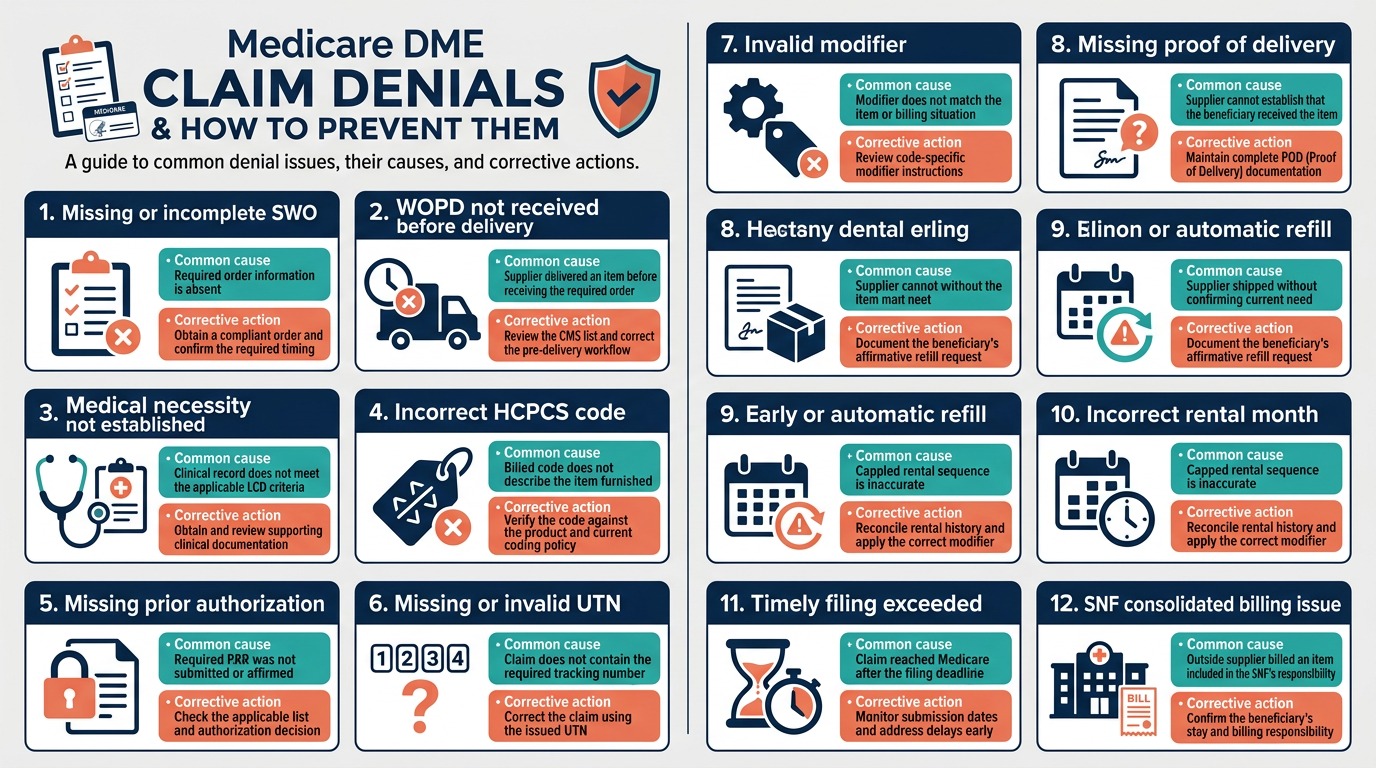
Medicare DME Claim Denials and How to Prevent Them
DME claim denials often result from a mismatch between the order, clinical record, product delivered, coding, authorization, and claim.
A supplier should identify the actual denial reason before correcting or resubmitting a claim. Changing a modifier without reviewing the underlying documentation may not resolve the problem.
Common Reasons for Medicare DME Claim Denials
How to Reduce DME Billing Denials
A reliable denial prevention process starts before delivery.
- Verify coverage before intake is complete. Confirm the beneficiary’s Medicare status and check whether the item meets the applicable coverage policy.
- Review the order before delivery. Determine whether the item requires an ordinary SWO or a WOPD. Do not use one rule for every product.
- Check prior authorization requirements. Review both the standard Required Prior Authorization List and the probationary list when the supplier’s enrollment status makes PPA relevant.
- Match the code to the item. Confirm the HCPCS description, product configuration, units, and modifiers.
- Reconcile delivery and claim information. Make sure the POD matches the beneficiary, item, quantity, and date billed.
- Monitor recurring supplies. Document the beneficiary’s refill request and follow the 30-day and 10-day timing requirements.
- Review denials by root cause. Track whether errors come from enrollment, documentation, coding, authorization, delivery, or claim submission. Correct the workflow that produced the denial instead of repeatedly fixing claims one at a time.
- Medicare DME Audit and Documentation Requirements
- DMEPOS suppliers should maintain records that support the services and items they bill. CMS and its contractors may request documentation to confirm that a claim met Medicare coverage, payment, and supplier requirements.
The supplier should maintain an organized record for each beneficiary and item furnished.
Documents to Retain
Depending on the item and claim, the file may include:
- Standard Written Order
- Written Order Prior to Delivery, when applicable
- Face-to-face encounter documentation
- Clinical records supporting medical necessity
- Prior authorization request and decision
- UTN, when applicable
- HCPCS coding and modifier details
- Proof of delivery
- Refill request documentation
- Rental history
- Continued-use and continued-medical-need records
- Repair and replacement records
- Claim submission and remittance information
- Relevant supplier communications
CMS requires suppliers to retain POD for seven years from the date of service. The supplier should also follow the applicable record-retention requirements for other documentation.
What Happens When a Supplier Cannot Support a Claim?
If the supplier cannot provide the required documentation, Medicare may deny the claim or seek recovery of a prior payment.
Depending on the facts, enrollment or supplier-standard violations may also lead to additional administrative action. Suppliers should treat a documentation request as a compliance matter, not merely a billing follow-up.
Frequently Asked Questions
What are the Medicare DME billing requirements in 2026?
Medicare DME suppliers must maintain appropriate enrollment and supplier compliance, confirm coverage and medical necessity, obtain a valid SWO, meet WOPD and face-to-face requirements when applicable, obtain prior authorization when required, use accurate HCPCS codes and modifiers, document delivery, and submit claims to the correct DME MAC within the timely filing period.
Does Medicare require accreditation for all DME suppliers?
Most DMEPOS suppliers must obtain accreditation from a CMS-approved accrediting organization. However, certain professionals and supplier categories may qualify for exemptions. Suppliers should confirm whether their organization and product category fall under an exemption.
How often must DMEPOS suppliers renew accreditation in 2026?
CMS changed the DMEPOS survey and reaccreditation cycle to at least once every 12 months, effective January 1, 2026. This replaces the previous three-year cycle.
What is a Standard Written Order for DME?
A Standard Written Order is the written order or prescription that supports a Medicare DMEPOS claim. It must include the beneficiary name or MBI, item description, quantity (when applicable), the treating practitioner’s name or NPI, the order date, and the treating practitioner’s signature.
What is the difference between an SWO and a WOPD?
An SWO is the general written order required for DMEPOS claims. A WOPD is an additional timing requirement for specified items. The supplier must receive the written order before delivering an item subject to the WOPD rule.