
Infusion billing involves coding, documenting, and submitting claims for medications and fluids administered through an intravenous or other approved route. Hospitals, physician practices, ambulatory infusion centers, oncology clinics, home infusion providers, and specialty pharmacies must follow different billing rules depending on the drug, administration method, place of service, and payer. This guide explains infusion CPT and HCPCS codes, drug billing, administration time, medical necessity, documentation, Medicare requirements, reimbursement, and common claim errors.
What Is Infusion Billing?
Infusion billing is the process of coding and submitting claims for medications, biological products, and fluids administered through an intravenous or other approved route. Providers must report the drug or substance, administration service, dosage, units, and supporting clinical documentation according to the applicable payer rules.
Infusion billing involves several types of healthcare services. A physician practice may administer an injectable medication during an office visit, an oncology clinic may provide chemotherapy, a hospital outpatient department may administer biological therapy, and a home infusion provider may coordinate medication delivery, equipment, and nursing services.
Each setting has different billing and reimbursement requirements. The correct claim depends on the medication, route of administration, infusion duration, clinical purpose, place of service, and provider type.
A complete infusion claim may involve two separate components:
- Drug billing: Reporting the medication or biological product using the appropriate HCPCS Level II code, NDC information when required, and units of service.
- Administration billing: Reporting the professional or facility service involved in administering the medication using the appropriate CPT or HCPCS code.
Providers must also establish medical necessity, document the actual administration, follow coding hierarchy rules, and check payer coverage policies. Reporting the drug without the correct administration details, or billing administration without supporting records, can lead to claim denials and reimbursement problems.
This guide explains infusion billing for physician practices, oncology clinics, hospitals, ambulatory infusion centers, specialty providers, and home infusion companies. It covers the major CPT code families, Medicare billing requirements, drug wastage modifiers, documentation standards, reimbursement methods, and common billing mistakes.
Which Healthcare Providers Need Infusion Billing?
Infusion billing applies to several healthcare settings. The billing process varies according to the services each provider furnishes and the rules governing its Medicare or commercial payer contracts.
Physician Offices and Medical Practices
Primary care practices and medical specialists may administer medications through injections or infusions when the service falls within their scope of practice.
Examples include:
- Intravenous antibiotics.
- Therapeutic iron infusions.
- Biological medications.
- Intravenous fluids for clinically indicated hydration.
- Injectable medications for chronic conditions.
- Therapeutic injections.
These practices may bill the medication and administration separately when the payer allows separate payment and the services meet the applicable requirements.
Oncology and Hematology Clinics
Oncology practices frequently administer chemotherapy, immunotherapy, and other antineoplastic or highly complex biological agents.
Their billing teams must distinguish chemotherapy administration from ordinary therapeutic infusions. The code selection depends on the drug, the administration method, and the level of complexity involved.
Common billing responsibilities include:
- Reporting chemotherapy administration.
- Reporting the correct drug HCPCS code.
- Calculating drug units.
- Documenting infusion start and stop times.
- Reporting applicable drug wastage.
- Checking payer authorization requirements.
- Coordinating drug acquisition and reimbursement.
Hospital Outpatient Departments
Hospital outpatient departments administer a wide range of infusion services, including chemotherapy, antibiotics, hydration, blood-related treatments, and biological therapies.
Hospitals generally submit facility claims using the UB-04 or electronic 837I format. The facility reports applicable services, drugs, supplies, and revenue codes under the Hospital Outpatient Prospective Payment System (OPPS), when applicable.
The physician’s professional services may be reported separately on a professional claim. Providers must distinguish the facility’s billing responsibility from the physician’s professional billing.
Ambulatory Infusion Centers
Ambulatory infusion centers provide scheduled infusion treatments without requiring an inpatient hospital admission.
These centers may administer:
- Immunoglobulin therapy.
- Monoclonal antibody treatments.
- Rheumatology medications.
- Neurology medications.
- Antibiotic therapy.
- Iron replacement therapy.
- Other specialty drugs.
Billing teams must verify whether the center bills under a physician office, hospital outpatient, or another facility arrangement. The setting affects claim format, payment methodology, and administration-code reporting.
Home Infusion Providers
Home infusion companies coordinate the delivery and administration of medications in a patient’s residence. Their services may involve specialty pharmacies, nursing agencies, physicians, durable medical equipment suppliers, and health plans.
Medicare’s Home Infusion Therapy benefit covers certain professional services associated with qualifying drugs administered intravenously or subcutaneously through a pump that qualifies as durable medical equipment. The benefit includes specified nursing services, patient and caregiver training, education, and monitoring furnished by a qualified home infusion therapy supplier.
Drug, equipment, supply, and professional service billing may follow different coverage pathways. Providers must identify which entity supplies each component and which benefit covers it. CMS Home Infusion Therapy guidance explains the Medicare benefit and supplier requirements.
Types of Infusion Services and Their Billing Differences
Before assigning a CPT code, the billing team must identify what the provider actually administered. Not every intravenous service qualifies as a therapeutic infusion, and not every medication administration belongs to the same code family.
Therapeutic Infusion
Therapeutic infusions deliver medications or substances to treat a medical condition.
Examples include:
- Intravenous antibiotics.
- Therapeutic iron.
- Certain biological medications.
- Intravenous medications for inflammatory conditions.
- Medications used to manage acute or chronic diseases.
Providers generally evaluate the therapeutic or non-chemotherapy infusion code family, including CPT 96365 and related add-on codes, when the service meets the code requirements.
Chemotherapy Infusion
Chemotherapy administration involves antineoplastic drugs and certain other highly complex medications or biological agents.
CPT codes in the 96401 to 96549 range describe chemotherapy and other highly complex drug administration services. The code family includes different administration routes and methods.
Medicare’s Claims Processing Manual explains that chemotherapy administration codes apply to parenteral antineoplastic drugs and certain agents used for non-cancer diagnoses. Drug names alone do not determine the appropriate code. The level of complexity and clinical circumstances also matter.
Hydration Infusion
Hydration therapy involves the administration of intravenous fluids and electrolytes when clinically necessary.
Examples include:
- Normal saline.
- Dextrose solutions.
- Electrolyte-containing fluids.
Hydration codes do not apply simply because a provider administers fluids during a medication infusion. The service must represent a medically necessary hydration intervention rather than fluid used to dilute or deliver another drug.
Intravenous Push
An IV push involves administering a medication directly into the vascular system through an IV access device. The administration method and provider’s presence during the injection help determine the correct code.
CPT 96374 and related codes apply to certain non-chemotherapy IV push services. Chemotherapy IV push services use a different code family.
Subcutaneous and Intramuscular Injections
Not all medication administration requires an infusion. Subcutaneous and intramuscular injections have their own administration codes.
For example, CPT 96372 describes certain therapeutic, prophylactic, or diagnostic subcutaneous and intramuscular injections. It should not be reported as an IV infusion code.
Infusion CPT Codes: A Complete Billing Reference
Selecting the correct CPT code is one of the most important parts of infusion billing. The code must describe the administration service actually performed, not simply the medication prescribed.
The main infusion administration code families include hydration, non-chemotherapy therapeutic infusions, injections, and chemotherapy administration.
The following table provides commonly used code references. Verify the current CPT codebook, payer policy, and applicable edits before submitting claims. CPT descriptors are proprietary to the American Medical Association.
1. Hydration CPT Codes
| CPT code | General service description | Billing consideration |
| 96360 | Initial IV hydration infusion | Reports qualifying initial hydration |
| 96361 | Additional hour of IV hydration | Add-on code when additional qualifying hydration time is documented |
CPT 96360 applies to the initial hydration service when the required time threshold and clinical criteria are met. CPT 96361 reports additional qualifying hydration time.
Hydration must be medically necessary. A practice cannot bill hydration merely because normal saline was used to keep an IV line open or deliver another medication.
Example: A patient presents with documented dehydration and receives a medically necessary IV fluid infusion. The provider evaluates the patient’s fluid needs, orders hydration, and documents the administration. The billing team reviews the actual duration and applies the appropriate hydration code.
2. Therapeutic, Prophylactic, and Diagnostic Infusion Codes
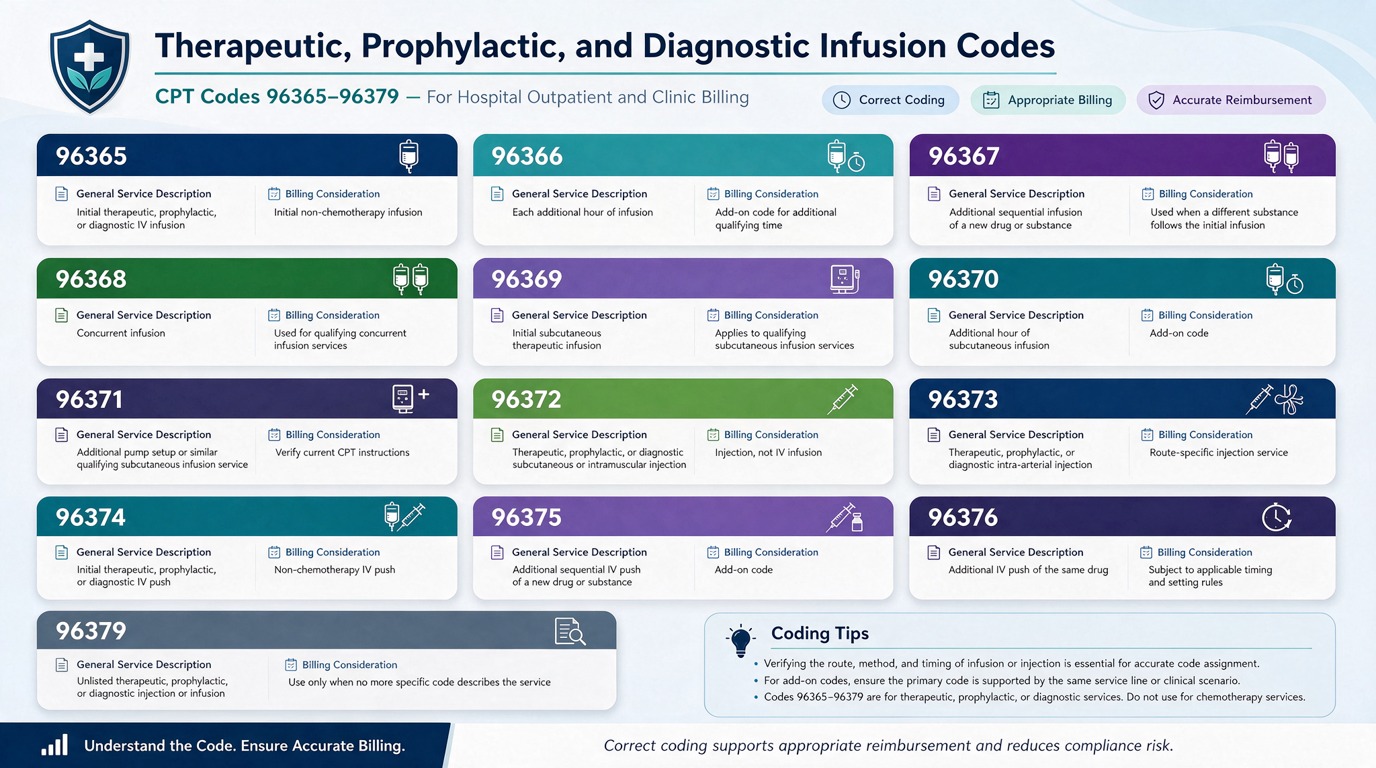
CPT 96365 is frequently used for qualifying non-chemotherapy IV infusion services. The billing team should verify the drug, route, infusion duration, and code hierarchy before assigning it.
CPT 96366 reports additional qualifying infusion time. It is not a separate initial infusion code.
CPT 96367 applies to a qualifying sequential infusion of a different substance. CPT 96368 describes a qualifying concurrent infusion and must follow the applicable coding instructions.
3. Chemotherapy Administration CPT Codes
Chemotherapy administration uses a separate code family because these services involve medications and administration circumstances that may require a higher level of clinical complexity and monitoring.
| CPT code | General service description |
| 96401 | Chemotherapy administration by subcutaneous or intramuscular route |
| 96402 | Hormonal antineoplastic administration by subcutaneous or intramuscular route |
| 96409 | Initial chemotherapy administration by IV push |
| 96411 | Additional chemotherapy IV push administration |
| 96413 | Initial chemotherapy IV infusion |
| 96415 | Each additional hour of chemotherapy infusion |
| 96417 | Sequential infusion of a different chemotherapy drug |
| 96420 | Initial chemotherapy administration by intra-arterial push |
| 96422 | Initial chemotherapy administration by intra-arterial infusion |
| 96521 | Refilling and maintenance of a portable pump |
| 96522 | Refilling and maintenance of an implanted pump or reservoir |
| 96523 | Irrigation of an implanted venous access device |
This table provides common code references, not a complete code set. The appropriate code depends on the actual administration method and current CPT instructions.
For example, CPT 96413 may apply to a qualifying initial chemotherapy infusion, while CPT 96415 reports additional qualifying infusion time. The billing team should not use 96415 without the appropriate primary chemotherapy administration code.
The drug itself also needs separate review. A medication used in oncology does not automatically qualify for chemotherapy administration coding. The clinical purpose, drug characteristics, and Medicare or payer guidance determine the appropriate code family.
4. Drug HCPCS Codes
Administration codes do not identify every medication administered. Many separately payable drugs require HCPCS Level II codes, commonly in the J-code family.
These codes describe specific medications or biological products and define a billing unit. The practice must convert the administered dose into the units described by the HCPCS code.
Examples of drug-code categories include:
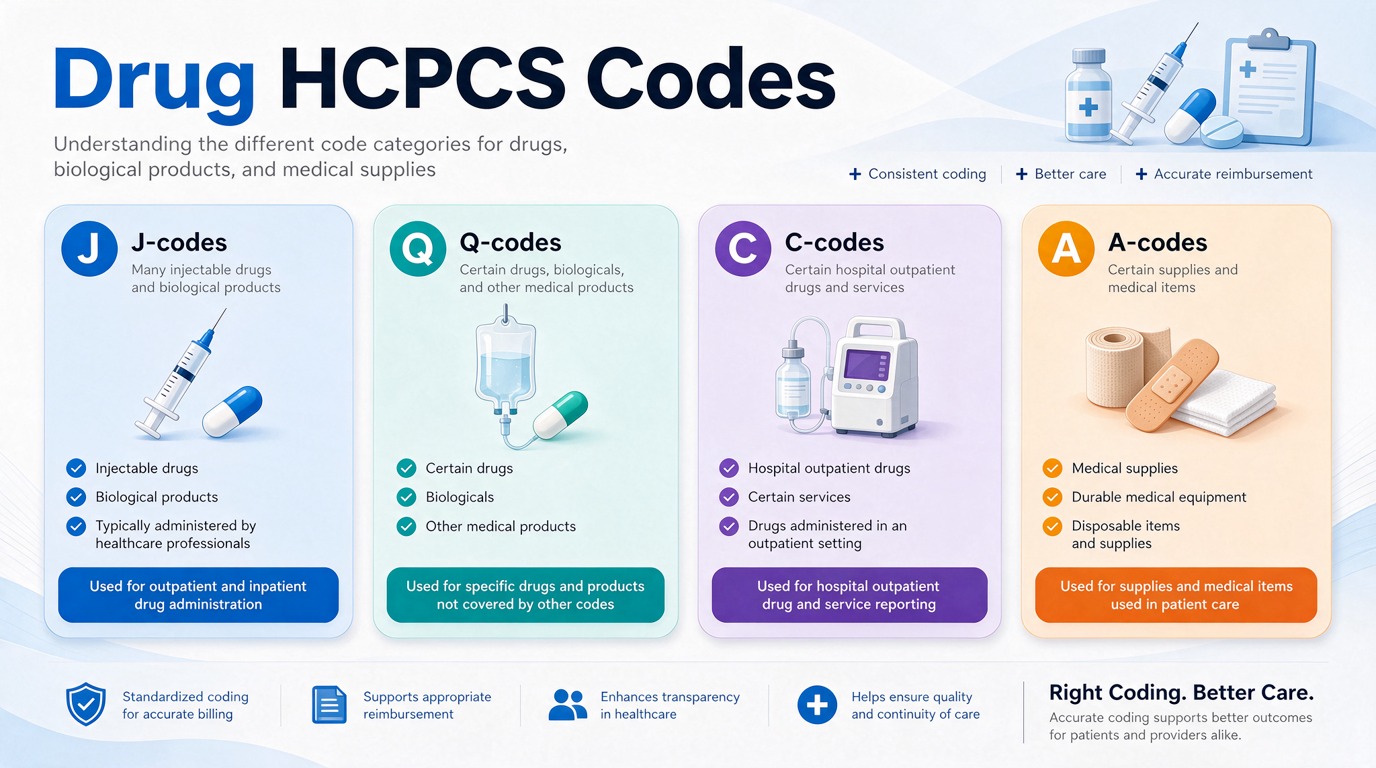
A drug code must match the actual medication and its HCPCS descriptor. The practice should not choose a code based only on a drug’s brand name or therapeutic category.
For each medication, verify:
- Generic and brand name, when relevant.
- HCPCS code.
- Long code descriptor.
- Billing unit.
- Drug concentration and package size.
- Route of administration.
- Applicable NDC requirements.
- Payer coverage and authorization.
- Any applicable wastage reporting rules.
How to Select the Correct Infusion Administration Code
The correct code depends on the administration method, medication type, infusion sequence, duration, and place of service.
A practical coding review should follow this order.
Step 1: Identify the Drug or Substance
Determine whether the provider administered:
- A non-chemotherapy therapeutic drug.
- A chemotherapy or highly complex drug.
- A hydration solution.
- A blood product.
- Another substance requiring a different administration code family.
Do not select a code based only on the diagnosis or medication name.
Step 2: Confirm the Route of Administration
The route helps determine the applicable code family.
Common routes include:
- Intravenous infusion.
- Intravenous push.
- Subcutaneous injection.
- Intramuscular injection.
- Subcutaneous infusion.
- Intra-arterial administration.
An IV push and an IV infusion are different services. The practice should not report an infusion code when the nurse administered the medication through a qualifying push method.
Step 3: Determine the Administration Sequence
Identify whether the medication was administered:
- As the initial infusion.
- Sequentially after another infusion.
- Concurrently with another infusion.
- Through a separate medically necessary IV access site.
The sequence affects the use of initial, subsequent, sequential, and concurrent codes.
Step 4: Review Actual Administration Time
Time-based infusion codes require accurate documentation of the administration period. The billing team should review the start and stop times and identify any interruptions.
Do not use the appointment duration as the infusion duration. The patient may spend 90 minutes in the clinic while the actual infusion lasts 55 minutes.
Step 5: Check the Coding Hierarchy
The practice must follow CPT instructions and Medicare NCCI policies when multiple services occur during the same encounter.
For example, Medicare’s infusion coding guidance generally places infusion services ahead of IV pushes and hydration when determining the primary service. However, the exact code selection depends on the services performed and applicable coding rules.
Step 6: Verify the Place of Service
The same administration service may have different billing treatment depending on whether it occurs in a physician office, hospital outpatient department, emergency department, or home.
The billing team must identify the correct claim type and determine whether the professional or facility entity reports the service.
Infusion Time Rules and Documentation
Time documentation has a direct effect on infusion code selection. An incorrect time calculation can result in an unsupported base code, an incorrect add-on unit, or a denial.
Record Actual Infusion Start and Stop Times
The medical record should identify when the infusion began and ended. If the infusion stopped temporarily, staff should record the interruption and the time it resumed.
For example:
| Event | Time |
| Infusion started | 9:10 AM |
| Infusion interrupted | 9:35 AM |
| Infusion resumed | 9:50 AM |
| Infusion completed | 10:25 AM |
The actual administration period is not the same as the total time the patient remained in the treatment area.
The provider should document the reason for a clinically relevant interruption, such as an adverse reaction, access problem, or required assessment.
Do Not Count Preparation and Routine Post-Infusion Work as Infusion Time
Starting an IV, preparing the medication, accessing a port, flushing the line, and routine post-infusion monitoring are not automatically additional infusion time.
According to CMS’s Medicare Claims Processing Manual, IV starts, access to an existing catheter or port, local anesthesia, routine flushing, and standard supplies are included in the payment for the administration service when performed to facilitate that service.
Apply Add-On Time Rules Correctly
Add-on codes report qualifying additional time beyond the initial service.
The billing team must review the current CPT time instructions for each code. Do not assume every additional 30 or 60 minutes automatically supports another unit.
For example, CPT 96366 reports each additional hour of qualifying therapeutic infusion time. CPT 96415 reports each additional hour of qualifying chemotherapy infusion time. The code families have their own reporting instructions.
Infusion Coding Hierarchy: Initial, Sequential, and Concurrent Services
When a patient receives multiple medications during one encounter, the practice must identify the primary service and determine whether additional services qualify for separate reporting.
Initial Infusion
An initial infusion code describes the primary qualifying infusion service during the encounter.
According to Medicare NCCI guidelines, there is only one initial service code for a patient encounter in the usual circumstances. An exception may apply when separate IV access sites are medically reasonable and necessary. A double-lumen catheter does not automatically support two initial infusion codes.
Sequential Infusion
A sequential infusion occurs when a different medication or substance is administered after the first infusion through the same access.
The clinical record should establish that the second infusion followed the first and that the service meets the applicable code requirements.
CPT 96367 and 96417 are examples of sequential infusion codes in their respective service categories.
Concurrent Infusion
Concurrent infusion occurs when two qualifying substances are administered at the same time through the same access.
The practice should not report concurrent administration simply because two medications appear on the treatment plan. The record must establish that the infusions actually occurred concurrently and that the code requirements are met.
CPT 96368 is a commonly used code for qualifying concurrent non-chemotherapy infusion services.
IV Push Services
An IV push is not interchangeable with an infusion. The administration method, duration, and continuous presence requirements help determine whether the service qualifies as an IV push.
CPT 96374 and 96375 apply to certain non-chemotherapy IV push services. Chemotherapy IV push services use codes such as 96409 and 96411.
Drug Billing: How to Report the Medication Correctly
Drug billing is a separate part of infusion reimbursement. The practice must report the correct medication code and units based on the actual amount administered.
A claim may contain the correct administration code but still receive a denial because the drug code, dosage, or unit calculation is inaccurate.
Match the HCPCS Code to the Drug
The billing team should verify the medication against the current HCPCS file.
Check the long descriptor, not only the short code description. The long descriptor identifies the billing unit and helps prevent incorrect quantity reporting.
For example, if a drug’s HCPCS code represents 10 mg per unit and the provider administers 40 mg, the claim generally requires four units, subject to the code’s specific billing instructions.
Calculate Drug Units
Use this calculation when the code defines a specific quantity per billing unit:
Number of units = Administered dosage ÷ HCPCS dosage per unit
Example:
- Drug administered: 60 mg.
- HCPCS billing unit: 10 mg.
- Billable units: 6.
The practice must retain the medication administration record and the calculation supporting the submitted units.
If the administered dose does not divide evenly by the HCPCS unit, follow Medicare’s applicable rounding instructions and payer requirements. Do not automatically round every drug quantity using the same method.
Review National Drug Code Requirements
Some payers require National Drug Code (NDC) information in addition to the HCPCS drug code.
The billing team should verify:
- The 11-digit NDC format.
- The NDC qualifier.
- The NDC quantity.
- The unit of measure.
- The actual drug package or container.
- The relationship between the NDC quantity and HCPCS units.
Medicaid and commercial plans may have different NDC reporting requirements. A practice should not assume that a Medicare claim rule applies to every payer.
Check Drug Acquisition and Coverage
Before administering a specialty medication, verify whether the drug falls under the patient’s medical benefit or pharmacy benefit.
Some medications are covered under Medicare Part B when furnished and administered under qualifying circumstances. Others may fall under Part D or a commercial plan’s pharmacy benefit.
The distinction affects authorization, medication sourcing, claim submission, and reimbursement responsibility.
JW and JZ Modifiers for Drug Wastage
Drug wastage is an important compliance issue for providers that administer medications from single-dose containers or single-use packages.
Medicare requires specific reporting for eligible separately payable Part B drugs when a portion of the drug is discarded.
JW Modifier: Drug Amount Discarded
Modifier JW identifies the amount of an eligible drug that the provider discarded and did not administer to any patient.
For Medicare claims, the discarded amount generally appears on a separate claim line from the administered amount.
The provider must document:
- Total drug quantity in the single-dose container.
- Amount administered.
- Amount discarded.
- Reason the remaining drug could not be used.
- Applicable HCPCS code and units.
The practice cannot report drug wastage from a multi-dose vial under the single-dose container discarded-drug policy.
JZ Modifier: No Drug Discarded
Modifier JZ indicates that no amount of the eligible drug was discarded.
Medicare requires JZ on applicable claims for separately payable Part B drugs from single-dose containers or single-use packages when there is no discarded amount.
The practice should verify whether the drug and setting fall within the modifier policy before reporting it.
JW vs. JZ Modifier Comparison
| Modifier | Purpose | Claim reporting |
| JW | Identifies eligible discarded drug amount | Separate line for the discarded quantity |
| JZ | Attests that no eligible drug amount was discarded | Report with the administered drug claim line when required |
Example: A provider opens a single-dose vial containing 100 mg of a drug. The patient receives 70 mg, and the remaining 30 mg must be discarded. If the drug qualifies under Medicare’s discarded-drug policy, the provider reports the administered amount and the eligible discarded amount according to the applicable claim instructions.
The practice must not report an amount as discarded if it was administered to another patient or retained for later use.
CMS provides detailed instructions for the JW and JZ modifiers, including the drug eligibility criteria and claim reporting requirements.
Infusion Billing Documentation Requirements
Complete documentation supports medical necessity, correct code selection, drug quantity reporting, and payment review.
The record should establish what the provider ordered, what staff administered, how the patient responded, and how the claim amount was calculated.
Physician Order and Treatment Plan
The medical record should include an authorized order for the medication or fluid.
The order should identify:
- Medication or solution.
- Dosage.
- Route of administration.
- Frequency.
- Duration or infusion instructions.
- Clinical indication.
- Relevant precautions or monitoring instructions.
The order should be consistent with the medication administration record.
Medical Necessity Documentation
The provider must establish why the infusion was necessary for the patient’s condition.
Relevant documentation may include:
- Diagnosis.
- Symptoms and clinical findings.
- Previous treatment history.
- Relevant laboratory results.
- Failed or inadequate prior therapies, when relevant.
- Treatment rationale.
- Response to previous treatment.
- Clinical reason for continuing or changing therapy.
A medication order alone does not establish medical necessity. The record should connect the treatment to the patient’s condition and the applicable coverage policy.
Medication Administration Record
The medication administration record should identify:
- Drug name.
- Dose ordered.
- Dose administered.
- Route.
- Administration date.
- Infusion start time.
- Infusion stop time.
- Administration site.
- Staff member who administered the medication.
- Any interruption.
- Patient response.
- Adverse reaction, if applicable.
The record should also identify the amount discarded when the provider reports eligible drug wastage.
Nursing Notes and Monitoring
Nursing documentation should support the service performed and the patient’s response.
Relevant details may include:
- Pre-infusion assessment.
- Vital signs when clinically indicated.
- IV access assessment.
- Medication administration.
- Infusion monitoring.
- Signs of an adverse reaction.
- Interventions performed.
- Post-infusion assessment.
- Discharge instructions.
The practice should document the monitoring required by the medication and the patient’s clinical condition.
Authorization and Coverage Records
For medications that require prior authorization, maintain the approval record and confirm that the authorization covers the drug, dose, frequency, and treatment period.
The practice should also retain relevant payer communications, specialty pharmacy approvals, and referral information.
Medicare Infusion Billing Requirements
Medicare infusion billing involves several separate payment and coverage rules. Providers must identify the correct Medicare benefit, billing entity, service setting, and claim type before submitting charges.
Medicare Part B Drug Coverage
Medicare Part B covers certain drugs and biologicals when the applicable coverage conditions are met.
Coverage may depend on:
- Whether the drug is usually administered by a physician or other qualified practitioner.
- Whether the drug is furnished incident to a covered professional service.
- Whether the drug meets the applicable statutory and regulatory coverage requirements.
- Whether a national or local coverage policy applies.
- Whether the provider meets enrollment and billing requirements.
Not every infusion medication qualifies for Part B payment. Some medications fall under Medicare Part D or another benefit.
Medicare Physician Office Billing
A physician practice may submit a professional claim for qualifying drug administration services and separately payable medications.
The claim generally uses the CMS-1500 form or electronic 837P transaction.
The practice should report the appropriate administration code, drug HCPCS code, units, diagnosis information, and applicable modifiers.
The physician or qualified practitioner must meet the applicable supervision and incident-to requirements when clinical staff perform the service.
Hospital Outpatient Infusion Billing
Hospital outpatient departments generally submit facility claims using the UB-04 or electronic 837I transaction.
The hospital must follow OPPS payment rules, revenue code requirements, packaging policies, and applicable claim edits.
The physician’s professional work may be billed separately when appropriate.
Providers should not copy physician-office billing practices directly into hospital outpatient claims. Medicare NCCI guidance distinguishes services reported by physician offices from facility billing.
Medicare Home Infusion Therapy Benefit
The Medicare Home Infusion Therapy benefit covers certain professional services associated with qualifying home infusion drugs.
The benefit applies to qualifying intravenous or subcutaneous drug administration through a pump that is durable medical equipment. Covered professional services may include nursing services, patient and caregiver training, education, remote monitoring, and other specified monitoring services.
The benefit does not automatically pay every component of a home infusion arrangement. Drug coverage, pump coverage, supplies, and professional services may fall under different Medicare payment rules.
Home infusion suppliers should verify:
- Supplier eligibility and enrollment.
- Required accreditation.
- Qualifying drug status.
- Plan of care.
- Patient’s home setting.
- Required nursing and professional services.
- Applicable visit and payment rules.
CMS maintains a directory of home infusion therapy suppliers and publishes guidance for the Medicare benefit.
Infusion Billing by Place of Service
The place of service can change how a provider reports and receives payment for infusion services.
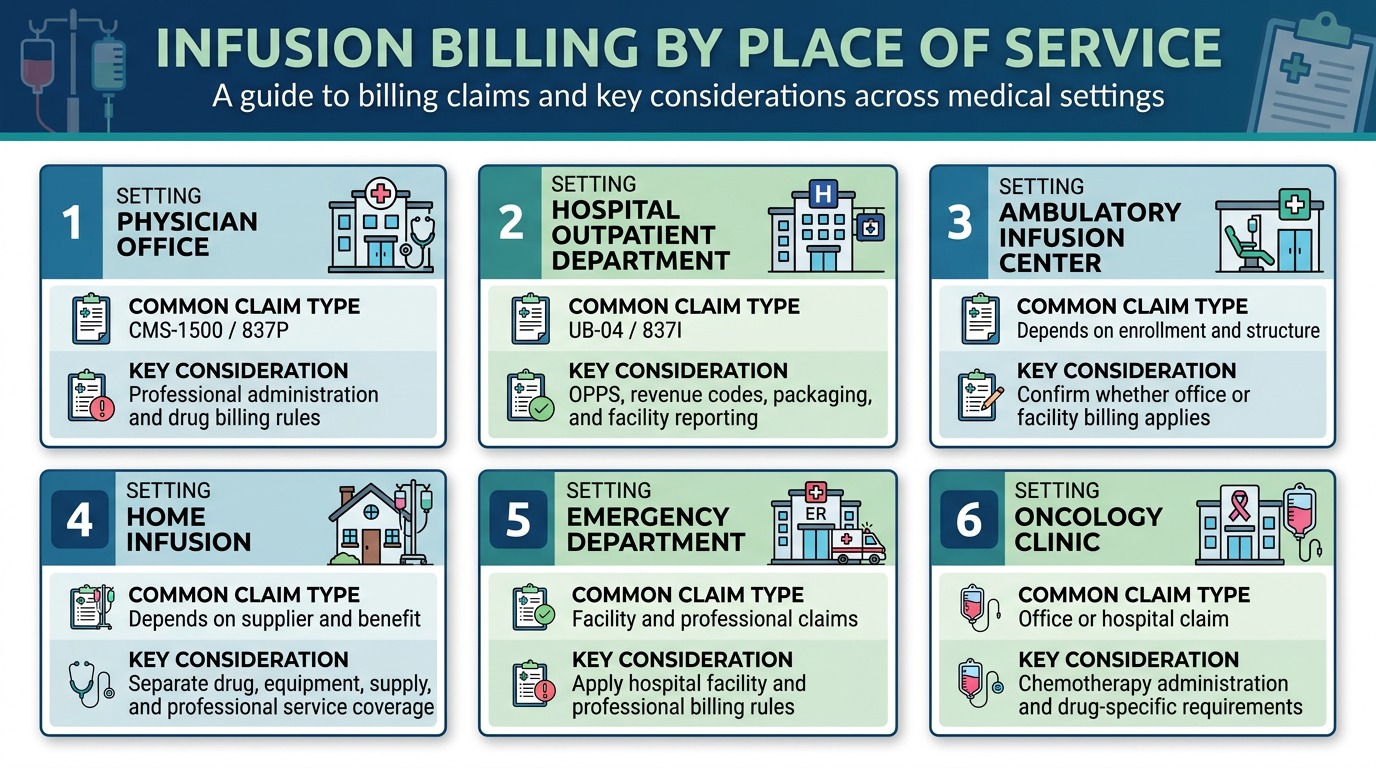
The billing team should verify the provider’s enrollment, place of service, and payer contract before assigning claim details.
Infusion Reimbursement: How Providers Get Paid
Infusion reimbursement may include payment for the drug, administration service, and other separately covered components.
The payment method depends on the payer, service setting, drug category, and applicable contract.
Medicare Physician Fee Schedule
Medicare generally pays eligible professional administration services under the Physician Fee Schedule when the service qualifies for separate payment.
The payment amount depends on the applicable code, locality, practice setting, and other payment adjustments.
Medicare Part B Drug Payment
Many separately payable Part B drugs are reimbursed using the applicable Average Sales Price (ASP) methodology, subject to statutory and regulatory adjustments.
The drug payment amount is not the same as the administration payment. A practice should review the applicable HCPCS drug code and Medicare payment file for the relevant quarter.
Hospital Outpatient Prospective Payment System
Hospital outpatient departments receive payment under OPPS for covered services.
Some drugs are separately payable, while others are packaged into an ambulatory payment classification or another payment bundle. The payment status may change by year and drug code.
Hospitals should review the applicable OPPS Addendum B, quarterly updates, and claim edits.
Commercial Payer Reimbursement
Commercial plans may use negotiated rates, percentage-of-charge arrangements, drug-specific pricing, or other contractual methods.
Some plans require specialty medications to come from designated specialty pharmacies. Others may use a buy-and-bill model in which the provider purchases the medication and seeks reimbursement after administration.
The practice should verify the drug acquisition pathway before scheduling treatment.
Why Infusion Reimbursement Varies
Several factors affect the final payment:
- Drug HCPCS code.
- Number of billable units.
- Administration CPT code.
- Place of service.
- Drug acquisition arrangement.
- Payer contract.
- Prior authorization.
- Medical necessity.
- Applicable modifiers.
- Drug packaging or payment status.
- Patient cost sharing.
Providers should not rely on one national infusion rate to estimate revenue across all payers and settings.
Prior Authorization and Benefits Verification for Infusion Services
Many infusion medications require prior authorization, especially high-cost specialty drugs and biological products.
The practice should verify coverage before purchasing the medication or scheduling treatment.
Confirm the Patient’s Insurance Benefits
Check the patient’s:
- Active coverage.
- Medical and pharmacy benefits.
- Specialist referral requirements.
- Deductible.
- Coinsurance.
- Copayment.
- Out-of-pocket maximum.
- Network status.
- Site-of-care restrictions.
A drug may be covered under the pharmacy benefit rather than the medical benefit. The practice should identify the correct pathway before acquiring the medication.
Obtain Prior Authorization
The authorization request should include the information the payer requires, such as:
- Diagnosis.
- Medication name.
- Dosage.
- Route.
- Frequency.
- Treatment duration.
- Clinical notes.
- Relevant laboratory results.
- Previous therapies.
- Reason for treatment.
- Prescribing practitioner’s information.
Authorization approval does not guarantee payment. The claim must still meet coverage, coding, documentation, and eligibility requirements.
Check Site-of-Care Requirements
Some payers require certain medications to be administered at a designated infusion center, hospital, or home setting.
If the provider uses a different site, the payer may deny or reduce payment.
The practice should document the approved location and any exception granted by the payer.
Common Infusion Billing Errors and How to Prevent Them
Infusion claims can fail because of code selection, drug units, time documentation, authorization, or place-of-service errors.
1. Reporting the Wrong Administration Code
A billing team may use a therapeutic infusion code for a chemotherapy administration service or report an IV infusion code when the provider performed an IV push.
Prevention: Confirm the drug category, route, and actual administration method before assigning the CPT code.
2. Billing More Than One Initial Infusion Code
Reporting multiple initial codes during one encounter without a valid exception can trigger an NCCI edit.
Prevention: Follow the initial-service hierarchy. Review whether separate IV access sites were medically reasonable and necessary before reporting more than one initial code.
3. Incorrect Infusion Time
Using appointment time instead of actual administration time can create unsupported units.
Prevention: Record start and stop times, interruptions, and the actual administration period.
4. Incorrect Drug Units
A practice may report the number of vials instead of the HCPCS billing units.
Prevention: Check the long HCPCS descriptor and calculate units using the code’s defined dosage.
5. Missing JW or JZ Modifier
Missing modifiers can result in incorrect drug wastage reporting or claim rejection.
Prevention: Review single-dose container requirements and apply the appropriate modifier when required by Medicare.
6. Billing Hydration Without Medical Necessity
A practice may report hydration when fluids were only used to deliver medication or maintain IV access.
Prevention: Document the clinical need for hydration and distinguish it from incidental fluid administration.
7. Separately Billing Included Supplies
IV starts, routine line access, flushes, and standard supplies are generally included in the administration payment when performed to facilitate the infusion.
Prevention: Review the Medicare Claims Processing Manual and payer policy before billing additional services.
8. Missing Prior Authorization
The medication may be clinically appropriate but still denied because the payer required authorization.
Prevention: Verify authorization before treatment and confirm that the approval covers the exact medication, dosage, frequency, and service location.
9. Incorrect Place of Service
Using a physician-office billing approach for a hospital outpatient service can lead to incorrect claim reporting.
Prevention: Confirm the billing entity and setting before selecting codes and submitting the claim.
10. Incomplete Medical Necessity Records
A claim may include the drug and administration codes but lack clinical evidence supporting the treatment.
Prevention: Maintain the physician order, diagnosis, treatment rationale, relevant clinical findings, and administration record.
Infusion Billing Workflow: From Order to Payment
A consistent workflow reduces billing errors and helps providers identify problems before claim submission.
Step 1: Receive and Review the Infusion Order
Confirm the medication, dosage, route, frequency, treatment duration, and clinical indication.
Check whether the order is complete and authorized.
Step 2: Verify Benefits and Authorization
Confirm coverage under the medical or pharmacy benefit. Check network status, authorization requirements, and site-of-care restrictions.
Step 3: Confirm Medication Acquisition
Determine whether the provider uses buy-and-bill, specialty pharmacy delivery, or another approved medication sourcing arrangement.
Verify the drug’s HCPCS code, NDC, billing unit, and package information.
Step 4: Schedule and Administer Treatment
Ensure the medication and required supplies are available. Staff should follow the treatment order and applicable clinical protocols.
Step 5: Complete the Medication Administration Record
Document the drug, dose, route, administration site, start and stop times, staff member, and patient response.
Record interruptions and discarded drug amounts when applicable.
Step 6: Assign the Administration Code
Review the administration method, drug category, time, sequence, and place of service.
Select the appropriate initial, sequential, concurrent, add-on, injection, hydration, or chemotherapy code.
Step 7: Calculate Drug Units
Use the HCPCS code descriptor to determine the billable units. Confirm the administered amount and any eligible discarded quantity.
Step 8: Apply Modifiers and Claim Details
Review JW, JZ, and other applicable modifiers. Confirm diagnosis linkage, units, NDC information, revenue codes, and claim format.
Step 9: Submit the Claim
Send the professional or facility claim to the correct payer using the required electronic format.
Step 10: Review Payment and Denials
Compare the remittance advice with the submitted claim. Investigate denials related to authorization, coding, medical necessity, units, drug coverage, and place of service.
Correct the underlying issue before resubmitting or appealing.
How Medical Billing Companies Support Infusion Providers
Infusion billing requires coordination between clinical staff, medication procurement teams, authorization specialists, and medical billing personnel. A billing error in one area can affect payment for the entire treatment encounter.
A medical billing company with infusion billing experience can support practices through:
- Insurance eligibility and benefits verification.
- Prior authorization follow-up.
- Infusion CPT code review.
- HCPCS drug code and unit validation.
- NDC reporting review.
- Drug wastage modifier checks.
- Claim submission.
- Payment posting.
- Denial management.
- Underpayment identification.
- Accounts receivable follow-up.
- Revenue cycle reporting.
Why Drug and Administration Charges Need Separate Review
Drug reimbursement and administration reimbursement follow different coding and payment rules. A claim may receive payment for the administration service but deny the drug line because the units or coverage information are incorrect.
The opposite can also occur. The payer may recognize the drug but deny the administration code because the time, sequence, or place-of-service information does not support the service.
A strong billing workflow reviews both components before submission and reconciles them after payment.
Track Infusion Revenue Separately
Infusion providers should monitor key performance indicators, including:
- Clean claim rate.
- First-pass acceptance rate.
- Drug reimbursement percentage.
- Administration reimbursement percentage.
- Authorization-related denial rate.
- Drug unit correction rate.
- Average days in accounts receivable.
- Underpayment rate.
- Denial overturn rate.
Separate reporting helps the practice identify whether revenue problems originate in medication billing, administration coding, payer authorization, or payment posting.
Infusion Billing Checklist for Providers
Use this checklist before submitting an infusion claim.
| Requirement | What to verify |
| Patient eligibility | Active coverage on the date of service |
| Medical necessity | Diagnosis and clinical rationale documented |
| Physician order | Medication, dosage, route, and frequency recorded |
| Prior authorization | Approval obtained when required |
| Drug identification | Correct medication and HCPCS code |
| Drug units | Units match the HCPCS billing descriptor |
| NDC | Correct format and quantity when required |
| Administration method | Infusion, IV push, injection, or hydration correctly identified |
| Administration time | Actual start and stop times recorded when applicable |
| Infusion sequence | Initial, sequential, and concurrent services distinguished |
| Drug wastage | Administered and discarded amounts documented |
| Modifiers | JW, JZ, and other applicable modifiers reviewed |
| Place of service | Correct office, hospital, or home setting |
| Claim format | Correct professional or facility claim |
| Payer policy | Coverage, coding, and reimbursement rules checked |
| Payment review | Remittance advice and adjustments reconciled |
Final Remarks
Infusion billing requires accurate reporting of both the medication and the service used to administer it. Providers must select the correct CPT administration code, verify the HCPCS drug code and billing units, document actual infusion time, and follow payer-specific coverage and reimbursement rules.
Physician practices, oncology clinics, hospitals, ambulatory infusion centers, and home infusion suppliers also need to account for differences in place of service and billing responsibility. Medicare’s NCCI policies, drug wastage rules, and home infusion benefit requirements add further compliance considerations.
A reliable infusion billing process connects the physician’s order, authorization, medication administration record, drug quantity calculation, code selection, and claim review. When these steps work together, providers can reduce avoidable denials, improve payment accuracy, and maintain better control over infusion revenue.
Frequently Asked Questions
What CPT codes are used for infusion billing?
Common infusion administration codes include 96360, 96361, 96365, 96366, 96367, 96368, 96372, 96374, and 96375. Chemotherapy administration commonly uses codes such as 96401, 96409, 96413, 96415, and 96417. The correct code depends on the drug, route, administration method, time, and service setting.
What is CPT 96365 used for?
CPT 96365 reports an initial therapeutic, prophylactic, or diagnostic intravenous infusion of a non-chemotherapy drug or substance when the service meets the code requirements.
What is the difference between CPT 96365 and 96413?
CPT 96365 belongs to the non-chemotherapy therapeutic, prophylactic, and diagnostic infusion code family. CPT 96413 belongs to the chemotherapy and highly complex drug administration code family. The appropriate code depends on the medication and the clinical complexity of its administration, not simply the fact that the drug enters the bloodstream.
What is the difference between CPT 96360 and 96365?
CPT 96360 reports qualifying IV hydration. CPT 96365 reports an initial therapeutic, prophylactic, or diagnostic infusion of a non-chemotherapy drug or substance. Fluids used to administer medication are generally incidental hydration and should not be separately billed as hydration.
Can a provider bill multiple initial infusion codes on the same day?
Generally, Medicare permits only one initial infusion or administration code per patient encounter. An exception may apply when separate IV access sites are medically reasonable and necessary. A double-lumen catheter alone does not justify reporting two initial infusion codes.
Can hydration be billed with a therapeutic infusion?
Hydration may be separately reportable when it represents a medically necessary service that meets the applicable code requirements. Fluid used to deliver another medication or maintain IV access is generally incidental and not separately payable.
What is the difference between sequential and concurrent infusion?
A sequential infusion involves administering a different drug or substance after the first infusion through the same access. A concurrent infusion involves administering qualifying substances at the same time. The documentation must support the actual sequence and administration method.
What is the JW modifier in infusion billing?
JW identifies an eligible drug amount discarded from a single-dose container or single-use package. Medicare requires the discarded amount to be reported separately when the drug qualifies under the applicable Part B discarded-drug policy.
When should providers use the JZ modifier?
JZ indicates that no eligible drug amount was discarded from an applicable single-dose container or single-use package. Medicare requires the modifier on applicable claims when no discarded amount exists.
Does Medicare cover home infusion therapy?
Medicare Part B covers professional services associated with certain qualifying home infusion drugs when the supplier and service meet the applicable requirements. Drug, equipment, supply, and professional service coverage may follow separate payment rules.
Can a physician bill for infusion administration performed by a nurse?
A physician practice may bill qualifying administration services performed by clinical staff when the applicable Medicare incident-to and supervision requirements are met. The practitioner must meet the required conditions for the service and setting.
Are infusion supplies separately billable?
Many routine supplies used to facilitate an infusion, including standard tubing, syringes, IV starts, and routine flushes, are included in the administration payment under Medicare guidance. Other items may have separate payment rules depending on the service and setting.
What documentation is required for infusion billing?
The record should include the physician order, medication name, dosage, route, clinical indication, actual administration time when applicable, drug quantity, administration record, patient response, and any discarded amount. Additional authorization and payer-specific records may also be necessary.
How does infusion billing differ between a physician office and a hospital?
Physician offices generally submit professional claims using the CMS-1500 or 837P format. Hospital outpatient departments generally submit facility claims using the UB-04 or 837I format and follow OPPS payment rules. The professional and facility components must be reported by the appropriate billing entities.