Chronic Care Management (CCM) billing allows eligible healthcare providers to receive Medicare reimbursement for coordinating care for patients with two or more chronic conditions. Accurate CCM coding requires providers to understand CPT codes, monthly time requirements, patient eligibility, consent, care plan documentation, and Medicare billing rules. This guide explains how to select the correct CCM codes, meet documentation requirements, avoid common claim denials, and bill for CCM services in 2026.
What Is Chronic Care Management (CCM)?
Chronic Care Management (CCM) is a Medicare Part B service that reimburses eligible healthcare practitioners for coordinating care for patients with multiple chronic conditions. These services help practices manage patients’ ongoing medical needs between office visits through medication management, care coordination, preventive care planning, communication with specialists, and follow-up after hospital or emergency department visits.
CCM differs from a routine office visit. A practitioner and clinical staff can perform qualifying care management activities without requiring the patient to attend a face-to-face appointment every month. The practice maintains a comprehensive care plan, monitors the patient’s progress, coordinates services, and provides access to clinical support when the patient needs assistance.
The Centers for Medicare & Medicaid Services (CMS) recognizes CCM as an important component of primary care. Medicare pays eligible practitioners under the Physician Fee Schedule (PFS) when they meet the applicable service, documentation, supervision, and billing requirements.
For a patient to qualify under the standard Medicare CCM definition, the patient must have:
- Two or more chronic conditions.
- Conditions expected to last at least 12 months or until the patient’s death.
- Conditions that place the patient at significant risk of death, acute exacerbation or decompensation, or functional decline.
- A comprehensive care plan that the practice establishes, implements, revises, or monitors.
Common qualifying conditions include diabetes, hypertension, chronic obstructive pulmonary disease (COPD), cardiovascular disease, arthritis, depression, asthma, and Alzheimer’s disease. A patient does not qualify automatically because the medical record lists two diagnoses. The practitioner must determine and document whether the patient’s conditions meet the CCM eligibility criteria.
CMS’s June 2025 Chronic Care Management Services booklet remains an important reference for Medicare CCM requirements. Practices should also review current-year Medicare payment policies and applicable payer guidance before submitting claims.
Chronic Care Management CPT Codes for 2026
Selecting the correct CCM CPT code requires more than checking the total number of minutes recorded during the month. The billing team must identify the service category, determine who performed the qualifying work, verify the required care management elements, and confirm that the time meets the applicable threshold.
Medicare recognizes six principal CPT codes for standard and complex CCM services.
CCM CPT Code Comparison
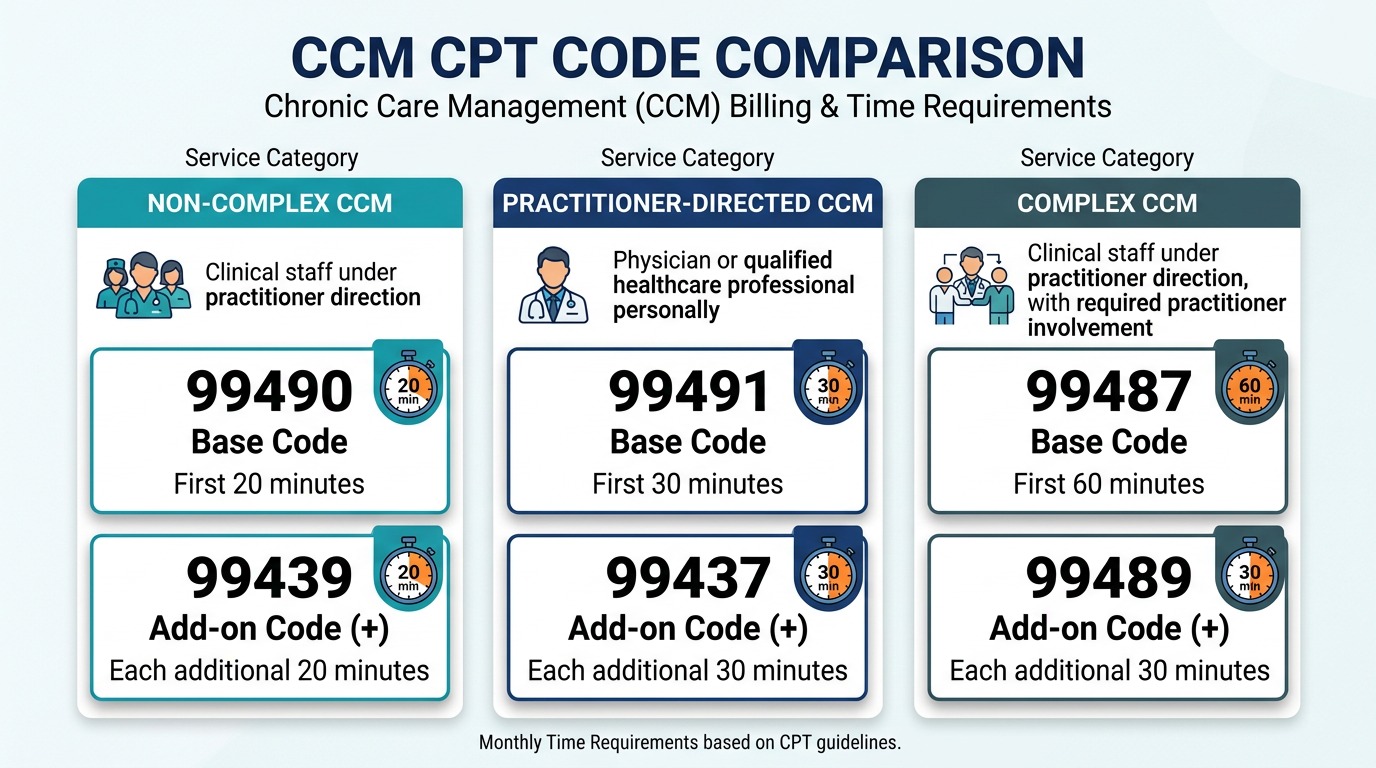
These codes describe services furnished during a calendar month. Practices must follow the applicable CPT descriptors and Medicare billing instructions when determining whether the documented time supports a base code or an add-on code.
CPT 99490: Non-Complex Chronic Care Management
CPT 99490 reports the first 20 minutes of qualifying non-complex CCM services furnished by clinical staff under the direction of a physician or other qualified healthcare professional during a calendar month.
The service includes care management activities for a patient with at least two qualifying chronic conditions and a comprehensive care plan that the practice establishes, implements, revises, or monitors.
Examples of qualifying work may include:
- Reviewing the patient’s current medication list.
- Following up on medication-related concerns.
- Coordinating appointments with specialists.
- Communicating with other healthcare professionals.
- Monitoring progress toward documented treatment goals.
- Reviewing relevant test results and arranging follow-up.
- Helping the patient access community-based clinical services.
- Coordinating preventive services and ongoing treatment.
The work must relate to the patient’s care management needs. Administrative activities such as scheduling unrelated appointments, routine data entry, or general office work do not become billable CCM time simply because staff performs them for an enrolled patient.
Example: A patient has diabetes and hypertension. During November, a clinical staff member spends 8 minutes reviewing medication adherence, 7 minutes coordinating a specialist appointment, and 6 minutes following up on the patient’s treatment plan. The total is 21 minutes of qualifying CCM work. If the remaining service requirements are met, the practice may report CPT 99490.
CPT 99439: Additional Non-Complex CCM Time
CPT 99439 is an add-on code for additional qualifying clinical staff time beyond the initial 20 minutes reported with CPT 99490.
The practice must meet the base-code requirements before reporting the add-on. It cannot submit 99439 as a standalone CCM service.
For example, a practice records 45 minutes of qualifying clinical staff time for a patient during one calendar month. The billing team should evaluate whether the documented time supports 99490 and the applicable additional 20-minute increment under 99439. It should not round the total time upward to create an additional unit.
The billing team should also check the current CPT instructions and Medicare claim edits for applicable unit limitations.
CPT 99491: CCM Personally Furnished by a Practitioner
CPT 99491 reports at least 30 minutes of qualifying CCM services personally furnished by the billing physician or other qualified healthcare professional during a calendar month.
This code differs from 99490 because the practitioner must personally perform the work. Clinical staff time cannot be used to satisfy the 30-minute threshold.
Qualifying practitioner activities may include:
- Reviewing the patient’s chronic conditions and treatment progress.
- Assessing clinical concerns that affect the care plan.
- Coordinating treatment with other practitioners.
- Personally managing care-related communication.
- Reviewing medication issues and making appropriate clinical decisions.
- Revising or monitoring the comprehensive care plan.
A physician cannot use 30 minutes of staff activity to satisfy the 99491 requirement. The record must show the practitioner’s own qualifying work and the time spent performing it.
CPT 99437: Additional Practitioner-Furnished CCM Time
CPT 99437 is an add-on code to CPT 99491. It reports each additional 30 minutes of qualifying CCM services personally furnished by the billing practitioner.
The code cannot be billed independently. The practice must first satisfy the 99491 base-code requirement.
For example, if a practitioner personally provides 65 minutes of qualifying CCM services during a calendar month, the billing team should review the applicable CPT time rules and claim edits to determine which units are supported. It must not include clinical staff minutes in the practitioner’s personal time total.
CPT 99487: Complex Chronic Care Management
CPT 99487 reports the first 60 minutes of qualifying complex CCM services furnished by clinical staff under the direction of a physician or other qualified healthcare professional.
Complex CCM requires more than a longer period of care coordination. The service must also include moderate- or high-complexity medical decision-making by the billing practitioner during the service period.
The practitioner must establish or substantially revise the comprehensive care plan as required by the code descriptor and document the clinical decision-making that supports complex CCM.
Patients may need complex CCM when multiple conditions create substantial coordination and treatment challenges. Examples may include patients with several chronic diseases, complicated medication regimens, significant functional limitations, frequent care transitions, or changing treatment needs.
However, a large number of diagnoses or medications does not automatically justify 99487. The practitioner must document the medical decision-making and care plan work required by the code.
CPT 99489: Additional Complex CCM Time
CPT 99489 reports each additional 30 minutes of qualifying complex CCM time beyond the first 60 minutes reported with 99487.
The practice must meet all complex CCM requirements, including the medical decision-making component. Additional staff time alone does not justify the code when the practitioner has not performed the required clinical work.
For example, a patient may require extensive coordination after multiple hospital encounters. Clinical staff may spend 95 minutes on qualifying care management activities during the month. The billing practitioner must also perform and document the required moderate- or high-complexity medical decision-making. The practice can then evaluate the documented time against the applicable 99487 and 99489 reporting requirements.
Non-Complex CCM vs. Complex CCM: What Is the Difference?
The distinction between non-complex and complex CCM affects code selection, documentation, and medical necessity.
Non-complex CCM supports ongoing management of multiple chronic conditions. Complex CCM applies when the patient’s needs require more involved care planning and moderate- or high-complexity medical decision-making by the billing practitioner.
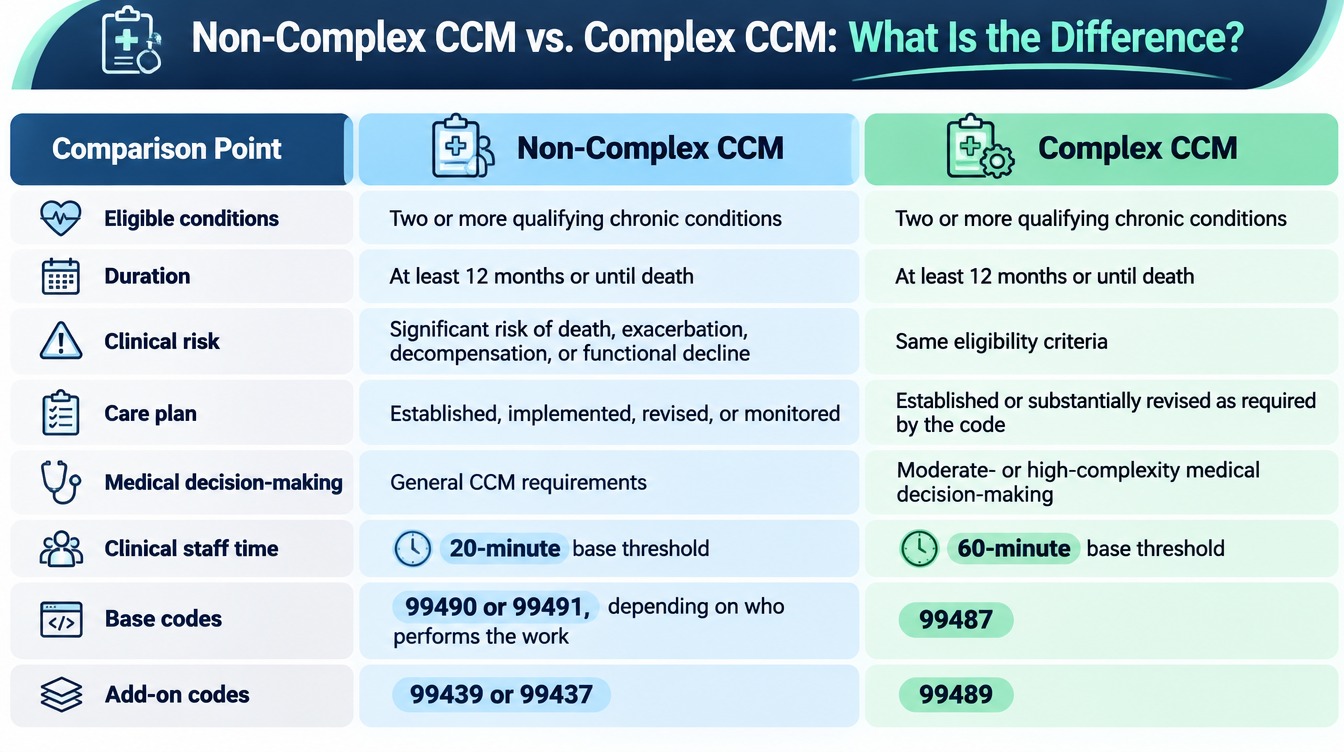
A practice should not select complex CCM merely because a patient has more diagnoses or requires more staff attention. The billing practitioner must establish that the clinical work meets the complex service requirements.
Medicare Eligibility Requirements for Chronic Care Management
Medicare CCM eligibility involves patient-level clinical criteria and service-level billing requirements. A practice should verify both before enrolling a patient.
1. The Patient Must Have at Least Two Chronic Conditions
The patient must have two or more chronic conditions that are expected to last at least 12 months or until death.
Examples include:
- Diabetes and hypertension.
- COPD and cardiovascular disease.
- Arthritis and chronic kidney disease.
- Alzheimer’s disease and hypertension.
- Asthma and depression.
The conditions must meet the applicable risk criteria. A diagnosis list alone does not establish eligibility.
2. The Conditions Must Create Significant Clinical Risk
The qualifying conditions must place the patient at significant risk of at least one of the following:
- Death.
- Acute exacerbation.
- Decompensation.
- Functional decline.
The practitioner should explain how the patient’s chronic conditions create these risks. For example, a patient with COPD and cardiovascular disease may require regular monitoring, medication coordination, and communication between multiple specialists to reduce the risk of deterioration.
3. The Practice Must Establish a Comprehensive Care Plan
The practitioner must establish, implement, revise, or monitor a comprehensive care plan as required by the applicable CCM code.
The plan should reflect the patient’s medical and nonmedical needs. It should also identify treatment goals, interventions, responsible care team members, and follow-up activities.
4. The Patient Must Provide Informed Consent
The practice must obtain written or verbal consent before billing CCM services.
The consent process must explain the service, possible cost-sharing obligations, the one-practitioner-per-calendar-month billing rule, and the patient’s right to stop receiving CCM services.
5. The Practice Must Meet the Initiating Visit Requirement
For new patients and patients who have not received a qualifying visit from the practitioner within the previous year, Medicare requires an initiating visit before CCM services begin.
The initiating visit may occur during:
- A comprehensive evaluation and management (E/M) visit.
- An Annual Wellness Visit (AWV).
- An Initial Preventive Physical Examination (IPPE).
The practitioner must discuss CCM during the initiating visit. A routine appointment that does not include the required discussion cannot automatically qualify.
CMS states that the initiating visit is separate from the monthly CCM service and may be billed separately when the applicable requirements are met.
Chronic Care Management Initiating Visit and HCPCS G0506
The initiating visit establishes the clinical basis for enrolling a patient in CCM. It gives the practitioner an opportunity to review the patient’s chronic conditions, assess care needs, explain the service, and develop an appropriate care management strategy.
The initiating visit is not a monthly CCM service. Practices should not count the initiating E/M or AWV time toward the monthly CCM time threshold.
When Can a Practice Bill G0506?
HCPCS G0506 reports an extensive assessment and care planning service for a patient who requires CCM. The billing practitioner may report it once at the initiating visit when the practitioner personally performs extensive assessment and care planning beyond the usual work included in the initiating visit and CCM service.
The code is not an automatic add-on for every CCM enrollment.
Documentation should establish:
- The patient’s chronic conditions and related risks.
- The additional assessment the practitioner performed.
- The care planning activities completed.
- Why the work exceeded the usual initiating visit and CCM requirements.
If the practitioner performs only the routine assessment and care planning already included in the initiating visit, the practice should not report G0506.
Patient Consent Requirements for CCM Billing
Patient consent is a required part of Medicare CCM enrollment. The practice must obtain written or verbal consent before billing the service and record the consent in the patient’s medical record.
CMS requires the practice to explain the following information:
- CCM services are available to eligible patients.
- The patient may have cost-sharing responsibilities.
- Only one practitioner can provide and bill CCM services for the patient during a calendar month.
- The patient may stop receiving CCM services at any time, with termination effective at the end of the calendar month.
- The practitioner explained the required information and recorded whether the patient accepted or declined the service.
Medicare does not require the practice to obtain consent again every month. The patient generally provides informed consent once unless the patient changes to a different CCM practitioner.
What Should the Consent Record Include?
A useful consent record should identify:
- Patient name and identifying information.
- Date consent was obtained.
- Whether consent was written or verbal.
- Name of the staff member or practitioner who obtained consent.
- Confirmation that the patient received the required cost-sharing explanation.
- Confirmation that the one-practitioner billing restriction was explained.
- Confirmation that the patient understands the right to discontinue services.
- Patient acceptance or refusal.
A signed consent form can support the record, but the practice should not rely on a form alone if the chart does not establish that the required information was explained.
Comprehensive Care Plan Requirements for CCM
The comprehensive care plan is one of the most important parts of a defensible CCM claim. It connects the patient’s chronic conditions with the clinical work performed throughout the month.
CMS expects a patient-centered electronic care plan based on the patient’s physical, mental, cognitive, psychosocial, functional, and environmental needs.
A care plan may include the following elements:
| Care plan element | What the practice should document |
| Problem list | Chronic conditions and related health concerns |
| Expected outcomes | Anticipated clinical outcomes and prognosis |
| Treatment goals | Measurable goals for disease management |
| Clinical interventions | Planned actions to address identified problems |
| Medication management | Medication review, adherence concerns, and treatment coordination |
| Symptom management | Symptoms requiring monitoring or follow-up |
| Cognitive and functional assessment | Relevant limitations affecting the patient’s care |
| Environmental assessment | Home and environmental factors affecting health |
| Caregiver assessment | Caregiver availability and support needs |
| Care coordination | Communication with specialists and outside providers |
| Periodic review | Updates based on patient progress and changing needs |
The Care Plan Must Be Accessible
The practice must make the electronic care plan available promptly to relevant members of the care team, both inside and outside the billing practice, when appropriate.
Patients and caregivers should receive a copy when necessary.
A care plan that remains in a document repository without informing actual care coordination does not demonstrate a well-functioning CCM process. The record should show that the practice uses the plan to guide ongoing work.
Update the Plan When the Patient’s Needs Change
The practice should revise or monitor the plan as required by the service and the patient’s condition.
For example, a patient may experience worsening COPD symptoms, develop medication-related concerns, or require follow-up after hospitalization. The care plan should reflect relevant changes, updated goals, and the actions taken by the care team.
CCM Time Tracking and Documentation Requirements
Time documentation is a frequent source of billing errors. Practices must record qualifying work accurately and apply the correct threshold for the code they report.
CCM services are measured by calendar month, not by a rolling 30-day period. The billing team should maintain a separate time record for each patient and each calendar month.
What Time Can Count Toward CCM?
Qualifying activities may include:
- Reviewing and updating the patient’s care plan.
- Medication review and coordination.
- Communication with other healthcare professionals.
- Follow-up after hospital or emergency department visits.
- Coordination of preventive services.
- Monitoring progress toward treatment goals.
- Reviewing relevant patient information.
- Supporting patient self-management.
- Coordinating community-based clinical services.
- Communicating with caregivers when relevant to the patient’s care.
The work must fall within the applicable CCM service requirements and relate to the individual patient’s needs.
What Time Should Not Be Counted?
Practices should exclude:
- Time spent on unrelated administrative tasks.
- Appointment scheduling that does not qualify as CCM work.
- General office management.
- Time already reported under another billed service.
- Clinical staff time used to meet the personal practitioner threshold for 99491 or 99437.
- Duplicate time recorded for multiple patients.
- Time spent on services outside the applicable CCM scope.
CMS explains that when one activity benefits multiple patients, the time must be divided among those patients when the activity is reasonable and necessary for each of them. A staff member cannot assign the entire duration of a shared activity to every patient involved.
How to Maintain a CCM Time Log
A useful time log should record:
| Documentation field | Example |
| Patient | Patient’s name or medical record identifier |
| Date of service | November 12, 2026 |
| Staff member | Clinical staff member’s name |
| Activity | Medication review and care coordination |
| Time spent | 8 minutes |
| Clinical purpose | Address medication adherence concern |
| Outcome | Follow-up with prescribing practitioner |
| Monthly total | Updated cumulative CCM minutes |
Each entry should describe the actual work performed. A monthly total without supporting activity records may not adequately demonstrate that the practice furnished the required service.
24/7 Access and Continuity of Care Requirements
Medicare CCM includes access to care and continuity arrangements outside normal office visits. The patient must have a way to reach a physician, qualified practitioner, or clinical staff member for urgent needs at any time.
The practice should establish:
- 24-hour, seven-day access to clinical support for urgent needs.
- A designated care team member who maintains regular contact with the patient.
- A way to schedule routine appointments with the care team.
- Phone and secure electronic communication options.
- Processes for sharing relevant health information with other practitioners.
A generic after-hours voicemail that does not provide an appropriate clinical access pathway may not demonstrate that the practice meets the CCM access requirement.
The practice should document its access process and ensure that staff understand how to route urgent patient concerns.
Chronic Care Management Billing Process: Step by Step
A standardized billing workflow helps practices identify eligible patients, complete enrollment, document monthly work, and submit claims accurately.
Step 1: Identify Eligible Patients
Review the patient population and identify individuals with two or more chronic conditions that meet Medicare’s duration and risk criteria.
Do not rely exclusively on diagnosis codes. The practitioner must determine whether the conditions create the required clinical risk and whether the patient needs ongoing care management.
Step 2: Verify Medicare Eligibility and Coverage
Confirm the patient’s Medicare coverage and identify whether Original Medicare or a Medicare Advantage plan applies.
For Original Medicare, review eligibility and applicable Part B coverage information. For Medicare Advantage, follow the plan’s provider contract, authorization, coding, and claim submission requirements.
The practice should also check whether another practitioner is already furnishing and billing CCM services for the patient during the calendar month.
Step 3: Complete the Initiating Visit
For patients who require an initiating visit, schedule a qualifying face-to-face E/M visit, AWV, or IPPE.
Discuss CCM during the visit, review the patient’s chronic conditions, and determine whether the service is appropriate.
Document the assessment and the decision to enroll the patient.
Step 4: Obtain and Record Patient Consent
Explain the service, possible cost-sharing responsibilities, the one-practitioner-per-month rule, and the patient’s right to stop the service.
Record written or verbal consent in the medical record before billing CCM.
Step 5: Create the Comprehensive Care Plan
Develop an electronic care plan that reflects the patient’s chronic conditions, treatment goals, medication needs, care coordination requirements, and relevant support needs.
Make the plan accessible to the appropriate care team members and share it with the patient or caregiver when necessary.
Step 6: Assign CCM Responsibilities
Identify the billing practitioner and the clinical staff members who will perform care management activities.
The billing practitioner must maintain the required involvement, direction, and oversight. Clinical staff may perform qualifying activities under the applicable supervision and incident-to requirements.
Step 7: Perform and Document Monthly CCM Activities
Throughout the calendar month, complete qualifying care management work and record each activity.
The practice should not wait until the end of the month to reconstruct the time log from memory. Real-time documentation provides a clearer record of the work performed.
Step 8: Review the Monthly Time and Code Selection
At the end of the service period, the billing team should:
- Confirm the patient’s eligibility.
- Verify consent and initiating visit requirements.
- Review the comprehensive care plan.
- Calculate qualifying time.
- Identify who performed the work.
- Determine whether the service was non-complex or complex.
- Check whether the practitioner completed the required medical decision-making for complex CCM.
- Review concurrent billing restrictions.
Step 9: Submit the Claim
Select the appropriate base code and add-on code, when supported. Report the correct diagnosis information and follow the payer’s claim submission instructions.
The claim should reflect the service period and provider information required by the applicable payer.
Step 10: Review the Remittance Advice
After claim processing, review the remittance advice for payment, adjustments, and denials.
Investigate any rejection or denial related to eligibility, duplicate billing, code selection, time requirements, or missing documentation. Correct the underlying issue before resubmitting when appropriate.
ICD-10-CM Diagnosis Coding for Chronic Care Management
CCM does not have one universal ICD-10-CM diagnosis code. The practice reports the patient’s documented chronic conditions that support medical necessity and eligibility.
Examples include:
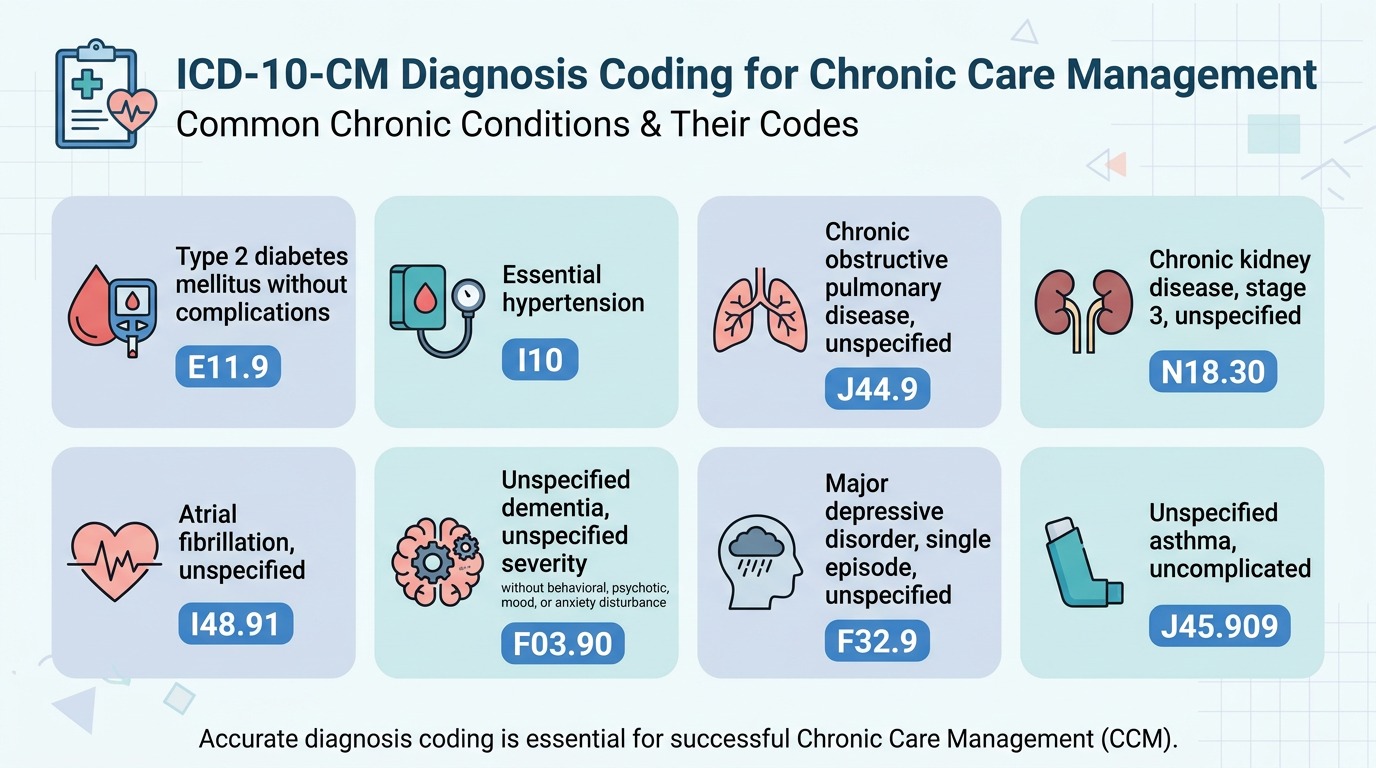
These are examples, not a substitute for code selection based on the patient’s actual documentation and the current ICD-10-CM code set.
How to Select Diagnosis Codes for CCM Claims
The billing team should:
- Review the practitioner’s documentation.
- Identify the chronic conditions addressed through CCM.
- Confirm that the codes reflect the documented diagnoses and specificity.
- Verify the current ICD-10-CM code descriptions and any applicable coding instructions.
- Link the diagnoses to the services when required by the payer’s claim rules.
Do not add diagnoses simply to make a patient appear eligible for CCM. The practitioner must establish the qualifying conditions and their associated clinical risks.
Chronic Care Management Reimbursement in 2026
Medicare reimburses CCM through the Physician Fee Schedule. The payment amount depends on the code reported, geographic locality, place of service, applicable payment adjustments, and other Medicare payment rules.
The six principal CCM codes do not have one universal payment amount across all practices.
A practice should use the applicable 2026 Medicare Physician Fee Schedule files or payment lookup tools to verify the amount for its locality and setting. It should not treat a national average or a vendor’s published rate as a guaranteed payment.
What Affects CCM Reimbursement?
Several factors influence the amount a practice receives:
- CPT code: Different CCM codes represent different service categories and time thresholds.
- Geographic locality: Medicare payment rates can vary by locality.
- Place of service: Facility and non-facility payment rules may produce different amounts.
- Provider eligibility: The billing practitioner must meet Medicare enrollment and qualification requirements.
- Payer contract: Commercial and Medicare Advantage plans may apply different reimbursement terms.
- Patient cost sharing: Medicare Part B cost-sharing rules may apply to CCM services.
How to Check 2026 Medicare CCM Rates
Practices should use the CMS Physician Fee Schedule Look-Up Tool or current PFS files to check the applicable payment information.
When reviewing a rate, confirm:
- The correct calendar year.
- The correct CPT code.
- The applicable locality.
- The facility or non-facility setting.
- Any relevant payment status or adjustment.
Avoid using a single national rate to forecast every practice’s CCM revenue. A realistic revenue estimate should use the practice’s actual payer mix, location, contracted rates, patient eligibility, and historical collection performance.
CCM Billing for Rural Health Clinics and Federally Qualified Health Centers
Rural Health Clinics (RHCs) and Federally Qualified Health Centers (FQHCs) have additional Medicare billing considerations for care coordination services.
One important change affects HCPCS G0511.
HCPCS G0511 Is No Longer the General CCM Billing Route
CMS required RHCs and FQHCs to transition from the general care management code G0511 to the individual CPT and HCPCS codes that describe the services furnished.
Although CMS allowed a transition period, G0511 was no longer reportable for these care coordination services after September 30, 2025.
For 2026 dates of service, RHCs and FQHCs should use the applicable individual care coordination codes and follow the current CMS billing instructions.
2026 RHC and FQHC Care Coordination Updates
Effective January 1, 2026, CMS allows RHCs and FQHCs to bill designated care coordination services established under the Physician Fee Schedule, subject to the applicable requirements.
CMS guidance also identifies the following claim details for care coordination services:
- RHC and FQHC claims use the applicable 052X revenue code.
- FQHC claims generally use the 77X bill type.
- RHC claims generally use the 71X type of bill.
- The applicable care coordination HCPCS codes must be reported.
- Practices must follow the relevant modifier instructions for their facility type.
CMS also specifies that these services are paid separately under the applicable national non-facility PFS rates when requirements are met. The services should not be treated as automatically included in the RHC All-Inclusive Rate or FQHC PPS payment.
RHCs and FQHCs should review the current Medicare Benefit Policy Manual, Medicare Claims Processing Manual, and their Medicare Administrative Contractor guidance before submitting claims.
Chronic Care Management vs. Advanced Primary Care Management
Advanced Primary Care Management (APCM) became available under Medicare beginning January 1, 2025. It provides a bundled approach to primary care management and includes elements associated with CCM, Principal Care Management, Transitional Care Management, and communication technology-based services.
Unlike traditional CCM, APCM does not use monthly time thresholds.
CMS recognizes three APCM base codes:
| HCPCS code | Patient category |
| G0556 | Patient with one or fewer qualifying chronic conditions |
| G0557 | Patient with two or more chronic conditions |
| G0558 | Qualified Medicare Beneficiary with two or more chronic conditions |
APCM requires the practitioner to serve as the focal point for the patient’s primary care services and meet the applicable service requirements.
How APCM Differs From CCM
| Comparison | CCM | APCM |
| Billing structure | Time-based CPT codes | Monthly bundled HCPCS codes |
| Time tracking | Required for time-based codes | No monthly time threshold |
| Patient criteria | Two or more qualifying chronic conditions | Depends on APCM level |
| Care planning | Comprehensive care plan | Comprehensive primary care management elements |
| Billing frequency | Generally once per calendar month under the applicable code family | Once per patient per calendar month |
| Code examples | 99490, 99439, 99487, 99489 | G0556, G0557, G0558 |
APCM may suit practices that provide comprehensive primary care and want a non-time-based payment structure. Traditional CCM may remain appropriate when the practice furnishes and documents the specific time-based services.
Practices should evaluate the patient’s needs, the practitioner’s role, the service elements, and applicable same-month billing restrictions before selecting a care management pathway.
CMS also introduced optional APCM add-on codes for behavioral health integration and psychiatric collaborative care services beginning January 1, 2026. These include G0568, G0569, and G0570 when the applicable APCM and add-on requirements are met.
CCM vs. Principal Care Management vs. Transitional Care Management
CCM is not the only Medicare care management service. Practices should understand how it differs from Principal Care Management (PCM) and Transitional Care Management (TCM).
| Service | Main purpose | Patient criteria | Common codes |
| CCM | Manage multiple chronic conditions | Two or more qualifying chronic conditions | 99490, 99439, 99491, 99437 |
| Complex CCM | Manage multiple conditions requiring complex care planning and medical decision-making | Two or more qualifying chronic conditions | 99487, 99489 |
| PCM | Manage one serious, high-risk chronic condition | One qualifying high-risk chronic condition | 99424, 99425, 99426, 99427 |
| TCM | Coordinate care after discharge from a qualifying facility | Patient discharged from an eligible inpatient or outpatient setting | 99495, 99496 |
| APCM | Provide comprehensive advanced primary care management | Patient meets the relevant APCM level and service criteria | G0556, G0557, G0558 |
CCM vs. PCM
CCM addresses multiple chronic conditions through a comprehensive care plan. PCM focuses on one complex chronic condition that creates significant risk of hospitalization, acute exacerbation, functional decline, or death.
The services may be furnished concurrently by different practitioners when the conditions being managed are different and all applicable requirements are met. The same practitioner cannot bill CCM and PCM for the same patient in the same month.
When both services are furnished concurrently, the practice must maintain the appropriate care plans and separate documentation for each service.
CCM vs. TCM
TCM addresses the transition from a qualifying healthcare setting back to the patient’s home or community.
It includes post-discharge communication, medical decision-making, and a face-to-face visit within the applicable timeframe.
CMS permits certain CCM services during the 30-day TCM period when the requirements are met. However, the practice cannot count the same minutes toward both services.
Can CCM Be Billed With RPM, TCM, or Other Care Management Services?
Concurrent billing rules require careful review because some services can be reported during the same period while others cannot.
CCM and TCM
CMS permits billing CCM and TCM during the same service period when both services are medically necessary and all requirements are met.
The practice must keep the work and time associated with each service separate. Minutes used for TCM cannot also count toward CCM.
CCM and RPM
CMS allows certain combinations of CCM and Remote Physiologic Monitoring (RPM) when each service independently meets its requirements.
The practice must maintain separate documentation and avoid double-counting time. Review current CPT instructions, Medicare policies, and payer rules before reporting both services.
CCM and RTM
Remote Therapeutic Monitoring (RTM) also has separate service requirements. CMS guidance addresses restrictions on concurrent RPM and RTM billing and their relationship with CCM and TCM.
A practice should not assume that every RPM or RTM code can be combined with CCM. Confirm the applicable code-level instructions and payer policies for the services furnished.
CCM and Home Health or Hospice Supervision
Medicare does not allow CCM billing during the same service period as:
- HCPCS G0181 for home health care supervision.
- HCPCS G0182 for hospice care supervision.
- Certain ESRD services reported under CPT codes 90951 through 90970.
These restrictions help prevent duplicate payment for overlapping care management work.
CCM and Prolonged E/M Services
CMS does not permit complex CCM and prolonged E/M services to be reported in the same calendar month under the applicable Medicare guidance.
The practice should also review current CPT instructions for other code combinations that may be restricted.
Common Chronic Care Management Billing Errors
CCM claims can be denied or challenged when the practice does not establish eligibility, document qualifying activities, or select the appropriate code.
The following errors deserve particular attention.
1. Billing Without Confirming Patient Eligibility
A patient with two diagnoses does not automatically qualify for CCM. The practitioner must document the required duration and clinical risk associated with the conditions.
Correction: Review the patient’s clinical record and document why the chronic conditions meet the eligibility criteria.
2. Missing Patient Consent
Submitting CCM claims without documented written or verbal consent creates a compliance risk.
Correction: Obtain consent before billing and record the required disclosures in the medical record.
3. Skipping the Initiating Visit
Practices may overlook the initiating visit requirement for new patients or patients who have not received a qualifying visit within the previous year.
Correction: Verify the patient’s visit history and complete the appropriate initiating visit before starting CCM.
4. Reporting the Wrong CPT Code
A practice may select 99490 when the practitioner personally furnished the qualifying work, or report 99491 using a time total that includes clinical staff activities.
Correction: Match the code to the service category and the person who performed the work.
5. Counting Non-Qualifying Activities
General administrative work does not qualify simply because staff performs it for an enrolled CCM patient.
Correction: Record the specific care management activity, its clinical purpose, and the time spent.
6. Double-Counting Time
The same minutes cannot support two separate billed services.
Correction: Maintain separate time records for CCM, TCM, RPM, RTM, and other services when concurrent billing is permitted.
7. Billing Complex CCM Without Required Medical Decision-Making
A patient may need extensive coordination, but 99487 and 99489 require moderate- or high-complexity medical decision-making by the billing practitioner.
Correction: Document the practitioner’s clinical decision-making and the care plan work supporting complex CCM.
8. Reporting Add-On Codes Without the Base Code
Codes 99439, 99437, and 99489 are add-on codes. They cannot be submitted independently of their required base codes.
Correction: Validate the code combination before claim submission.
9. Using the Wrong Calendar Month
CCM uses a calendar-month service period. A rolling 30-day period can result in incorrect time calculations.
Correction: Maintain monthly time totals from the first through the last day of each calendar month.
10. Ignoring Payer-Specific Requirements
Medicare Advantage and commercial plans may apply their own network, authorization, claim, and reimbursement requirements.
Correction: Verify the patient’s plan and applicable billing policy before submitting the claim.
How to Reduce CCM Claim Denials and Improve Revenue Accuracy
A reliable CCM billing process begins before the first claim. Practices should establish procedures that connect patient enrollment, clinical documentation, time tracking, coding, and payment review.
Use a Patient Eligibility Checklist
Create a standard eligibility review that confirms:
- Two or more qualifying chronic conditions.
- Expected duration of at least 12 months or until death.
- Significant clinical risk.
- Practitioner assessment and approval.
- Medicare coverage and applicable payer requirements.
- Previous CCM enrollment or billing activity, when relevant.
Standardize Consent Documentation
Use a consistent consent workflow. Staff should document the date, method, required disclosures, and patient decision.
The practice should also maintain a process for recording withdrawal of consent and updating the patient’s enrollment status.
Use a Dedicated CCM Time-Tracking Workflow
Record time when the work occurs, not reconstructed at month-end.
A standardized system should identify the patient, staff member, date, activity, duration, and outcome. It should also prevent duplicate time from being assigned to multiple services.
Review Code Selection Before Claims Go Out
The billing team should verify:
- The correct base code.
- The appropriate add-on code, if supported.
- The correct service period.
- The type of staff who performed the work.
- The documented time threshold.
- The required complex CCM medical decision-making, when applicable.
- Concurrent billing restrictions.
Monitor Denial Patterns
Track CCM denials by reason rather than treating every rejection as an isolated issue.
For example, repeated denials for insufficient documentation may indicate a problem with time logs or care plan records. Duplicate billing denials may point to poor enrollment verification or overlapping services.
A monthly denial review helps the practice correct workflow problems before they affect a larger number of claims.
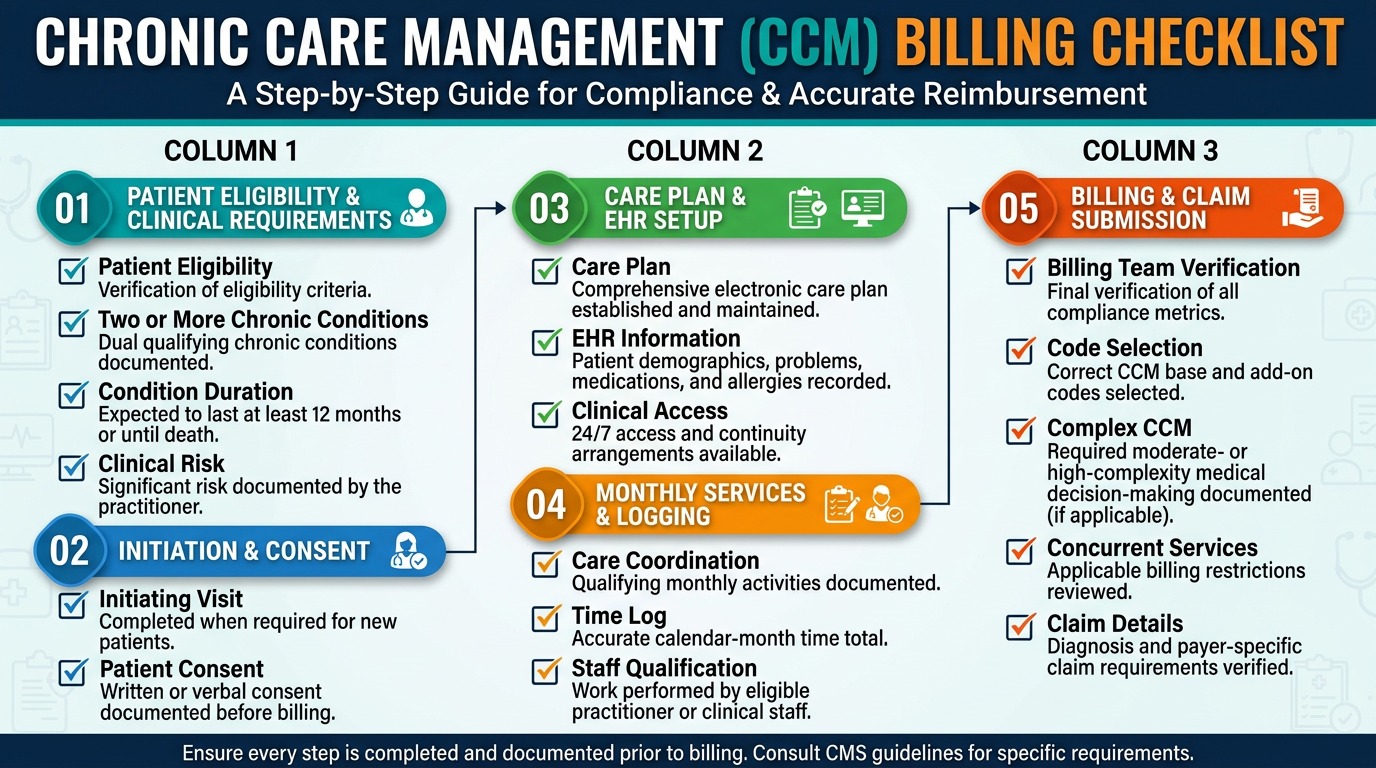
Chronic Care Management Billing Checklist
Use this checklist before submitting a CCM claim.
Final Thoughts
Chronic Care Management can support more consistent care coordination for patients with multiple chronic conditions while creating a recurring reimbursement opportunity for eligible practices. However, a successful CCM program requires more than enrolling patients and submitting CPT 99490 each month.
The practice must establish patient eligibility, obtain informed consent, complete an initiating visit when required, maintain a comprehensive electronic care plan, provide appropriate access to clinical support, and document qualifying monthly activities.
Accurate code selection is equally important. The distinction between 99490, 99439, 99491, 99437, 99487, and 99489 depends on the service category, practitioner involvement, medical decision-making, and documented time.
Practices that connect clinical workflows with billing controls are better positioned to submit defensible claims, reduce avoidable denials, and maintain consistent CCM operations. Review current CMS guidance, CPT instructions, and payer policies regularly because Medicare payment and reporting requirements can change.
Frequently Asked Questions
What CPT code is used for Chronic Care Management?
The principal CCM CPT codes are 99490, 99439, 99491, 99437, 99487, and 99489. The appropriate code depends on whether the service is non-complex or complex, who performed the work, and the qualifying time documented during the calendar month.
What is the minimum time required for CPT 99490?
CPT 99490 requires at least 20 minutes of qualifying clinical staff CCM time during a calendar month. The work must meet the applicable CCM service requirements and occur under the direction of an eligible billing practitioner.
What is the difference between CPT 99490 and 99491?
CPT 99490 reports the first 20 minutes of qualifying CCM time furnished by clinical staff under practitioner direction. CPT 99491 reports at least 30 minutes of CCM services personally furnished by the billing physician or other qualified healthcare professional.
Clinical staff time cannot satisfy the 99491 personal-time requirement.
What is the difference between CPT 99487 and 99490?
CPT 99490 reports non-complex CCM with a 20-minute clinical staff threshold. CPT 99487 reports complex CCM with a 60-minute clinical staff threshold and requires moderate- or high-complexity medical decision-making by the billing practitioner.
The codes represent different service categories and cannot be selected based on time alone.
Can a practice bill CPT 99439 without CPT 99490?
No. CPT 99439 is an add-on code to CPT 99490. The practice must meet the base-code requirements before reporting the additional time.
Can a practice bill CPT 99489 without CPT 99487?
No. CPT 99489 is an add-on code for complex CCM and must be reported with CPT 99487 when the applicable requirements are met.
Does Medicare require written consent for CCM?
Medicare accepts written or verbal consent. The practice must document the consent and confirm that the patient received the required information about CCM availability, cost sharing, the one-practitioner-per-month rule, and the right to stop services.
Does CCM require a face-to-face visit every month?
No. CCM services are generally non-face-to-face. However, Medicare requires an initiating visit for new patients and patients who have not received a qualifying visit from the practitioner within the previous year, subject to applicable CMS rules.
Can two practitioners bill CCM for the same patient in one month?
No. Medicare permits only one practitioner to bill CCM for a patient during a calendar month. The practice should verify whether another practitioner is already furnishing and billing the service.
Can CCM and TCM be billed in the same month?
Yes. Medicare permits CCM and TCM to be reported during the same service period when both services meet their requirements. However, the practice cannot count the same time toward both services.
Can CCM be billed with RPM?
Certain CCM and RPM combinations may be reported during the same period when each service meets its separate requirements. The practice must maintain distinct documentation and avoid double-counting time. It should also verify the current CPT and payer-specific restrictions.
What is the ICD-10 code for Chronic Care Management?
CCM does not have one universal ICD-10-CM diagnosis code. The practice reports the patient’s documented chronic conditions, such as diabetes, hypertension, COPD, or cardiovascular disease, as appropriate.
How much does Medicare pay for CCM?
Medicare payment varies by CCM CPT code, geographic locality, place of service, and applicable payment adjustments. Practices should check the current Medicare Physician Fee Schedule for the correct rate rather than relying on a single national amount.
Can a third-party company provide CCM services?
A practice may arrange for external clinical staff to furnish the clinical staff portion of CCM when the applicable Medicare incident-to, supervision, and other billing requirements are met. The billing practitioner must retain the required involvement and clinical integration. The practice cannot simply transfer its billing responsibility to an outside company.
Is G0511 still used for CCM billing by RHCs and FQHCs?
No. CMS transitioned RHCs and FQHCs to individual CPT and HCPCS care coordination codes. G0511 was no longer reportable for these services after September 30, 2025. Practices should follow the individual code requirements for 2026 dates of service.