
Aetna provider enrollment can look like a simple application, but joining the network involves several separate steps. Providers typically start with a request for participation, then move through contracting and credentialing before Aetna finalizes network participation. Aetna also evaluates whether it needs additional providers in the geographic area.
For physicians, nonphysician providers, behavioral health professionals, groups, and facilities, understanding the process before submitting an application can prevent missing information, credentialing delays, and confusion about when you can actually begin billing Aetna.
This guide explains what to expect during Aetna provider enrollment, what documents you may need, how CAQH fits into the process, how long enrollment can take, and what to do after approval.
What Is Aetna Provider Enrollment?
Aetna provider enrollment refers to the process of requesting participation in an Aetna network and completing the required contracting and physician credentialing steps.
It helps Aetna determine whether a provider meets its participation requirements and whether the network needs that provider in a particular geographic area.
One important distinction can save providers a lot of confusion:
Provider enrollment, contracting, and credentialing are not the same thing.
Aetna states that credentialing occurs separately from network contracting. Both need to reach completion before a provider becomes an Aetna network provider.
The basic process looks like this:
- Request participation
- Aetna reviews network need
- Contracting, when applicable
- Credentialing
- Contract finalization
- Participation effective date
Provider can begin billing according to the applicable contract and plan rules
Aetna describes its onboarding process in substantially this order.
Who Can Apply to Join the Aetna Network?
Aetna provides different participation pathways depending on the provider type.
The current Aetna enrollment site separates requests into categories that include:
- Medical
- Dental
- Behavioral health
- Pharmacy
- Facilities and ancillary providers
Individual medical providers and provider groups follow a different pathway from hospitals, facilities, and ancillary organizations.
Medical applicants can include physicians and nonphysician providers.
Aetna’s application guidance specifically references provider types such as:
- Nurse practitioners
- Physician assistants
- Midwives
- Physicians
- Other medical health care professionals
Behavioral health professionals should use Aetna’s behavioral health participation pathway rather than the general medical request.
Aetna Provider Enrollment vs Credentialing
Many providers use these terms interchangeably. They shouldn’t.
Provider enrollment
This broadly refers to getting established with the payer for participation and applicable billing.
Contracting
This establishes the contractual relationship between the provider and Aetna.
Credentialing
Aetna reviews professional qualifications and other information to determine whether the provider meets its credentialing standards.
Aetna says credentialing includes reviewing information such as training, licenses, certifications or registrations, academic background, and professional competence and conduct.
Network participation
You become an Aetna network provider only after the applicable contracting and credentialing requirements have been completed.
So, submitting an application does not mean you can immediately treat Aetna members as an in-network provider.
Aetna Provider Enrollment Process
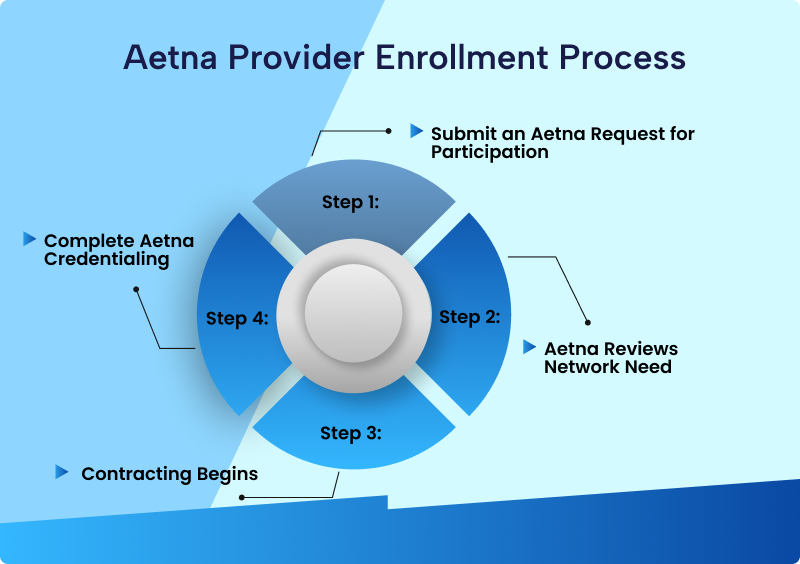
Step 1: Submit an Aetna Request for Participation
The process starts with Aetna’s request to join the network.
For individual medical providers and provider groups, Aetna provides an online request for participation form.
Before submitting, confirm that you are using the correct application type.
For example, Aetna instructs behavioral health professionals to use the behavioral health request rather than the medical request.
Information may include:
- Provider name
- NPI
- Provider type
- Specialty
- Tax identification information
- Practice location
- Contact information
- Participation information
- Other information requested by Aetna
Make sure the information matches your existing provider records.
A mismatch between your NPI, legal name, tax information, practice address, and credentialing records can create unnecessary follow up.
Step 2: Aetna Reviews Network Need
Submitting the application does not guarantee that Aetna will offer a contract.
Aetna evaluates its current network and the need to serve members in the provider’s geographic area. State law also influences this process.
Aetna currently states that it will let applicants know within 45 days whether they are eligible for participation and whether it will begin the contracting process for the applicable medical network request.
This stage matters because a provider can have excellent credentials and still receive a decision that Aetna does not currently need another provider of that type in the area.
What does that mean for providers?
Don’t interpret a participation request as a guaranteed contract.
Aetna first determines whether it wants to pursue participation.
Step 3: Contracting Begins
If Aetna decides to pursue participation, the next stage involves contracting when applicable.
Aetna explains that network management may contact the provider to begin the contracting process. Its onboarding information also states that providers may receive an electronic contract through Adobe Sign.
Review the contract carefully before signing.
Pay particular attention to:
- Participating entities
- Tax identification information
- Practice locations
- Effective date
- Covered products
- Reimbursement provisions
- Administrative requirements
- Termination provisions
- Provider obligations
Don’t assume that signing the contract means credentialing has finished.
Aetna treats contracting and credentialing as separate processes.
Step 4: Complete Aetna Credentialing
Credentialing represents one of the most important parts of Aetna provider enrollment.
Aetna verifies information about the provider’s professional background and qualifications.
The review can include:
- Education
- Training
- Licensure
- Certifications
- Registration
- Professional history
- Practice information
- Professional competence
- Professional conduct
- Other credentialing information
Aetna explains that it uses CAQH ProView for credentialing and recredentialing in most states.
That means your CAQH profile deserves careful attention before you start the Aetna process.
| What Is CAQH ProView?
CAQH ProView provides an electronic provider profile that health plans can use during credentialing. Instead of sending the same provider information separately to multiple health plans, providers can maintain their information in CAQH and authorize participating plans to access it. Aetna says it uses CAQH ProView as its credentialing data source for most states. Your CAQH profile should contain current information about:
Aetna’s provider education materials specifically emphasize keeping CAQH current and ensuring Aetna has authorization to access the application. |
Do You Need to Authorize Aetna in CAQH?
Yes, when Aetna uses CAQH for your credentialing.
Creating a CAQH profile alone doesn’t give Aetna access to it.
Aetna instructs providers to designate Aetna as an authorized health plan so it can retrieve the credentialing information.
This small step causes problems when providers overlook it.
Your CAQH profile might look complete on your screen, but Aetna may not be able to retrieve it until you authorize access.
Documents You Need for Aetna Credentialing
Exact requirements depend on provider type, state, specialty, and applicable credentialing rules.
However, providers should expect to maintain documentation such as:
Professional License
Keep your active state license current.
NPI Information
Make sure your NPI information matches your provider records.
Education and Training
Maintain accurate school, residency, fellowship, or other applicable training information.
Board Certification
If applicable, provide current certification information.
Malpractice Insurance
Aetna’s provider education materials specifically instruct providers to maintain current professional liability insurance information in CAQH.
DEA Registration
Where applicable, maintain current DEA information.
Aetna’s provider education materials specifically identify current DEA and state license information as part of the CAQH data providers should maintain.
Practice Locations
List all applicable service locations accurately.
Aetna advises providers to ensure that CAQH contains active service locations for the state where they seek participation.
Work History
Keep employment and professional history complete and accurate.
Aetna Credentialing Exceptions by State
Don’t assume every provider follows exactly the same CAQH workflow.
Aetna’s current provider manual says it uses CAQH ProView for individual professionals in most states, but it identifies exceptions, including Washington and certain provider situations in Arkansas and Minnesota.
Aetna also states that providers in Washington, physicians in Arkansas, and providers joining the Allina Health | Aetna joint venture network in Minnesota may use different credentialing vendors.
This is one reason providers should check the current Aetna instructions for their state before beginning credentialing.
How Long Does Aetna Provider Enrollment Take?
There isn’t one guaranteed timeline from application to network participation.
Different stages have different timeframes.
Aetna currently states that it will notify applicants within 45 days regarding whether it will pursue participation after the request for participation.
For credentialing, Aetna’s onboarding information says the credentialing process can take approximately 45 days once it starts.
That doesn’t mean every provider will complete enrollment in exactly 90 days.
The actual timeline can change based on:
- Provider type
- State
- Network availability
- Contracting
- Credentialing requirements
- Missing information
- CAQH status
- Verification issues
- Payer requests
- Provider response time
- State specific requirements
So, treat published timeframes as process guidance rather than a promise that your provider will become participating on a specific date.
What Can Delay Aetna Provider Enrollment?
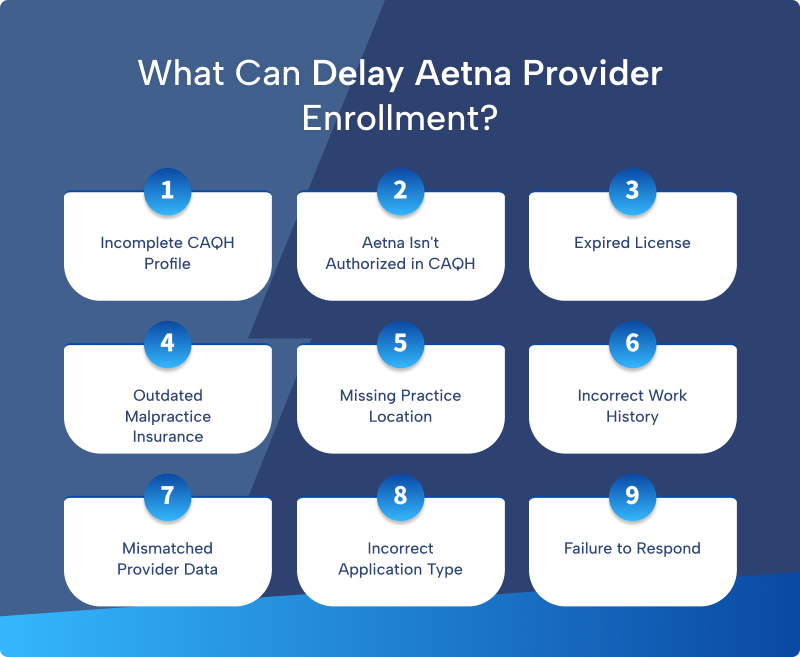
Most enrollment delays don’t come from one complicated problem.
They often come from small information gaps.
Incomplete CAQH Profile
If required information remains incomplete, Aetna may not have what it needs for credentialing.
Aetna Isn’t Authorized in CAQH
Aetna cannot retrieve the information if you haven’t granted access.
Expired License
An expired license can create a verification problem.
Outdated Malpractice Insurance
Your professional liability information needs to remain current.
Missing Practice Location
A provider may have a new office that doesn’t appear in the credentialing profile.
Incorrect Work History
Gaps or inconsistencies can trigger questions during verification.
Mismatched Provider Data
Differences among your NPI, CAQH, tax information, license, and application can cause follow up.
Incorrect Application Type
A behavioral health provider who uses the wrong participation pathway can create unnecessary delays.
Failure to Respond
A credentialing team may need clarification or documentation.
Slow responses can extend the overall process.
Aetna Provider Enrollment Checklist
Before you apply, prepare the following.
Provider information
☐ Legal name
☐ NPI
☐ Specialty
☐ Taxonomy
☐ Practice address
☐ Mailing address
☐ Contact information
Credentialing information
☐ Active state license
☐ CAQH profile
☐ CAQH attestation
☐ Aetna authorization in CAQH
☐ Education history
☐ Training history
☐ Work history
☐ Board certification, if applicable
☐ Malpractice insurance
☐ DEA registration, if applicable
☐ Practice locations
Business information
☐ Tax ID
☐ Group information
☐ Organization NPI, when applicable
☐ Billing information
☐ Ownership information, when applicable
Keeping this information ready can reduce back and forth during enrollment.
What Happens After Credentialing?
Once the credentialing process finishes, Aetna finalizes the applicable contracting process.
Aetna states that providers receive written notice after credentialing, and its network management team helps complete contracting when applicable.
Aetna’s onboarding information explains that once the provider receives the finalized participation information and the system reflects the effective date, the provider can begin submitting claims according to the applicable network and plan requirements.
Don’t start billing simply because:
- You submitted an application
- Aetna contacted you
- You completed CAQH
- You signed a contract
- Credentialing finished
Wait until you understand the actual participation effective date and applicable billing requirements.
How Do You Know In Network In-Network Status with Aetna?
Look for formal confirmation of your participation and effective date.
Aetna’s onboarding information states that its systems will update to reflect the participation effective date and that the provider will then be ready to submit claims.
Your billing team should keep a copy of:
- Signed contract
- Countersigned agreement, when applicable
- Welcome communication
- Effective date
- Provider participation information
- Applicable network information
This documentation can help prevent billing mistakes.
What Should You Do After Aetna Enrollment?
Getting enrolled doesn’t mean the administrative work ends.
Your practice should maintain accurate provider information.
Aetna currently encourages providers to keep their profiles updated and warns that failing to verify information can create a risk of removal from its provider directory.
After enrollment, monitor:
- Practice address
- Phone number
- Provider specialty
- Provider status
- Tax ID
- NPI information
- Practice locations
- Credentialing information
- Provider directory information
When information changes, update the appropriate payer systems instead of assuming one update will reach every system automatically.
What Is Availity and How Does It Fit In?
Availity is not the same thing as Aetna credentialing.
Aetna uses Availity for many day to day provider transactions.
According to Aetna, providers can use the Availity portal to:
- Submit claims
- Check eligibility
- Check claim status
- Request authorizations
- Upload supporting records
- File disputes and appeals
- Update provider information
- Check payments
So think of the workflow this way:
Aetna enrollment and credentialing
Gets you through the network participation process.
Availity
Helps you manage many ongoing transactions after you start working with Aetna.
Aetna also provides training and onboarding resources for providers using Availity.
Does Aetna Provider Enrollment Guarantee Payment?
No.
Enrollment means the provider has completed the applicable participation requirements. It does not guarantee payment for every claim.
Claims still need to meet applicable:
- Coverage requirements
- Medical necessity rules
- Coding requirements
- Authorization requirements
- Eligibility requirements
- Timely filing requirements
- Documentation requirements
- Contractual requirements
A patient’s Aetna coverage also doesn’t automatically mean that every service receives payment.
Your billing team should verify benefits and eligibility before providing services when appropriate.
Aetna Provider Enrollment for Groups
Group enrollment introduces another layer.
The practice may have:
- Organization NPI
- Tax ID
- Individual provider NPIs
- Multiple service locations
- Multiple specialties
- Multiple providers
Your billing team needs to keep the group and individual provider records aligned.
Aetna’s current participation guidance states that individual physicians and providers joining an already contracted group may follow a different process from providers establishing a new group relationship. It also notes that hospital-based providers joining an already contracted group may not need to complete the application independently.
Always verify the correct pathway rather than submitting duplicate applications.
What If You Already Participate with Aetna?
Don’t submit a new participation request simply because something changed.
Aetna provides separate workflows for existing providers making practice changes or other updates. Its current enrollment guidance specifically says existing network providers should not use the new participation form to update their Tax ID.
Depending on the change, you may need to update:
- Practice address
- Tax ID
- Group affiliation
- Provider status
- Specialty
- Service location
- Other provider data
Use the applicable Aetna provider update process.
Frequently Asked Questions
How long does Aetna provider enrollment take?
There is no single guaranteed total timeframe. Aetna currently states that it will notify applicants within 45 days about whether it will pursue participation, while its onboarding information says credentialing can take approximately 45 days. Contracting, network availability, provider type, state requirements, and missing information can affect the overall timeline.
Final Takeaway
Aetna provider enrollment involves more than completing an online form.
The process can involve network review, contracting, credentialing, CAQH, verification, final participation, and provider data maintenance. Aetna currently uses CAQH ProView for credentialing in most states, while certain states and network arrangements use different credentialing vendors.
The best way to avoid delays is to prepare your provider information before you apply. Keep CAQH current, authorize Aetna to access your profile, maintain active licenses and insurance, verify every practice location, respond quickly to requests, and don’t confuse credentialing completion with your actual network effective date.
Once you’re participating, keep your provider information accurate and use Aetna’s current provider tools, including Availity, for ongoing transactions. Aetna specifically encourages providers to keep their directory and provider data current.
Aetna provider enrollment is manageable when you treat it as a process rather than a single application.
FAQs
Does Aetna use CAQH for credentialing?
Yes. Aetna says it uses CAQH ProView for credentialing and recredentialing in most states, with certain state and network exceptions.
Do I need to authorize Aetna in CAQH?
Yes, when Aetna uses CAQH for your credentialing. You need to designate Aetna as an authorized health plan so Aetna can access your information.
Can I see Aetna patients after submitting my enrollment application?
Not simply because you submitted the application. You need to complete the applicable participation, contracting, and credentialing requirements and confirm your effective participation date before treating the provider as an in-network Aetna provider.
What can delay Aetna credentialing?
Common problems include incomplete CAQH information, expired licenses, outdated malpractice insurance, missing practice locations, incorrect work history, lack of Aetna authorization in CAQH, and unresolved information discrepancies.
Does Aetna use Availity for provider enrollment?
Aetna uses Availity for many provider transactions, but the network participation and credentialing process follows its own workflow. Providers can use Availity for claims, eligibility, authorizations, provider information updates, disputes, appeals, and other transactions.