
If you’re a healthcare provider planning to join insurance networks, you’ve probably heard about CAQH credentialing.
For many physicians and other healthcare professionals, CAQH plays an important role in the payer credentialing process.
This guide explains how CAQH works, what providers need, how to complete the profile, how reattestation works, common mistakes, and how CAQH fits into the overall medical credentialing process.
What Is CAQH?
CAQH provides a centralized online system that allows healthcare professionals to maintain professional information and supporting documents for participating health plans and organizations.
The Council for Affordable Quality Healthcare, or CAQH, operates the CAQH Provider Data Portal, formerly known as CAQH ProView. Healthcare providers use the portal to maintain professional information and supporting documents. Participating health plans and healthcare organizations can then access that information for credentialing and related purposes when the provider authorizes access.
Instead of completing the same basic provider information repeatedly for different credentialing organizations, providers can maintain information in one central profile and authorize participating organizations to access it.
This can include information about:
- Professional education and training.
- Medical licenses.
- Board certifications.
- Work history.
- Practice locations.
- Professional liability insurance.
- Hospital affiliations.
- Malpractice claims information.
- NPI information.
- DEA registration when applicable.
- Other professional credentials and documents.
The exact information and documents required can vary by provider type and health plan.
CAQH does not decide whether a provider joins an insurance network. The health plan makes that decision based on its own credentialing and network requirements.
What Is CAQH Credentialing?
The term “CAQH credentialing” can confuse.
CAQH does not credential healthcare professionals in the same way an insurance company does.
Instead, the process generally works like this:
- Provider creates a CAQH profile
- Provider enters professional information
- Provider uploads required documents
- Provider reviews the information
- Provider attests that the information is accurate
- Provider authorizes participating health plans to access the profile
- Health plan reviews the information
- Health plan verifies credentials
- Health plan makes its credentialing decision
The health plan remains responsible for its credentialing decision.
CAQH provides the data platform that helps support the process.
Who Uses CAQH?
Many healthcare professionals may use CAQH when participating health plans require it.
Common provider types include:
- Physicians and nonphysician medical providers.
- Nurse practitioners.
- Physician assistants.
- Psychologists.
- Licensed clinical social workers.
- Professional counselors.
- Behavioral health providers.
- Physical therapists.
- Occupational therapists.
- Speech-language pathologists.
- Other eligible healthcare professionals.
Requirements vary by payer, state, provider type, and network.
For example, Aetna states that it uses CAQH ProView for credentialing and recredentialing for healthcare professionals. Aetna also provides separate participation processes for medical, behavioral health, dental, and facility providers.
Why Does CAQH Matter for Healthcare Providers?
CAQH can simplify the administrative side of credentialing, but providers still need to manage their profiles carefully.
A complete and accurate CAQH profile can help a provider:
- Give participating health plans access to current credentialing information.
- Reduce repeated requests for the same professional information.
- Keep supporting documents organized.
- Update professional information in one central location.
- Support initial credentialing.
- Support recredentialing.
- Reduce delays caused by missing information.
The keyword here is accurate.
A provider may have an active CAQH profile but still experience credentialing delays if the profile contains an expired license, missing work history, incorrect practice address, outdated malpractice coverage, or missing authorization.
CAQH Credentialing vs Payer Credentialing
These terms often get mixed together.
CAQH
CAQH provides the platform where providers maintain information and documents.
Payer Credentialing
The insurance company reviews and verifies the provider’s qualifications and decides whether the provider meets its participation requirements.
Payer Contracting
The provider and payer establish the contractual relationship, including participation terms and reimbursement arrangements.
These processes connect, but they do not mean the same thing.
A provider can have a complete CAQH profile and still have no payer contracts.
Likewise, a provider can hold an active professional license and NPI but still need to complete CAQH and payer credentialing before joining an insurance network.
What Information Does a CAQH Profile Include?
Providers should expect to provide detailed professional information.
Personal Information
The profile may require information that identifies the provider and supports verification.
Providers should enter information exactly as requested and ensure that it matches their official records.
Professional License Information
Providers should maintain current license information for every state in which they practice, when applicable.
This may include:
- License number.
- State.
- Issue date.
- Expiration date.
- Status.
An expired license can create credentialing problems.
Education and Training
Providers may need to provide:
- Medical school or professional school.
- Graduate education.
- Residency.
- Fellowship.
- Internship.
- Other relevant training.
The information should match official records.
Work History
Providers should maintain accurate employment and practice history.
Gaps in work history can create additional questions during credentialing.
A provider should not leave unexplained gaps simply because a previous employer no longer exists or because the provider considers the information unimportant.
The credentialing organization may request clarification.
Practice Locations
The provider should list current practice locations as required.
The information should match the provider’s payer applications, NPI records, and other credentialing documents whenever applicable.
Inconsistent addresses can cause delays.
Professional Liability Insurance
Providers may need to provide current malpractice insurance information.
The policy should meet the applicable payer requirements.
Keep the expiration date current.
Board Certification
If applicable, providers should maintain accurate board certification information.
The provider should also update the profile when certification status changes.
Hospital Affiliations
Providers may need to list current hospital affiliations.
If the provider has no hospital privileges, the application may require an explanation or alternative information, depending on the payer.
DEA Registration
Providers who hold DEA registration may need to provide applicable information.
Not every provider requires DEA registration.
Only report information that applies to the provider.
CAQH Documents Checklist
Before starting the application, gather documents such as:
- NPI information.
- State professional licenses.
- DEA certificate, when applicable.
- Board certification documents.
- Professional liability insurance.
- Education and training information.
- Employment history.
- Hospital affiliation information.
- Work history explanations.
- Practice addresses.
- Tax identification information when required by the payer.
- Other documents requested by participating health plans.
A provider should review the CAQH profile requirements and payer specific instructions rather than assume that every provider needs the same documents.
How to Complete CAQH Credentialing
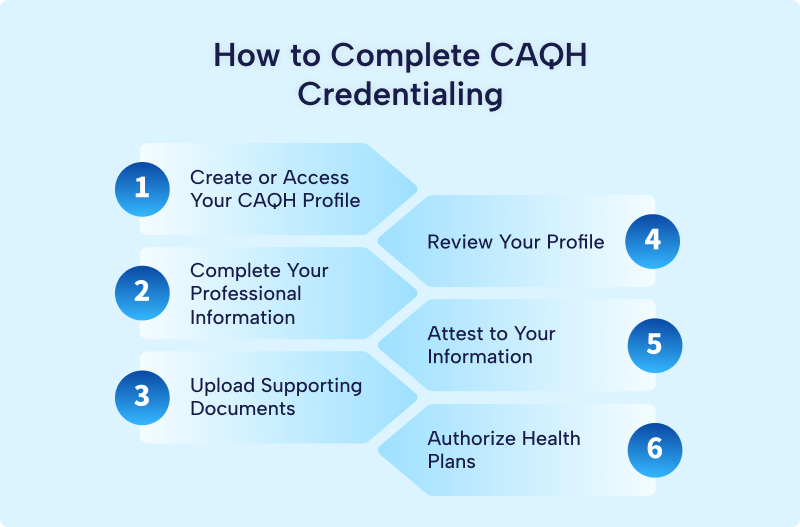
Step 1: Create or Access Your CAQH Profile
Start by creating a CAQH account or accessing an existing profile.
If you already have a CAQH profile, do not automatically create another one.
Check your existing profile first.
Duplicate profiles can create confusion and administrative problems.
Step 2: Complete Your Professional Information
Enter your information carefully.
Check:
- Legal name.
- NPI.
- License information.
- Practice locations.
- Education.
- Training.
- Employment history.
- Hospital affiliations.
- Professional liability coverage.
Make sure the information matches your official documents.
Step 3: Upload Supporting Documents
Upload the documents required for your provider type and participating health plans.
Check expiration dates carefully.
A provider may complete the application but still face delays because an important document expired before the payer finished reviewing the profile.
Step 4: Review Your Profile
Review the entire profile before submitting it.
Look for:
- Missing fields.
- Incorrect addresses.
- Expired licenses.
- Missing documents.
- Employment gaps.
- Incorrect NPI information.
- Outdated insurance.
- Incorrect specialty information.
Step 5: Attest to Your Information
CAQH requires providers to review and attest to the accuracy of their information.
Providers should not attest without reviewing the profile.
The attestation confirms that the provider reviewed the information and considers it accurate.
Step 6: Authorize Health Plans
A provider must authorize participating health plans to access the profile when required.
This step matters.
A provider may have a complete CAQH profile, but a payer may not be able to access the information if the provider has not authorized the payer.
Aetna specifically instructs providers to designate Aetna as an authorized health plan so it can access credentialing information.
How Often Do You Need to Reattest to CAQH?
Providers must regularly review and reattest to their information.
CAQH’s current provider guidance states that providers generally need to reattest every 120 days, while providers whose primary practice state is Illinois follow a 180 day reattestation cycle.
Providers should not wait until a payer requests an update.
A good practice includes checking the profile regularly and updating information as changes occur.
What Happens If You Forget to Reattest?
If a provider misses the required reattestation period, the profile can become expired.
That can create problems when a payer attempts to access the provider’s information during credentialing or recredentialing.
The provider may need to:
- Log in to CAQH.
- Review the profile.
- Update outdated information.
- Upload expired documents.
- Complete the attestation.
- Reauthorize payer access when necessary.
A lapsed CAQH profile can delay credentialing even when the provider holds an active license.
How Long Does CAQH Credentialing Take?
CAQH itself provides the data platform, while each payer controls its own credentialing timeline.
The overall process can take several weeks or longer depending on:
- Completeness of the application.
- Document availability.
- License verification.
- Work history questions.
- Malpractice verification.
- Payer workload.
- Network requirements.
- Contracting requirements.
- Provider specialty.
- State-specific requirements.
A provider should not assume that completing CAQH means the provider can immediately bill the payer.
The payer must complete its own process.
Common CAQH Credentialing Mistakes
Letting Your Profile Expire
Providers sometimes complete CAQH once and forget about it.
How to avoid it: Set reminders for reattestation and monitor expiration dates.
Using Different Information Across Applications
A provider’s legal name, practice address, NPI, specialty, and license information should remain consistent across credentialing records.
How to avoid it: Compare CAQH with payer applications and NPPES records.
Forgetting to Authorize the Payer
A payer may not access your profile without authorization.
How to avoid it: Check your authorized health plans.
Uploading Expired Documents
An expired malpractice policy or license can stop the process.
How to avoid it: Track expiration dates and update documents before they expire.
Ignoring Employment Gaps
Incomplete work history can trigger questions.
How to avoid it: Provide complete history and explain gaps when required.
CAQH Credentialing Checklist for Providers
Before you submit or reattest, confirm that:
- Your legal name matches official records.
- Your NPI information remains accurate.
- Your professional licenses remain active.
- Your malpractice insurance remains current.
- Your practice addresses remain accurate.
- Your specialty information remains correct.
- Your work history remains complete.
- Your education and training information remains accurate.
- Your hospital affiliations remain current.
- Your required documents remain valid.
- You completed the attestation.
- You authorized the appropriate health plans.
Final Thoughts
CAQH can make payer credentialing more manageable, but it does not eliminate the provider’s responsibility.
A complete profile, accurate documents, timely reattestation, and proper payer authorization can help prevent unnecessary delays.
The biggest mistake providers make is treating CAQH as a one-time application.
It isn’t.
Your credentials change. Licenses expire. Practice locations change. Insurance policies renew. Payer relationships change.
Your CAQH profile needs ongoing attention.
Stop Letting Credentialing Paperwork Slow Your Practice
Credentialing delays can affect when a provider joins a network, starts seeing insured patients, and begins receiving in-network reimbursement.
RCM Xperts can help healthcare practices manage the administrative work surrounding credentialing, payer enrollment, provider data, and revenue cycle operations.
Keep your attention on patient care. Let RCM Xperts help keep your credentialing process moving. Reach out today to discuss how your practice can reduce credentialing delays and stay ready for payer enrollment.
Frequently Asked Questions
Is CAQH the same as credentialing?
No. CAQH provides a centralized platform for provider information. Health plans conduct their own credentialing and decide whether providers meet their participation requirements.
Do all healthcare providers need CAQH?
No. Requirements vary by payer, provider type, state, and network. Check the requirements of each health plan you want to join.
Does CAQH cost money for providers?
Providers should review current CAQH information for applicable fees and program requirements. Do not assume that every credentialing service has the same cost structure.
How often should I update CAQH?
CAQH requires regular reattestation. The standard cycle generally occurs every 120 days, while Illinois providers follow a 180-day cycle under current CAQH guidance.
Does completing CAQH make me an in-network provider?
No. The payer must complete its credentialing and contracting processes before you become an in-network provider.