
Chronic hypoxic respiratory failure ICD-10 code: J96.11, Chronic respiratory failure with hypoxia.
For 2026, J96.11 remains the specific ICD-10-CM code for chronic respiratory failure with hypoxia. CMS’s FY 2026 code set also distinguishes it from J96.10, chronic respiratory failure without a specified hypoxic or hypercapnic component; J96.12, chronic respiratory failure with hypercapnia; and J96.21, acute and chronic respiratory failure with hypoxia.
The coding decision, however, does not begin with the codebook. It begins with the provider’s clinical documentation.
A low oxygen saturation reading does not automatically establish chronic respiratory failure. Likewise, home oxygen use alone does not give the coder permission to assign J96.11. The record should establish the condition being treated and support the provider’s documented diagnosis. That distinction matters for claim accuracy, medical necessity, audits, and reimbursement.
This guide explains how to code chronic hypoxic respiratory failure in 2026, what documentation supports J96.11, how to distinguish it from related respiratory failure codes, how oxygen therapy affects billing, and what billing teams should review before submitting claims.
What Is the ICD 10 Code for Chronic Hypoxic Respiratory Failure?
The ICD 10 CM code is:
J96.11, Chronic respiratory failure with hypoxia
The code belongs to category J96, Respiratory failure, not elsewhere classified.
Here is the relevant group of codes:
| ICD 10 CM code | Description |
| J96.10 | Chronic respiratory failure, unspecified whether with hypoxia or hypercapnia |
| J96.11 | Chronic respiratory failure with hypoxia |
| J96.12 | Chronic respiratory failure with hypercapnia |
| J96.20 | Acute and chronic respiratory failure, unspecified whether with hypoxia or hypercapnia |
| J96.21 | Acute and chronic respiratory failure with hypoxia |
| J96.22 | Acute and chronic respiratory failure with hypercapnia |
| J96.90 | Respiratory failure, unspecified, unspecified whether with hypoxia or hypercapnia |
| J96.91 | Respiratory failure, unspecified with hypoxia |
| J96.92 | Respiratory failure, unspecified with hypercapnia |
CMS’s FY 2026 ICD 10 CM files list these distinctions within the J96 category.
The key word in J96.11 is “chronic.”
If the provider documents an acute episode superimposed on an established chronic condition, the appropriate code may instead be J96.21, acute and chronic respiratory failure with hypoxia, assuming the documentation supports both components.
What Does J96.11 Mean?
J96.11 identifies a patient with chronic respiratory failure accompanied by hypoxia.
The diagnosis generally describes a persistent impairment in respiratory function in which the patient does not maintain adequate oxygenation under the circumstances documented by the treating clinician.
The underlying cause may vary.
For example, chronic hypoxic respiratory failure may occur in a patient with:
- Advanced COPD
- Interstitial lung disease
- Pulmonary fibrosis
- Certain neuromuscular disorders
- Severe pulmonary hypertension
- Chronic heart or lung conditions
- Other disorders that impair oxygenation
The underlying disease and respiratory failure are not automatically interchangeable diagnoses.
A patient may have COPD and chronic hypoxic respiratory failure. In that situation, the documentation and coding should reflect the conditions that the clinician actually assessed and treated, subject to the applicable ICD 10 CM guidelines and payer rules.
Is J96.11 the Same as Hypoxemia?
No.
This distinction causes frequent confusion in respiratory coding.
J96.11 means chronic respiratory failure with hypoxia.
R09.02 means hypoxemia.
Hypoxemia describes low oxygen levels. Chronic respiratory failure represents a more specific clinical diagnosis involving respiratory system failure.
A patient can have an episode of hypoxemia without meeting the clinical criteria for chronic respiratory failure.
Therefore, a coder should not automatically convert every low oxygen saturation reading into J96.11.
Example
A patient with pneumonia has an oxygen saturation of 88% during an acute visit.
That finding alone does not establish chronic respiratory failure.
Now consider a patient with documented chronic lung disease who has an established diagnosis of chronic respiratory failure with hypoxia and requires long term supplemental oxygen according to the physician’s assessment.
That documentation presents a very different coding situation.
The coder should code the documented condition rather than making an independent clinical diagnosis from a single measurement.
J96.11 vs J96.21: What Is the Difference?
The distinction between these two codes becomes especially important during hospitalizations.
J96.11
Chronic respiratory failure with hypoxia
Use when the provider documents chronic respiratory failure with hypoxia and the encounter does not establish an acute exacerbation of the respiratory failure itself.
J96.21
Acute and chronic respiratory failure with hypoxia
This code applies when the provider documents both acute and chronic respiratory failure with hypoxia.
For example, a patient may have established chronic respiratory failure and then experience an acute respiratory deterioration requiring a significant escalation in respiratory support.
The coder should not assign J96.21 simply because a chronically ill patient has a temporary increase in oxygen requirement.
The documentation must support the acute component.
CMS’s 2026 code set clearly separates J96.11 from J96.21.
J96.11 vs J96.12
The distinction here concerns the type of respiratory abnormality documented.
- 11: chronic respiratory failure with hypoxia
- 12: chronic respiratory failure with hypercapnia
If the provider documents both chronic hypoxia and chronic hypercapnia, coding should follow the applicable ICD 10 CM guidelines and the documentation.
Do not select J96.12 merely because the patient has severe COPD.
COPD does not automatically establish chronic hypercapnic respiratory failure.
The record needs to support the condition being coded.
J96.11 vs J96.10
J96.10 applies when the provider documents chronic respiratory failure but does not specify whether it involves hypoxia or hypercapnia.
If the provider clearly documents chronic respiratory failure with hypoxia, J96.11 provides the more specific code.
If the record simply states “chronic respiratory failure” without further specification, the coder should not invent hypoxia or hypercapnia.
A documentation query may be appropriate when clarification is clinically reasonable and necessary.
Can You Code J96.11 Based Only on Oxygen Use?
Not automatically.
A patient may use supplemental oxygen for several reasons. Oxygen use alone does not allow the coder to independently diagnose chronic respiratory failure.
CMS’s oxygen coverage guidance focuses on documented hypoxemia and specific coverage criteria for home oxygen. CMS states that Medicare covers home oxygen therapy and oxygen equipment for acute or chronic conditions when the patient demonstrates hypoxemia, subject to the applicable coverage requirements.
That does not mean:
Oxygen use = J96.11
Instead, think of the two questions separately.
Clinical coding question: What diagnosis did the provider document and support?
Oxygen coverage question: Does the patient meet the payer’s requirements for the oxygen equipment or service being billed?
Those questions overlap, but they are not identical.
Documentation Requirements for J96.11
There is no single laboratory value that substitutes for complete clinical documentation.
A strong record should establish the provider’s assessment of chronic respiratory failure and describe the clinical circumstances supporting that diagnosis.
Depending on the patient and setting, useful documentation may include:
- Explicit diagnosis of chronic respiratory failure with hypoxia
- Underlying pulmonary or cardiac condition
- Oxygenation findings
- Pulse oximetry results
- Arterial blood gas results when clinically obtained
- Oxygen requirement and delivery method
- Baseline oxygen requirement
- Changes from baseline
- Relevant pulmonary findings
- Respiratory symptoms and functional impact
- Treatment plan
- Clinical assessment of chronicity
- Response to respiratory treatment
- Relevant imaging or pulmonary testing when applicable
The exact documentation needed depends on the encounter and payer.
The most important point is that the provider should document the diagnosis rather than leaving the coder to infer it.
Weak documentation
Low oxygen. On oxygen at home.
That describes findings and treatment but does not clearly establish chronic respiratory failure.
Stronger documentation
Chronic respiratory failure with hypoxia related to advanced COPD. Patient remains on continuous supplemental oxygen at baseline and requires continued oxygen therapy.
The second example explicitly identifies the condition and its relationship to the underlying disease.
The record should still contain the clinical facts supporting the assessment.
What Clinical Evidence Can Support Chronic Hypoxic Respiratory Failure?
Coders should not establish clinical diagnoses independently, but billing teams can recognize the types of information that clinicians commonly use when evaluating chronic hypoxic respiratory failure.
Potential supporting information includes:
Oxygen saturation
Pulse oximetry can document oxygenation status.
However, one isolated SpO2 value does not automatically prove chronic respiratory failure.
The clinical context matters.
Arterial blood gas testing
An ABG can provide information about oxygenation and ventilation when clinically indicated.
Again, the coder should use the provider’s documented diagnosis rather than independently interpreting a laboratory result as a diagnosis.
Long-term oxygen requirement
A documented long-term supplemental oxygen requirement can support the clinical picture.
It should not, by itself, create the diagnosis.
Baseline oxygen needs
Documentation becomes more useful when it distinguishes baseline status from an acute change.
For example:
Baseline oxygen requirement is 2 L/min by nasal cannula. The patient now requires 5 L/min.
That information helps clinicians and reviewers understand the patient’s respiratory status.
Pulmonary disease history
The underlying condition may provide important clinical context.
Examples include advanced COPD, pulmonary fibrosis, or another chronic respiratory disease.
The underlying condition should still be coded according to the provider’s documentation and applicable coding guidelines.
Why Documentation Specificity Matters for Reimbursement
Respiratory failure codes can affect the clinical picture presented on a claim and, depending on the setting and payer methodology, may influence payment calculations or medical record review.
That makes unsupported specificity risky.
A coder should not select J96.11 because it appears more clinically significant than a symptom code.
Likewise, a provider should not document respiratory failure simply to increase reimbursement.
The diagnosis must reflect the patient’s actual condition.
CMS emphasizes that claims must contain the information necessary for processing and that medical records should support reported services and diagnoses.
Chronic Hypoxic Respiratory Failure and Medical Necessity
Medical necessity becomes particularly important when the diagnosis appears alongside respiratory services or durable medical equipment.
For example, Medicare has specific coverage rules for home oxygen.
CMS states that oxygen therapy and oxygen equipment may receive coverage for acute or chronic conditions when the patient demonstrates hypoxemia. The coverage policy includes specific qualifying circumstances and documentation requirements.
Therefore, the presence of J96.11 on a claim does not automatically guarantee payment for oxygen equipment.
The payer may still review:
- Qualifying oxygen measurements
- Testing conditions
- Timing of testing
- Physician orders
- Medical necessity
- Equipment type
- Supplier documentation
- Applicable coverage criteria
- Continued need requirements
The diagnosis code supports the clinical picture. It does not replace the payer’s coverage requirements.
Billing Home Oxygen for a Patient With J96.11
Home oxygen billing requires more than attaching J96.11 to a DME claim.
Medicare’s oxygen policy contains specific requirements for coverage, including qualifying evidence of hypoxemia and documentation. CMS’s current oxygen guidance states that Medicare covers home oxygen for qualifying acute or chronic conditions when hypoxemia is demonstrated.
CMS’s oxygen policy article also lists J96.11 among diagnosis codes that can appear in the coverage framework, while specific coding circumstances and modifiers can affect whether a diagnosis supports a particular claim.
What the billing team should verify
Before submitting an oxygen claim, check:
Diagnosis
Does the provider document chronic respiratory failure with hypoxia?
Qualifying testing
Does the patient meet the applicable oxygen coverage criteria?
Testing documentation
Does the record contain the required information about the oxygen measurement?
Order
Is the required physician or practitioner order present?
Equipment
Does the equipment billed correspond to the prescribed therapy?
Supplier documentation
Does the DME supplier have the records required under the applicable Medicare rules?
Modifiers and claim details
Are the required HCPCS codes and modifiers correct?
Payer policy
Does the specific payer impose additional requirements?
A correct J96.11 code cannot compensate for missing oxygen qualification documentation.
Chronic Respiratory Failure and Pulse Oximetry Billing
Pulse oximetry frequently appears in respiratory care.
CMS maintains specific billing and coding guidance for respiratory therapy and oximetry services. One Medicare article, revised effective January 1, 2026, addresses respiratory therapy and oximetry services and notes that certain oximetry codes have specific payment and bundling rules.
For example, CMS states that CPT codes 94760, 94761, and 94762 are bundled with critical care services under the applicable NCCI rules and cannot be separately paid when billed with critical care codes 99291 and 99292.
That illustrates an important billing principle:
The diagnosis may support the medical reason for a service, but coding edits and service relationships still determine whether the service receives separate payment.
Do not assume that adding J96.11 makes every respiratory service separately billable.
Chronic Hypoxic Respiratory Failure and Respiratory Therapy
Respiratory therapy claims may involve diagnosis coding, procedure coding, physician orders, documentation, and medical necessity requirements.
CMS’s respiratory care billing article, effective January 1, 2026, states that respiratory care services require a specific written order from the physician or appropriate NPP under the associated coverage requirements.
That means a billing review should connect three elements:
The diagnosis
Why does the patient need the service?
The order
Who ordered the service, and does the order satisfy the applicable requirement?
The service documentation
What service did the clinician actually provide?
A mismatch among these three elements can create a denial even when J96.11 itself is correctly reported.
Chronic Hypoxic Respiratory Failure in Hospital Coding
Hospital coding requires additional care because the principal diagnosis, secondary diagnoses, present on admission status, and inpatient coding rules can affect the final claim.
J96.11 may be reported when chronic respiratory failure with hypoxia meets the applicable reporting requirements and the provider documents the condition.
However, the code should not automatically become the principal diagnosis simply because it represents a serious condition.
Principal diagnosis selection follows the inpatient coding guidelines and depends on the circumstances of the admission.
The FY 2026 ICD 10 CM Official Guidelines provide the rules that govern diagnosis reporting and sequencing.
Example
A patient with established chronic hypoxic respiratory failure is admitted for treatment of bacterial pneumonia.
The pneumonia may drive the admission, while chronic respiratory failure may represent an additional documented condition affecting the patient’s care.
The final sequencing depends on the complete clinical record and applicable inpatient coding rules.
Do not determine sequencing from the diagnosis code alone.
Chronic Hypoxic Respiratory Failure and COPD
COPD and chronic respiratory failure often appear together, but they represent different clinical concepts.
COPD identifies the underlying pulmonary disease.
J96.11 identifies chronic respiratory failure with hypoxia.
If both conditions are documented and reportable for the encounter, both may appear on the claim according to the applicable coding guidelines.
Do not replace the underlying disease with J96.11.
Likewise, do not automatically add J96.11 to every COPD claim.
Example
Provider documentation states:
- Severe COPD with chronic respiratory failure with hypoxia. Patient remains on home oxygen.
- That documentation identifies both the underlying condition and the respiratory complication.
- The coder should evaluate both conditions under the applicable ICD 10 CM guidelines.
- Chronic Hypoxic Respiratory Failure and Home Oxygen
- Home oxygen often becomes part of the documentation for patients with J96.11.
But the relationship needs careful handling.
A clinician may document:
- Chronic respiratory failure with hypoxia, requiring continuous oxygen.
- That is clinically different from:
- Uses oxygen occasionally.
- The second statement does not establish chronic respiratory failure.
For oxygen reimbursement, Medicare uses specific qualifying criteria. CMS’s 2026 patient guidance states that Medicare covers home oxygen therapy and oxygen equipment when qualifying hypoxemia exists, including for chronic conditions.
The oxygen claim therefore requires its own medical necessity review.
Does J96.11 Guarantee Oxygen Coverage?
No.
This is one of the most important points for billing teams.
Diagnosis coding and DME coverage are related, but they are not the same thing.
A patient can have a valid J96.11 diagnosis and still fail a particular oxygen coverage requirement.
Conversely, a patient may demonstrate hypoxemia that qualifies for oxygen coverage without the provider documenting chronic respiratory failure.
The payer evaluates the requirements applicable to the item or service being billed.
CMS’s oxygen policy specifically establishes coverage criteria for home oxygen and equipment.
Reimbursement for J96.11 in 2026
There is no single national dollar amount that can be attached to J96.11.
J96.11 is an ICD-10-CM diagnosis code, not a CPT procedure code with a fixed reimbursement rate.
Payment depends on what service is being billed, the setting, payer, claim methodology, documentation, and other factors.
- For physician services, reimbursement can depend on the applicable CPT or HCPCS code and the Medicare Physician Fee Schedule or payer contract.
- CMS published the CY 2026 Medicare Physician Fee Schedule final rule and related payment files for 2026.
- For inpatient hospital claims, diagnosis coding can influence MS DRG assignment when applicable.
- For DME, reimbursement depends on the equipment or supply HCPCS code and applicable Medicare DME payment and coverage rules.
So it would be misleading to say:
“J96.11 reimburses $X.”
A more accurate statement is:
J96.11 supports diagnosis reporting. The associated service or facility payment depends on the procedure, setting, payer methodology, and applicable coverage rules.
How J96.11 Can Affect the Claim
Depending on the care setting, a documented chronic respiratory failure diagnosis may provide important clinical context for services such as:
- Pulmonary evaluation
- Respiratory therapy
- Oximetry
- Pulmonary function related services
- Home oxygen
- Respiratory equipment
- Chronic disease management
- Inpatient care
But the diagnosis does not automatically make each service payable.
The claim still needs:
- Correct CPT or HCPCS coding
- Correct ICD 10 CM coding
- Appropriate modifiers
- Required orders
- Medical necessity documentation
- Correct place of service
- Payer specific requirements
- Accurate claim submission
Common Coding Mistakes With J96.11
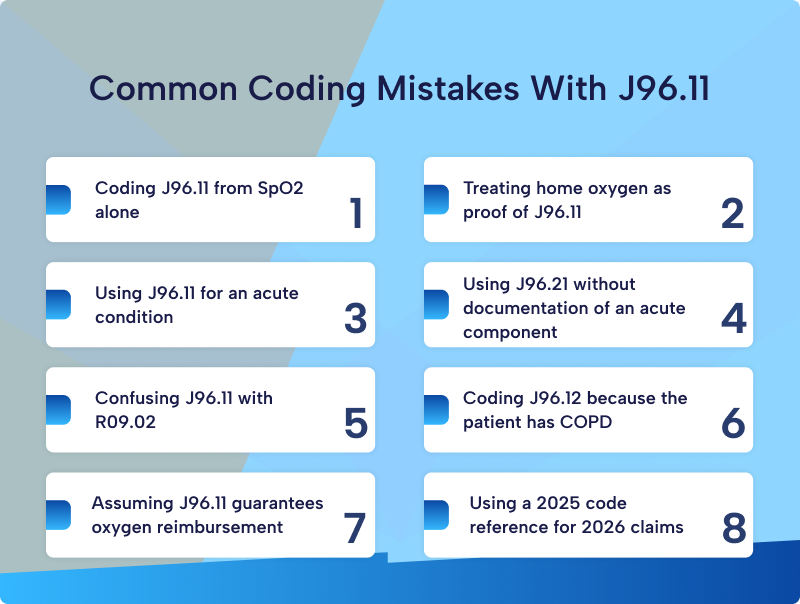
Coding J96.11 from SpO2 alone
A low oxygen saturation does not allow a coder to independently diagnose chronic respiratory failure.
Better approach: Code the provider’s documented diagnosis and query when clarification is appropriate.
Treating home oxygen as proof of J96.11
Home oxygen may support the clinical picture, but oxygen use alone does not establish chronic respiratory failure.
Better approach: Look for explicit provider documentation and supporting clinical information.
Using J96.11 for an acute condition
A patient with acute hypoxic respiratory failure does not automatically receive J96.11.
Better approach: Determine whether the provider documented acute, chronic, or acute on chronic respiratory failure.
Using J96.21 without documentation of an acute component
A chronically hypoxic patient may temporarily require more oxygen without the provider diagnosing acute on chronic respiratory failure.
Better approach: Do not infer acute respiratory failure from a change in oxygen flow alone.
Confusing J96.11 with R09.02
Hypoxemia and chronic respiratory failure with hypoxia are not interchangeable.
Better approach: Review the provider’s clinical assessment and diagnosis.
Coding J96.12 because the patient has COPD
COPD does not automatically mean chronic hypercapnic respiratory failure.
Better approach: Look for documentation supporting hypercapnia and chronic respiratory failure.
Assuming J96.11 guarantees oxygen reimbursement
It does not.
Better approach: Review the oxygen coverage criteria and qualifying documentation separately.
Using a 2025 code reference for 2026 claims
Annual ICD 10 CM updates matter.
Better approach: Use the code set applicable to the date of service. CMS provides FY 2026 ICD 10 CM files and official guidelines.
How to Improve J96.11 Documentation
Providers can make coding more defensible by documenting the diagnosis directly instead of expecting the coder to reconstruct it.
A useful note may address:
- Diagnosis: Chronic respiratory failure with hypoxia
- Underlying condition: COPD, pulmonary fibrosis, or another documented cause
- Current status: Baseline oxygen requirement and relevant respiratory findings
- Treatment: Supplemental oxygen or other respiratory therapy
- Clinical assessment: Why the provider considers the respiratory failure chronic and hypoxic
- Plan: Continued treatment, monitoring, testing, or adjustment
The exact content should reflect the patient’s actual condition.
Do not copy a diagnosis statement into every note without reassessing whether it remains clinically accurate.
When Should a Coder Query the Provider?
A query may be appropriate when the record contains enough clinical information to justify clarification but the diagnosis remains unclear.
For example, the record may repeatedly document:
- Long term oxygen therapy
- Chronic severe pulmonary disease
- Persistent hypoxemia
- Significant baseline oxygen requirement
Yet the provider documents only “hypoxia.”
The coder should not independently upgrade the diagnosis to chronic respiratory failure.
A compliant query can ask the provider to clarify the condition when appropriate.
The query should present the relevant clinical indicators without steering the provider toward a desired diagnosis.
J96.11 and Z99.81
Another code that may appear in patients receiving long term oxygen is:
Z99.81, Dependence on supplemental oxygen
This is a status code describing dependence on supplemental oxygen.
It does not replace J96.11 when chronic respiratory failure with hypoxia is documented and reportable.
The two codes answer different questions:
- 11: What respiratory condition does the patient have?
- 81: What oxygen dependence status does the patient have?
Whether both should be reported depends on the clinical circumstances and applicable coding guidelines.
Do not add a status code automatically simply because oxygen appears somewhere in the record.
J96.11 and Z99.11
Z99.11 identifies dependence on a respirator.
This is different from supplemental oxygen dependence.
CMS’s FY 2026 Official Guidelines specifically address ventilator weaning and state that encounters for weaning from a mechanical ventilator should receive a code from J96.1 followed by Z99.11, dependence on respirator status.
This distinction matters because oxygen therapy and mechanical ventilation represent different forms of respiratory support.
Here is a simplified example of documentation that clearly communicates the diagnosis:
Assessment: Chronic respiratory failure with hypoxia secondary to advanced COPD. Patient’s baseline oxygen requirement is 2 L/min via nasal cannula. Continue supplemental oxygen as prescribed. No evidence of acute respiratory deterioration from baseline today.
The coder now has a clear provider assessment.
The record also provides clinical context for the chronic condition and oxygen requirement.
Compare that with:
- Assessment: COPD. On oxygen.
- The second note may describe an important treatment detail, but it does not clearly document chronic respiratory failure with hypoxia.
If the distinction matters for coding, a compliant provider query may be appropriate.
Billing Workflow for Claims With J96.11
A practical workflow can follow this sequence.
Review the provider diagnosis
Confirm that the provider documents chronic respiratory failure with hypoxia.
Confirm the clinical context
Review the record for relevant findings, treatment, oxygen requirement, and underlying disease.
Select the specific ICD 10 CM code
Use J96.11 when the documentation supports chronic respiratory failure with hypoxia.
Review additional diagnoses
Determine whether underlying conditions or relevant status codes should also be reported under the applicable guidelines.
Check the service being billed
Identify the CPT or HCPCS service associated with the diagnosis.
Check medical necessity
Review the payer’s coverage policy for that service.
Review documentation requirements
Confirm that the medical record contains the required order, testing, clinical assessment, or other documentation.
Run coding edits
Check NCCI edits and payer specific claim rules where applicable.
Submit the claim
Use the correct payer, provider, place of service, diagnosis pointers, modifiers, and service codes.
Review the remittance
If the payer denies the service, identify whether the issue involves:
- Coding
- Medical necessity
- Documentation
- Coverage
- Authorization
- Bundling
- Eligibility
- Timely filing
- DME requirements
Then work the denial based on the actual reason rather than resubmitting the same claim.
What to Check During a J96.11 Coding Audit
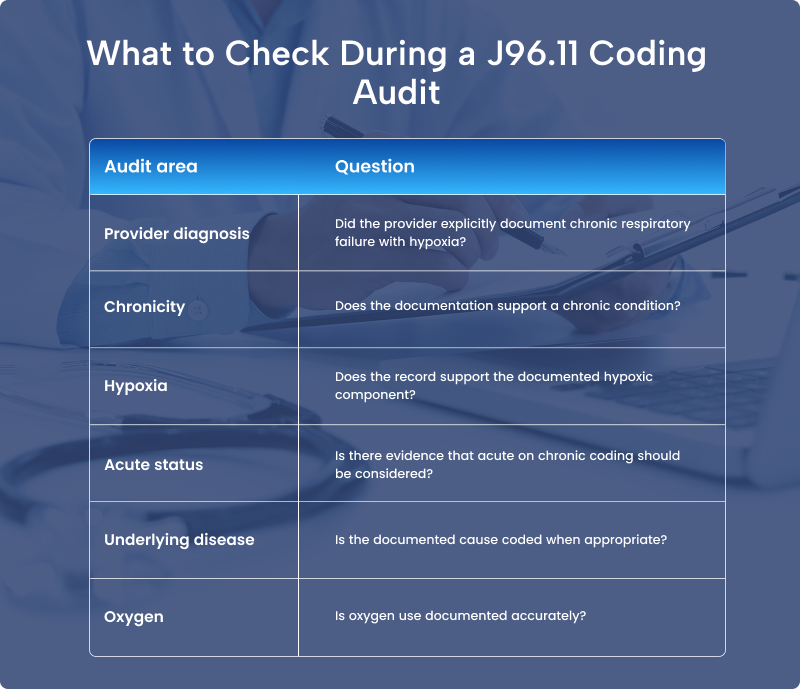
A focused audit can identify problems quickly.
Select a sample of claims containing J96.11 and compare the claim with the medical record.
Check:
| Audit area | Question |
| Provider diagnosis | Did the provider explicitly document chronic respiratory failure with hypoxia? |
| Chronicity | Does the documentation support a chronic condition? |
| Hypoxia | Does the record support the documented hypoxic component? |
| Acute status | Is there evidence that acute on chronic coding should be considered? |
| Underlying disease | Is the documented cause coded when appropriate? |
| Oxygen | Is oxygen use documented accurately? |
| DME | If oxygen equipment is billed, does the record meet coverage requirements? |
| Orders | Are required orders present? |
| Testing | Is required qualifying testing documented? |
| CPT/HCPCS | Does the procedure or equipment code match the service? |
| Medical necessity | Does the diagnosis support the billed service under payer policy? |
| Payer rules | Have payer specific requirements been checked? |
An audit should look for both undercoding and unsupported coding.
The goal is not to maximize the number of J96.11 diagnoses.
The goal is to report the patient’s actual documented condition accurately.
What to Do When J96.11 Is Denied
First, identify the denial reason.
A denial might say:
- Diagnosis does not support medical necessity
- Documentation is insufficient
- Oxygen criteria not met
- Required testing missing
- Invalid diagnosis for the billed service
- Service bundled
- Authorization missing
- Claim information incomplete
Do not assume that every denial involving J96.11 requires a coding correction.
If the diagnosis is correct but documentation is missing
Gather the requested records and follow the payer’s reconsideration or documentation submission process.
If the provider documented the wrong respiratory status
Determine whether a corrected claim is appropriate and whether a compliant documentation clarification is needed.
If the oxygen qualification criteria are missing
Review the applicable oxygen coverage policy before resubmitting the DME claim.
If the service is bundled
Review the applicable coding edits rather than changing the diagnosis merely to obtain separate payment.
CMS’s respiratory therapy guidance provides examples of services subject to bundling under NCCI edits.
2026 Medicare Considerations
For 2026 claims, billing teams should work from current CMS materials rather than relying on older coding articles.
CMS’s FY 2026 ICD 10 CM Official Guidelines are available for the 2026 code year, and the CMS code files identify J96.11 as chronic respiratory failure with hypoxia.
CMS also revised its respiratory therapy and oximetry billing guidance effective January 1, 2026.
The Medicare Physician Fee Schedule also has a specific CY 2026 final rule and associated payment files.
For home oxygen, CMS updated its Medicare Learning Network guidance in February 2026 and continues to identify hypoxemia as the basis for coverage of home oxygen therapy and equipment under the applicable requirements.
That means a 2026 billing review should account for three separate sources of information:
2026 ICD 10 CM rules
For diagnosis coding.
Current Medicare coverage and billing policies
For services such as oxygen, respiratory therapy, and oximetry.
Current payment files and payer contracts
For reimbursement.
Final Takeaway
For 2026, J96.11 is the ICD 10 CM code for chronic respiratory failure with hypoxia. The code is straightforward. The difficult part is deciding whether the medical record actually supports it.
A low oxygen saturation does not automatically equal chronic respiratory failure. Home oxygen does not automatically equal J96.11. COPD does not automatically equal J96.11. And J96.11 does not automatically guarantee payment for oxygen, respiratory therapy, or another service.
For oxygen claims, add a fifth checkpoint: qualifying oxygen coverage criteria. CMS’s 2026 guidance continues to require evidence of qualifying hypoxemia for Medicare home oxygen coverage under the applicable rules.
When those pieces agree, J96.11 becomes a defensible diagnosis code rather than simply another code added to the claim.
Make Chronic Respiratory Failure Claims Easier to Get Right
J96.11 requires accurate diagnosis coding, supporting documentation, and payer specific billing knowledge. RCM Xpert helps healthcare practices review respiratory claims, correct coding issues, manage denials, and pursue unpaid reimbursements.
Get a Free Billing Audit from RCM Xpert
Frequently Asked Questions
What is the ICD 10 code for chronic hypoxic respiratory failure in 2026?
The ICD 10 CM code is J96.11, Chronic respiratory failure with hypoxia. CMS’s FY 2026 code files continue to identify J96.11 with this description.
What is the difference between J96.11 and J96.21?
J96.11 describes chronic respiratory failure with hypoxia. J96.21 describes acute and chronic respiratory failure with hypoxia. The latter requires documentation supporting both the chronic condition and an acute respiratory failure component.
Is chronic hypoxia the same as chronic respiratory failure?
No. Hypoxia or hypoxemia does not automatically establish chronic respiratory failure. The provider should document the respiratory failure diagnosis when clinically appropriate. Coders should not create J96.11 solely from an oxygen saturation result.
Can I use J96.11 for a patient on home oxygen?
Not solely because the patient uses oxygen. Home oxygen use may support the clinical picture, but the coder needs provider documentation supporting chronic respiratory failure with hypoxia. Oxygen coverage also has separate payer requirements. CMS states that Medicare home oxygen coverage depends on qualifying hypoxemia and applicable coverage criteria.
What is the difference between J96.11 and R09.02?
J96.11 represents chronic respiratory failure with hypoxia. R09.02 represents hypoxemia. They describe different clinical concepts and should not be treated as interchangeable codes.
When should a provider query be used for J96.11?
A query may be appropriate when the record contains clinically relevant indicators, but the provider’s diagnosis does not clearly identify the condition needed for accurate coding. For example, the record may document long-term oxygen use and persistent hypoxemia while the assessment only states “hypoxia.” The query should remain clinically neutral and allow the provider to determine the appropriate diagnosis.