

Denial codes appear on remittance advices for a reason. They tell providers something specific about why a claim was not paid as expected. Among the hundreds of possible denial codes, CO 24 stands out as one of the most misunderstood. Many billing teams treat it like a coding error or an appeal opportunity when neither is correct.
This guide explains what CO 24 actually means, why it happens, what it costs your practice, and how to resolve it. The information here draws from payer manuals, industry data, and the real experiences of practices that have learned to handle this denial correctly.
What CO 24 Means?
CO 24 is a Claim Adjustment Reason Code that appears on the Explanation of Benefits or Electronic Remittance Advice when a payer denies a claim line.
The official description is clear: Charges are covered under a capitation agreement or managed care plan.
The CO prefix stands for contractual obligation. This designation matters because it tells you who bears the financial responsibility.
When a CO group code appears with CO 24, the provider is contractually obligated to write off the charge. The patient cannot be billed for the denied amount.
In plain terms, the payer is telling the provider that payment for the service was already arranged through a different mechanism.
The fee-for-service claim submitted is not the correct billing pathway. The payer is not saying the claim had a coding error or that documentation was insufficient. The message is that you submitted the claim through the wrong channel.
CO 24 vs Other Denial Codes
CO 24 gets confused with other contractual obligation codes more often than it should. Here is how it compares to the codes it is most commonly mixed up with:
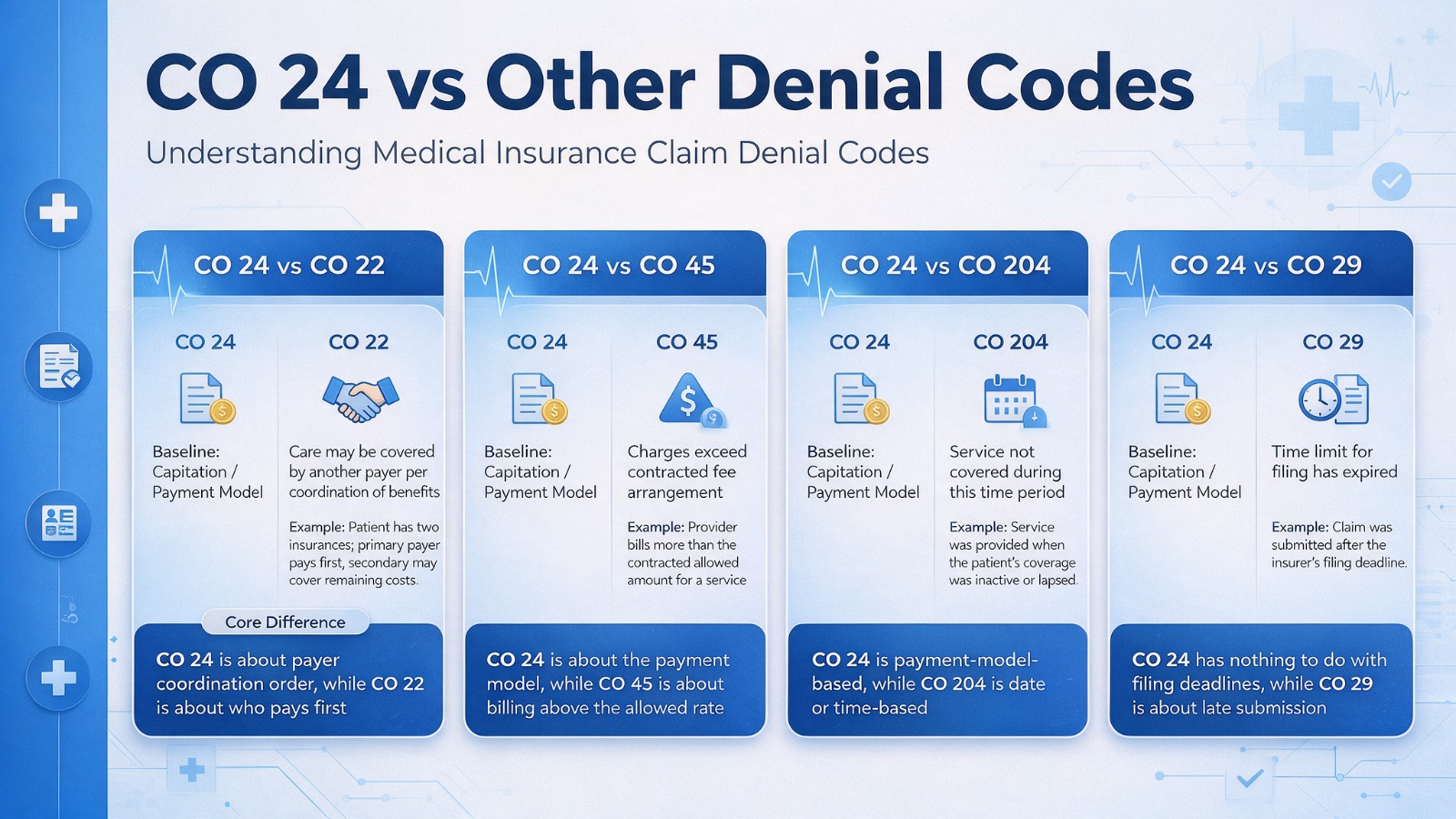
The distinction matters because each code requires a different resolution approach. Treating a CO 24 like a CO 45 means adjusting your fee schedule when the real issue is capitation enrollment. That does not fix anything.
Common Reasons CO 24 Denials Happen
CO 24 arises from specific situations where a fee-for-service claim conflicts with a capitated payment arrangement. Understanding these scenarios helps identify the correct resolution path.
Medicare Advantage Routing Errors
This is the most frequent cause of CO 24 denials. A Medicare beneficiary enrolls in a Medicare Advantage plan, which replaces their original Medicare coverage.
The provider checks eligibility and sees active Medicare Part A and Part B. Assuming the patient is on traditional Medicare, the provider submits the claim to Medicare.
The claim is denied with CO 24. What happened is that the eligibility screen showed active Part A and B, but the patient’s benefits are actually administered through a Medicare Advantage plan. Traditional Medicare is not the correct payer.
Medicare Advantage plans operate on a capitated model and are responsible for covering services. Billing traditional Medicare for a service that falls under the MA plan triggers CO 24.
First Coast Service Options, a Medicare Administrative Contractor, specifically notes that this reason code appears when a claim is submitted to Medicare and the beneficiary is enrolled in a Medicare Advantage plan.
They advise providers to obtain eligibility and benefit information before rendering services and to ask patients if they have recently enrolled in any new health insurance plans.
Services Already Included in Capitation
Under a capitation agreement, a provider receives a fixed monthly payment per patient regardless of how many services that patient receives. When the provider submits a fee-for-service claim for a service already covered by that monthly payment, the payer denies it with CO 24.
This scenario plays out frequently with Remote Patient Monitoring. Practices bill RPM codes expecting fee-for-service payment, only to receive CO 24 denials. The payer is essentially saying: We already paid you for this work through your capitation payment. You do not get a second check just because you submitted an RPM claim.
Medicaid Managed Care Routing
Similar to Medicare Advantage, many Medicaid beneficiaries are enrolled in managed care organizations. The provider submits the claim to the state Medicaid program instead of the specific MCO assigned to the patient. The claim is denied with CO 24.
Behavioral Health Carve-Outs
Some insurance plans carve out mental health or substance use treatment to specialized managed care entities. The provider bills the primary medical payer for the service, but the service falls under a separate capitated arrangement. The claim is denied with CO 24.
Capitation at the Service Level
Some capitation agreements cover specific service categories, such as primary care services, but carve out specialty procedures, diagnostic tests, or ancillary services for separate fee-for-service billing. If the provider bills a service that is included under the capitation, CO 24 follows.
The Financial Impact of CO 24 Denials
A single CO 24 denial might seem like a minor nuisance, but the costs add up quickly. Every denied claim requires staff time to pull the claim, research the issue, contact the payer, and either resubmit or write it off. That is time your staff could spend working clean claims or following up on aging accounts.
Industry data compiled from MGMA, AAPC, and HFMA shows that rework costs per denied claim range from $25 to $118. At a practice processing 500 claims per month with a 5 percent CO 24 denial rate, that is 25 denied claims each month. At $25 to $118 in rework costs per claim, that is $625 to $2,950 in administrative costs alone, before counting the delayed or lost revenue from the denied services.
For practices with a heavy managed care patient mix, these denials accumulate quickly. Investing in accurate billing processes and proactive denial management delivers measurable ROI, often within the first billing cycle.
ABA practices are particularly vulnerable. Data from approximately 50 behavioral health practices shows CO 24 accounts for 8 to 14 percent of all first-pass denials on ABA claims. Monthly CO 24 exposure for mid-size practices ranges from $12,000 to $28,000. For large multi-site ABA groups, denial buckets reach $40,000 to $90,000 per month.
Can You Appeal a CO 24 Denial
The answer depends on whether the denial is valid.
If the denial is valid, meaning the service truly is covered under a capitation arrangement and the claim was submitted to the wrong payer, filing an appeal is a waste of staff time. Appeals are for routing mistakes and attribution problems, not for fighting capitation terms you already agreed to.
If the denial was issued in error, for example the service is specifically carved out of the capitation agreement or the patient was not actually enrolled in a managed care plan on the date of service, then an appeal is appropriate.
When you do appeal, include specific documentation:
- The section of your capitation contract showing the service is carved out
- Patient eligibility verification records from the date of service
- Prior authorization documentation if the plan required it
- A cover letter that explains specifically why the denial is incorrect
Generic appeal letters get generic results. The more precise your documentation, the faster the resolution. Payer appeals teams respond to evidence, not persuasion.
How to Fix a CO 24 Denial?
Review the Denial
Start by reading the full denial details on the remittance advice. Identify which payer issued the CO 24. Confirm whether the patient is enrolled in a capitated or managed care plan with that payer. Determine whether the claim was submitted to the wrong payer or the correct payer denied it in error.
Check the Remark Codes
Review any accompanying Remittance Advice Remark Codes. Codes like N30 (ineligibility), N24 (missing or invalid service or site), or MA88 (missing or invalid claim) often accompany capitation-related routing errors and provide additional context.
Verify Patient Eligibility
Confirm the patient’s insurance coverage for the specific date of service. Review the patient’s insurance card. Verify eligibility through the payer’s portal or a real-time 270/271 eligibility transaction. Check whether the patient is enrolled in a managed care plan and which specific plan is responsible for coverage.
For Medicare patients, remember that active Part A and B does not necessarily mean traditional Medicare. Check the Bill Option Code or OPT Code to confirm the correct payer.
Review the Contract.
If the claim was submitted correctly and the denial appears related to capitation, review the provider contract. Determine which services are included in the capitation payment and which are carved out and billable separately. Many specialty procedures, diagnostic tests, and ancillary services may still be eligible for fee-for-service billing depending on the agreement.
Resubmit to the Correct Payer
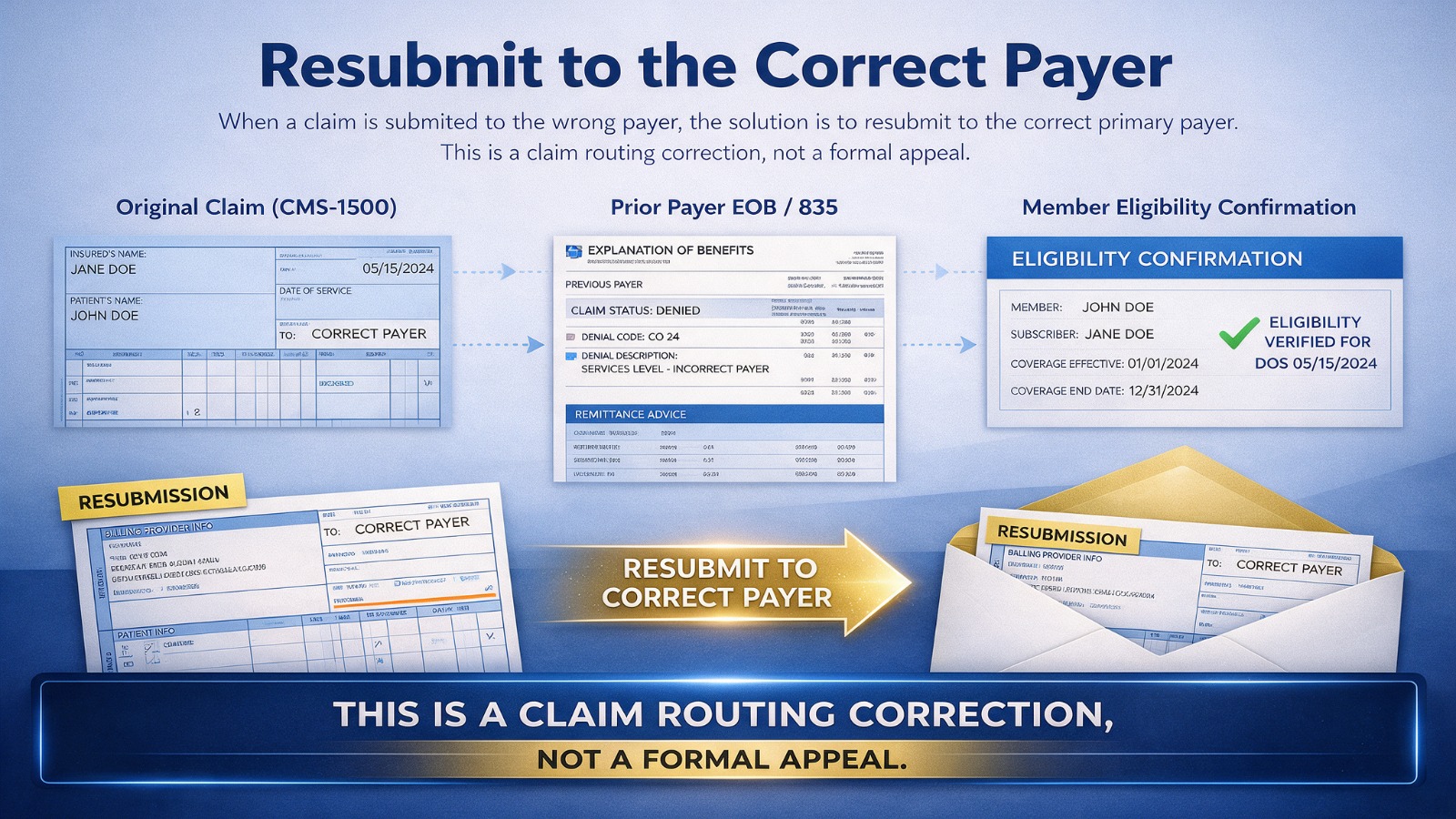
This is a resubmission to the correct payer, not an appeal. For Medicare Secondary Payer situations, ensure the MSP questionnaire on file is current.
File an Appeal if Denied in Error
If the claim was submitted correctly and the CO 24 denial appears incorrect, file a formal appeal. Include eligibility verification confirming the patient was covered under the billed plan, documentation showing the service is not included in the capitation arrangement, and a clear explanation of why the denial is incorrect.
Write Off the Balance
If the denial is valid and no appeal is warranted, write off the balance as a contractual adjustment. Do not bill the patient for the denied amount when the Group Code is CO.
When to Stop Fighting CO 24
Some CO 24 denials are contractually correct and cannot be fixed. If your contract bundles a service into capitation, no modifier in the world will change that. Stop treating every CO 24 as a coding error. Stop burning staff time on contractually correct appeals. And for services you know will generate CO 24 denials every month, stop blindly submitting those claims and expecting different results.
Instead, document the work for quality and risk purposes, but recognize that those claim lines are not a reliable revenue stream under the capitation arrangement. The conversation should shift from how do we appeal this denial to what other codes are still payable outside of capitation and how can we use this data to negotiate better per-member-per-month rates.
Conclusion
CO 24 is not a coding error. It is a contract signal. It means your claim went through the wrong payment pathway. Either the service is already covered under a capitation arrangement, or you submitted the claim to the wrong payer.
The right response depends on the specific situation. If the claim was misrouted, resubmit to the correct payer. If the denial is valid, write it off and stop wasting resources on appeals. If the denial was issued in error, appeal with precise documentation.
The most effective strategy is prevention. Verify eligibility before every visit. Know your contracts. Train your staff. And when a denial is contractually correct, accept it and move on. The time saved by not chasing unappealable denials can be redirected to recovering revenue from claims that can actually be won.
Transform Your Denial Management with RCM Xpert
CO 24 denials are among the most preventable denial types in medical billing, yet they continue to drain revenue from practices across every specialty. The fix requires specialized knowledge, consistent follow-through, and a clear understanding of capitation contracts and payer rules. That is where RCM Xpert comes in.
RCM Xpert provides end-to-end medical coding and billing services designed to turn your documentation into accurate, compliant, and fully billable claims. We go beyond assigning codes. We review your workflows, identify recurring issues like CO 24, and fix them at the source.
Contact RCM Xpert today
Frequently Asked Questions
What does denial code CO 24 mean?
CO 24 is a Claim Adjustment Reason Code that indicates charges are covered under a capitation agreement or managed care plan. The CO prefix stands for Contractual Obligation, which means the provider must write off the denied amount and cannot bill the patient. The payer is telling you that the service you billed should not go through fee-for-service payment because it is already covered by a prepaid arrangement.
Can I appeal a CO 24 denial?
Yes and no. If the denial is valid because the claim was submitted to the wrong payer or the service is truly covered under capitation, an appeal will not resolve the issue. You must resubmit to the correct primary payer instead. However, if the denial was issued in error, for example the service is explicitly carved out of the capitation agreement, then a formal appeal with supporting documentation is appropriate.
Can I bill the patient for a CO 24 denial?
Not when the group code is CO. The CO prefix means Contractual Obligation, so the provider is contractually required to write off the charge. Once the correct primary payer has processed the claim, any remaining patient responsibility amount can be billed to the patient according to that payer’s Explanation of Benefits.
Why do CO 24 denials happen?
The most common reason is submitting claims to the wrong payer. For example, when a patient has switched to a Medicare Advantage plan but the provider bills traditional Medicare. Another cause is billing separately for services that are already included in a capitation agreement. Outdated coordination of benefits information and lack of prior authorization can also trigger these denials.
How can I prevent CO 24 denials?
Verify patient eligibility before every visit using real-time eligibility checks. For Medicare patients, check the Bill Option Code or OPT Code to confirm whether they are on traditional Medicare or a Medicare Advantage plan. Maintain a contract matrix that clearly defines which services are included in capitation and which are carved out for fee-for-service billing. Configure your billing system to flag capitated claims before submission.
How much do CO 24 denials cost my practice?
For ABA practices specifically, CO 24 accounts for 8 to 14 percent of first-pass denials. Mid-size practices report monthly exposure of $12,000 to $28,000, while large multi-site groups see denial buckets reaching $40,000 to $90,000 per month. The rework cost per denied claim ranges from $25 to $118 in administrative time.
What documentation do I need to appeal a CO 24 denial?
When appealing a CO 24 denial that was issued in error, include a copy of the original claim, the prior payer’s EOB or 835 electronic remittance advice showing the denial, member eligibility confirmation for the date of service, the relevant medical records supporting the service, and documentation showing the service is carved out of the capitation agreement.