

CPT code 90785 reports interactive complexity during a psychiatric or psychotherapy service. It does not represent a separate psychotherapy session. Instead, it captures additional communication-related work that makes an otherwise reportable psychiatric service substantially more difficult to perform.
Providers should use 90785 only when the clinical circumstances support interactive complexity and the medical record clearly explains what made communication difficult, how the provider adapted the session, and why those adaptations were necessary.
CMS identifies 90785 as an add-on code that can accompany psychiatric diagnostic evaluations, psychotherapy, and group psychotherapy in appropriate circumstances.
This guide explains when healthcare providers can report 90785, which codes can accompany it, what documentation should contain, common billing mistakes, and how to build a defensible claim.
What Is CPT Code 90785?
CPT 90785 represents interactive complexity associated with a psychiatric service.
The key point is that interactive complexity does not simply mean that a session felt difficult, emotional, lengthy, or complicated.
The provider must encounter a communication problem or interactional circumstance that creates additional work during the psychiatric service.
For example, a child may have limited verbal communication and require play equipment or other communication techniques. A caregiver may become emotionally reactive and interfere with the treatment process. A provider may also need to address a mandated report involving abuse or neglect during the psychiatric encounter.
CMS describes interactive complexity as communication difficulties during a psychiatric procedure.
90785 is an add-on code
You cannot normally submit 90785 as a standalone psychiatric service.
You report it alongside an eligible primary service when the encounter meets the requirements for interactive complexity.
Common primary codes include:
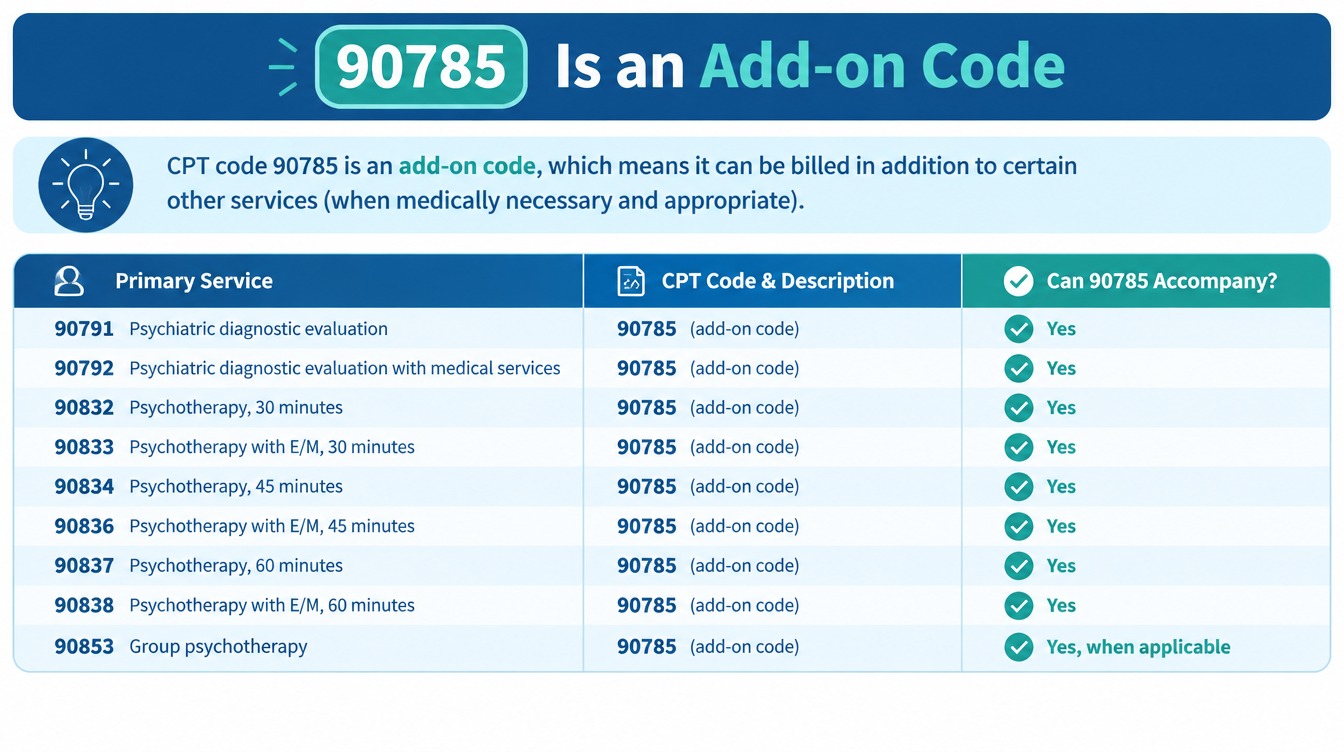
CMS lists these combinations in its current Medicare psychiatric and psychotherapy billing guidance.
When Should a Provider Use 90785?
The provider should first determine whether the session involved genuine interactive complexity.
Several situations can support reporting 90785.
Maladaptive Communication Complicates the Session
Interactive complexity may apply when communication among participants becomes unusually difficult and interferes with the provider’s ability to deliver the psychiatric service.
Examples include:
- Severe anxiety that disrupts communication
- Highly reactive behavior
- Repeated questioning that significantly interferes with the therapeutic process
- Persistent disagreement among participants
- Significant communication problems between the patient and caregiver
The important distinction involves how the communication problem affects the service.
Simply documenting that a patient was anxious does not automatically justify 90785.
The note should explain how the anxiety or other communication problem affected the session and what the provider did to address it.
For example:
The patient’s severe anxiety resulted in repeated interruptions and difficulty responding to treatment questions. The provider used structured questions, simplified communication, and additional redirection to complete the therapeutic intervention.
That documentation provides a clinical reason for the additional complexity.
A Caregiver’s Behavior Interferes With Treatment
Children frequently receive psychiatric services with parents or caregivers involved in the encounter.
The presence of a parent does not automatically make the session interactive complexity.
The caregiver’s participation must create a communication or behavioral issue that complicates delivery of the psychiatric service.
For example, a parent may become highly emotional when discussing the child’s behavior. The provider may need to redirect the parent repeatedly, manage conflicting accounts, and modify the therapeutic approach so the child can participate.
In that situation, the medical record should describe:
- Who participated
- What communication problem occurred
- How the problem affected the psychiatric service
- What intervention the provider used
- Why the intervention was necessary
Mandated Reporting Creates Interactive Complexity
A psychiatric encounter may involve suspected abuse, neglect, or another event that requires reporting to an appropriate third party.
CMS guidance recognizes circumstances involving mandated reporting or a sentinel event as potential interactive complexity situations.
However, the provider should not automatically append 90785 merely because a report occurred.
The documentation should connect the event to the psychiatric service.
For example:
During psychotherapy, the patient disclosed suspected abuse. The provider addressed the disclosure with the patient and caregiver, explained the reporting process, managed the resulting emotional response, and modified the therapeutic intervention to address the immediate communication difficulties.
The note should demonstrate that the event created additional interactional work during the psychiatric service.
Special Communication Techniques Are Required
Some patients cannot communicate effectively through ordinary verbal interaction.
CMS guidance recognizes circumstances where the provider uses adaptations such as:
- Play equipment
- Physical communication devices
- Nonverbal communication
- An interpreter or translator
- Other communication techniques required because of significant communication limitations
CMS specifically discusses these adaptations in its interactive complexity guidance.
For example, a child with limited expressive language may require structured play techniques and visual communication tools during psychotherapy.
The provider should document the communication limitation and explain how the selected technique helped the provider deliver the service.
When Should You Not Report 90785?
One of the biggest billing problems involves treating 90785 as a general code for a difficult psychotherapy session.
That approach can result in denials.
A Difficult Patient Alone Does Not Justify 90785
A patient who argues with the provider does not automatically qualify.
The provider needs to establish that the communication or interaction created additional complexity during the psychiatric service.
A Family Member’s Presence Alone Does Not Qualify
A parent, spouse, guardian, or other family member may participate in a session without creating interactive complexity.
The provider should document the specific communication problem rather than simply stating that a family member attended.
Longer Treatment Time Does Not Automatically Qualify
90785 does not replace the time requirements of the underlying psychotherapy code.
If a provider performs 60 minutes of psychotherapy, the provider still needs to meet the requirements for the appropriate psychotherapy code.
Interactive complexity represents the additional interactional work. It does not turn a shorter psychotherapy session into a longer one.
A Medicare LCD explains that when 90785 accompanies psychotherapy, the interactive complexity affects the work intensity, not the psychotherapy time itself.
Emotional Conversations Do Not Automatically Qualify
Mental health treatment often involves emotional conversations.
A patient crying, discussing trauma, becoming upset, or experiencing grief does not automatically establish interactive complexity.
The documentation needs to show a qualifying communication difficulty or other circumstance recognized by the applicable payer policy.
Which CPT Codes Can Be Billed With 90785?
For Medicare, CMS identifies several psychiatric services that can accompany 90785.
Psychiatric Diagnostic Evaluation
Providers may report:
90791 + 90785
or
90792 + 90785
when the diagnostic evaluation includes qualifying interactive complexity.
CMS specifically identifies 90785 for use with both psychiatric diagnostic evaluation codes.
Individual Psychotherapy
Depending on the service provided, a provider may report:
- 90832 + 90785
- 90834 + 90785
- 90837 + 90785
The provider must meet the requirements of the underlying psychotherapy code and separately establish the interactive complexity.
Psychotherapy With E/M
When an eligible practitioner provides psychotherapy with a separately identifiable E/M service, 90785 may accompany:
- 90833
- 90836
- 90838
The provider must meet the requirements for both the psychotherapy and E/M components.
Group Psychotherapy
CMS also recognizes:
90853 + 90785
when the specified patient in the group psychotherapy encounter experiences qualifying interactive complexity.
Important Codes You Should Not Pair With 90785
Providers should pay particular attention to excluded combinations.
Medicare guidance excludes 90785 from use with several services, including psychotherapy for crisis codes 90839 and 90840 and certain psychological or neuropsychological testing services. CMS also identifies several behavioral treatment codes that should not be combined with 90785.
For example:
- 90839 + 90785 = Do not report together
- 90840 + 90785 = Do not report together
This matters because crisis psychotherapy already has its own coding structure.
CMS specifically states that 90839 and 90840 should not be billed with 90785 or other psychiatric service codes listed in its crisis psychotherapy guidance.
How to Document CPT 90785
Documentation represents one of the most important parts of 90785 billing.
A provider should not rely on a generic statement such as
“Interactive complexity present.”
That statement does not explain why the provider reported the add-on code.
Instead, the note should tell the story of the interaction.
A Strong 90785 Documentation Framework
Document these five elements:
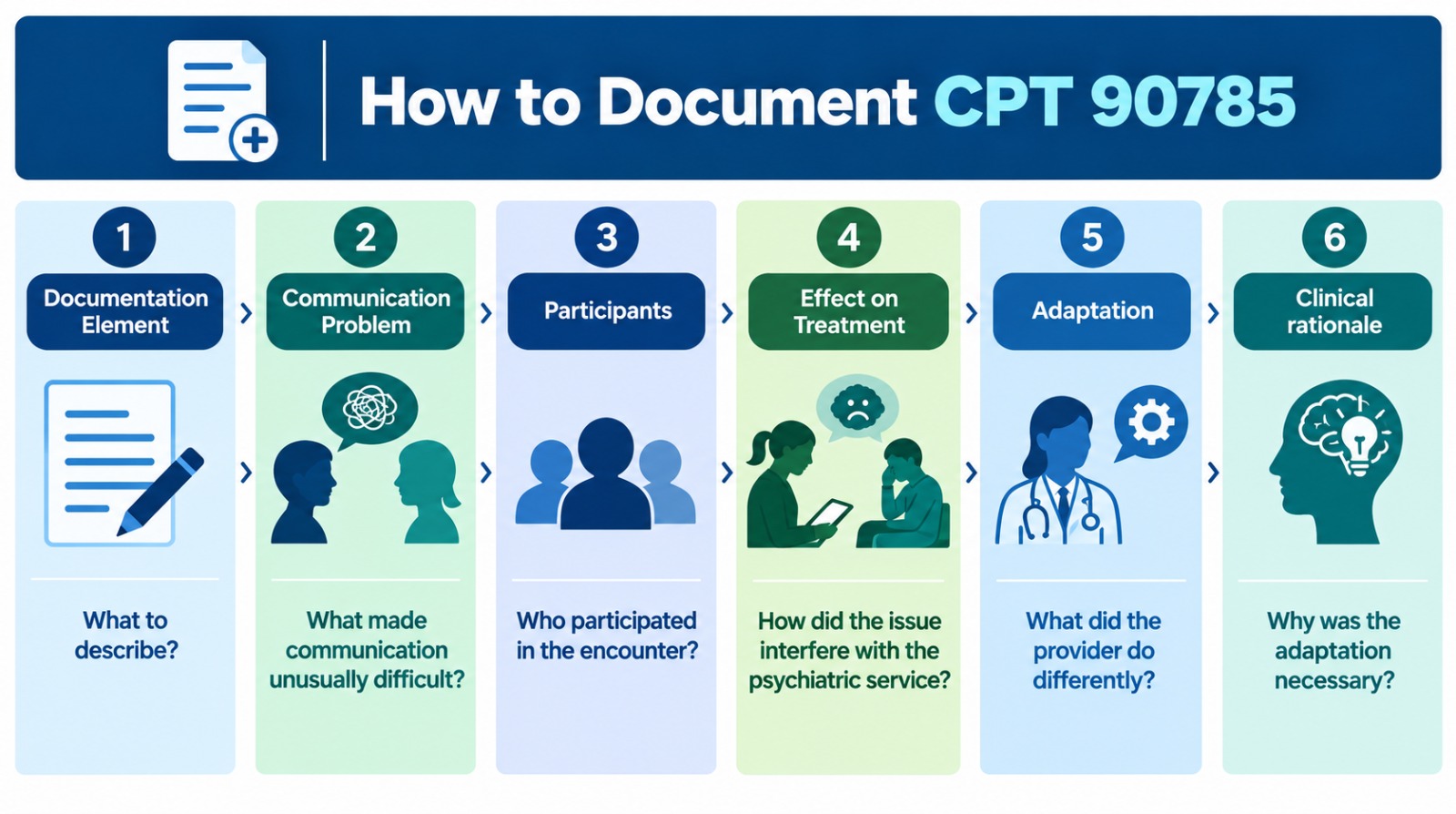
This structure helps connect the clinical facts to the billed service.
CMS guidance requires the record to support the interactive complexity circumstances and, in applicable Medicare policies, document communication limitations, adaptations, and the rationale for using those techniques.
Example of Weak Documentation
Consider this note:
Patient attended therapy with mother. Mother was upset. Interactive complexity billed.
This documentation creates several problems.
It does not explain:
- Why the mother was upset
- How her behavior affected treatment
- What communication problem occurred
- What the provider did
- Why the additional work justified 90785
A payer could reasonably question the claim.
Example of Stronger Documentation
A stronger note might state:
Patient attended psychotherapy with mother. During discussion of the patient’s behavioral symptoms, mother became highly reactive and repeatedly interrupted the patient and provider. Conflicting reports from patient and mother interfered with assessment and therapeutic communication. Provider redirected both participants, used structured questions, separated responses when necessary, and modified the therapeutic approach to maintain patient participation. These communication interventions were necessary to complete the planned psychotherapy.
This example connects the circumstances to the additional work.
Providers should still tailor the documentation to the actual encounter. They should never copy a template simply to justify 90785.
Does 90785 Require Additional Time?
This question causes confusion because 90785 represents additional work but does not function like a timed psychotherapy code.
The underlying psychotherapy code remains subject to its own time requirements.
For example, if a provider bills 90834, the provider must meet the applicable psychotherapy time requirements. Adding 90785 does not allow the provider to select 90834 merely because interactive complexity occurred.
CMS states that interactive complexity relates to increased work intensity and does not change psychotherapy time.
Some Medicare guidance also calls for documentation of the time spent providing interactive complexity services when 90785 accompanies a time-based service. Therefore, providers should follow the documentation requirements of their Medicare Administrative Contractor and payer rather than assuming that one universal time rule applies to every payer.
Does an Interpreter Automatically Support 90785?
Not necessarily.
An interpreter can become relevant to interactive complexity when the communication barrier significantly affects the psychiatric service and the provider must use adaptations to overcome the barrier.
However, providers should not assume that every session involving an interpreter automatically qualifies.
The medical record should explain the communication barrier and the way it affected the psychiatric service.
For example:
Patient has limited English proficiency. Provider used an interpreter throughout the psychotherapy encounter and modified questioning and communication techniques because direct communication between provider and patient was significantly limited.
Whether the payer accepts 90785 for that specific situation depends on the payer’s policy.
This distinction matters because Medicare coverage policies and commercial payer policies do not always apply identical criteria.
90785 and Telehealth
Telehealth does not automatically prevent the use of 90785.
CMS currently identifies 90785 among behavioral health codes in its telehealth-related materials.
However, providers still need to satisfy the requirements for the underlying service, telehealth eligibility, provider qualifications, documentation, and payer coverage.
The fact that the encounter occurred through video does not itself establish interactive complexity.
The documentation still needs to explain the communication difficulty and additional work.
90785 and Medical Necessity
Medical necessity starts with the underlying psychiatric service.
A provider should establish why the patient requires psychiatric evaluation or psychotherapy and then document why interactive complexity occurred during that service.
Think about the claim as two connected questions:
Why did the patient need the psychiatric service?
Then:
What happened during that service that created qualifying interactive complexity?
The diagnosis supports the clinical reason for treatment. The 90785 documentation supports the additional interactional complexity.
A diagnosis alone does not justify 90785.
How to Bill 90785 Correctly
A practical billing workflow looks like this:
Step 1: Identify the Primary Psychiatric Service
Determine whether the provider performed:
- Psychiatric diagnostic evaluation
- Individual psychotherapy
- Psychotherapy with E/M
- Group psychotherapy
Select the appropriate primary CPT code based on the actual service.
Step 2: Determine Whether Interactive Complexity Occurred
Ask whether the encounter involved a qualifying communication problem or circumstance.
Do not use 90785 simply because the patient required extra attention.
Step 3: Review the Medical Record
Look for documentation showing:
- The communication difficulty
- Participants involved
- Effect on the service
- Adaptations or interventions
- Clinical rationale
Step 4: Check the Payer Policy
Medicare provides national guidance, but Medicare Administrative Contractors may publish additional LCD and billing guidance.
Commercial insurers can also establish their own policies.
Check the payer’s current policy before creating a blanket billing rule for all claims.
Step 5: Submit 90785 With the Appropriate Primary Code
Do not submit 90785 as an independent psychiatric service.
For example:
90834 + 90785
could represent psychotherapy with qualifying interactive complexity.
Step 6: Review Claim Edits
Check for:
- Invalid code combinations
- NCCI edits
- Payer specific exclusions
- Provider eligibility
- Diagnosis requirements
- Telehealth requirements
- Modifier requirements when applicable
CMS advises providers to review NCCI and other applicable claim editing requirements before submitting Medicare claims.
Common CPT 90785 Billing Mistakes and How to Fix Them
Billing CPT 90785 requires more than identifying a challenging psychotherapy encounter. Providers must show that the encounter involved qualifying interactive complexity and that the medical record supports the additional work. Small documentation gaps can lead to claim denials, payment delays, or payer audits.
Here are the most common mistakes providers and billing teams should watch for.
Using 90785 for Every Difficult Therapy Session
A difficult session does not automatically qualify for interactive complexity. A patient may be emotional, angry, tearful, resistant, or unwilling to participate without meeting the requirements for 90785.
Solution:
Document the specific interactional or communication problem that created additional work. Explain how it interfered with the psychiatric service and what the provider did to manage the situation.
Writing Only “Interactive Complexity Present”
A statement such as “interactive complexity present” gives the payer very little information. It does not explain what happened during the encounter.
Solution:
Describe the actual circumstances. The note should identify the communication problem, its effect on treatment, the provider’s intervention, and why that intervention became necessary.
Treating 90785 as a Time-Based Add-On
Some providers assume that spending extra time with a patient automatically supports 90785.
It does not.
The additional work must result from qualifying interactive complexity. Extra minutes alone do not establish the code.
Solution:
Select the primary psychotherapy code based on the actual service and applicable time requirements. Report 90785 only when the encounter also meets the requirements for interactive complexity.
Billing 90785 Without Checking the Primary CPT Code
90785 does not function as a standalone psychotherapy service. Providers need an eligible psychiatric service to support the add on code.
Solution:
Before submitting the claim, verify the primary CPT code and confirm that the payer permits 90785 with that service. For example, Medicare permits 90785 with certain psychiatric diagnostic evaluation, psychotherapy, and group psychotherapy codes.
Reporting 90785 With Crisis Psychotherapy
One important coding mistake involves combining 90785 with crisis psychotherapy codes 90839 or 90840. Medicare guidance does not permit these combinations.
Solution:
Check the current payer coding policy and applicable claim edits before submitting the claim. Do not add 90785 simply because the crisis encounter involved complicated communication.
Failing to Explain Communication Adaptations
Some patients require modified communication methods, but providers sometimes document only that an adaptation occurred.
For example:
“Used play therapy.”
That statement does not explain why the provider needed the technique.
Solution:
Document the patient’s communication limitation, the technique used, and how the technique allowed the provider to complete the psychiatric service.
Assuming an Interpreter Automatically Supports 90785
Using an interpreter does not automatically make an encounter interactive complexity.
Solution:
Document the communication barrier and explain how it affected the psychiatric service. If the provider needed to modify communication techniques because of the barrier, describe those modifications. Then check the specific payer policy before billing.
Ignoring Payer Specific Requirements
Medicare, Medicaid, Medicare Administrative Contractors, and commercial insurers may apply different billing and documentation rules.
A claim that meets one payer’s requirements may still receive a denial from another payer.
Solution:
Create payer-specific billing guidelines for 90785. Verify coverage, eligible primary codes, provider requirements, authorization rules, claim edits, and documentation requirements before submitting claims.
Assuming a Diagnosis Automatically Justifies 90785
The patient’s psychiatric diagnosis supports the medical necessity of the underlying service. It does not automatically establish interactive complexity.
Solution:
Keep the documentation for the underlying psychiatric service and the documentation supporting 90785 connected but distinct. Explain why the patient needed treatment and separately explain what made communication unusually complex during that encounter.
Not Reviewing Denial Patterns
Some practices continue submitting 90785 claims without analyzing why payers reject them.
This can cause the same denial to recur.
Solution:
Track 90785 denials by payer and reason. Look for patterns involving specific CPT combinations, documentation problems, authorization issues, or payer policies. Update the billing workflow when the practice identifies a recurring problem.
Final Takeaway
CPT code 90785 is not a general “difficult session” code.
Providers should use it when a psychiatric service involves qualifying interactive complexity that creates additional communication or interactional work. The strongest claims connect three things clearly:
The communication problem → the provider’s adaptation → the impact on the psychiatric service.
For example, documenting that a caregiver became highly reactive provides only part of the story. Documenting how that behavior disrupted therapeutic communication, what the provider did to manage it, and why those interventions became necessary creates a much stronger coding record.
Medicare currently recognizes 90785 with specified psychiatric diagnostic, psychotherapy, and group psychotherapy services, while also excluding it from certain services such as crisis psychotherapy.
Providers and billing teams should also remember that payer policy controls reimbursement. Medicare rules, MAC guidance, Medicaid policies, and commercial payer policies can differ. Check the applicable policy before making 90785 a routine billing practice.
Frequently Asked Questions
Can CPT 90785 be billed by itself?
No. 90785 functions as an add on code and generally requires an eligible primary psychiatric service.
Can I bill 90785 with 90837?
Yes, when the psychotherapy service meets the applicable requirements and the encounter also contains qualifying interactive complexity. Medicare identifies 90785 for use with 90837.
Does having a parent in a child’s therapy session justify 90785?
No. The provider must document a qualifying communication or interactional problem and explain how it complicated the psychiatric service.
Can I use 90785 with 90839 or 90840?
No, under Medicare guidance. CMS specifically excludes 90785 from use with psychotherapy for crisis codes 90839 and 90840.
Does an interpreter automatically qualify for 90785?
No. The documentation should establish the communication barrier, explain how it affected the psychiatric service, and describe the adaptations required. Payer policy also matters.
Does 90785 add psychotherapy time?
Interactive complexity does not change the time requirement of the underlying psychotherapy code. CMS describes it as additional work intensity rather than additional psychotherapy time.
How should providers document 90785?
Document the communication difficulty, participants involved, effect on treatment, adaptations used, and clinical reason those adaptations were necessary. This creates a clear connection between the clinical circumstances and the add-on code.