
You know CPT codes. You use them every day for surgeries, office visits, and procedures.
But then you order a wheelchair, administer a flu shot, or prescribe an infusion drug, and suddenly you are staring at a totally different code set, wondering what planet it came from.
That is HCPCS.
And if you get it wrong? The claim denies.
The payment is delayed. And you spend 20 minutes on hold with an insurance company just to hear, “Ma’am, you used the wrong code format.”
What HCPCS codes are, how they work, and, most importantly, how to use them correctly so you actually get paid.
What IS HCPCS?
HCPCS stands for Healthcare Common Procedure Coding System. Pronounced “hick-picks” if you want to sound like you have been doing this for 20 years.
Here is the simple version: CPT codes describe what the doctor does (surgeries, exams, procedures). HCPCS Level II codes describe everything else—the supplies, the equipment, the drugs, the ambulance ride
Think of it this way:
- CPT = The service you performed
- HCPCS Level II = The stuff you used to perform it
Medicare created this system back in the day to handle claims for items not covered by existing CPT codes. Now every insurance company uses it. So, you need to know it.
The Two Levels You Need to Know About
There are technically three levels of HCPCS codes. But Level III is dead (phased out in 2003). So here are the two.
Level I: CPT Codes (The Ones You Already Know)
These are maintained by the American Medical Association (AMA). They are:
- Five digits, all numbers (like 99213 for an office visit)
- Used for physician services, surgeries, evaluation and management
- Updated once per year by the AMA
You probably use every single day. Moving on.
Level II: HCPCS Codes (The Ones You Need to Learn)
These are maintained by the Centers for Medicare & Medicaid Services (CMS). They are:
- One letter followed by four digits (like A0428 for ambulance services)
- Used for supplies, drugs, equipment, and non-physician services
- Updated quarterly by CMS (four times per year, not just once)
This is where most providers mess up. Because you are used to annual CPT updates. But HCPCS changes every three months. If you are still using January codes in July, you are probably submitting dead codes.
Here is a quick comparison so you can see the difference at a glance:
| Feature | CPT (HCPCS Level I) | HCPCS Level II |
| What they cover | Physician procedures, surgeries, E/M visits | Supplies, DME, drugs, ambulance, vaccines |
| Who maintains them | American Medical Association (AMA) | Centers for Medicare & Medicaid Services (CMS) |
| Code format | 5-digit numeric (e.g., 99213) | 1 letter + 4 digits (e.g., A0428) |
| Update schedule | Annually | Quarterly |
| Modifier format | 2-digit numeric | 2-character alphanumeric |
| Examples | 99204 (office visit), 11721 (nail debridement) | G0008 (flu vaccine admin), E0110 (crutches) |
The HCPCS Code Categories
HCPCS Level II codes start with a letter. That letter tells you which service category you are billing. Learn these prefixes, and you will stop fumbling around looking for codes.
| Prefix | Category | Examples |
| A | Transport, medical/surgical supplies, administrative | A0428 (ambulance), A4550 (surgical tray) |
| B | Enteral and parenteral therapy | B4155 (enteral formula) |
| C | Hospital outpatient payment (temporary) | C1788 (portable ultrasound) |
| E | Durable medical equipment (DME) | E1161 (manual wheelchair), E0110 (crutches) |
| G | Temporary procedures/services (Medicare) | G0008 (flu vaccine administration), G0101 (pelvic exam) |
| J | Drugs administered other than oral (injectable/infusable) | J0178 (injectable drugs), J7510 (immunosuppressive) |
| K | Temporary DME codes | K0001 (standard wheelchair) |
| L | Orthotics and prosthetics | L4205 (repair of orthotic device) |
| V | Vision and hearing services | V2520 (contact lens), V2786 (hearing aid) |
The J-codes are especially important if you do any infusion or injection services. That is how you bill for the drug itself (separate from the administration, which is usually a CPT code.
What Is New for 2025-2026?
This is the part that burns people. You think you know the codes. You keep billing the same way. Then January 1 hits, and suddenly your claims are being denied.
Here is what is changing.
For 2025
The 2025 HCPCS Level II code set includes:
- New codes (marked with a specific symbol in code books)
- Revised codes (the description changed)
- Deleted codes (do not use these anymore – they will deny)
- Updated drug codes (including brand-name drugs and National Drug Class directory matches)
If you are using a 2024 code book right now, stop. You are submitting outdated codes.
For 2026 (Effective January 1, 2026)
CMS releases quarterly updates, but the big annual changes drop in January.
Based on the latest announcements, here are some of the notable changes coming:
New codes being added (separately reimbursable):
C7566, C7571, J0162, J0654, J1073, J1736, J1737, J1837, J2516, J2596, J3291, J3376, J3379
New codes for DME providers only:
A4295, A4296, A4297 (only reimbursable to DME suppliers, not physicians)
Codes requiring medical review (get prior auth):
C1607, C1608, C7567, C7568, C7569, G0571, and a whole series of C9810-C9817 codes
New M-codes (quality measures – informational only):
M1426 through M1503 (these track quality reporting, not separate payment)
Do not memorize this list. That is what the code book is for. But know that changes exist, and check your codes quarterly. Especially J-codes and C-codes. Those change the most.
Modifiers: The Tiny Detail That Saves Your Claim?
You can use the right code but still get denied if you miss the modifier.
HCPCS Level II modifiers are two characters (either two letters, or a letter and a number).
Some common examples you need to know:
| Modifier | Meaning | When to Use |
| AJ | Clinical social worker | Service provided by a CSW |
| F1-F9 | Specific digits (left hand, second digit, etc.) | Procedures on specific fingers/toes |
| GY | Item or service statutorily excluded | Medicare non-covered service (patient must sign ABN) |
| GZ | Item or service expected to be denied as not reasonable/necessary | Medicare will likely deny – no ABN signed |
| KX | Medical policy requirements met | DME claims when documentation supports coverage |
| LT/RT | Left side/Right side | Procedures performed on left or right side of body |
| U1-U9 | Medicaid level of care | State Medicaid specific coding |
Pro tip: Do not guess on modifiers. If you are wrong, the claim will be denied. Keep a modifiers reference sheet at every billing station.
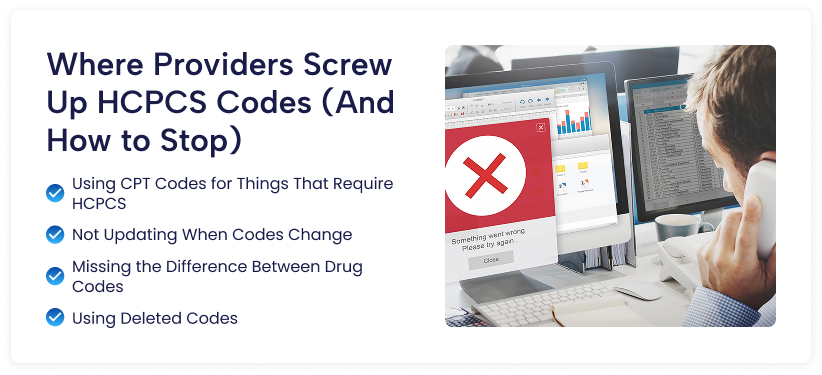
Where Providers Screw Up HCPCS Codes (And How to Stop)
After reviewing denial data and speaking with billers, here are the most common mistakes I see.
Mistake #1: Using CPT Codes for Things That Require HCPCS
If you order a wheelchair and bill a CPT code, the claim will deny. Wheelchairs are E-codes (E1161, etc.). Same with crutches (E0110). Same with surgical supplies (A-codes).
Before you bill any supply, drug, or equipment, ask yourself: “Is this a service I performed (CPT) or something I used (HCPCS)?”
Not Updating When Codes Change
Remember how I said HCPCS updates quarterly? Most providers update annually. That means for 9 months of the year, they are potentially using old codes.
The fix: Subscribe to CMS email updates. Check the HCPCS quarterly release on the CMS website. Or buy an updated code book each quarter if you are old school. But check.
Missing the Difference Between Drug Codes
A drug has two separate billable components:
- The drug itself (HCPCS J-code)
- The administration of the drug (CPT code)
You need both. But if you bill the J-code without the admin code, or vice versa, the claim may process incorrectly.
Always check your coding for every drug administered. Confirm you have both the supply/drug code AND the procedure code.
Using Deleted Codes
CMS deletes codes every quarter. If you keep billing them, claims will be denied. But here is the sneaky part: Sometimes they replace a deleted code with a new code that has a completely different number. You cannot just keep billing the old one.
The fix: Before you submit any claim with a HCPCS code, run a quick validation. Many billing software systems have a “code check” feature. Use it.
The Quarterly Update Survival Guide
Because HCPCS changes four times per year, you need a system. Here is mine:
- January 1: Annual update. Buy the new code book. Check for deleted J-codes and E-codes.
- April 1: First quarterly update. Run a report of all claims submitted in Q1. Identify any changed codes and update your templates.
- July 1: Second quarterly update. Check for new C-codes and G-codes (these change most often).
- October 1: Third quarterly update. Prepare for January. Review CMS advance notices about code deletions in the next annual update.
If this sounds like a lot of work, you are right. But it is less work than appealing 50 denied claims because you missed a code change.
How to Look Up HCPCS Codes Fast?
You cannot memorize 8,000 codes. Do not try. Here is how to find what you need:
The Code Book
Buy the current HCPCS Level II Professional edition from a reputable publisher. Look for one with:
- Color-coded bars and icons for new/revised/deleted codes
- A Table of Drugs (generic and brand-name drugs with their codes)
- APC status indicators and ASC payment symbols
- Modifier appendix with usage guidance
Online Search Tools
CMS maintains a public HCPCS file. Several third-party tools also offer search functionality for free or at low cost. Just make sure whatever you use is updated quarterly.
Your Billing Software
Most EHR and billing systems have a built-in HCPCS code lookup. But double-check the update date. Some software vendors are slow to push quarterly updates.
| Let me walk you through a real example so you can see how CPT and HCPCS codes work together.
You give a Medicare patient a flu shot. You need two codes:
Wait, two admin codes? Yes. Medicare requires G0008 instead of 90471 for flu vaccine administration. If you use 90471 for a Medicare patient, the claim will probably be denied. What about the vaccine itself? That is a third code (the product code for the specific vaccine, which varies by manufacturer and formulation). That is often another HCPCS code in the J or Q category. So, one flu shot = three codes on the claim:
This is why medical billing is complicated. But once you understand the structure, it makes sense. |
Key Deadlines and Action Items for 2025-2026
By January 15, 2025:
- Purchase 2025 HCPCS Level II code book
- Update any saved code lists in your EHR
- Train billing staff on new/deleted codes
Quarterly (April, July, October 2025):
- Check CMS HCPCS quarterly release
- Verify no changes affect your most-used codes
- Update charge masters if needed
By December 1, 2025:
- Review advance notice of 2026 changes
- Begin preparing for January 1, 2026 updates
January 1, 2026:
- New HCPCS codes take effect
- Stop using deleted codes immediately
The Bottom Line
HCPCS codes are not hard. They are just different from what you are used to. And because CMS updates them quarterly, you have to stay on top of changes more actively than with CPT codes.
Here is what you need to do:
- Know the prefixes (A, E, J, G, etc.) so you can find codes faster
- Buy a current code book and replace it every year (or subscribe to quarterly updates)
- Check for changes in January, April, July, and October
- Use the right modifiers – they are not optional
- Validate every HCPCS code before you submit the claim
Do these things, and you will stop getting denied for “invalid code” or “code not effective for date of service.”