

A deductible can look like a simple number on an insurance card, but it affects almost every part of a provider’s revenue cycle.
Before a claim reaches final payment, the practice may need to determine how much of the patient’s deductible remains, whether the service applies to that deductible, and what portion the patient must pay after adjudication.
For providers, the important question isn’t simply “What is the patient’s deductible?” It is “How does this patient’s deductible apply to this particular service, on this particular date, under this particular plan?”
That distinction matters because two patients with the same insurance company can have very different benefit structures.
What Is a Deductible in Health Insurance?
A deductible in health insurance is the amount a patient generally must pay toward covered healthcare services before the health plan begins paying according to the plan’s applicable cost sharing rules.
For example, suppose a patient’s plan has a $2,000 annual deductible.
If the patient has already accumulated $1,500 toward that deductible, another $500 may remain.
If the patient receives a covered service with an allowed amount of $300 and the service applies to the deductible, the patient’s responsibility could include that $300, depending on the plan.
The provider should not assume that the patient’s billed charge equals the amount that counts toward the deductible.
The payer generally determines the allowed amount during claim adjudication.
Why Deductibles Matter to Healthcare Providers
Deductibles directly affect patient responsibility and collections.
Consider a physician who bills $250 for a covered service.
The payer’s allowed amount may be $180.
If the patient’s remaining deductible covers the full $180, the payer may apply $180 to the patient’s deductible and issue no payment to the provider.
The patient may then owe the $180 according to the plan’s benefits.
So, the provider’s billing team needs to understand three different figures:
- Billed charge: What the provider submits.
- Allowed amount: The amount the payer recognizes under the plan or contract.
- Patient responsibility: The portion the payer assigns to the patient.
These numbers often differ.
Deductible vs Premium, Copay, and Coinsurance
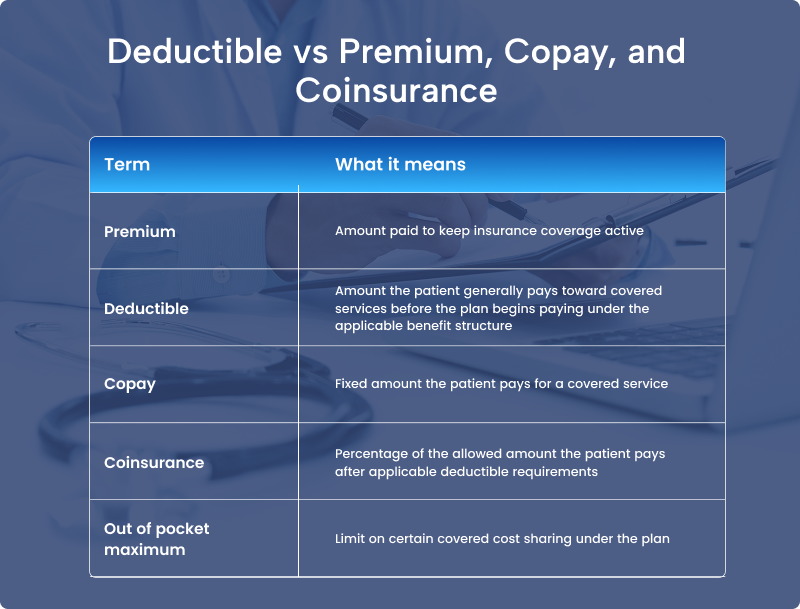
Patients often confuse these terms, and front office staff sometimes face the same confusion.
| Term | What it means |
| Premium | Amount paid to keep insurance coverage active |
| Deductible | Amount the patient generally pays toward covered services before the plan begins paying under the applicable benefit structure |
| Copay | Fixed amount the patient pays for a covered service |
| Coinsurance | Percentage of the allowed amount the patient pays after applicable deductible requirements |
| Out-of-pocket maximum | Limit on certain covered cost sharing under the plan |
These amounts work together, but they don’t mean the same thing.
How a Deductible Works
Imagine a health plan with:
- Annual deductible: $1,500
- Coinsurance after deductible: 20%
- Out-of-pocket maximum: $5,000
The patient hasn’t paid anything toward the deductible yet.
The patient receives a covered service with an allowed amount of $500.
If the service applies fully to the deductible, the patient may owe the $500.
The remaining deductible becomes:
$1,500 − $500 = $1,000
Now suppose the patient later receives another covered service with an allowed amount of $1,000 that also applies to the deductible.
That claim could satisfy the remaining deductible.
After the deductible is satisfied, the plan may begin applying the 20% coinsurance to covered services, subject to the plan’s rules.
This example simplifies real claims. Actual benefits can include separate deductibles, copays, exclusions, network rules, and services that bypass the deductible.
Does Every Medical Service Apply to the Deductible?
No.
This is one of the most important points for providers.
A patient’s plan may cover certain preventive services without requiring the patient to meet the deductible first, depending on the plan and applicable law.
Other services may have:
- A copay before the deductible
- Separate deductibles
- Coinsurance
- No coverage
- Network-specific rules
- Service-specific cost sharing
Never tell a patient that “you have to meet your deductible before insurance pays for anything.”
That statement can be wrong.
The provider should verify the patient’s specific benefits.
Individual vs Family Deductibles
Family plans can create another layer of complexity.
A plan may have both:
Individual deductible
and
Family deductible
For example:
| Benefit | Amount |
| Individual deductible | $2,000 |
| Family deductible | $4,000 |
The plan may apply services to an individual member’s deductible while also tracking the family’s cumulative deductible.
The exact mechanics depend on the plan design.
Billing staff should verify how the plan applies individual and family cost sharing rather than assuming that every family plan works the same way.
Embedded and Non-Embedded Deductibles
Family health plans can use different deductible structures.
Embedded deductible
Each individual may have an individual deductible within the family plan.
Once that individual reaches the applicable threshold, the plan may begin paying according to the individual’s benefits even if the entire family deductible hasn’t been met.
Non-embedded deductible
The family may need to reach the overall family deductible before the plan begins applying certain benefits.
The specific plan documents determine how these structures operate.
For providers, the practical lesson is simple:
Check the patient’s benefit information instead of guessing from the family plan’s total deductible.
In Network vs. Out-of-Network Deductibles
Some plans maintain separate deductibles for:
- In network services
- Out-of-network services
A patient might have:
- In-network deductible: $1,500
- Out-of-network deductible: $3,000
A provider who participates with the patient’s plan may therefore bill under a completely different cost-sharing structure from an out-of-network provider.
This affects both eligibility verification and patient estimates.
What Is a Deductible Accumulator?
A deductible accumulator tracks how much the patient has already paid or accumulated toward the applicable deductible.
During eligibility verification, billing staff may see information such as:
- Annual deductible: $2,000
- Deductible met: $1,250
- Remaining: $750
The exact information available depends on the payer and eligibility transaction.
The accumulator can help staff estimate patient responsibility, but it doesn’t guarantee the final amount.
The payer determines the final responsibility when it adjudicates the claim.
Why Eligibility Verification Matters
A patient may tell the front desk:
“I’ve already met my deductible.”
That information may be outdated.
The patient could have:
- Changed plans
- Used another provider
- Received treatment earlier in the year
- Reached a family deductible
- Used an out of network provider
- Received services that apply differently under the plan
The billing team should verify benefits using current payer information.
What Should Providers Verify About a Deductible?
Before the patient’s appointment, review:
- Deductible amount
- Amount already met
- Remaining deductible
- Individual or family deductible
- In network deductible
- Out of network deductible
- Service specific deductible
- Copay
- Coinsurance
- Out of pocket maximum
- Benefit frequency
- Coverage status
- Effective dates
- Network status
Also verify whether the specific service applies to the deductible.
Knowing that a patient has a $2,000 deductible isn’t enough.
How Deductibles Affect Patient Estimates
Suppose an orthopedic practice schedules a patient for a procedure.
The patient’s eligibility response shows:
- Deductible: $3,000
- Remaining deductible: $2,200
- Coinsurance: 20%
The practice shouldn’t automatically tell the patient:
“You owe $2,200.”
The patient’s actual responsibility depends on:
- The contracted allowed amount
- Whether the procedure applies to the deductible
- Whether other services have separate cost sharing
- Whether the patient has secondary coverage
- Whether the provider participates in network
- Whether the claim includes noncovered services
A better approach is to provide an estimate based on verified benefits and explain that the payer determines the final responsibility after adjudication.
Deductible and Allowed Amount
This distinction causes many billing disputes.
Imagine:
- Provider charge: $500
- Payer allowed amount: $300
- Patient deductible remaining: $300
The patient may owe $300 if the entire allowed amount applies to the deductible.
The patient doesn’t automatically owe the provider’s full $500.
For a contracted provider, the payer’s allowed amount and contract terms generally determine the amount that can be collected from the patient for covered services.
Deductible and Contractual Adjustments
Suppose a provider bills:
$500
The payer allows:
$300
The patient’s deductible responsibility equals:
$300
The remaining $200 represents the difference between the billed charge and allowed amount under the applicable contract.
The practice shouldn’t simply transfer that $200 to the patient when the provider has a contractual obligation to accept the payer’s allowed amount.
This is why payment posting should separate:
- Insurance payment
- Patient responsibility
- Contractual adjustment
- Other adjustments
Deductible and Copay
A patient may have both a deductible and a copay.
But the plan determines how they interact.
For example, a plan could require a fixed copay for certain office visits while applying the deductible to other services.
Another plan could apply the deductible before coinsurance.
The provider shouldn’t create a universal rule such as:
“The patient always pays the deductible first, then the copay.”
That isn’t how every benefit structure works.
Deductible and Coinsurance
Coinsurance represents a percentage of the applicable allowed amount.
For example:
- Allowed amount: $1,000
- Coinsurance: 20%
If the deductible requirements have been satisfied and the service falls under the 20% coinsurance benefit, the patient’s coinsurance could be $200.
But if the deductible still applies, the payer may assign some or all of the allowed amount to the deductible first.
The EOB or ERA shows how the payer actually processed the claim.
Deductible and Out of Pocket Maximum
The out-of-pocket maximum sets a limit on certain covered cost sharing under a health plan.
Depending on the plan and applicable rules, amounts such as deductibles, copayments, and coinsurance may count toward the out-of-pocket limit.
Once the patient reaches the applicable limit, the plan generally pays 100% of covered benefits for the remainder of the plan year, subject to the plan’s terms.
Not every expense necessarily counts.
Premiums, noncovered services, and certain other costs generally don’t count toward the federal out of pocket maximum.
Providers should use the patient’s plan information rather than making assumptions about which charges count.
Deductible and Preventive Services
Certain preventive services may receive special cost sharing treatment under applicable federal requirements when provided by an in-network provider.
For example, some preventive services may receive coverage without cost sharing.
But the details matter.
The patient’s plan, service, provider network status, and coding can affect how the claim processes.
A preventive service can also occur during a visit that includes a separate problem-oriented service.
The billing team should review the applicable coding and payer rules rather than assuming the entire encounter becomes deductible-free.
Deductibles in High Deductible Health Plans
A high deductible health plan, or HDHP, combines a higher deductible with specific federal requirements.
These plans often pair with Health Savings Accounts, or HSAs, when the individual meets the applicable eligibility requirements.
Providers frequently encounter patients who have substantial deductibles under these plans.
For the practice, this can mean:
- Larger patient balances
- Greater need for eligibility verification
- More patient payment questions
- Higher importance of accurate estimates
- More attention to payment plans and collection policies
The provider still needs to distinguish between the patient’s deductible and the provider’s contractual allowed amount.
Deductible and HSA Payments
Patients with HSA eligible plans may use HSA funds for qualified medical expenses.
From the provider’s perspective, the HSA doesn’t change how the payer adjudicates the claim.
The payer determines the patient’s responsibility.
The patient can then use available funds according to applicable HSA rules.
The practice should post the payment according to its normal payment posting procedures.
How Deductibles Affect Medical Billing
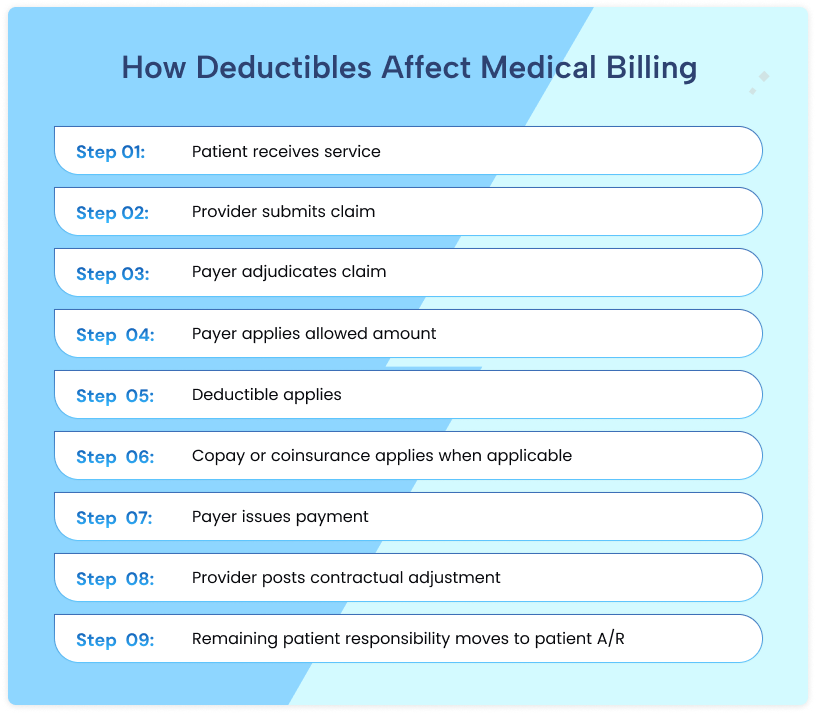
A claim can move through the revenue cycle like this:
- Patient receives service
- Provider submits claim
- Payer adjudicates claim
- Payer applies allowed amount
- Deductible applies
- Copay or coinsurance applies when applicable
- Payer issues payment
- Provider posts contractual adjustment
- Remaining patient responsibility moves to patient A/R
This sequence explains why the amount the patient pays at the time of service may differ from the final amount after insurance processes the claim.
Deductible and Claims Processing
When the payer adjudicates the claim, the EOB or ERA typically identifies how the allowed amount gets divided.
For example:
| Claim component | Amount |
| Provider charge | $450 |
| Allowed amount | $300 |
| Deductible | $200 |
| Coinsurance | $20 |
| Payer payment | $80 |
| Patient responsibility | $220 |
| Contractual adjustment | $150 |
The numbers above provide a simplified example.
Actual claim processing depends on the patient’s plan and the services reported.
What Is a Deductible Denial?
Strictly speaking, a deductible isn’t necessarily a denial.
A payer may process a claim and assign the allowed amount to the patient’s deductible.
The EOB might show:
- Claim processed
- Insurance payment: $0
- Patient responsibility: $250
- Reason: Deductible
The provider’s system may classify the account as “zero payment,” but that doesn’t mean the payer denied the claim.
The payer processed it according to the patient’s benefits.
This distinction matters for denial reporting.
Common Deductible Billing Mistakes
Deductible-related errors often begin during eligibility verification or patient registration, long before the claim reaches the payer. A billing team may have accurate insurance information but still quote the wrong patient responsibility because it relied on an outdated deductible balance, ignored network rules, or treated an eligibility response as a guarantee.
Here are the mistakes providers should watch most closely.
Assuming the Patient’s Deductible Is Still the Same
A deductible isn’t a fixed balance throughout the year. Every eligible claim that applies to the deductible can change the remaining amount. A patient who had $1,200 remaining last month might have only $500 left today after receiving services from another provider.
For example, a patient arrives for a $300 allowed service. Your eligibility check from several weeks ago showed $800 remaining, but the patient has since received treatment elsewhere. If the current balance is actually $500, using the old information could produce an inaccurate estimate.
Verify eligibility and deductible accumulators as close to the date of service as your workflow allows. Record the verification date and the information returned by the payer.
Collecting the Full Billed Charge
The provider’s charge isn’t automatically the amount the patient owes. For an in-network provider, the payer contract generally establishes an allowed amount for covered services.
For example, a practice may charge $400 for a service, while the payer’s allowed amount is $250. If the patient’s deductible applies to the entire allowed amount, the patient’s responsibility may be $250, not $400.
Billing the full charge to the patient can create inaccurate statements and contractual problems.
Base patient estimates on the applicable allowed amount, benefit information, and network status rather than the provider’s standard charge.
Ignoring Network Status
Network status can change the patient’s financial responsibility significantly. Some health plans have separate in network and out of network deductibles, and the allowed amounts can differ as well.
Consider a patient with a $1,500 in network deductible and a $3,000 out of network deductible. If the practice doesn’t participate with the patient’s plan, using the in network deductible to calculate the estimate could leave the patient with a much larger balance than expected.
Confirm that the provider and facility participate in the patient’s specific plan before calculating an estimate. Don’t assume that participation with an insurance company’s network applies to every product that insurer sells.
Treating Every Service the Same
A deductible doesn’t necessarily apply to every service in the same way. A plan may apply a deductible to one type of service while charging a fixed copay for another. Certain preventive services may also receive different cost sharing treatment when applicable requirements are met.
For example, a patient might have a $2,000 deductible for many medical services but a fixed office visit copay under the plan’s benefits. Applying the full deductible to every appointment could give the patient the wrong expectation.
Verify how the patient’s plan handles the specific CPT or service category being provided. Don’t calculate responsibility from the deductible alone.
Calling Every Zero Payment a Denial
A claim that produces a $0 insurance payment hasn’t necessarily been denied.
Suppose the provider submits a claim with a $300 allowed amount. The payer processes the claim correctly but applies the entire $300 to the patient’s remaining deductible. The payer sends no payment to the provider, yet the claim has been adjudicated rather than denied.
This distinction matters when practices calculate denial rates and decide which claims need follow up.
Read the EOB or ERA before categorizing the claim. Determine whether the payer denied the service, applied the amount to the deductible, assigned coinsurance, or processed the claim under another benefit rule.
Giving Patients Exact Estimates When Benefits Remain Uncertain
Eligibility verification helps the practice estimate responsibility, but it doesn’t guarantee the final claim outcome. The payer may process the claim differently after reviewing the actual procedure, diagnosis, network status, modifiers, authorization, or other claim details.
For example, a practice may estimate that a patient owes $600 before a procedure. The payer later processes the claim with a different allowed amount or applies another benefit rule, producing a final responsibility of $475.
Present pre-service amounts as estimates, not guaranteed balances. Explain that the final amount depends on how the payer adjudicates the claim. Once the EOB or ERA arrives, reconcile the account and bill the patient for the actual adjudicated responsibility.
Failing to Recheck Benefits for Scheduled Services
Some practices verify benefits when they first schedule a patient but don’t recheck them when the appointment finally occurs. That gap can cause problems when the plan changes, the deductible resets, or the patient’s accumulator changes.
Establish a verification window that fits your specialty and payer mix. For high-cost procedures, verify benefits again shortly before the service date and document the response.
Confusing Deductible with Patient Responsibility
A patient’s remaining deductible doesn’t automatically equal the amount the patient owes for a particular service.
Suppose the patient has $1,000 remaining on a deductible, but the payer allows only $600 for the service. If the entire allowed amount applies to the deductible, the patient may owe $600, not $1,000.
Consider the remaining deductible alongside the service’s allowed amount and the plan’s other cost sharing rules.
Failing to Reconcile the Patient Account After Adjudication
An estimate created before the appointment shouldn’t remain the final balance automatically. The EOB or ERA may show a different deductible amount, coinsurance, copay, contractual adjustment, or payer payment.
Compare the payer’s adjudication with the patient’s account before sending the final statement. Post the insurance payment and contractual adjustment correctly, then transfer only the actual patient responsibility to patient A/R.
Final Thoughts
A deductible is more than a number in an eligibility response. It can determine whether the payer sends money to the provider, how much the patient owes, and how the billing team should post the claim.
The safest approach is to verify the patient’s current benefits, network status, deductible balance, service specific cost sharing, and applicable allowed amount before estimating responsibility. Then let the payer’s EOB or ERA determine the final balance.
For providers, that process prevents a common billing mistake: treating the patient’s deductible as a fixed amount that applies identically to every service.
It doesn’t.
The plan decides how cost sharing works, the claim shows what service occurred, and the payer’s adjudication establishes the final patient responsibility.
Get Deductible Billing Right with RCM Xperts
Deductible issues can turn correctly submitted claims into patient balances, payment delays, and avoidable billing disputes. RCM Xperts helps providers verify benefits, review deductible accumulators, calculate patient responsibility, post EOB and ERA payments accurately, and follow up on unpaid or incorrectly processed claims.
Frequently Asked Questions
What is a deductible in health insurance?
A deductible is the amount a patient generally pays toward covered healthcare services before the health plan begins paying according to the applicable benefit structure.
Does insurance pay anything before the deductible is met?
Some plans cover specific services with a copay or other cost sharing before the deductible, while certain preventive services may receive special coverage. The patient’s plan determines the applicable rules.
Does the deductible count toward the out-of-pocket maximum?
Deductible payments generally count toward the federal out of pocket maximum for covered services under applicable plans, but providers should rely on the patient’s plan information for the exact structure.
Can a provider collect the entire deductible upfront?
Providers can request payment toward estimated patient responsibility according to their policies and applicable laws, contracts, and plan requirements. However, the practice shouldn’t treat an estimated deductible amount as a guaranteed final balance.
What happens after the deductible is met?
The plan typically begins applying its next level of cost sharing, such as coinsurance or copayments, for covered services. The exact structure depends on the plan.
What is the difference between a deductible and an out-of-pocket maximum?
The deductible represents the amount the patient generally pays before the plan begins paying according to applicable benefits. The out-of-pocket maximum limits certain covered cost sharing during the plan year.
Why did insurance pay nothing on my patient’s claim?
The payer may have applied the allowed amount to the patient’s deductible. A zero-insurance payment doesn’t automatically mean the payer denied the claim.