
Hospital billing and professional billing can cover the same patient encounter, but they handle different services and claims. Hospital billing reports facility services and resources, while professional billing covers the work performed by physicians and other practitioners. Understanding the difference helps billing teams choose the right claim type, coding details, and reimbursement path.
Hospital Billing vs Professional Billing
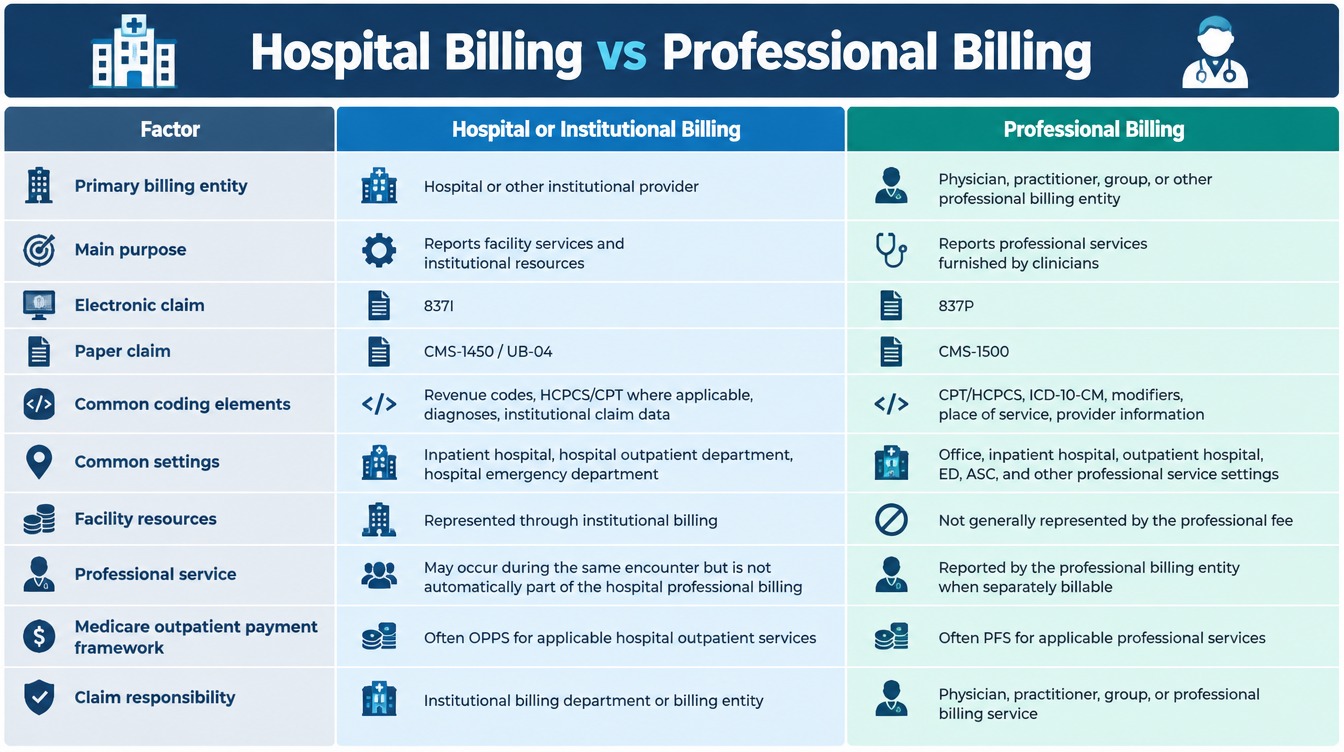
The exact billing rules vary by payer, provider type, service, contract, and setting. The table describes the general distinction rather than a universal rule for every claim.
What Is Hospital or Institutional Billing?
Hospital billing is the process used by a hospital or other institutional provider to report services and charges to a payer.
The claim represents the facility side of the encounter.
Depending on the type of care, the institutional claim can contain information about:
- Hospital services
- Revenue centers
- Room and board
- Supplies
- Drugs and biologicals
- Diagnostic services
- Therapy services
- Hospital outpatient procedures
- Emergency department facility services
- Operating room resources
- Medical supplies and equipment
- Other facility-related services
The specific information reported depends on the claim type, payer requirements, provider type, and services furnished.
For Medicare institutional billing, CMS identifies the CMS-1450 as the institutional paper claim form, commonly known as the UB-04. CMS also identifies the 837I as the electronic institutional claim format.
The institutional claim therefore tells the payer what the facility furnished and what resources the facility is seeking payment for.
Hospital Billing Does Not Mean Every Service Delivered in the Hospital
A hospital may provide the physical location, nurses, equipment, supplies, and other resources for an encounter. A physician may separately provide the professional service.
The fact that the physician performed the service inside the hospital does not automatically convert the physician’s professional claim into an institutional claim.
For example, a patient may undergo a procedure in a hospital outpatient department. The hospital may report the facility services on an institutional claim, while the physician may separately report the professional service on a professional claim when the applicable billing rules permit separate payment.
That is why the phrase “hospital-based billing” can create confusion when it is used as a synonym for every service provided inside a hospital.
What Is Professional Billing?
Professional billing is the process of submitting claims for services furnished by physicians and other eligible practitioners.
The professional claim focuses on the clinician’s service rather than the hospital’s overall facility resources.
Professional services may include:
- Evaluation and management services
- Surgical services
- Professional interpretation of diagnostic tests
- Procedures
- Consultations where applicable
- Therapy services
- Certain preventive services
- Other covered professional services
The provider submits the service using the applicable CPT or HCPCS code, diagnosis information, modifiers when required, place of service, and other claim information.
For Medicare, the CMS-1500 is the standard paper claim form used by non-institutional providers or suppliers when paper submission is permitted. The electronic equivalent for professional claims is the 837P.
Professional Billing Can Occur Inside a Hospital
This is one of the most important concepts in hospital versus professional billing.
A physician can perform a service in an inpatient hospital or outpatient hospital and still submit a professional claim.
CMS’s place of service guidance distinguishes inpatient hospital services with POS 21 from outpatient hospital services with POS 22. POS 23 identifies the hospital emergency room.
The professional claim therefore communicates both the service and the setting in which the professional furnished it.
Why Can One Patient Receive Both a Hospital Bill and a Professional Bill?
A single encounter can involve two different billing entities.
Consider a patient who goes to a hospital outpatient department for a procedure.
The hospital provides:
- The facility
- Equipment
- Nursing resources
- Supplies
- Treatment space
- Other facility resources
The physician provides:
- Professional evaluation
- Medical decision-making where applicable
- Procedure performance
- Professional interpretation or other professional work when separately reportable
The hospital and physician have different services to report.
As a result, the payer may receive an institutional claim from the hospital and a professional claim from the physician or physician group.
This does not automatically mean the patient was charged twice for the same service.
The claims represent different components of the healthcare encounter.
The actual payment and patient responsibility depend on the payer’s benefit design, contracts, coverage policies, deductibles, coinsurance, copayments, claim adjudication, and applicable billing rules.
UB-04 vs CMS-1500
The difference between the UB-04 and CMS-1500 is one of the most common questions in medical billing.
They serve different claim categories.
What Is the UB-04?
The UB-04 is the common name for the CMS-1450 institutional paper claim form.
CMS states that the CMS-1450, also known as the UB-04, is used by institutional providers when paper billing is permitted. CMS also notes that the form is used for institutional charges and that the National Uniform Billing Committee maintains the form.
The institutional claim contains information designed for facility billing.
Important claim elements can include:
- Type of bill
- Revenue codes
- Service dates
- Charges
- HCPCS or other applicable procedure information
- Diagnosis codes
- Patient status
- Occurrence information
- Value information
- Provider information
- Other institutional billing data
The exact requirements depend on the payer and claim circumstances.
What Is the CMS-1500?
The CMS-1500 is the standard paper claim form used for professional claims when paper submission is permitted.
CMS describes it as the standard claim form used by non-institutional providers or suppliers to bill Medicare carriers and certain other payers.
A professional claim generally includes information such as:
- CPT or HCPCS code
- Diagnosis code
- Units
- Charge
- Modifier
- Place of service
- Rendering provider information
- Billing provider information
- Dates of service
- Patient information
UB-04 vs CMS-1500 Quick Comparison
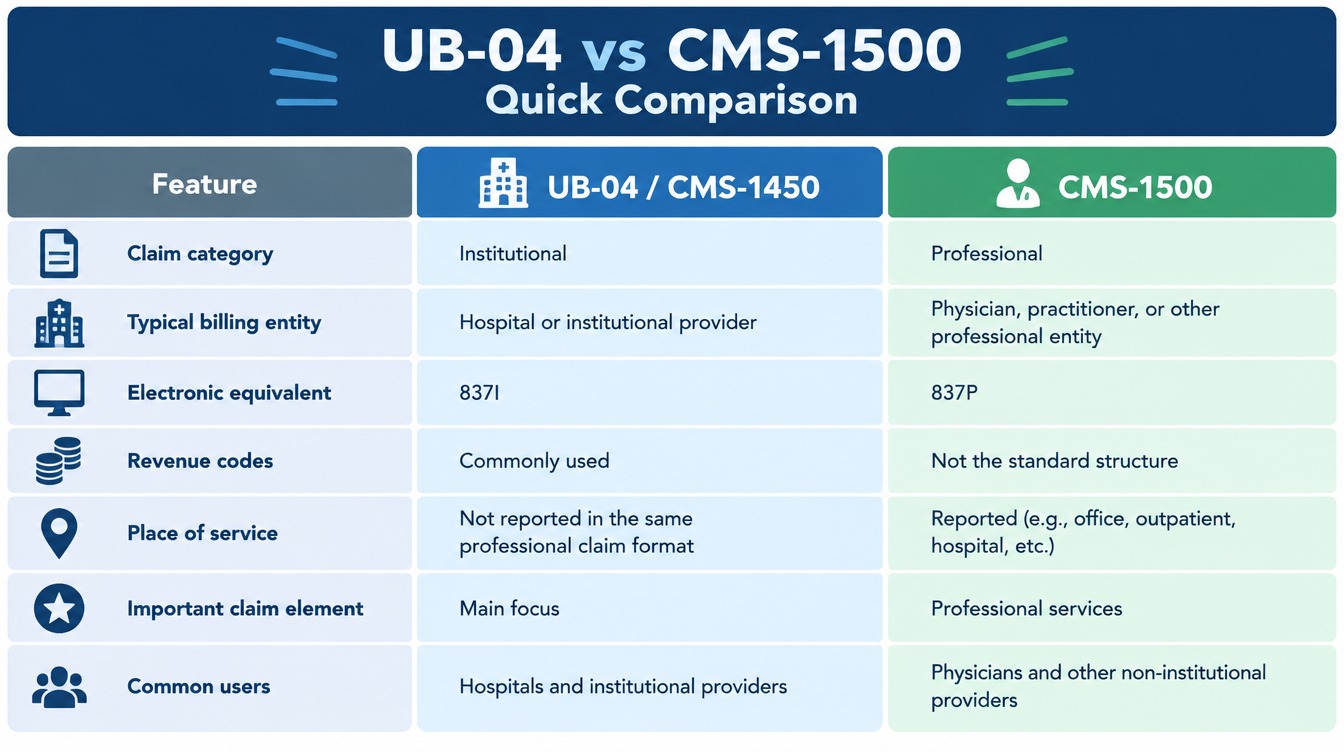
CMS maintains separate billing instructions for institutional and professional claims.
837I vs 837P
Most healthcare claims are submitted electronically rather than through paper forms.
The electronic distinction parallels the paper claim distinction.
837I: Institutional Claims
The 837I is the electronic format for institutional claims.
CMS describes the 837I as the standard electronic format institutional providers use to submit healthcare claims.
Hospitals and other institutional providers use this transaction when applicable.
837P: Professional Claims
The 837P is the electronic professional claim format.
Physicians, practitioners, and other professional billing entities use the 837P when the service is reported as a professional claim.
CMS’s Medicare electronic billing resources maintain separate companion guides for 837I institutional claims and 837P professional claims.
Why the 837I and 837P Difference Matters
A clearinghouse needs to know what type of claim it is processing.
The claim format determines the structure of the data submitted to the payer.
For example, institutional claims contain institutional elements such as revenue-code reporting, while professional claims contain professional billing elements such as place of service and professional service lines.
Submitting the wrong transaction format can create claim rejection or processing problems before the payer even reaches substantive medical necessity or payment edits.
Facility Fee vs Professional Fee
The terms “facility fee” and “professional fee” are often used interchangeably by patients, but they represent different concepts.
A facility fee generally relates to the resources used by the facility to provide care.
A professional fee generally relates to the clinician’s professional service.
What Does a Facility Fee Represent?
A facility payment can account for resources associated with operating the facility and delivering the service.
Depending on the setting, these resources can include:
- Clinical space
- Nursing services
- Equipment
- Supplies
- Technical staff
- Facility overhead
- Certain drugs and materials
- Other hospital resources
The exact services included in a facility payment depend on the payer’s payment methodology.
For Medicare hospital outpatient services paid under OPPS, CMS groups applicable services into Ambulatory Payment Classifications, or APCs. CMS explains that APC payments are made for items and services furnished by hospital outpatient departments.
What Does a Professional Fee Represent?
The professional fee generally represents the clinician’s work.
Depending on the service, that can include:
- Taking a medical history
- Performing an examination
- Medical decision-making
- Performing a procedure
- Interpreting a diagnostic study
- Providing treatment
- Documenting the professional service
The professional payment methodology varies by payer and service.
For applicable Medicare professional services, the Physician Fee Schedule provides the payment framework.
The important point is that a professional fee does not automatically include the hospital’s facility resources.
Hospital Outpatient Billing vs Professional Billing
Hospital outpatient billing provides one of the clearest examples of how the two systems interact.
CMS generally pays applicable hospital outpatient department services under the Hospital Outpatient Prospective Payment System, or OPPS. Services paid under OPPS are assigned to payment groups called Ambulatory Payment Classifications.
The physician or other practitioner may separately submit a professional claim for the professional service.
This creates two distinct billing streams.
Example
Suppose a patient visits a hospital outpatient department for a diagnostic procedure.
The hospital may bill for:
- Facility resources
- Equipment
- Staff
- Supplies
- Applicable facility services
The physician may bill for:
- Professional performance of the service
- Professional interpretation, where separately reportable
- Other professional services supported by the documentation and billing rules
The payer evaluates the claims under the applicable payment rules.
The hospital claim and professional claim therefore should not be treated as duplicate versions of the same bill.
Hospital Inpatient Billing vs Professional Billing
The distinction also applies to inpatient care.
A hospital inpatient admission can involve:
- An institutional claim from the hospital.
- Professional claims from physicians and other practitioners who provide separately billable services.
For example, a patient admitted for a surgical procedure may generate a hospital claim for the inpatient facility services.
The surgeon may separately submit a professional claim for the surgical service.
An anesthesiologist may also submit a professional claim for anesthesia services when separately billable.
Other practitioners may have separate professional billing responsibilities depending on the services provided and payer rules.
The exact payment methodology varies by payer and service. Medicare inpatient hospital facility payment and professional payment operate under different payment frameworks.
The important billing principle is that the hospital’s institutional claim does not automatically replace every professional claim associated with the admission.
Place of Service in Professional Billing
Place of service is particularly important on professional claims because it identifies where the service occurred.
CMS identifies:
- POS 21: Inpatient Hospital
- POS 22: Outpatient Hospital
- POS 23: Emergency Room, Hospital
- POS 24: Ambulatory Surgical Center
CMS’s POS definitions distinguish these settings because the location of service can affect claim processing and payment.
A professional claim for a physician service furnished to a registered hospital inpatient is different from a professional claim for a service furnished in a physician office.
The CPT or HCPCS code may describe the service, but the place of service provides additional information about where it occurred.
For Medicare, CMS has specifically addressed POS reporting for professional services furnished to hospital inpatients and outpatients.
Incorrect POS reporting can therefore lead to payment problems, incorrect reimbursement, or claim edits.
Revenue Codes in Hospital Billing
Revenue codes are a major distinction between institutional and professional billing.
Hospital claims commonly use revenue codes to identify the department or category of service associated with a charge.
Examples include revenue-code categories associated with:
- Room and board
- Emergency services
- Operating room services
- Laboratory services
- Radiology
- Pharmacy
- Respiratory services
- Other hospital departments
Revenue codes do not function like CPT codes.
A revenue code generally identifies the institutional charge category, while CPT or HCPCS codes identify specific procedures, services, supplies, or items when required.
This distinction is especially important when writing or reviewing institutional billing content.
A revenue code should not automatically be treated as a standalone procedure code.
CPT and HCPCS Codes in Hospital and Professional Billing
CPT and HCPCS codes can appear in both institutional and professional billing, depending on the service and claim requirements.
That does not mean the two claim types are interchangeable.
The same underlying clinical service can require different claim-level information depending on who is billing and which payer rules apply.
For example, an institutional claim may combine a revenue code with a HCPCS or CPT code when required.
A professional claim typically reports the CPT or HCPCS service line with the applicable diagnosis, modifier, place of service, units, and provider information.
The billing team should therefore determine the correct claim type before deciding how to structure the service line.
Diagnosis Codes in Hospital vs Professional Billing
Both institutional and professional claims use diagnosis information to support the medical necessity and clinical context of services when required.
ICD-10-CM diagnosis codes help communicate the condition, symptom, finding, or reason for treatment.
However, diagnosis coding does not determine the claim type by itself.
The same diagnosis can appear on both an institutional claim and a professional claim because both claims can relate to the same patient encounter.
For example, a patient with a respiratory condition may have:
- A hospital claim for facility services
- A physician claim for professional evaluation
- A separate claim for a diagnostic procedure when applicable
The diagnosis connects the service to the patient’s clinical circumstances, while the claim type identifies the billing pathway.
Professional Component vs Technical Component
Another important distinction is professional component and technical component billing.
These terms often arise with diagnostic testing and certain other services.
The professional component generally represents the physician or practitioner’s professional work associated with a service.
The technical component generally represents resources such as equipment, technical staff, and related operational resources.
Medicare does not split every service into professional and technical components.
CMS’s Physician Fee Schedule guidance identifies different PC/TC indicators. For diagnostic tests that have both components, modifier 26 can identify the professional component and modifier TC can identify the technical component when the code permits those modifiers.
Modifier 26
Modifier 26 generally identifies the professional component when applicable.
It does not mean “physician service” for every CPT code.
The code must be eligible for professional component reporting.
Modifier TC
Modifier TC generally identifies the technical component when applicable.
Again, not every CPT code can be reported with modifier TC.
CMS specifically notes that some codes are professional-component-only, technical-component-only, global-only, or otherwise do not permit the use of modifiers 26 and TC.
This is why billers should verify the code’s PC/TC indicator rather than adding modifier 26 or TC based only on the location where the service occurred.
Global Billing vs Component Billing
Some diagnostic services can be billed globally when one entity provides both the professional and technical components.
Other situations require separate component billing.
For example, a physician may perform the professional interpretation while a hospital or imaging facility provides the technical resources.
The appropriate reporting depends on the specific CPT or HCPCS code, ownership and performance of the service, payer rules, and applicable billing instructions.
A common billing error occurs when a biller assumes that every diagnostic code can be divided into professional and technical components.
That assumption is incorrect.
CMS’s PC/TC indicators should be reviewed for Medicare Physician Fee Schedule services when determining whether modifiers 26 or TC apply.
How Reimbursement Differs
Hospital and professional reimbursement can follow different methodologies.
There is no single reimbursement formula that applies to every hospital claim or every professional claim.
The payer, service, setting, provider type, contract, and program all matter.
Medicare Hospital Outpatient Reimbursement
For applicable hospital outpatient department services, Medicare generally uses OPPS.
CMS describes OPPS as the payment system used for applicable hospital outpatient department services and states that services are assigned to APC payment groups.
CMS also publishes annual OPPS rules and payment files. The 2026 OPPS final rule establishes payment policies and amounts for services paid under the 2026 OPPS.
Medicare Professional Reimbursement
Applicable professional services may be paid under the Medicare Physician Fee Schedule.
The professional payment amount depends on the applicable code, locality, relative value information, conversion factor, geographic adjustments, and other Medicare payment policies.
The PFS also distinguishes facility and nonfacility payment circumstances for applicable services.
Therefore, a physician’s professional reimbursement should not be calculated simply by taking the hospital’s facility payment and assigning part of it to the physician.
The two payment systems have different structures.
Commercial Insurance Reimbursement
Commercial payer reimbursement can differ substantially from Medicare.
A commercial plan may use:
- Contracted fee schedules
- Percentage-of-Medicare arrangements
- Case rates
- Per diem arrangements
- Bundled payments
- Contract-specific reimbursement
- Other negotiated methodologies
The patient’s benefit plan also affects cost sharing.
For this reason, a medical billing article should avoid presenting one universal percentage or reimbursement formula for all commercial payers.
Common Hospital and Professional Billing Errors
Billing teams can prevent many denials by identifying the claim type before reviewing the individual service line.
Treating the Hospital Claim and Professional Claim as the Same Claim
The two claims have different purposes.
A hospital claim represents institutional services.
A professional claim represents professional services.
Assuming Every Service Performed in a Hospital Is Institutional
A physician can provide a professional service in a hospital.
The location does not automatically determine the claim type.
Using the Wrong Claim Format
An institutional claim and professional claim have different electronic and paper formats.
CMS identifies 837I and CMS-1450 for institutional billing and 837P and CMS-1500 for professional billing.
Reporting an Incorrect Place of Service
Professional claims need accurate place-of-service reporting.
POS 21, 22, and 23 represent different hospital-related settings.
Confusing Revenue Codes With Procedure Codes
Revenue codes identify institutional charge categories.
They should not automatically be treated as substitutes for CPT or HCPCS codes.
Applying Modifier 26 or TC Without Checking Code Eligibility
Not every service can be divided into professional and technical components.
CMS’s PC/TC indicators determine whether modifiers 26 and TC apply for Medicare services.
Assuming One Reimbursement Method Applies to Every Payer
Medicare, Medicaid, and commercial plans can use different payment methodologies.
Contract terms can also change commercial reimbursement.
Assuming a Hospital-Employed Physician Automatically Bills on the Hospital Claim
Employment arrangement and claim type are separate concepts.
A hospital-employed physician may still have professional billing responsibilities depending on the organizational and payer arrangement.
Failing to Match the Billing Entity to the Service
The billing entity must have the appropriate enrollment, contracting, credentialing, and billing authority for the service being submitted.
Treating Two Claims as Duplicate Billing Without Reviewing Their Purpose
Two claims for the same encounter do not automatically represent duplicate billing.
The billing team should determine whether one represents facility services and the other represents professional services.
How Medical Billers Can Separate Hospital and Professional Claims
A practical workflow can reduce claim confusion.
Step 1: Identify the Billing Entity
Determine who furnished and is billing for the service.
Is it:
- Hospital?
- Physician?
- Physician group?
- Individual practitioner?
- Other institutional provider?
- Other professional entity?
Step 2: Identify the Claim Type
Determine whether the service belongs on an institutional or professional claim.
Step 3: Verify the Setting
For professional claims, confirm the appropriate place of service.
For institutional claims, verify the applicable facility claim requirements.
Step 4: Review the Service Code
Confirm the CPT or HCPCS code where applicable.
For institutional claims, determine whether the service also requires a revenue code.
Step 5: Check Modifiers
Verify whether a modifier applies and whether the code permits it.
Do not automatically add modifiers based on assumptions about the service.
Step 6: Confirm Diagnosis Support
Make sure the diagnosis coding supports the service and accurately represents the patient’s documented condition or reason for care.
Step 7: Verify Payer Rules
Check:
- Coverage
- Authorization
- Network status
- Claim requirements
- Coding edits
- Bundling rules
- Payment methodology
- Provider contract
Step 8: Submit the Correct Transaction
Use the applicable institutional or professional electronic claim format.
For Medicare, CMS identifies the 837I and 837P as the relevant institutional and professional electronic claim formats.
Step 9: Reconcile the Remittance
Review the payer’s response for:
- Payment
- Denial
- Rejection
- Bundling
- Deductible
- Coinsurance
- Copayment
- Contractual adjustment
- Medical necessity edits
- Coding edits
This final step helps the revenue cycle team determine whether the issue came from coding, eligibility, authorization, claim formatting, contract terms, or payment policy.
Final Takeaway
The most useful way to distinguish hospital billing from professional billing is to stop looking only at the location where the patient received care.
The key questions are:
- Who provided the service?
- Who is submitting the claim?
- What type of service is being reported?
- Is the claim institutional or professional?
- What payment methodology applies?
A hospital can submit an institutional claim for facility services while a physician submits a professional claim for clinical work performed during the same encounter.
For Medicare, that distinction is reflected directly in the claim infrastructure: institutional claims use the 837I and CMS-1450/UB-04 framework, while professional claims use the 837P and CMS-1500 framework.
Once the facility and professional sides are separated, billing teams can more accurately handle coding, claim submission, reimbursement, denial management, and patient billing questions.
Need Better Control Over Hospital and Professional Billing?
Managing institutional and professional claims requires careful attention to coding, claim formats, payer rules, and reimbursement. RCM Xpert Billing helps hospitals, physician groups, and healthcare organizations manage billing workflows, catch claim issues, follow up on denials, and improve payment accuracy.
Let RCM Xpert Billing review your billing process and help you identify where claims, payments, or revenue may be getting held up.
Request a Billing Review
Frequently Asked Questions
Is hospital billing the same as institutional billing?
In most medical billing discussions, hospital billing refers to institutional billing when the hospital is the billing entity. However, institutional billing is broader than hospitals because other institutional providers can also submit institutional claims.
What is the difference between UB-04 and CMS-1500?
The UB-04, formerly CMS-1450, is an institutional paper claim form. CMS-1500 is the standard professional paper claim form for non-institutional providers and suppliers when paper submission is permitted.
What is the difference between 837I and 837P?
The 837I is the electronic institutional claim transaction. The 837P is the electronic professional claim transaction. CMS maintains separate implementation and companion guidance for the two transaction types.
Can a hospital and physician both bill for the same patient encounter?
Yes. A hospital can submit an institutional claim for facility services while a physician or other professional can submit a professional claim for separately billable professional services, subject to payer rules.
Does a physician working in a hospital use a UB-04?
Not simply because the physician works in a hospital. The physician’s professional service is generally reported through the professional claim pathway when the physician or professional entity is the billing entity.
What is a facility fee?
A facility fee generally represents facility resources and services associated with an encounter. The exact services included depend on the payer, setting, payment methodology, and contract.
What is the difference between professional and technical components?
The professional component generally represents professional work, while the technical component generally represents technical resources such as equipment and staff for applicable services. Medicare applies PC/TC distinctions only to applicable codes.
Can modifier 26 be used on every CPT code?
No. Modifier 26 applies only when the code and payer rules permit professional component reporting. CMS’s PC/TC indicators should be reviewed for applicable Medicare services.
Does hospital billing always mean OPPS?
No. OPPS applies to applicable Medicare hospital outpatient services. Different hospital settings and services can fall under different payment systems, and other payers can use different methodologies. CMS’s OPPS program specifically addresses applicable hospital outpatient department services.
Why did I receive separate hospital and physician bills?
The hospital may have billed for facility services while the physician billed separately for professional services. The exact reason depends on the services provided, provider arrangements, and insurance plan.