
Dizziness is one of those symptoms that can look simple in a patient’s chart but require careful attention when it comes to ICD-10-CM coding. A patient may describe feeling lightheaded, unsteady, faint, off balance, or as though the room is moving. The provider may document only dizziness, or the evaluation may identify a specific underlying disorder.
For dizziness and giddiness, the ICD-10-CM code is R42.
The official description of R42 is Dizziness and giddiness. CMS includes R42 in the current ICD-10-CM code set.
However, finding R42 in the code book is only the first step. The more important coding question is whether R42 actually represents the condition documented for the encounter.
A patient can present with dizziness because of a vestibular disorder, medication effect, cardiovascular problem, neurologic condition, dehydration, metabolic abnormality, or another documented disease. If the provider establishes a specific diagnosis, the coder should evaluate that diagnosis instead of automatically assigning a symptom code.
What Is the ICD-10 Code for Dizziness and Giddiness?
The ICD-10-CM code for dizziness and giddiness is:
R42: Dizziness and giddiness
R42 appears in Chapter 18 of ICD-10-CM, which covers symptoms, signs, and abnormal clinical and laboratory findings that are not classified elsewhere.
The code is used to describe the documented symptom when the clinical record supports dizziness or giddiness and no more specific diagnosis should replace the symptom code for that encounter.
The distinction between a symptom and a disease is important.
“Dizziness” describes what the patient experiences or what the provider identifies as the clinical problem. It does not, by itself, explain why the patient feels dizzy.
For example, a patient could report dizziness during an office visit. After examination, the provider may document dizziness and order additional testing because the cause remains undetermined. In that situation, R42 may accurately describe the documented condition.
A different patient may have dizziness caused by a specifically diagnosed vestibular disorder. In that case, the provider’s documented diagnosis may lead to a different ICD-10-CM code.
Therefore, coders should not treat R42 as a universal code for every patient who mentions dizziness.
What Does R42 Mean?
R42 is the ICD-10-CM classification for Dizziness and giddiness. CMS’s current code files continue to list R42 under the symptom and sign classifications.
The code can apply to documented complaints such as dizziness and giddiness. It also has an important relationship with the term “vertigo.”
In coding, the word vertigo requires context.
A provider may document vertigo as a nonspecific symptom, or the provider may diagnose a specific vestibular disorder. Those two situations should not automatically receive the same code.
This is why a coder should examine the complete assessment rather than searching the medical record for one isolated word.
For example:
Documentation: “Patient presents with dizziness. Etiology remains unclear.”
This may support R42 when the provider’s final assessment remains dizziness.
By comparison:
Documentation: “Benign paroxysmal vertigo, right ear.”
That is a specific diagnosis. The coder should evaluate the appropriate diagnosis code rather than defaulting to R42.
The difference is not simply terminology. It reflects the level of diagnostic specificity in the medical record.
Is R42 a Symptom Code?
Yes.
R42 is a symptom and sign code rather than a code that identifies a particular underlying disease.
This matters because symptom codes can be appropriate when a definitive diagnosis has not been established, but they should not be used as a substitute for a documented disease when the record provides a more specific diagnosis.
Consider a patient who reports dizziness during an initial evaluation. The provider performs an examination but cannot determine the cause. The provider documents dizziness and plans additional diagnostic workup.
The encounter may appropriately be represented by R42.
Now consider a patient who has already been evaluated and receives a documented diagnosis of a specific vestibular disorder. In that situation, the more specific diagnosis may be the appropriate choice.
The coder’s task is therefore to represent the provider’s documented clinical conclusion accurately.
When Should R42 Be Used?
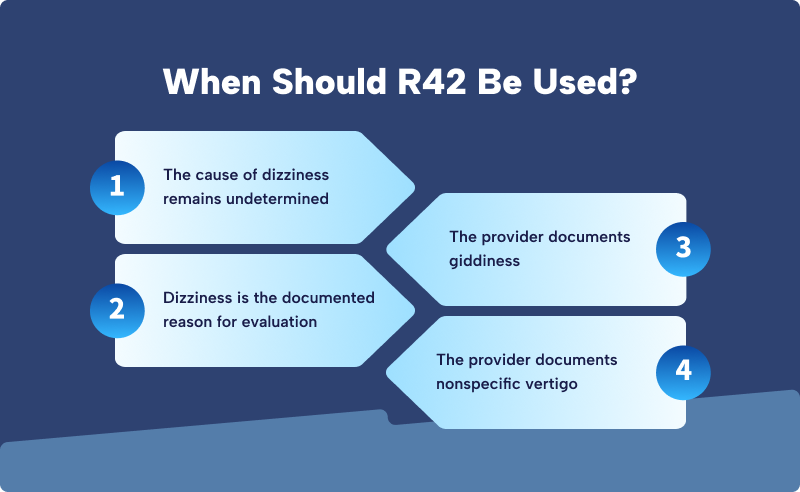
R42 may be appropriate when the provider documents dizziness or giddiness as the condition being evaluated and does not establish a more specific diagnosis that should replace the symptom code.
Several situations can lead to this type of coding.
The cause of dizziness remains undetermined
A patient may undergo an evaluation for dizziness without receiving a definitive diagnosis during that encounter.
The provider may document the symptom, review the patient’s history, perform an examination, and order additional testing.
If the final assessment remains dizziness or giddiness, R42 may be appropriate.
Dizziness is the documented reason for evaluation
A patient may present specifically because of recurrent dizziness. The provider evaluates the complaint but does not identify a definitive underlying condition.
When the provider documents dizziness as the assessment, R42 may accurately represent the encounter.
The provider documents giddiness
The term giddiness falls within the description of R42.
The coder should still review the complete documentation to determine whether another diagnosis has been established.
The provider documents nonspecific vertigo
R42 can also be relevant when the provider documents nonspecific vertigo, because ICD-10-CM distinguishes nonspecific vertigo from specific vertiginous disorders.
That distinction becomes particularly important when reviewing the H81 category.
When Should You Avoid Automatically Using R42?
The presence of dizziness in the patient’s history does not automatically mean that R42 should be reported.
There are several reasons.
First, the provider may establish a more specific diagnosis.
Second, dizziness may be a symptom of another condition that the provider identifies as the primary diagnosis.
Third, the documentation may describe a specific type of vestibular disorder that belongs elsewhere in ICD-10-CM.
The coder should therefore ask a straightforward question:
What did the provider diagnose at the end of the encounter?
That answer is generally more useful than simply searching the chart for “dizziness.”
For example, suppose a patient presents with dizziness and the provider ultimately diagnoses a specific vestibular disorder. Reporting only R42 may fail to capture the diagnosis documented by the provider.
The reverse is also true. A coder should not invent a more specific disorder simply because the patient describes a particular sensation.
If the provider documents only dizziness and does not establish a cause, the coder should not independently diagnose the patient.
R42 and Vertigo: Are They the Same?
No.
R42 includes nonspecific vertigo, but ICD-10-CM also contains specific codes for vertiginous syndromes and other vestibular disorders.
CMS code files list conditions within the H81 category, including disorders such as Ménière’s disease, benign paroxysmal vertigo, vestibular neuronitis, other peripheral vertigo, and vertigo of central origin.
This creates an important coding distinction.
If the provider documents a specific vestibular diagnosis, the coder should review the applicable H81 code rather than automatically assigning R42.
For example, a provider may document:
“Benign paroxysmal vertigo.”
That is different from simply documenting:
“Dizziness.”
The first statement identifies a specific disorder. The second describes a symptom.
The ICD-10-CM classification reflects that difference.
R42 vs. H81 Codes
The relationship between R42 and H81 is one of the most important areas to understand when coding dizziness.
R42 represents dizziness and giddiness.
The H81 category contains specific disorders of vestibular function and vertiginous syndromes.
CMS’s ICD-10-CM materials list examples within H81, including:
- Ménière’s disease
- Benign paroxysmal vertigo
- Vestibular neuronitis
- Other peripheral vertigo
- Vertigo of central origin
- Other disorders of vestibular function
- Unspecified disorder of vestibular function
The coder should not select an H81 diagnosis merely because dizziness sounds vestibular.
The medical record must support the diagnosis.
Likewise, the coder should not automatically use R42 when the provider has clearly documented a specific vestibular disorder.
What Is the Difference Between Dizziness and Vertigo?
Dizziness is a broad symptom description.
Vertigo is generally used to describe a sensation of movement, such as spinning or the perception that the surroundings are moving.
However, coding should not rely solely on a patient’s description.
A patient may use the word “dizzy” to describe several different sensations. One person may mean lightheadedness. Another may mean imbalance. Another may mean a spinning sensation.
The provider’s assessment determines how the condition should be represented in the medical record.
This is particularly important because specific vestibular diagnoses have their own ICD-10-CM classifications.
A coder should not convert a patient’s wording into a specific medical diagnosis without provider documentation.
ICD-10 Code for Lightheadedness
Lightheadedness can be reported under R42 when the provider documents the symptom and no more specific diagnosis applies.
The important point is that “lightheadedness” should not be treated as an automatic diagnosis independent of the provider’s assessment.
For example, a patient may report feeling lightheaded when standing. The provider may investigate the complaint and ultimately diagnose an underlying condition.
If the provider documents that underlying condition as the diagnosis, the coder should review that diagnosis.
If the evaluation does not establish a definitive cause and the provider’s assessment remains lightheadedness or dizziness, R42 may be appropriate.
This is another example of why coding from the assessment is more reliable than coding from a symptom mentioned in isolation.
ICD-10 Code for Feeling Faint vs. Dizziness
Feeling faint and dizziness can overlap in everyday language, but they are not automatically interchangeable for coding purposes.
The patient may describe feeling as though they are about to pass out. Depending on the provider’s assessment, this could involve a different diagnosis or symptom classification.
For example, syncope and collapse have a separate ICD-10-CM classification.
Therefore, a coder should not automatically assign R42 whenever a patient says they feel faint.
Review what the provider actually diagnosed.
This distinction becomes particularly important in records involving falls, loss of consciousness, near-syncope, orthostatic symptoms, or cardiovascular evaluation.
ICD-10 Code for Imbalance
Balance problems can accompany dizziness, but imbalance does not automatically equal R42.
The provider may diagnose a specific neurologic, vestibular, musculoskeletal, or other condition.
If the provider documents only dizziness, R42 may be relevant.
If the provider establishes another condition, the coder should evaluate the documented diagnosis.
The key principle remains the same: code the provider’s documented condition rather than constructing a diagnosis from individual symptoms.
What Documentation Supports R42?
Accurate diagnosis coding begins with adequate clinical documentation.
A record supporting R42 may contain information such as:
- The patient’s reported dizziness
- Onset of symptoms
- Duration
- Frequency
- Severity
- Triggers
- Associated symptoms
- Physical examination findings
- Neurologic findings
- Vestibular findings
- Diagnostic testing
- Provider assessment
- Treatment plan
- Follow-up recommendations
- Whether an underlying cause was established
Not every record needs every item listed above.
The purpose is not to create a checklist that providers must complete solely for R42. The medical record should accurately describe the encounter and support the diagnosis selected.
The most important element for coding is the provider’s assessment and diagnostic documentation.
Why the Provider’s Assessment Matters
A patient’s complaint and the provider’s diagnosis are not necessarily the same thing.
A patient may say:
“I feel dizzy.”
The provider may determine that the patient has a specific disorder.
Alternatively, the provider may conclude:
“Dizziness, etiology unclear.”
Those records lead to different coding considerations.
This is why coders should review the assessment and plan rather than relying exclusively on the chief complaint.
The chief complaint tells you why the patient sought care. The assessment tells you what the provider concluded.
For diagnosis coding, that distinction can be critical.
R42 and Abnormal Test Results
Dizziness evaluations frequently involve diagnostic testing.
A patient may undergo blood work, imaging, cardiac testing, or vestibular testing.
An abnormal test result does not automatically become the diagnosis.
The FY 2026 Official Guidelines state that abnormal findings are not coded and reported unless the provider indicates their clinical significance.
That principle is useful when reviewing dizziness-related encounters.
For example, if a laboratory result is outside the normal range but the provider does not diagnose a condition related to that result, the coder should not independently create a diagnosis from the laboratory value.
The provider’s interpretation remains important.
Dizziness and Vestibular Testing
Dizziness is frequently associated with vestibular evaluations.
CMS Medicare billing and coding materials for vestibular and audiologic function studies include R42 among diagnosis codes used in connection with covered testing under the applicable policy.
However, the presence of R42 on a coverage article does not mean that every service involving dizziness is automatically covered.
This distinction is important for billing teams.
A diagnosis code can describe the patient’s condition while payer policy separately determines whether a particular service is covered for that condition.
Common Dizziness Coding Mistakes
Using R42 for every patient who reports dizziness
This is probably the most common oversimplification.
Dizziness is a symptom with many potential causes.
If the provider documents a specific diagnosis, review that diagnosis before assigning R42.
Assuming all vertigo is R42
R42 includes nonspecific vertigo, but ICD-10-CM also has specific vestibular and vertiginous diagnoses.
The coder should determine whether the provider documented a specific disorder.
Coding a diagnosis from symptoms alone
A coder should not diagnose benign paroxysmal vertigo, Ménière’s disease, orthostatic hypotension, dehydration, or another condition simply because the patient’s symptoms appear compatible with that diagnosis.
The provider’s documentation must support the diagnosis.
Coding from a laboratory result alone
An abnormal laboratory value does not automatically establish a diagnosis.
CMS’s coding guidelines specifically address the reporting of abnormal findings and the need for provider documentation of their clinical significance.
Ignoring the date of service
ICD-10-CM codes are updated annually.
A code reference found online may correspond to an earlier fiscal year.
CMS currently provides separate ICD-10-CM files for FY 2026 and FY 2027, with the FY 2027 diagnosis files applying to encounters from October 1, 2026 through September 30, 2027.
Always verify the applicable code set for the date of service.
Treating payer coverage as a coding rule
A payer’s medical policy may specify which diagnoses support a particular service.
That does not change the underlying ICD-10-CM definition of R42.
Coding and coverage are related but separate questions.
How to Choose the Correct ICD-10 Code for Dizziness
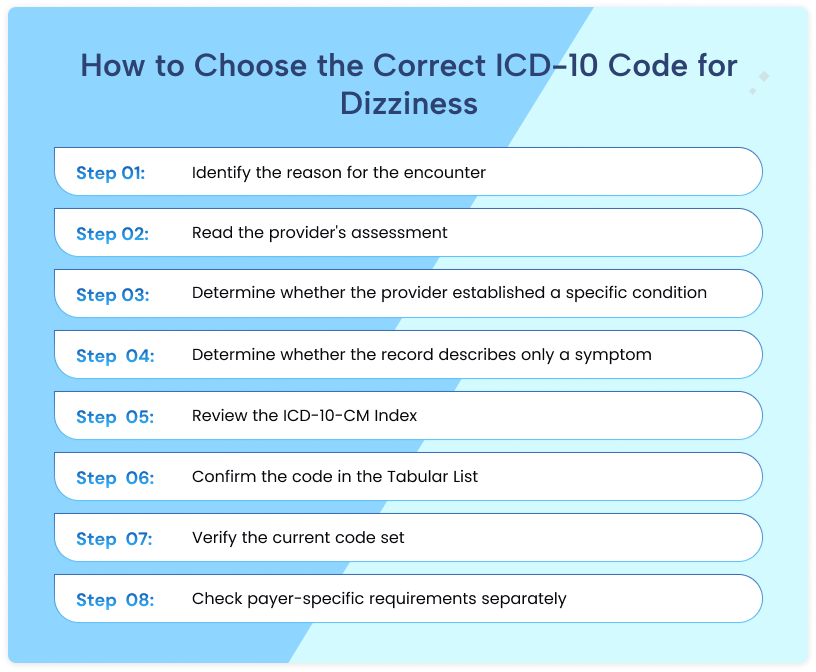
A practical coding workflow can reduce errors.
Step 1: Identify the reason for the encounter
Determine why the patient received the service.
Was the patient evaluated for dizziness, vertigo, imbalance, faintness, or another complaint?
Step 2: Read the provider’s assessment
Do not stop at the chief complaint.
Look for the provider’s diagnostic conclusion.
Step 3: Determine whether the provider established a specific condition
If the provider diagnosed a specific disease or disorder, review that diagnosis before selecting R42.
Step 4: Determine whether the record describes only a symptom
If the provider’s assessment remains dizziness or giddiness without a more specific diagnosis, R42 may be appropriate.
Step 5: Review the ICD-10-CM Index
Use the documented diagnostic term to locate the applicable classification.
Step 6: Confirm the code in the Tabular List
Do not stop after finding a term in the Alphabetic Index.
Review the Tabular List, including applicable inclusion terms, Excludes notes, and coding instructions.
Step 7: Verify the current code set
Confirm that the code applies to the patient’s date of service.
CMS maintains the current ICD-10-CM files and annual updates.
Step 8: Check payer-specific requirements separately
If the diagnosis supports a particular billed service, review the payer’s applicable medical policy.
A correct ICD-10-CM code does not by itself guarantee payment.
Does R42 Change Every Year?
ICD-10-CM is updated annually, so coders should verify current-year code files.
For the current FY 2027 code set, CMS lists R42 as Dizziness and giddiness and provides the FY 2027 diagnosis files for encounters from October 1, 2026 through September 30, 2027.
This is why online articles should include a clear update date and should be reviewed whenever CMS publishes a new code set.
A page that continues to cite an older year’s code file without checking subsequent updates can become unreliable even if the code itself has not changed.
R42 vs. Syncope and Collapse
Dizziness and syncope should not be treated as interchangeable diagnoses.
R42 represents dizziness and giddiness.
Syncope and collapse have a separate classification.
This distinction matters because a patient may describe feeling as though they are going to faint, while another patient may describe a spinning sensation without any loss of consciousness.
The provider’s assessment should determine the diagnosis.
A coder should not use the patient’s casual wording to select a different medical condition.
R42 vs. Unsteadiness
Unsteadiness can accompany dizziness, but the terms are not necessarily synonymous.
A patient may experience gait instability or balance problems without describing dizziness.
If the provider documents a specific symptom or condition other than dizziness, the coder should review the appropriate ICD-10-CM classification rather than forcing the documentation into R42.
Again, the coding decision should follow the provider’s documented diagnosis.
R42 vs. Vestibular Dysfunction
Vestibular dysfunction belongs to a different diagnostic framework from a nonspecific dizziness complaint.
If the provider documents a specific vestibular disorder, the coder should evaluate the relevant H81 or other applicable classification.
CMS’s ICD-10-CM materials include several vestibular and vertiginous conditions under H81.
The presence of dizziness does not automatically establish vestibular dysfunction.
That diagnosis requires provider documentation.
R42 and Telehealth Encounters
Dizziness may also be evaluated through telehealth.
The diagnosis coding principles do not change simply because the encounter occurs remotely.
The provider’s documentation still needs to support the diagnosis reported for the encounter.
If the provider evaluates dizziness and documents R42 as the established condition, R42 may be reported subject to the payer’s telehealth and billing requirements.
If the provider establishes a more specific diagnosis, that diagnosis should be evaluated instead.
The billing team should separately verify payer-specific telehealth rules, including eligible services, place-of-service requirements, modifiers, and coverage restrictions.
How R42 Affects Claims
A diagnosis code is one component of a medical claim.
For a claim involving dizziness, the diagnosis should accurately support the service documented and billed.
Potential claim issues can occur when:
- The diagnosis does not match the documentation
- A more specific documented diagnosis is ignored
- A suspected outpatient diagnosis is coded as confirmed
- The diagnosis does not support medical necessity under the payer’s policy
- The claim uses an outdated code
- Documentation does not support the reported condition
- The billed service has separate coverage restrictions
A clean claim therefore requires more than inserting R42 into the diagnosis field.
The diagnosis, procedure, documentation, payer policy, and patient coverage all need to align.
Final Takeaway
The ICD-10-CM code for dizziness and giddiness is R42.
But accurate dizziness coding requires more than recognizing the code number.
R42 is appropriate when the documented condition is dizziness or giddiness and the encounter does not establish a more specific diagnosis that should be reported instead. The coder should distinguish a nonspecific symptom from conditions such as specific vestibular disorders, because ICD-10-CM provides separate classifications for many of those diagnoses.
The most reliable workflow is straightforward:
Read the provider’s assessment. Determine whether a specific diagnosis was established. Review the applicable ICD-10-CM Index and Tabular List. Check all relevant coding instructions. Verify the code for the date of service. Then review payer-specific coverage and medical necessity requirements separately.
For current coding, CMS should remain one of the primary sources for verifying the applicable ICD-10-CM files. CMS’s FY 2027 materials identify R42 as Dizziness and giddiness and apply the FY 2027 diagnosis code set to encounters from October 1, 2026 through September 30, 2027.
The central coding principle is simple: do not let the word “dizziness” make the coding decision by itself. Let the provider’s documented diagnosis, the ICD-10-CM classification, and the rules applicable to the encounter determine the code.
Frequently Asked Questions
What is the ICD-10 code for dizziness and giddiness?
The ICD-10-CM code is R42, Dizziness and giddiness. CMS lists R42 in its current ICD-10-CM code files.
Can a coder diagnose the cause of dizziness?
No. Coders should not independently establish a medical diagnosis from symptoms, test results, or clinical assumptions. The reported diagnosis must be supported by provider documentation and applicable coding guidelines.
Does low blood pressure automatically mean dizziness should be coded differently?
Not necessarily. The provider’s documented assessment determines the diagnosis. A coder should not independently establish a cause based only on a clinical measurement.
Can dizziness and an underlying condition both be coded?
Sometimes, depending on the documentation and applicable ICD-10-CM guidelines. Do not automatically report every symptom with an underlying diagnosis.
Is R42 a billable ICD-10-CM code?
R42 is a specific ICD-10-CM code used to report dizziness and giddiness. Whether a claim containing R42 is payable depends on the service, documentation, payer policy, medical necessity, and other claim requirements.
Does R42 guarantee medical necessity?
No. A diagnosis code does not guarantee payment or medical necessity. Payer-specific coverage policies may establish additional requirements.
Does R42 apply to Medicare?
R42 is an ICD-10-CM diagnosis code used across HIPAA-covered healthcare transactions, not a Medicare-only code. Medicare coverage for a particular service depends on the applicable Medicare policy. CMS Medicare billing materials include R42 in certain vestibular testing policies.
Should R42 be used when vertigo is documented?
It depends on how the provider documents the condition. Nonspecific vertigo may fall under R42, while a specific vertiginous or vestibular disorder may require another ICD-10-CM code.
What should a coder do if the documentation is unclear?
Follow the organization’s coding policies and applicable query procedures. Do not independently infer a diagnosis that the provider has not documented.