
Hypogonadism isn’t one code. It’s a whole family of codes that split apart based on where the problem originates, and picking the wrong branch of that family tree is one of the fastest ways to watch a legitimate testosterone therapy claim bounce right back.
This guide sorts out which Hypogonadism ICD-10 code belongs where, what documentation needs to back it up, and why so many testosterone therapy claims run into trouble that has nothing to do with the treatment itself.
Primary Versus Secondary Hypogonadism
Before any code gets picked, there’s one clinical question that has to be answered first: is the problem coming from the gonads themselves, or from somewhere upstream in the hypothalamic-pituitary-gonadal axis that’s supposed to be signaling the gonads to work properly?
Primary Hypogonadism
Primary hypogonadism means the testicles (or ovaries) themselves aren’t producing enough hormone, even though the brain is sending the right signals. Think testicular failure, Klinefelter syndrome, damage from chemotherapy, trauma, or infection like mumps orchitis. In this scenario, the pituitary is actually working overtime trying to compensate, which shows up in the labs as elevated LH and FSH alongside low testosterone.
Secondary Hypogonadism
Secondary hypogonadism flips that picture. The testicles are perfectly capable of producing hormones, but they’re never getting the signal to do so, because the problem sits at the hypothalamus or pituitary level. Labs here typically show low or inappropriately normal LH and FSH alongside low testosterone, since the pituitary isn’t sending the message it should be sending.
This isn’t just a clinical curiosity. It’s the entire basis on which an ICD-10 code is correct, and coding hypogonadism without ever checking LH and FSH is one of the most common documentation gaps that drive denials in this category. A single testosterone reading, on its own, tells you almost nothing about which branch of this condition you’re actually dealing with.
Codes for Primary (Testicular) Hypogonadism
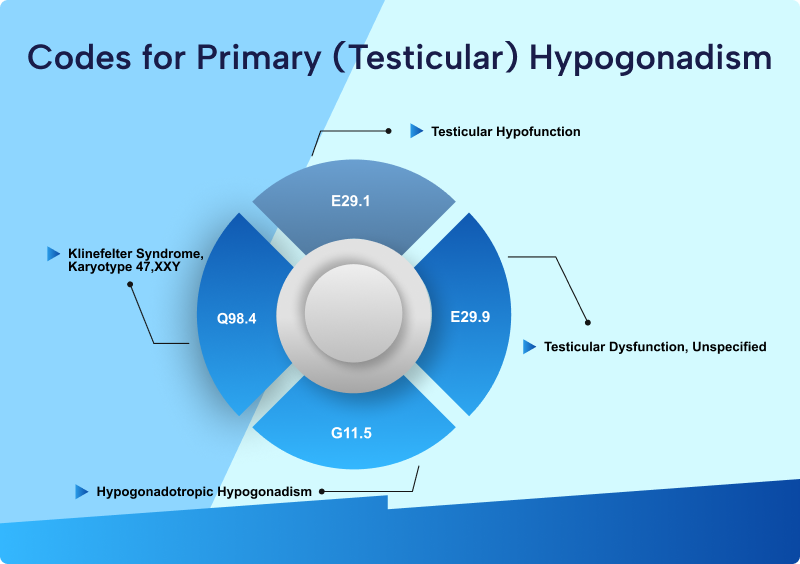
- E29.1, Testicular Hypofunction: The main code for primary male hypogonadism, covering testosterone deficiency stemming from testicular failure, Klinefelter syndrome, orchitis, testicular trauma, or chemotherapy-induced testicular damage
- E29.9, Testicular Dysfunction, Unspecified: Used when a testicular-origin problem is clear but the specific type hasn’t been pinned down yet, appropriate for an initial workup before a more definitive diagnosis is reached
- G11.5, Hypogonadotropic Hypogonadism (in certain congenital or genetic contexts): Applies in specific hypogonadotropic presentations, though this sits outside the core E29 family and requires careful chart review to confirm it’s genuinely the right fit
- Q98.4, Klinefelter Syndrome, Karyotype 47,XXY: An additional code to report alongside E29.1 specifically when genetic testing has confirmed Klinefelter syndrome as the underlying cause
CPT Codes for Secondary (Pituitary/Hypothalamic) Hypogonadism
- E23.0, Hypopituitarism: The primary code for secondary hypogonadism, covering pituitary gland conditions like pituitary adenomas, Sheehan’s syndrome, or panhypopituitarism that result in insufficient signaling to the gonads
- E23.1, Drug-Induced Hypopituitarism: Specifically for cases where a medication, glucocorticoids being a common culprit, is the identified cause of the pituitary dysfunction
- E23.7, Disorder of the Pituitary Gland, Unspecified: Used when pituitary involvement is clear but a more specific classification isn’t yet available in the documentation
Codes for Female Hypogonadism
- E28.39, Other Primary Ovarian Failure: Covers premature ovarian failure, resistant ovary syndrome, and other primary causes of estrogen deficiency tied to ovarian dysfunction, functionally the female equivalent of E29.1
- E28.310, Symptomatic Premature Menopause: Applies when ovarian failure occurs before the typical age of menopause and presents with associated symptoms
Post-Treatment and Historical Status Codes
- E89.5, Postprocedural Hypogonadism: Applies specifically when hypogonadism results from a medical procedure, such as orchiectomy or certain cancer treatments, rather than an underlying disease process
- Z87.438, Personal History of Resolved Hypogonadism: Used when documenting a patient’s history of hypogonadism that has been treated and is no longer clinically active, distinct from active ongoing management
The Testosterone Level Gray Zone
Here’s a detail that trips up more claims than it should: not every low-ish testosterone number automatically justifies a hypogonadism diagnosis. Current clinical guidance points to roughly 300 ng/dL as a general threshold, but there’s a well-documented gray zone, often cited somewhere around 231 to 346 ng/dL, where a single total testosterone reading alone isn’t considered sufficient to confirm true hypogonadism.
In that borderline range, free testosterone needs to be measured as well, since total testosterone can be misleadingly normal or borderline in men with abnormal sex hormone-binding globulin levels, while free testosterone tells a clearer story about what’s actually biologically available. Coding a hypogonadism diagnosis off a borderline total testosterone reading alone, without a free testosterone value backing it up, is a pattern that increasingly draws payer scrutiny, and it’s also just not great medicine.
Age-related decline deserves its own mention here too. Testosterone naturally drifts downward with age, and that alone isn’t hypogonadism. Coding an older patient’s naturally lower testosterone as a formal hypogonadism diagnosis, absent both the biochemical threshold and a clear symptom picture, is a documentation practice that doesn’t hold up well under review.
Testosterone Therapy Billing: The Z-Code That Belongs Alongside E29.1
Once a patient is established on testosterone replacement therapy, ongoing visits and lab monitoring need a code that reflects continued management of that therapy, not just the underlying diagnosis on its own. This is where a long-term drug therapy Z-code pairs with the primary hypogonadism diagnosis, signaling to the payer that this is an established patient on active treatment rather than a fresh diagnostic workup.
This pairing matters for more than just claim accuracy. It supports medical necessity for the recurring lab work that ongoing testosterone therapy requires, hematocrit checks, PSA monitoring, repeat testosterone levels, since payers want to see that ongoing monitoring is tied to documented, active treatment rather than open-ended testing without a clear therapeutic anchor.
Where These Claims Typically Fall Apart
The most common and most avoidable error is defaulting straight to E29.1 without ever confirming LH and FSH, essentially assuming primary hypogonadism because that’s the more familiar code, when the actual lab picture might point toward E23.0 instead. This single habit accounts for a disproportionate share of the miscoding in this category.
Coding off one testosterone draw, rather than the two separate morning measurements that solid clinical guidelines call for, is another frequent gap, and it’s one that shows up clearly to anyone reviewing the chart against the billed diagnosis.
Leaning on nonspecific symptoms, fatigue, mood changes, low energy, as the sole documented justification for the diagnosis is a pattern that draws scrutiny, given how weakly those symptoms actually correlate with confirmed low testosterone in the clinical literature.
And forgetting to add Klinefelter syndrome’s specific code, Q98.4, alongside E29.1 when genetic testing has actually confirmed that diagnosis leaves useful clinical detail off the claim that could matter for both risk adjustment and continuity of care documentation down the line.
A Quick Mental Checklist Before Coding a Hypogonadism Claim
- Confirm two separate morning total testosterone measurements, not a single reading, and not one drawn in the afternoon
- Check whether LH and FSH were measured, since this is the single detail that determines primary versus secondary coding
- If total testosterone falls in the borderline 231-346 ng/dL range, confirm a free testosterone level was also obtained
- Match the documented symptoms against what the clinical literature actually supports as testosterone-responsive, rather than relying on general, nonspecific complaints alone
- Check for any known underlying cause, Klinefelter syndrome, pituitary adenoma, chemotherapy history, prior surgery, that would justify a more specific code than an unspecified fallback
- For patients already established on therapy, confirm the long-term drug therapy Z-code is paired with the diagnosis on follow-up visits
- Rule out simple age-related decline as the actual explanation before finalizing a formal hypogonadism diagnosis code
Conclusion
Hypogonadism coding rewards the same habit that drives good medicine generally: looking at the labs before deciding what’s going on. E29.1 and E23.0 aren’t interchangeable shortcuts for “low testosterone” they represent genuinely different underlying mechanisms, and the LH and FSH values are what separate one from the other. Get two confirmed morning testosterone readings, check the gonadotropins, watch for that borderline testosterone range where free testosterone becomes essential, and the coding for this condition stops being a guessing game and starts reflecting what’s actually happening in the patient’s body, which happens to be exactly what a payer wants to see too.
Endocrinology and urology practices lose real revenue to hypogonadism claims that get denied over missing LH/FSH data or thin symptom documentation. RCM Xpert is a New York-based Medical billing company that ensures coding accuracy for hormone-related diagnoses, catching these documentation gaps before they turn into denials.
Contact us today for a complimentary review of your hypogonadism and testosterone therapy claims.
FAQs
Can a physician diagnose hypogonadism from a single testosterone test?
Clinical guidelines generally call for two separate morning testosterone measurements before confirming a diagnosis, since a single reading, especially one drawn later in the day, doesn’t reliably reflect a patient’s true hormonal status given testosterone’s natural diurnal pattern. Coding and billing a hypogonadism diagnosis, and the therapy that follows it, off just one test result is a documentation gap that can surface during a payer audit or medical necessity review.
What’s the actual difference between coding E29.1 and E23.0?
E29.1 applies when the problem originates in the testicles themselves, meaning primary hypogonadism, typically confirmed by elevated LH and FSH alongside low testosterone. E23.0 applies when the testicles are functioning normally but aren’t receiving adequate signaling from the pituitary gland, meaning secondary hypogonadism, typically showing low or inappropriately normal LH and FSH. Choosing between them requires actually having LH and FSH results in hand, not just a low testosterone number on its own.
Is it ever appropriate to code hypogonadism in an older man with naturally declining testosterone?
Only when both a genuine biochemical threshold, generally testosterone below roughly 300 ng/dL, and a clear, testosterone-responsive symptom picture are both present and documented. Age-related testosterone decline on its own, without meeting these criteria, doesn’t constitute a hypogonadism diagnosis, and coding it as such without adequate biochemical and symptomatic support creates real audit risk.
Why would a testosterone therapy claim get denied if the diagnosis code looks correct?
Even with the right diagnosis code attached, a claim can still get denied if the supporting documentation doesn’t clearly back up medical necessity, meaning missing LH/FSH data, only one testosterone measurement on file, or a borderline testosterone level without a confirming free testosterone value. Payers increasingly review the underlying lab data behind hypogonadism claims rather than accepting the diagnosis code alone as sufficient justification.
What code should be used for a woman with confirmed premature ovarian failure?
E28.39, Other Primary Ovarian Failure, is generally the appropriate code for premature ovarian failure and related causes of ovarian-origin estrogen deficiency in women. If the presentation specifically involves symptomatic premature menopause, E28.310 may be the more precise choice depending on how the clinical picture is documented.
Does a patient with a history of hypogonadism that’s been successfully treated still need an active diagnosis code on every visit?
Not necessarily. If the condition has genuinely resolved and is no longer being actively managed, Z87.438, Personal History of Resolved Hypogonadism, is the more accurate code rather than continuing to bill an active E29.1 or E23.0 diagnosis indefinitely. That said, if a patient remains on long-term testosterone therapy to manage an ongoing condition, the active diagnosis code paired with the appropriate long-term drug therapy Z-code remains correct, since the condition is still being actively treated rather than resolved.