

Payment Posting Services That Catch Underpayments and Denials Before They Cost You Revenue
RCM Xpert provides specialized payment posting services for medical, dental, and behavioral health practices that need accurate payment reconciliation, timely denial identification, and better control over outstanding revenue. Our medical billing payment posting services cover insurance remittances, patient payments, contractual adjustments, CARC and RARC review, underpayment detection, credit balance resolution, secondary billing, and payment reporting.
Payment posting should do more than record a number in a practice management system. It should tell your billing team what the payer actually paid, why the payer adjusted the claim, whether the payment matches the contracted rate, and whether someone needs to act on the account.
RCM Xpert handles payment posting as a revenue cycle checkpoint, not simple data entry.
Get a Free Billing Audit
What Is Payment Posting in Medical Billing?
Payment posting is the process of recording payments from insurers and patients against the correct claim, applying contractual adjustments, and identifying denials or payment discrepancies.
It sits at an important point in the revenue cycle. Once a payer adjudicates a claim, the payment and remittance information tell the practice what happened to that claim.
A payment posting specialist needs to determine:
- What the payer paid
- What the payer allowed
- What amount represents a contractual adjustment
- What amount remains the patient’s responsibility
- Whether the payer denied or partially denied a service
- Whether the payment matches the contracted rate
- Whether another payer should receive the remaining balance
- Whether the account contains an overpayment or credit balance
That makes payment posting a diagnostic checkpoint.
A CARC code that looks like a routine adjustment can hide a meaningful payment issue if nobody compares the actual reimbursement with the payer’s contracted rate. That check can disappear when staff treats posting as data entry.
Accurate posting gives the practice a clean financial record and gives denial management and AR teams the information they need to act.
Where Payment Posting Fits in the Revenue Cycle
Payment posting connects claim submission with denial management, AR recovery, patient billing, and final account reconciliation.
The revenue cycle does not end when a claim leaves the practice.
A typical sequence looks like this:
| Revenue Cycle Stage | Primary Function |
| Eligibility verification | Confirm coverage and benefits |
| Charge entry | Record billable services |
| Coding | Assign appropriate diagnosis and procedure codes |
| Claim submission | Send claims to the payer |
| Payment posting | Record payment and adjustment information |
| Denial management | Resolve rejected or denied claims |
| AR recovery | Follow up on unpaid balances |
| Patient billing | Bill appropriate patient responsibility |
| Reconciliation | Confirm account and payment records agree |
Payment posting therefore connects several RCM functions.
It can also reveal problems created earlier in the cycle. For example, an incorrect contractual adjustment may signal a payer configuration problem. A denial recorded through a CARC code can move directly into denial management services. An unpaid balance can move into AR recovery services. Patient responsibility can move into patient billing services.
Similarly, accurate front end information from eligibility verification helps the practice determine whether the patient’s remaining balance makes sense.
The result is a connected revenue cycle instead of separate billing tasks.
The Payment Posting Challenges Costing Your Practice Revenue
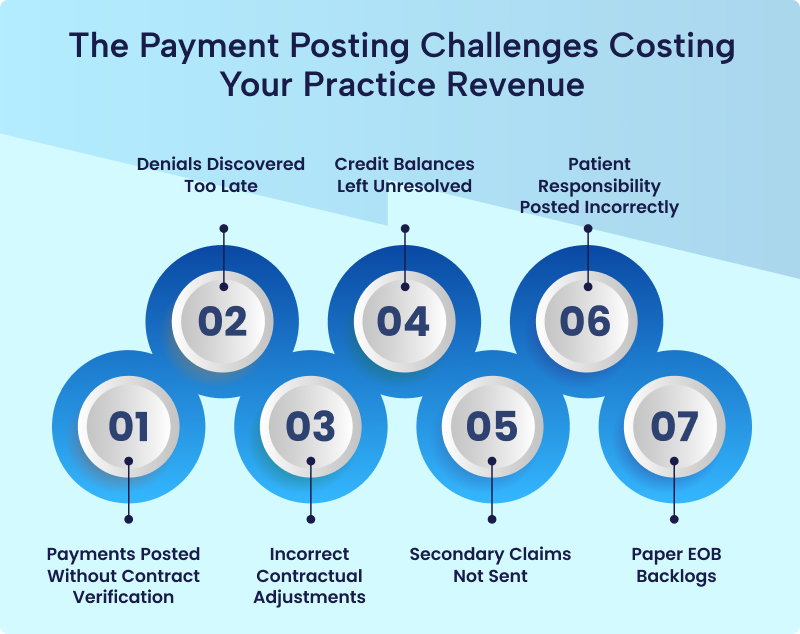
Slow posting, missed underpayments, late denial identification, incorrect adjustments, credit balances, and poor payer reconciliation can leave revenue unresolved even after the payer processes a claim.
Payments Posted Without Contract Verification
A payer may pay less than the amount the practice expects under its contracted fee schedule. If the staff simply posts the payer’s amount and closes the claim, the short payment can disappear into the normal adjustment process.
Denials Discovered Too Late
A denial identified during posting can move into the appropriate follow up workflow immediately. A denial discovered weeks later during an AR review gives the practice less time to correct or appeal it.
Incorrect Contractual Adjustments
Contractual adjustments should reflect the agreement between the payer and provider. Incorrect adjustment amounts can distort AR, patient balances, and financial reporting.
Credit Balances Left Unresolved
Overpayments and credit balances need review. Leaving them open can create reconciliation problems and may create refund obligations.
Secondary Claims Not Sent
When a primary payer adjudicates a claim and leaves an appropriate balance for another payer, the posting process needs to recognize that balance and support the next billing step.
Patient Responsibility Posted Incorrectly
Copays, deductibles, coinsurance, and self-pay balances need to reflect the payer’s adjudication. Posting patient responsibility incorrectly can result in inaccurate statements and patient disputes.
Paper EOB Backlogs
Electronic remittances can support automated posting, but paper EOBs and complex exceptions still require human review. A growing paper backlog can delay reconciliation.
These problems explain why specialized payment posting services in medical billing can matter even when a practice already has a billing team.
Why In-House and Generic Outsourced Payment Posting Both Fall Short
In-house payment posting works well at lower volumes when staff can check every payment against the contract, but growing volume can push underpayment checks and denial identification aside.
An internal employee may begin with enough time to post every remittance carefully. As claim volume grows, the same person may also handle eligibility, charge entry, claim submission, patient calls, and AR.
Payment posting then becomes a production task.
The same problem can appear with a generalist outsourcing company. A vendor may post the payment correctly but fail to check whether the amount matches the contracted rate. It may also record a CARC and move on without recognizing that the code requires immediate denial follow-up.
A specialist should understand that the purpose of posting extends beyond account balance updates.
The question is not simply, “Was the payment posted?”
The better question is, “What did the payment tell us about this claim?”
That distinction sets up the scope of RCM Xpert’s payment posting services in healthcare.
What’s Included in RCM Xpert’s Payment Posting Services
RCM Xpert handles insurance and patient payments, contractual adjustments, denial identification, credit balances, secondary billing, and payment reporting as connected parts of the revenue cycle.
Insurance Payment Posting
Insurance posting records remittances from payers using sources such as:
- Electronic Remittance Advice
- Paper EOBs
- Electronic Funds Transfer
The team records the payment, applicable adjustment, patient responsibility, and denial information against the correct claim.
Patient Payment Posting
Patient payment posting handles:
- Copayments
- Deductibles
- Coinsurance
- Self pay balances
- Online portal payments
Insurance payment posting and patient payment posting serve different purposes. Insurance posting starts with payer adjudication. Patient posting records money received from the patient after the practice determines the appropriate responsibility.
Contractual Adjustment Application
Contractual adjustments need to reflect the applicable payer agreement. Incorrect adjustments can distort both the practice’s financial records and the patient’s balance.
Denial Identification
CARC and RARC codes help identify why the payer adjusted or denied a claim. Posting staff can route appropriate denials to the denial management services workflow.
Credit Balance Resolution
Overpayments and credit balances receive review instead of remaining indefinitely on the account.
Secondary and Tertiary Billing
When a payer leaves an appropriate balance for another insurer, the posting workflow identifies the remaining balance and supports secondary or tertiary claim sequencing.
Reporting
Payment posting data can help practice leaders review payer behavior, unresolved balances, adjustment patterns, denials, and reconciliation issues.
The next step is understanding the documents that actually carry this information.
EOB, ERA, and the ANSI X12 835 Standard: How Payments Actually Get Posted
An EOB explains claim adjudication on paper or PDF, while an ERA delivers equivalent remittance information electronically through the ANSI X12 835 standard.
| Document | Format | Posting Method |
| Explanation of Benefits, EOB | Paper or PDF | Manual posting or OCR-assisted capture |
| Electronic Remittance Advice, ERA | Electronic file | Automated or assisted posting |
| Electronic Funds Transfer, EFT | Electronic payment | Matched with the related remittance |
- An Explanation of Benefits, or EOB, explains how a payer adjudicated a claim. It can show the billed amount, allowed amount, payment, adjustment, patient responsibility, and other claim information.
- An Electronic Remittance Advice, or ERA, provides comparable remittance information electronically.
- The ANSI X12 835 standard defines the electronic structure used for ERA files. It tells software where to find payment amounts, adjustment information, patient responsibility, and other remittance details.
That standard matters because the practice management system can read structured information without requiring staff to manually type every payment.
The payment itself may arrive through an EFT, or Electronic Funds Transfer. The remittance explains how the payer applied that payment to claims.
The three pieces therefore work together:
- ERA explains the adjudication electronically.
- EFT transfers the money.
- Payment posting connects the remittance and money to the correct account.
When the system encounters an exception, human review becomes important.
CARC and RARC Codes, How Denials Get Identified During Posting
CARC codes explain why a claim received a particular adjustment, while RARC codes provide additional detail about that adjustment or denial.
A Claim Adjustment Reason Code, or CARC, communicates the payer’s stated reason for paying a claim differently than billed.
A Remittance Advice Remark Code, or RARC, adds supporting information that helps the biller understand the payer’s decision.
For example, a payment may contain a contractual adjustment that looks routine. But the CARC and RARC combination may reveal that the payer processed a service differently because of a coverage, bundling, authorization, or documentation issue.
Reading these codes at the time of posting creates an important advantage.
The denial can move into the appropriate workflow immediately instead of waiting for an AR specialist to discover it during a later account review.
That creates a direct connection between payment posting services and denial management services.
The goal isn’t to challenge every adjustment. Contractual reductions may be correct. The goal is to understand what happened and route exceptions to the right next step.
Catching Underpayments Through Contractual Variance Detection
Contractual variance detection compares the payer’s actual payment with the contracted allowed amount and flags a short payment instead of accepting it as final.
Suppose a payer contract allows $100 for a particular service, but the remittance shows a payment of $82 after accounting for applicable patient responsibility and contractual terms.
The posting process should not automatically assume that the $18 difference represents a legitimate adjustment.
The team needs to compare the remittance against the applicable contract or fee schedule.
The review can identify:
- Short payments
- Incorrect contractual adjustments
- Unexpected payer reductions
- Incorrect patient responsibility
- Missing payments
- Other reconciliation discrepancies
This process can uncover revenue that otherwise disappears into accepted adjustments.
It also gives the practice a cleaner AR picture because staff can distinguish legitimate contractual reductions from amounts that require payer follow up.
Get a Free Billing Audit
Auto Posting vs. Manual Posting, and Where OCR Fits
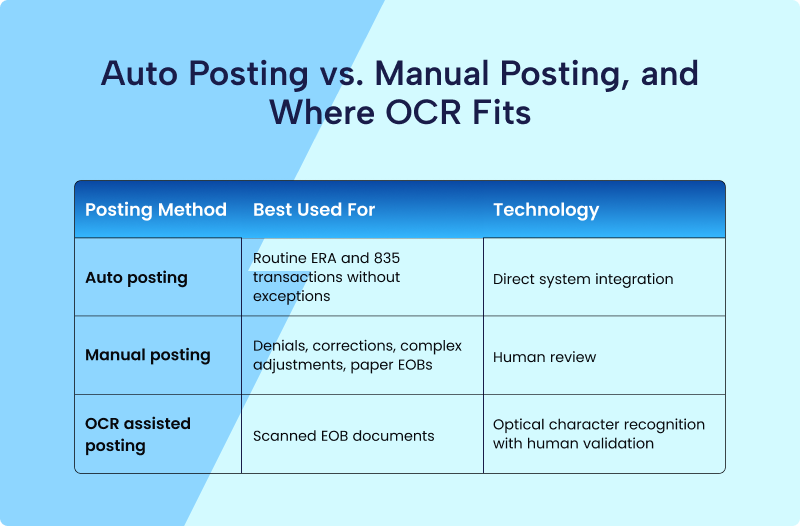
Automated posting works best for routine electronic remittances, while manual review handles denials, exceptions, paper EOBs, and complex adjustments.
| Posting Method | Best Used For | Technology |
| Auto posting | Routine ERA and 835 transactions without exceptions | Direct system integration |
| Manual posting | Denials, corrections, complex adjustments, paper EOBs | Human review |
| OCR assisted posting | Scanned EOB documents | Optical character recognition with human validation |
Automation can reduce repetitive data entry when the ERA contains predictable information.
It should not eliminate judgment.
A denial, unusual adjustment, secondary payer situation, or contract variance may require a person to examine the remittance.
OCR can help convert information from scanned EOBs into usable data. The resulting information still needs validation because scanned documents can contain recognition errors.
The strongest workflow uses automation for routine volume and human review for exceptions.
Insurance Payment Posting vs. Patient Payment Posting
Insurance payment posting records payer remittances, while patient payment posting records copays, deductibles, coinsurance, and self pay amounts after insurance adjudication.
| Payment Type | Common Source | Information Recorded |
| Insurance payment | ERA, EOB, EFT | Payment, adjustment, patient responsibility, CARC and RARC |
| Patient payment | Portal, check, card, other approved payment method | Patient payment against outstanding responsibility |
Keeping these functions clear helps prevent inaccurate patient balances.
For example, a patient’s statement should not reflect an amount that the payer already assigned to contractual adjustment.
Likewise, a payment received from the patient should not reduce the wrong claim or account.
Accurate posting keeps the patient ledger, payer ledger, and practice financial records aligned.
In House vs. Outsourced Payment Posting, A Real Comparison
In house posting can make sense for low volume practices with diligent staff, while growing practices often benefit from outsourcing when underpayments, denials, and reconciliation checks start slipping through.
| Factor | In House Posting | General Outsourced Posting | RCM Xpert |
| Denial identification | Often found during later AR review | Varies | CARC and RARC reviewed during posting |
| Underpayment detection | May not receive systematic contract checks | Inconsistent | Payments checked against contracted rates |
| Volume | Staff capacity limits growth | Generally scalable | Automation supports routine volume |
| State payment timing | Often not actively monitored | May vary | Applicable state rules considered |
| Staff continuity | Depends on internal staffing | Depends on account assignment | Dedicated account team |
| Cost | Salary, benefits, training, software | Vendor fee | Cost scales with the selected arrangement |
A low volume practice with one experienced staff member who checks every payment against the contract can reasonably keep posting in house.
Outsourcing becomes more practical when claim and remittance volume grows, staff cannot review every payment, denials surface late, or the practice cannot confirm that contracted payment rates receive consistent checking.
That makes the decision a matter of volume, staff capacity, contract oversight, and revenue risk rather than a universal rule.
Nationwide Payment Posting, With State Specific Payment Timing Rules
RCM Xpert provides payment posting services across all 50 states while accounting for applicable state payment timing requirements.
The keyword data shows demand across national and regional searches, including payment posting services in the United States, payment posting services in the USA, New York, California, Los Angeles, and several Florida locations. Florida represents the strongest geographic cluster in the supplied search data, with terms covering the state, Boca Raton, Orlando, and Fort Lauderdale.
This makes geographic relevance important for a payment posting money page.
New York Prompt Pay Law
New York provides a useful example of why payment timing matters.
New York Insurance Law § 3224 a requires insurers to pay or deny certain undisputed claims within 45 days for paper submissions and 30 days for electronic submissions. The law also provides for a 12 percent annual interest penalty in applicable circumstances.
For a New York practice, payment posting can therefore do more than reconcile the account.
The posting record can help identify whether a payer processed a claim within the applicable statutory timeframe and whether a late payment may require further review.
State rules vary, so a nationwide billing workflow should not assume that one payment timing rule applies everywhere.
RCM Xpert can support practices nationally while incorporating applicable state specific payment requirements into the broader reconciliation process.
How Our Payment Posting Process Works
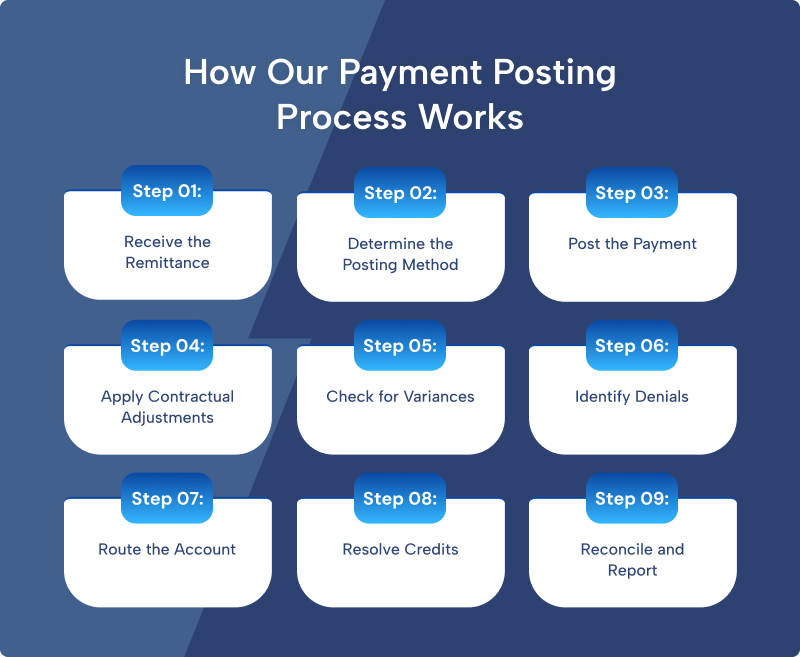
RCM Xpert moves each remittance through receipt, posting, reconciliation, exception review, denial routing, secondary billing, and reporting.
Step 1, Receive the Remittance
The process begins when the practice receives an ERA, EOB, or related EFT information.
Step 2, Determine the Posting Method
Routine electronic remittances can move through automated posting workflows. Paper EOBs and exceptions receive manual or OCR-assisted review.
Step 3, Post the Payment
The payment is matched to the correct claim and account.
Step 4, Apply Contractual Adjustments
The team records applicable contractual adjustments according to the payer’s adjudication and the provider’s agreement.
Step 5, Check for Variances
The payment is compared against the applicable contracted rate. Short payments and other discrepancies receive review.
Step 6, Identify Denials
CARC and RARC codes are reviewed to identify denials and other adjustment reasons.
Step 7, Route the Account
A denial can move to denial management services. An unpaid balance can move to AR recovery services. An appropriate remaining balance can move to secondary or tertiary billing.
Step 8, Resolve Credits
Credit balances and overpayments receive review for appropriate adjustment or refund handling.
Step 9, Reconcile and Report
The final step confirms that payment information and account balances reconcile and provides reporting that helps the practice understand unresolved issues.
Get a Free Billing Audit
Our AAPC and AHIMA Certified Payment Posting Team
RCM Xpert’s payment posting workflow should combine trained billing professionals, quality assurance, and measurable review processes rather than relying on automated posting alone.
The supplied brief calls for AAPC and AHIMA credentials, quality assurance processes, and performance KPIs. It also prohibits unsupported statistics or guarantees.
A qualified payment posting team should understand:
- EOB and ERA processing
- ANSI X12 835 remittances
- EFT reconciliation
- CARC and RARC codes
- Contractual adjustments
- Contract variance detection
- Credit balance resolution
- Secondary billing
- Patient responsibility
- Denial routing
- AR reconciliation
Quality assurance should review both posting accuracy and exception handling.
The objective is not simply to post every transaction. It is to make sure the resulting account accurately reflects what happened to the claim.
Payment Posting Support Across Every Specialty
RCM Xpert supports payment posting workflows for medical, dental, and behavioral health practices, with specialty-specific attention to payer rules and reimbursement structures.
Medical Practices
Medical payment posting can involve multiple commercial insurers, Medicare, Medicaid, managed care plans, secondary coverage, and complex contractual adjustments.
Dental Practices
Dental RCM payment posting services require separate consideration because dental benefit structures, fee schedules, claim formats, and patient responsibility can differ from medical billing.
Behavioral Health
Behavioral health payment posting can involve payer specific reimbursement rules, authorization issues, patient responsibility, and recurring denial patterns.
Multispecialty Practices
A multispecialty practice may have different payer contracts and reimbursement patterns across departments. Payment posting needs to preserve those distinctions.
RCM Xpert can also connect payment posting with broader services such as mental health billing services, AR recovery services, denial management services, and other revenue cycle functions where applicable.
Why Choose RCM Xpert for Payment Posting?
RCM Xpert treats payment posting as a revenue diagnostic function, using remittance data to identify denials, underpayments, contractual variances, and account issues.
Many payment posting pages stop at basic tasks such as recording EOBs, ERAs, and EFTs.
RCM Xpert’s approach goes further by naming the actual mechanics that determine what happens after a payer processes a claim.
That includes CARC and RARC codes, the ANSI X12 835 standard, contractual variance detection, credit balance resolution, and state payment timing considerations.
The distinction matters.
A payment posting specialist should be able to look at an ERA and understand more than the payment amount. The specialist should recognize why the payer adjusted the claim, whether the adjustment makes sense, whether the patient responsibility matches the adjudication, and whether the account needs another action.
RCM Xpert also connects posting with the rest of the revenue cycle.
- A denial should not sit inside the posting queue.
- A short payment should not become an accepted adjustment simply because the payer issued money.
- A secondary balance should not remain unresolved.
- A credit balance should not remain open without review.
This diagnostic approach gives payment posting a direct role in revenue recovery.
RCM Xpert also brings a New York based perspective to a nationwide service model, with the supplied brief identifying payment posting demand across New York, Florida, California, and national markets.
Get Started With a Dedicated Payment Posting Team
Stop Treating Payment Posting as Data Entry
Your practice already earned the payment. The next question is whether your billing workflow accurately records it, identifies what the payer changed, catches short payments, and sends exceptions to the right team.
RCM Xpert can help your practice review its current payment posting process, including remittance handling, contractual adjustments, denial identification, reconciliation, and AR handoff.
You can start with a free billing audit and identify where your current posting workflow may need closer review.
Get a Free Billing Audit
FAQs
What is payment posting in medical billing?
Payment posting is the process of recording payments from insurers and patients against the correct claim, applying contractual adjustments, and identifying denials or payment discrepancies. Accurate posting provides the practice with a current account balance and helps identify issues that require denial management, secondary billing, refunds, or AR follow-up.
What is the difference between an EOB and an ERA?
An EOB is a paper or PDF explanation of how an insurer adjudicated a claim. An ERA is the electronic equivalent and follows the ANSI X12 835 standard. ERA data can support automated posting because the payment, adjustment, and patient responsibility information follows a structured electronic format.
What are CARC and RARC codes?
CARC means Claim Adjustment Reason Code. It tells the biller why a claim received a particular payment or adjustment. RARC means Remittance Advice Remark Code and provides additional explanation. Reviewing both during payment posting helps identify denials and other exceptions quickly instead of waiting for a later AR review.
How does payment posting catch underpayments?
Payment posting catches underpayments by comparing the payer’s actual reimbursement with the contracted allowed amount for the applicable service. If the payment falls below the expected contractual rate without a valid explanation, the short payment can be flagged for follow up instead of being accepted as a final adjustment.
What is the difference between insurance payment posting and patient payment posting?
Insurance payment posting records payer remittances from sources such as ERAs, EOBs, and EFTs. Patient payment posting records money received from patients, including copayments, deductibles, coinsurance, and self pay balances. The two workflows use different payment sources but ultimately need to produce an accurate account balance.
How does payment posting help with denial management?
Payment posting can identify denials as soon as the payer remittance arrives. CARC and RARC codes provide information about the payer’s adjustment or denial. The billing team can then route the account to denial management for correction, reconsideration, appeal, or another appropriate action rather than discovering the issue weeks later.
Does New York have a law requiring insurers to pay claims promptly?
Yes. New York Insurance Law § 3224 a establishes payment timing requirements for applicable claims, including 45 days for paper submissions and 30 days for electronic submissions. The law also provides for a 12 percent annual interest penalty in applicable circumstances. Practices should review the specific statutory requirements that apply to their claims.
Should a practice handle payment posting in house or outsource it?
Either approach can work. A low volume practice with diligent staff who consistently check payments against contracts may keep posting in house. Outsourcing becomes more useful as transaction volume grows, underpayments go unchecked, denials surface late, or staff lack time for detailed reconciliation. The decision should reflect volume, staffing, contracts, and revenue risk.
Do you support dental payment posting?
Yes. Dental payment posting requires its own workflow because dental fee schedules, benefit structures, payer rules, and patient responsibility can differ from medical billing. RCM Xpert can support dental RCM payment posting as a distinct workflow rather than treating dental remittances exactly like medical claims.
Does RCM Xpert provide payment posting services nationwide?
Yes. RCM Xpert provides payment posting services across all 50 states. The workflow can account for state-specific payment timing requirements, while the supplied search data shows demand for payment posting services in national markets as well as New York, California, and Florida locations.