
Podiatry billing is different from other specialties.
According to a 2025 OIG audit, nearly half of the sampled Medicare podiatry claims did not meet requirements. The dominant reasons were insufficient documentation, incorrect coding, and lack of medical necessity.
This blog covers the most common podiatry billing mistakes and how to avoid them.
Common Mistakes in Podiatry Medical Billing and How to Avoid?
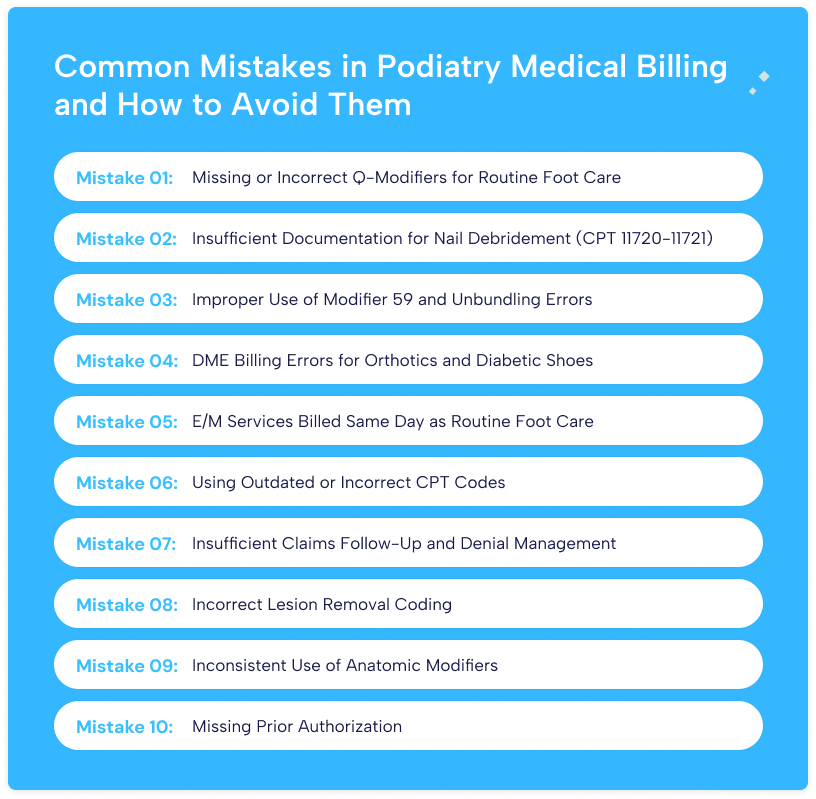
Podiatry Medical billing errors fall into predictable patterns. Each error costs time and money. Each error is preventable.
Let’s discuss the most common podiatry billing mistakes and how to avoid them.
Mistake #1 – Missing or Incorrect Q-Modifiers for Routine Foot Care
Medicare generally excludes routine foot care. Routine foot care includes paring or cutting of corns and calluses, trimming or debridement of nails, and hygienic or preventive maintenance. However, Medicare covers routine foot care when a patient has a systemic condition that makes nonprofessional care unsafe. Qualifying conditions include diabetes, peripheral artery disease, chronic neurologic conditions, and other systemic diseases.
To bill for routine foot care, providers must use Q-modifiers to link the service to the qualifying systemic condition.
Missing these modifiers is a top reason for denials.
| Modifier | Description | When to Use |
| Q7 | Class A finding | Patient has one class A finding (non-traumatic amputation of foot or integral part thereof) |
| Q8 | Class B finding | Patient has two class B findings (advanced trophic changes, marked paresthesia, absent pedal pulses, etc.) |
| Q9 | Class C finding | Patient has one class B and two class C findings (skin changes, diminished sensation, etc.) |
How to Avoid This Mistake
- Train billing staff to check for qualifying systemic conditions before submitting any routine foot care claim.
- Require documentation of the specific class findings in the clinical note.
- Use a checklist at claim submission that includes verification of the correct Q-modifier. Run a monthly report of denied routine foot care claims to catch missing modifier patterns.
Mistake #2 – Insufficient Documentation for Nail Debridement (CPT 11720-11721)
Nail debridement codes 11720 (one to five nails) and 11721 (six or more nails) require documentation of medical necessity. Medicare and commercial payers expect specific clinical findings that justify the procedure. Vague notes like “thick nails” or “patient requested trimming” do not support medical necessity.
For nail debridement to be covered, documentation must show:
- Thickness of the nails
- Presence of pain or infection
- Difficulty cutting nails due to systemic condition
- Specific nails treated (e.g., left great toe, right second digit)
- Clinical findings supporting necessity (dystrophic changes, subungual debris, onychomycosis)
The 2025 OIG audit found that many podiatry claims lacked sufficient medical record support. Typical deficiencies included:
- Incomplete or absent procedure notes
- Lack of signatures or dates
- Failure to document the required complicating systemic condition
- Inadequate detail to substantiate the number of nails treated
How to Avoid This Mistake
- Use structured note templates that prompt documentation of nail thickness, pain, infection, and systemic condition.
- Require providers to document the specific nails treated by digit and laterality. Implement pre-bill reviews for all nail debridement claims before submission.
- Train providers on the difference between CPT 11730 (temporary nail avulsion), 11732 (additional temporary avulsion), and 11750 (permanent nail avulsion).
Mistake #3 – Improper Use of Modifier 59 and Unbundling Errors
Modifier 59 is used to indicate that two procedures are separate and distinct, not bundled under National Correct Coding Initiative (NCCI) edits. But podiatry practices overuse modifier 59. They apply it when a different modifier would be more appropriate. They use it to bypass bundling rules when the services are actually not separate .
Modifier 59 should only be used when :
- Procedures are performed at different anatomical sites
- Procedures are performed at different patient encounters
- Procedures are separate and distinct with no overlap
CMS now prefers more specific modifiers than 59:
| Modifier | Meaning |
| XE | Separate encounter |
| XS | Separate structure |
| XP | Separate practitioner |
| XU | Unusual non-overlapping service |
One common error involves wound debridement codes (11042-11047) and compression application codes (29580-29581). These code pairs are bundled by NCCI edits. Appending modifier 59 to the compression code to bypass the bundle is inappropriate unbundling. Only the column 1 code (debridement) should be submitted.
Another error involves billing post-operative evaluation and management services during global periods. Charges during global periods get denied automatically unless separately identifiable with modifier 24 or 25.
How to Avoid This Mistake
- Review NCCI edits quarterly. Train billers on the difference between modifier 59 and X-modifiers.
- Use claims scrubbing software to flag potential unbundling errors before submission.
- Check bundling rules before applying modifiers, when two services are performed at the same site at the same encounter.
Mistake #4 – DME Billing Errors for Orthotics and Diabetic Shoes
Durable medical equipment (DME) billing for custom orthotics and diabetic shoes has specific requirements that differ from standard clinical billing. Many podiatry practices do not realize they are using Medicare billing protocols for commercial claims or vice versa. The result is denials and audit flags.
Notes that simply state “patient has flat feet” or “foot pain” create audit vulnerability. Documentation must include diagnosis, biomechanical findings, functional limitations, previous conservative treatments that failed, and clinical reasoning for the specific orthotic prescribed.
- Incorrect HCPCS codes – Custom orthotics use specific codes (L3010, L3020, L3030, etc.) based on device type, materials, and specifications. Using the wrong code creates denials.
- Missing modifiers for laterality – Bilateral custom orthotics require appropriate bilateral modifiers (LT, RT).
- Improper coding combinations for diabetic shoes – Diabetic shoes with custom inserts require specific coding combinations from the L3030-L3090 range. Billing custom orthotics without also billing appropriate diabetic footwear codes results in denials.
- Missing pre-authorization – Many DME items require pre-authorization. Billing without documented authorization creates compliance concerns.
How to Avoid This Mistake
- Establish comprehensive documentation standards for all DME claims. Before providing any DME, verify pre-authorization requirements with the patient’s insurance carrier.
- Document delivery and fitting of the device, including delivery date, fitting adjustments, and patient education provided.
- Maintain carrier-specific billing protocols and conduct pre-billing compliance reviews for high-value DME claims.
Mistake #5 – E/M Services Billed Same Day as Routine Foot Care
Evaluation and management services are payable on the same date as routine foot care only when the E/M service is significant and separately identifiable from the procedure. Many practices bill modifier 25 with an E/M code on the same day as a nail debridement or lesion removal without documenting what made the E/M separate.
The 2025 OIG audit found that E/M services billed with routine foot care were a recurrent issue. Documentation often did not justify modifier 25.
To bill an E/M service on the same date as a procedure:
- The E/M service must be significant and separately identifiable
- Modifier 25 must be appended to the E/M code
- Documentation must clearly show what evaluation work occurred beyond the pre- and post-procedural work inherent to the procedure code
- The E/M must address a separate problem or a significant change in the patient’s condition
How to Avoid This Mistake
- Apply modifier 25 conservatively. Only bill same-day E/M when there is truly a separate, identifiable evaluation.
- Train billing team to document the distinct nature of the E/M service. Implement pre-bill reviews for claims that combine E/M codes with procedure codes.
Mistake #6 – Using Outdated or Incorrect CPT Codes
CPT codes change every year. Medicare’s 2024 revisions to wound debridement codes (11042-11047) triggered mass rejections where updates were not applied. Outdated coding practices are the most common cause of denials across podiatry clinics.
Financial Impact of Outdated Codes
| Error Type | Financial Impact |
| Expired CPT Codes | Up to 18% denial rate |
| Missing Q-modifiers | 30-40% revenue loss |
| Bundling Errors | Payer audits and repayments |
For 2026, podiatrists are estimated to see an increase in total Medicare payments of more than 4 percent. Work RVU increases were finalized for both great toe arthrodesis codes (CPT 28750 and 28755). A new skin substitute payment rate of $127.28 per square centimeter was adopted.
How to Avoid This Mistake
- Review CPT, HCPCS, and ICD-10 code updates annually before they take effect.
- Update billing software with current codes before January 1 of each year.
- Subscribe to payer bulletins for mid-year changes. Conduct quarterly internal audits to catch coding errors.
- Verify Local Coverage Determination (LCD) adherence for all Medicare claims.
Mistake #7 – Insufficient Claims Follow-Up and Denial Management
One of the least visible but most costly problems is the backlog of claims that were never followed up, were denied without appeal, or stalled due to missing documentation. Every unworked claim is unfinished revenue. Many practices absorb these losses simply because follow-up feels overwhelming.
According to industry data, denial rates above 10 percent can cause $80,000 to $120,000 in annual revenue loss for a typical practice. Increased accounts receivable days strain clinic cash flow. Practices under 35 days in AR grow revenue 23 percent faster than competitors.
According to AAPC, common denial reasons include:
- Missing prior authorization
- Incorrect patient date of birth
- Provider network issues
- Patient eligibility
- Coordination of benefit errors
- Timely filing deadlines
- Bundled or global service errors
How to Avoid This Mistake
- Submit claims within 48 hours of the patient visit. Review denials weekly to identify recurring errors.
- Track denials by reason and payer to identify trends. Check clearinghouse daily for claims stuck in queue.
- Implement an end-to-end revenue cycle management system including cash posting, EOB processing, denial management, and insurance follow-ups.
Mistake #8 – Incorrect Lesion Removal Coding
Lesion removal codes for the foot require precise differentiation between removal, shaving, and debridement. CPT 11305 is often misused.
CPT 11305 is for shaving of epidermal or dermal lesion on the foot, single lesion, diameter 0.5 cm or less . The CPT book explains that this sharp removal may be performed by transverse incision or horizontal slicing.
Important distinctions:
- CPT 11305 is NOT intended for shaving to reduce the thickness of a callus
- CPT 11305 is NOT intended for debridement of an ulcer
- This code is reserved for sharp removal of epidermal and dermal lesions
How to Avoid This Mistake
- Document the type of lesion being removed. Document the diameter of the lesion.
- Use the correct code based on the procedure performed (shaving vs. excision vs. debridement).
- Do not use lesion removal codes for routine callus care or ulcer debridement.
Mistake #9 – Inconsistent Use of Anatomic Modifiers
Podiatry procedures often involve multiple toes or both feet. Without anatomic modifiers, payers cannot determine which digits received services.
Anatomic Modifiers for Podiatry
| Modifier | Description |
| TA | Left foot, great toe |
| T1 | Left foot, second digit |
| T2 | Left foot, third digit |
| T3 | Left foot, fourth digit |
| T4 | Left foot, fifth digit |
| T5 | Right foot, great toe |
| T6 | Right foot, second digit |
| T7 | Right foot, third digit |
| T8 | Right foot, fourth digit |
| T9 | Right foot, fifth digit |
For nail avulsions, when performing temporary avulsions on more than one toe, CPT 11732 (add-on code) should be used with anatomic modifiers. No modifier 59, 51, or X-modifiers should be used in this scenario.
For bilateral procedures, modifier 50 should be used instead of billing the same code twice with LT and RT.
How to Avoid This Mistake
- Train billers on the correct use of anatomic modifiers.
- Document the specific digit(s) treated in the clinical note. Use the TA-T9 modifiers consistently for all toe-specific procedures.
- Do not use modifier 59 when anatomic modifiers are available and appropriate.
Mistake #10 – Missing Prior Authorization
Many podiatry services require prior authorization. Orthotics, diabetic shoes, wound care supplies, and certain surgical procedures all need pre-approval from the payer. Practices that skip this step or assume authorization is not needed end up with denied claims and no recourse.
These services usually require prior authorization
- Custom orthotics and diabetic shoes
- Durable medical equipment
- Certain surgical procedures
- Wound care supplies and skin substitutes
- Advanced imaging
How to Avoid This Mistake
- Verify prior authorization requirements before scheduling any procedure. Obtain authorization in writing. Document the authorization number in the patient record.
- Confirm the authorization matches the specific CPT codes, date of service, and place of service.
- If a surgeon changes course mid-procedure, appeal pointing out that stopping to wait for a new authorization would be more wasteful than completing the procedure.
Conclusion
The 2025 OIG audit found that nearly half of podiatry claims did not meet Medicare requirements. The dominant reasons were insufficient documentation, incorrect coding, and lack of medical necessity. These are preventable errors.
The difference between a practice that loses 10 percent of podiatry revenue to denials and a practice that loses 2 percent is not luck. It is process. Build the processes. Train the staff. Audit the work. Get paid correctly.
If your podiatry claims are getting denied, underpaid, or stuck in AR, the problem isn’t random — it’s process.
RCM Xpert identifies exactly where your billing is breaking down, whether it’s missing modifiers, incorrect coding, or weak documentation. We fix it at the system level so your practice gets paid accurately and consistently.
Stop losing revenue to preventable billing mistakes.
Book your free consultation today and take control of your revenue cycle.