

Medicare Advantage, commercial insurance, managed Medicaid, and employer-sponsored health plans can use different filing rules. The deadline can also change depending on whether the claim is an original submission, a corrected claim, a secondary claim, or a resubmission after another payer processes the claim.
For behavioral health practices, timely filing becomes especially important because claims often involve recurring visits, multiple payers, coordination of benefits, authorization requirements, telehealth services, and frequent eligibility changes. A claim can sit in an accounts receivable queue while staff resolves an eligibility or authorization issue, only to reach the payer after the filing deadline.
This guide explains timely filing limits for behavioral health claims, how the deadline works, what counts as a timely submission, how Medicare differs from commercial and Medicaid plans, what happens when a claim is denied for timely filing, and how behavioral health organizations can prevent avoidable write-offs.
What Is a Timely Filing Limit?
A timely filing limit is the period during which a provider must submit a claim to a payer after the service is rendered or after another event specified by the payer’s policy.
For example, a payer may require a provider to submit a new claim within 180 calendar days of the date of service.
If the provider submits the claim after the applicable deadline, the payer may deny it for timely filing.
The deadline does not determine whether the service was clinically appropriate. It determines whether the claim reached the payer within the contractual or regulatory timeframe.
This distinction matters in behavioral health billing.
A provider can have:
- A valid patient-provider relationship
- An active provider credential
- A covered behavioral health benefit
- Proper clinical documentation
- A valid CPT or HCPCS code
- Appropriate authorization
- Correct diagnosis coding
and still receive a denial if the claim arrived after the payer’s timely filing deadline.
Timely Filing Limit for Behavioral Health Claims?
Behavioral health claims do not have one universal timely filing limit.
The applicable deadline depends primarily on the payer, plan, state requirements, provider contract, claim type, and circumstances surrounding the claim.
Common filing periods can include 90 days, 120 days, 180 days, 365 days, or longer periods. These examples illustrate why practices should never assume that every behavioral health claim has the same deadline.
A payer may also establish different deadlines for:
- New claims
- Corrected claims
- Claims involving another insurer
- Claims following a primary payer determination
- Retroactive eligibility
- Claim reconsiderations
- Appeals
- Resubmissions after rejection
The provider’s contract and current payer billing policy should control.
Behavioral Health Timely Filing Limits by Payer Type
The following framework is more useful than assigning one deadline to all behavioral health claims.
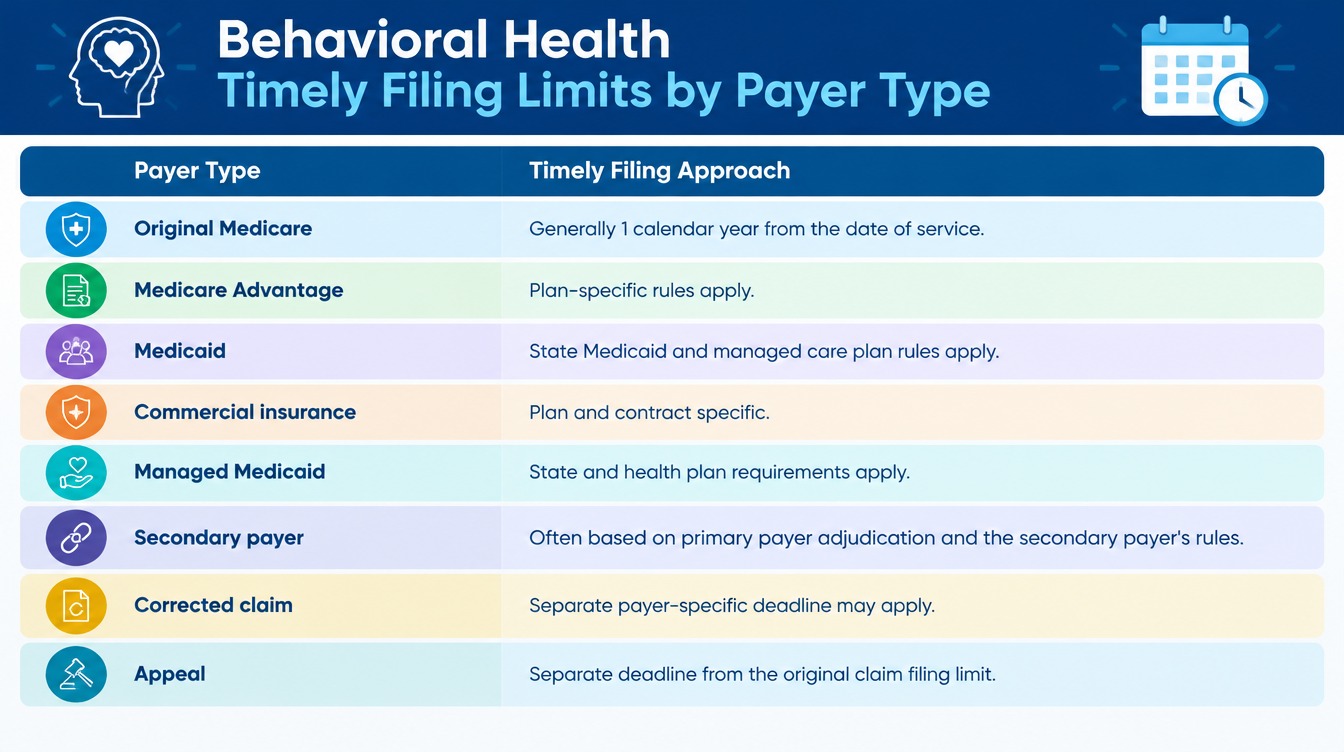
Medicare Fee-for-service provides one of the clearest federal standards. CMS requires Medicare claims to reach the appropriate Medicare Administrative Contractor no later than one calendar year after the date of service, subject to limited exceptions.
Commercial and Medicaid claims require more caution because deadlines can vary by plan and jurisdiction.
Medicare Timely Filing Limit for Behavioral Health Claims
For Original Medicare Fee-for-Service claims, the general timely filing limit is one calendar year from the date the service was furnished.
This rule applies to Medicare Part A and Part B claims, including applicable behavioral health services billed under Medicare.
For professional behavioral health services, the practice therefore should not treat Medicare’s filing period as an open-ended billing window.
The operational rule is simple:
Submit the Medicare claim as soon as the claim is clean and billable rather than waiting until the end of the one year.
CMS also specifies limited exceptions to the general one-year filing requirement.
These include certain situations involving:
- Administrative error by Medicare or its contractor
- Retroactive Medicare entitlement
- Certain retroactive Medicare entitlement situations involving Medicaid
- Retroactive disenrollment from a Medicare Advantage plan or PACE organization
The existence of an exception does not mean every late claim can be accepted. The provider must meet the applicable requirements and provide appropriate evidence.
Medicare Timely Filing Example
A behavioral health provider furnishes a covered psychotherapy service on October 15, 2026.
The practice should submit the Original Medicare claim no later than the applicable one-calendar-year deadline.
Waiting until October 2027 creates unnecessary risk because a rejected or incomplete submission can require additional processing time.
The safer revenue-cycle practice is to submit the claim shortly after the date of service once documentation and coding are complete.
Medicaid Timely Filing Limits for Behavioral Health Claims
Medicaid requires a different approach because Medicaid is administered through state programs and can also involve managed care organizations.
There is no single nationwide provider timely filing deadline that should be applied to every Medicaid behavioral health claim.
The applicable rule may come from:
- State Medicaid regulations
- State Medicaid provider manuals
- Medicaid managed care contracts
- Managed Medicaid health plan provider manuals
- Provider agreements
- State-specific billing guidance
This means a behavioral health practice operating in several states should maintain separate Medicaid filing rules rather than using one national deadline.
Federal Medicaid guidance also distinguishes state Medicaid claims involving third-party liability from ordinary provider billing situations. States must have laws requiring certain third-party insurers to honor claims submitted by Medicaid within three years from the date the service was furnished. That rule should not be interpreted as a universal three-year provider filing limit for all Medicaid claims.
Medicaid Example
A behavioral health clinic treats a Medicaid member for psychotherapy.
The clinic should first determine:
- Which Medicaid program covers the member.
- Whether the member is enrolled in fee-for-service Medicaid or managed Medicaid.
- Which entity should receive the claim.
- What the applicable provider filing deadline is.
- Whether the plan has special rules for corrected or secondary claims.
A practice should not assume that the federal third-party liability timeframe gives the provider three years to submit every Medicaid claim.
Commercial Insurance Timely Filing Limits
Commercial payer deadlines vary substantially.
A provider contract may establish the filing period, while the payer’s provider manual may explain operational requirements.
Common commercial filing periods include 90 days, 120 days, 180 days, and 365 days, but these are examples rather than universal rules.
For behavioral health practices, the contract should be treated as the primary reference when it contains a specific filing requirement.
For example, UnitedHealthcare’s published provider guidance establishes specific timely filing rules that vary by product and provider status. Its 2025 administrative guide states that commercial plans allow up to 180 days for nonparticipating providers, while other plan categories have different requirements. The guide also addresses claims involving another payer.
That illustrates an important billing principle:
Do not create one payer rule and apply it across every product offered by the same insurance company.
The health plan name alone may not tell you the correct filing limit.
Medicare Advantage Timely Filing
Medicare Advantage claims should not automatically be billed according to Original Medicare’s one-year rule.
Medicare Advantage claims generally go to the member’s Medicare Advantage organization, not directly to the Original Medicare claims contractor.
The plan’s provider agreement and administrative requirements determine the applicable claim submission rules.
A behavioral health practice should therefore identify:
- The member’s Medicare Advantage plan
- The claims payer
- Provider network status
- Timely filing limit
- Corrected claim deadline
- Appeal deadline
- Coordination of benefits requirements
A practice that submits a Medicare Advantage claim late cannot necessarily rely on Original Medicare’s general filing period as a defense.
What Starts the Timely Filing Clock?
The starting point depends on the payer’s rules.
For many claims, the clock begins with the date of service.
For other situations, the applicable date may be:
- Date of discharge
- Date of the primary payer’s explanation of benefits
- Date of denial
- Date of eligibility notification
- Date of retroactive enrollment
- Date the payer received a prior claim
This distinction becomes particularly important for secondary claims and corrected claims.
Date of Service
For an ordinary outpatient behavioral health claim, the date of service commonly serves as the starting point.
For example:
A patient receives psychotherapy on March 10.
If the payer allows 180 days for a new claim, the practice must submit the claim within the payer’s defined 180-day period.
Primary Payer Adjudication Date
A secondary claim may follow a different timeline.
If the behavioral health provider bills the primary insurer first, the secondary payer may establish a filing period based on the primary payer’s payment, denial, or explanation of benefits.
The exact rule depends on the secondary payer.
A payer may require the provider to submit the secondary claim within a certain number of days after the primary payer processes the claim.
Timely Filing for Corrected Behavioral Health Claims
A corrected claim is not necessarily governed by the same deadline as the original claim.
This is one of the most important distinctions for behavioral health billing teams.
A practice may submit an original claim on time but discover later that it contains:
- Incorrect modifier
- Wrong place of service
- Incorrect diagnosis
- Incorrect units
- Wrong provider information
- Missing authorization information
- Incorrect patient information
- Incorrect charge
- Coding error
The provider may need to submit a corrected claim using the payer’s required correction process.
Some payers give providers a separate period for corrected claims. Others require corrections within a specified number of days after the original claim adjudication.
Do not assume that a claim submitted after the original filing period is automatically timely simply because an original claim was filed.
The billing team should verify:
- Whether the original claim was accepted.
- Whether the payer assigned a claim number.
- Why the claim needs correction.
- Which frequency or resubmission indicator the payer requires.
- The payer’s corrected claim deadline.
- Whether the payer requires a replacement claim or adjustment.
- Whether supporting documentation is required.
Rejected Claim vs. Denied Claim
Behavioral health billing teams should distinguish a rejected claim from a denied claim.
A rejected claim may fail an initial submission or data validation process and may not enter the payer’s adjudication process as a complete claim.
A denied claim has generally been adjudicated and received a denial reason.
The distinction affects how the billing team handles timely filing.
For example, a clearinghouse rejection caused by a missing field may need immediate correction and resubmission.
A payer denial for timely filing requires a different analysis.
The practice should preserve electronic acknowledgments and payer responses so it can establish what happened to the original submission.
What Happens When a Behavioral Health Claim Misses the Filing Deadline?
A payer may deny the claim as untimely.
The denial can create several consequences:
- No payer reimbursement
- Increased accounts receivable
- Additional staff work
- Appeal workload
- Potential contractual write-off
- Delayed provider payment
- Revenue leakage
- Patient balance complications
The practice should not automatically bill the patient simply because the payer denied the claim for timely filing.
Patient billing depends on the payer contract, applicable law, member protections, and the circumstances of the denial.
For Original Medicare, CMS specifically states that when the provider is responsible for failing to file a timely claim, the provider generally cannot shift the missed Medicare payment to the beneficiary as a normal patient responsibility. Only amounts that would otherwise have been applicable, such as appropriate deductible or coinsurance, may be collectible under the applicable rules.
Can a Timely Filing Denial Be Appealed?
The answer depends on the payer and the reason for the late submission.
A behavioral health practice should first determine whether it actually missed the deadline.
Before writing off the account, review:
- Date of service
- Original claim submission date
- Clearinghouse acceptance
- Payer receipt information
- Rejection reports
- Payer claim history
- Corrected claim history
- Eligibility records
- Coordination of benefits information
- Payer correspondence
If the provider submitted the claim within the required period but the payer did not process it correctly, the practice may have grounds for reconsideration or appeal.
Documentation becomes critical.
Evidence That Can Support a Timely Filing Dispute
Maintain records such as:
- Clearinghouse acceptance report
- Payer acknowledgment
- Claim control number
- Electronic submission report
- Payer portal history
- EDI transaction records
- Original claim copy
- Rejection report
- Remittance advice
- Primary payer EOB
- Eligibility verification
- Correspondence with the payer
A statement such as “we submitted it on time” is weaker than a dated electronic acknowledgment showing that the payer or its designated claims processor received the claim within the required period.
Coordination of Benefits and Timely Filing
Coordination of benefits creates one of the most common exceptions to ordinary claim workflows.
A behavioral health patient may have:
- Employer-sponsored insurance
- Medicare
- Medicaid
- Medicare Advantage
- A spouse’s plan
- Secondary commercial coverage
The practice may not know which payer is primary at the time of service.
The provider may then submit to the wrong payer, wait for the claim to process, receive a denial, and finally discover the correct payer.
This can consume much of the available filing period.
Example
A behavioral health service occurs on January 10.
The practice initially believes Payer A is primary and submits the claim.
Payer A determines that Payer B is primary and denies the claim.
The practice now needs to submit the claim to Payer B.
The deadline for Payer B may be calculated from the date of service, the primary payer’s determination, or another date defined by the payer’s policy.
The practice should not assume that the secondary payer automatically grants a new full filing period.
Timely Filing and Retroactive Eligibility
Retroactive eligibility can create another difficult situation.
A patient may receive behavioral health services before the practice receives confirmation that the patient had coverage on the date of service.
Once eligibility becomes effective retroactively, the provider may need to submit claims for services that are already several weeks or months old.
Some Medicaid and managed care programs provide specific exceptions for retroactive eligibility.
For example, certain Medicaid plans establish special filing rules based on the date the provider receives notification of the member’s retroactive enrollment.
Because these policies differ, staff should document:
- Original eligibility status
- Date eligibility was discovered
- Effective date of coverage
- Date the payer notified the provider
- Date the claim was submitted
- Applicable exception
- Supporting documentation
Timely Filing for Behavioral Health Telehealth Claims
Telehealth does not automatically create a separate universal timely filing period.
The claim remains subject to the applicable payer’s filing rules.
However, telehealth claims can generate additional billing issues that indirectly increase timely filing risk.
Examples include:
- Incorrect place of service
- Incorrect telehealth modifier
- Audio-only versus audio-video reporting errors
- Provider enrollment issues
- Payer-specific telehealth policies
- Authorization problems
- Incorrect rendering provider information
If a claim repeatedly rejects because of telehealth coding or payer configuration problems, the filing deadline can approach while staff work through the issue.
The solution is not to wait for the claim to become perfect before monitoring the deadline.
Create an aging workflow that escalates unresolved claims before the filing limit expires.
Timely Filing and Behavioral Health CPT Codes
The filing limit generally applies to the claim rather than creating a separate deadline for each behavioral health CPT code.
Common behavioral health services may include psychotherapy, psychiatric diagnostic evaluation, medication management, and other behavioral health services.
Examples can include:
- 90791
- 90792
- 90832
- 90834
- 90837
- 90846
- 90847
- 99202 through 99215 when applicable
- Other behavioral health or evaluation and management services
The CPT code does not determine the payer’s timely filing period.
A claim containing 90834 does not automatically receive a different filing deadline from a claim containing 90837 simply because the procedure code differs.
The payer’s filing policy controls.
Timely Filing and Behavioral Health Claims With Multiple Visits
Behavioral health practices frequently submit claims for recurring services.
A patient may receive weekly psychotherapy for several months.
Each date of service generally represents its own billing event, even when the practice submits claims in batches.
Do not allow older claims to sit behind newer claims simply because the patient has ongoing treatment.
For example:
| Date of service | Claim status | Billing priority |
| January 5 | Not submitted | High |
| January 12 | Submitted | Monitor |
| January 19 | Submitted | Monitor |
| January 26 | Documentation pending | High |
| February 2 | Ready to bill | Normal |
The January 5 claim should not wait for the February 2 claim.
A practice should prioritize the oldest unbilled service within the payer’s filing window.
Behavioral Health Timely Filing Denial Workflow
When a timely filing denial appears, use a structured review instead of immediately adjusting the balance.
Step 1: Identify the Payer
Confirm the exact payer and product.
Do not rely solely on the insurance company’s corporate name.
Step 2: Identify the Claim Type
Determine whether the claim is:
- Original
- Corrected
- Secondary
- Crossover
- Resubmitted
- Appeal
Step 3: Determine the Applicable Deadline
Check the current payer manual, provider agreement, or plan-specific policy.
Step 4: Establish the Submission Date
Find the earliest valid evidence of submission and receipt.
Step 5: Review the Claim History
Look for:
- Rejection
- Acceptance
- Payer control number
- Denial
- Request for information
- Corrected claim
- Other payer activity
Step 6: Determine Why the Claim Was Late
Possible causes include:
- Internal billing delay
- Clearinghouse rejection
- Payer system issue
- Eligibility uncertainty
- Retroactive coverage
- Coordination of benefits
- Incorrect payer identification
- Enrollment problem
- Provider error
Step 7: Determine Whether an Exception Applies
Review the payer’s rules for applicable exceptions.
Step 8: Appeal or Correct the Claim
If the practice has evidence supporting an exception or timely submission, submit the appropriate reconsideration or appeal with documentation.
Step 9: Document the Final Resolution
Record:
- Denial reason
- Deadline
- Submission date
- Exception
- Appeal date
- Payer response
- Final disposition
- Adjustment reason, if applicable
This creates an audit trail and helps identify recurring billing problems.
How Behavioral Health Practices Can Prevent Timely Filing Denials
The strongest strategy is prevention.
Set an Internal Billing Deadline
Do not use the payer’s maximum filing limit as the practice’s internal target.
If a payer allows 180 days, the practice should not create a workflow that gives billers 170 days to submit claims.
Set a much shorter internal target.
For example:
Date of service → documentation completion → claim submission → clearinghouse acceptance → payer adjudication
The exact internal targets should reflect staffing, volume, payer mix, and practice operations.
Track Unbilled Services Daily
An unbilled behavioral health encounter should enter a work queue quickly.
The billing team should be able to see:
- Date of service
- Patient
- Payer
- Provider
- Claim status
- Days since service
- Authorization status
- Documentation status
- Filing deadline
- Next action
Monitor Rejections Separately
A rejected claim should not disappear into an ordinary accounts receivable queue.
Rejected claims require rapid correction because the practice still needs to establish a valid submission.
Create Payer-Specific Filing Rules
Build a payer matrix containing:
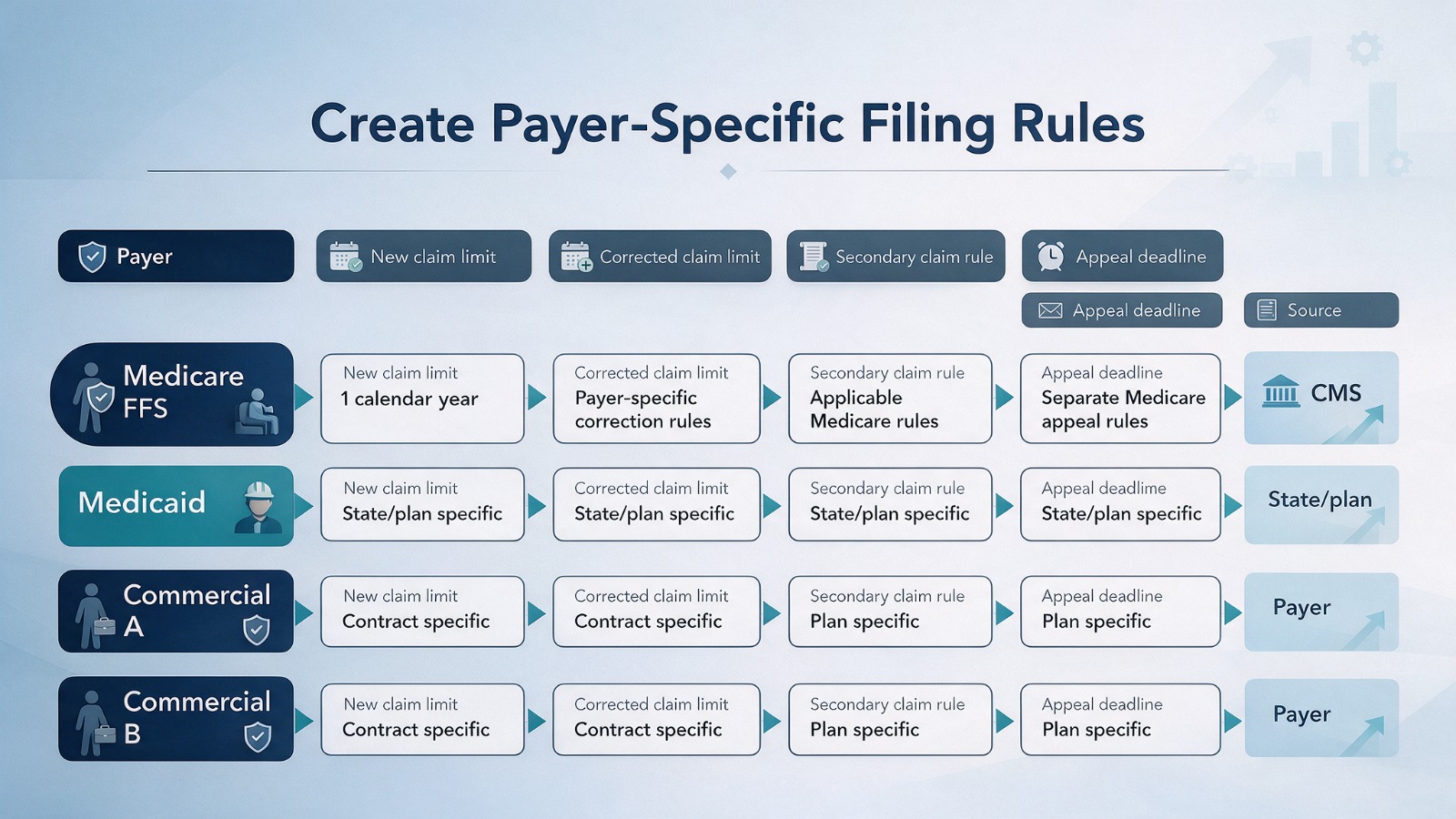
Update the matrix when payer manuals or contracts change.
Escalate Aging Claims
Set internal escalation points before the actual deadline.
For example:
- Early warning
- Billing supervisor review
- Payer research
- Exception review
- Management escalation
The practice should know about a potentially late claim before the deadline passes.
Behavioral Health Timely Filing Audit Checklist
A behavioral health practice can use the following checklist during a billing audit:
- Payer identified correctly
- Member eligibility verified
- Date of service confirmed
- Correct provider identified
- Correct billing entity identified
- Authorization reviewed when applicable
- Claim submitted within payer deadline
- Clearinghouse acceptance documented
- Payer receipt documented when available
- Rejections monitored
- Denials worked promptly
- Corrected claim rules reviewed
- Secondary claim rules reviewed
- Primary EOB retained when applicable
- Timely filing exceptions documented
- Appeals submitted within the applicable deadline
- Final disposition recorded
Frequently Asked Questions
What is the timely filing limit for behavioral health claims?
There is no single nationwide limit. The deadline depends on the payer, plan, provider contract, state requirements, and claim type. Common payer limits can range from several months to one year or longer, but the applicable payer policy should always control.
What is Medicare’s timely filing limit for behavioral health claims?
Original Medicare generally requires claims to reach the appropriate Medicare contractor within one calendar year from the date of service, subject to limited exceptions.
Does Medicaid have a 365-day timely filing limit?
Not universally. Medicaid filing requirements vary by state and by managed care arrangement. Some Medicaid programs use a one-year deadline, while specific managed Medicaid plans can establish different requirements under applicable contracts and state rules.
Is the timely filing limit based on the date of service?
Often, but not always. Original claims commonly use the date of service. Secondary claims, corrected claims, retroactive eligibility claims, and other special circumstances can use different dates under the applicable payer policy.
Do telehealth behavioral health claims have a different timely filing deadline?
Not automatically. Telehealth claims generally follow the applicable payer’s timely filing rules. However, telehealth-specific coding
and provider enrollment issues can create additional delays.
Can a behavioral health provider appeal a timely filing denial?
It depends on the payer and the circumstances. The provider should first determine whether the claim was actually late, whether the payer received it within the deadline, and whether an exception applies.
What should I do if the clearinghouse rejected my claim?
Correct the rejection promptly and resubmit the claim. Keep the clearinghouse rejection and resubmission records. Do not assume that an attempted submission automatically protects the claim from timely filing requirements.