

Vision insurance can look straightforward on a patient’s benefit summary. In practice, providers often face a different picture. A patient may have medical insurance for an eye condition and separate vision insurance for routine eye care, while the same encounter can contain services that belong under different benefit structures.
That distinction affects eligibility, coding, claim submission, patient responsibility, and reimbursement.
For optometrists, ophthalmologists, optical practices, ambulatory surgery centers, and other providers involved in eye care, understanding how vision insurance works can prevent avoidable claim problems. The key is to determine what the patient received, why they received it, and which payer should process each service before the claim goes out.
What Is Vision Insurance?
Vision insurance provides benefits for eligible eye care services and products. Depending on the plan, coverage may include routine eye examinations, refraction, eyeglasses, contact lenses, or allowances toward frames and lenses.
Vision insurance differs from traditional medical insurance because it generally focuses on routine vision care and corrective eyewear, while medical insurance typically covers the diagnosis and treatment of eye disease or injury when the service meets the plan’s medical coverage requirements.
For providers, that distinction matters because the patient’s vision plan may not be the correct payer for every eye care service.
A patient could have:
- Medical insurance: Covers treatment for glaucoma, cataracts, diabetic eye disease, eye infections, or injuries when covered.
- Vision insurance: Covers eligible routine eye exams, refraction, frames, lenses, or contacts according to the plan.
The same patient may carry both.
Vision Insurance vs Medical Insurance
One of the most important concepts for eye care billing is knowing which benefit applies to the service.
| Service or situation | May involve vision insurance | May involve medical insurance |
| Routine eye examination | Yes | Sometimes, depending on circumstances |
| Refraction | Often | Coverage varies |
| Eyeglasses | Often | Usually limited to specific medical situations |
| Contact lenses | Often | Sometimes for specific medical indications |
| Cataract evaluation | Usually not as routine vision care | Yes |
| Glaucoma management | No, generally medical | Yes |
| Diabetic eye disease evaluation | No, generally medical | Yes |
| Eye injury | No, generally medical | Yes |
| Conjunctivitis treatment | Usually medical | Yes |
| Retinal disease | No, generally medical | Yes |
| Routine vision screening | Often | Depends on plan |
These categories don’t represent a universal rule for every payer.
The patient’s benefit plan, clinical circumstances, provider participation, and payer policies determine coverage.
Why Vision Insurance Billing Creates Problems for Providers
The biggest billing issue often appears before coding.
It starts with payer identification.
A patient may hand the front desk a medical insurance card and a separate vision plan card. If staff don’t identify both correctly, the practice may submit the claim to the wrong payer.
For example:
A patient schedules an annual eye exam and reports that they have both medical insurance and a vision plan.
The provider performs a routine eye examination and refraction.
The billing team sends the entire claim to the medical payer.
The payer denies the routine vision portion.
The service itself wasn’t necessarily wrong. The claim simply went through the wrong benefit channel.
Who Needs to Understand Vision Insurance?
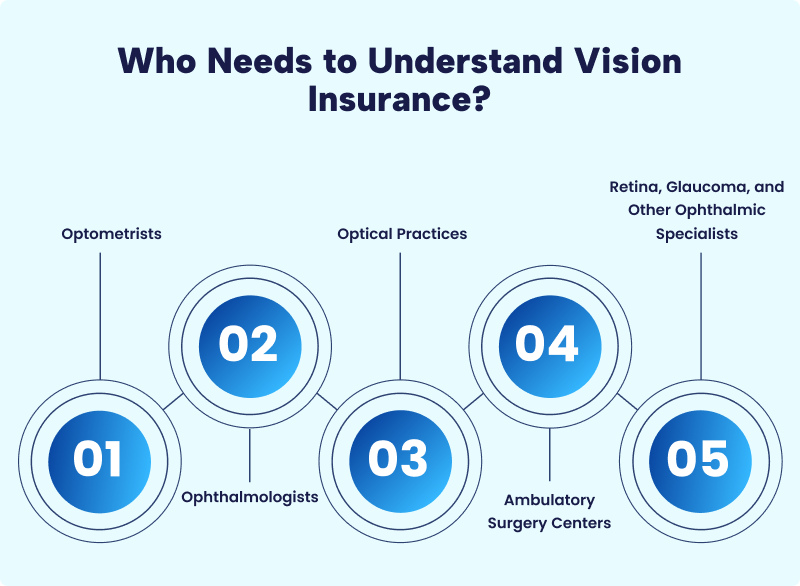
Vision insurance billing matters to several types of providers.
Optometrists
Optometrists often provide routine examinations, refractions, contact lens services, eyewear-related services, and medical eye care.
Their billing process may involve both vision and medical plans.
Ophthalmologists
Ophthalmologists provide medical and surgical eye care, so their practices often work heavily with medical insurance. However, certain routine services may involve a patient’s vision benefits depending on the service and plan.
Optical Practices
Optical businesses frequently work with vision plans for frames, lenses, contacts, and other covered materials.
The financial workflow can differ from professional medical claims.
Ambulatory Surgery Centers
ASCs may bill medical insurance for covered ophthalmic procedures such as cataract surgery.
Vision insurance generally doesn’t replace medical coverage for surgical treatment of eye disease.
Retina, Glaucoma, and Other Ophthalmic Specialists
Specialists usually deal with medical insurance because their services involve diagnosed or suspected eye disease.
How Vision Insurance Works for Providers
A typical vision insurance billing workflow looks like this:
- Patient schedules appointment
- Verify vision and medical benefits
- Determine reason for visit
- Confirm provider network status
- Perform documented service
- Select appropriate codes
- Determine payer
- Submit claim
- Post payment
- Bill patient responsibility
- Work denials or underpayments
The critical decision happens before claim submission:
Which benefit should pay for this service?
Vision Insurance Eligibility Verification
Eligibility verification should go beyond asking whether the patient has active insurance.
The billing team should confirm the patient’s actual vision benefits.
Review:
- Member ID
- Subscriber information
- Coverage status
- Effective date
- Plan type
- Network status
- Routine eye examination benefit
- Refraction benefit
- Frame allowance
- Lens benefit
- Contact lens allowance
- Frequency limitations
- Copayment
- Deductible
- Coinsurance
- Out of pocket requirements
- Prior authorization requirements
- Benefit expiration or renewal date
Frequency limitations deserve special attention.
A vision plan may allow a routine examination at a specific interval, such as once every 12 months or 24 months. The exact frequency varies by plan.
Don’t assume that every patient becomes eligible for another exam on January 1.
Why Benefit Frequency Matters
Consider a patient who had a covered routine examination in March.
The patient returns in December and expects another covered exam.
The plan may still consider the patient inside the frequency limitation.
If the practice doesn’t verify the benefit, the patient may receive an unexpected bill.
Vision Insurance and Refraction
Refraction creates frequent billing questions.
A refraction determines the patient’s refractive error and helps establish the prescription for corrective lenses.
Whether vision insurance covers the service depends on the patient’s plan.
Medical plans may have different rules regarding refraction, especially when the provider performs a medically necessary eye examination for a diagnosed condition.
Providers should avoid assuming that the examination and refraction always follow the same coverage rules.
Routine Eye Exam vs Medical Eye Exam
This distinction can determine which payer processes the claim.
Routine vision examination
The patient comes in primarily to check vision and obtain or update a prescription.
The service may fall under the patient’s vision plan.
Medical eye examination
The patient presents with a complaint or diagnosed condition requiring medical evaluation.
Examples include:
- Eye pain
- Redness
- Sudden vision changes
- Glaucoma
- Cataracts
- Retinal disease
- Diabetic eye disease
- Ocular inflammation
- Eye injury
The service may fall under medical insurance, subject to the plan’s coverage requirements.
The provider’s documentation should explain the clinical reason for the encounter.
Documentation Requirements for Vision Insurance Billing
Good documentation helps the billing team connect the service to the patient’s benefit and the reported codes.
For an eye examination, documentation may include:
- Chief complaint
- History
- Relevant medical history
- Ocular history
- Examination findings
- Assessment
- Diagnosis
- Treatment plan
- Medical decision making when applicable
- Refraction findings when performed
- Prescription information
- Follow up instructions
The exact documentation depends on the service and coding requirements.
The important point is that the record should describe what the provider actually evaluated and why.
Coding Vision Services Correctly
Vision insurance claims can involve several categories of codes.
Depending on the service, the claim may include:
- CPT codes
- HCPCS codes
- ICD 10 CM diagnosis codes
- Modifiers
- Vision plan specific codes
- Product or material information
Don’t select a diagnosis simply because it makes a claim more likely to pay.
The diagnosis should accurately describe the patient’s condition or the reason for the encounter.
Likewise, don’t select a procedure code based only on the patient’s benefit.
The code should represent the service the provider actually performed.
Vision Insurance and ICD 10 Coding
ICD 10 CM codes help describe the patient’s condition or reason for care.
Examples of ophthalmic diagnoses include conditions involving:
- Refractive errors
- Cataracts
- Glaucoma
- Retinal disorders
- Conjunctival disorders
- Corneal conditions
- Eye infections
- Ocular injuries
The appropriate diagnosis depends on the provider’s assessment.
For routine vision services, the coding requirements can differ from those for medical eye care.
Vision Insurance Claims: What Providers Should Check
Before submitting a claim, verify:
Patient information
Is the name, date of birth, member ID, and subscriber information, correct?
Payer
Is the claim going to the patient’s vision plan or medical insurer?
Provider
Is the provider enrolled and participating under the applicable network?
Service
Does the CPT or HCPCS code describe the service performed?
Diagnosis
Does the diagnosis support the encounter?
Modifiers
Are modifiers required and supported?
Frequency
Has the patient already used the benefit during the applicable period?
Patient responsibility
Does the claim reflect the plan’s copay, deductible, coinsurance, or allowance rules?
Common Vision Insurance Billing Mistakes
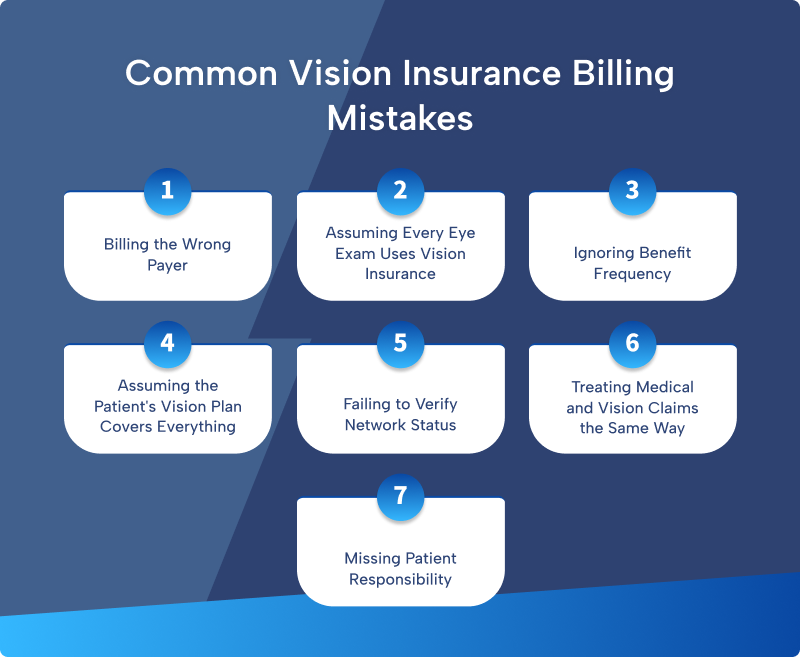
Billing the Wrong Payer
This is one of the simplest errors to prevent.
A patient has medical and vision coverage, but the practice sends routine vision services to the medical payer.
Solution: Verify both plans and identify the appropriate payer for each service.
Assuming Every Eye Exam Uses Vision Insurance
Not every eye examination represents routine vision care.
A patient may present because of a medical complaint or diagnosed eye condition.
Solution: Review the reason for the encounter and the provider’s documentation.
Ignoring Benefit Frequency
A patient may have active vision insurance but no remaining benefit for a particular service.
Solution: Check the patient’s benefit history and frequency limitations before providing non-emergency routine services.
Assuming the Patient’s Vision Plan Covers Everything
Vision plans often have defined benefits rather than unlimited coverage.
A plan may cover an exam but provide a limited allowance for frames or lenses.
Solution: Verify the specific benefit categories.
Failing to Verify Network Status
A patient may have vision insurance but still face higher out of pocket costs if the provider doesn’t participate in the applicable network.
Solution: Confirm provider participation under the patient’s specific plan.
Treating Medical and Vision Claims the Same Way
Medical insurance and vision insurance don’t always use the same billing workflow.
Solution: Build separate payer rules and claim workflows where necessary.
Missing Patient Responsibility
The patient’s benefit may include a copay or allowance structure.
Solution: Verify benefits before the appointment and explain expected charges clearly.
Vision Insurance and Coordination of Benefits
Some patients carry multiple forms of coverage.
For example:
- Primary medical plan: Employer sponsored health insurance
- Vision plan: Separate employer vision benefit
A provider should determine which payer applies to the service before submitting the claim.
If a service involves medical insurance and the patient also has vision coverage, don’t automatically bill both.
The order and coordination depend on the service and applicable plan rules.
Vision Insurance for Medicare Patients
Medicare deserves special attention.
Original Medicare generally doesn’t provide routine coverage for eyeglasses and routine eye examinations in the same way a standalone vision plan does. However, Medicare can cover certain medically necessary eye services and specific circumstances involving corrective lenses after covered procedures.
Medicare Advantage plans can offer additional vision benefits, depending on the plan.
Therefore, providers should verify the patient’s exact Medicare coverage rather than assuming that all Medicare beneficiaries have identical vision benefits.
Vision Insurance for Pediatric Patients
Children’s vision benefits can follow different rules from adult coverage.
Under the Affordable Care Act, pediatric vision care forms part of the essential health benefit structure for applicable plans and marketplaces, although the exact coverage and administration can vary.
Providers should verify the child’s specific plan.
Don’t assume that an adult vision benefit schedule applies to a pediatric patient.
Vision Insurance and Contact Lens Coverage
Contact lens benefits vary considerably among plans.
A plan may:
- Cover contact lenses instead of eyeglasses
- Provide an allowance
- Cover medically necessary contacts under separate rules
- Limit replacement frequency
- Require the patient to use a participating optical provider
The provider or optical practice should verify the benefit before ordering materials.
Vision Insurance and Eyeglasses
Eyeglass coverage can involve several separate components:
Frame allowance
The plan may provide a specific dollar allowance toward frames.
Lens coverage
Basic lenses may receive coverage while premium options require additional patient payment.
Lens enhancements
Items such as coatings or specialty features may have separate charges.
Replacement frequency
The plan may limit how often the patient receives a new pair.
The practice should explain these distinctions before completing the order.
Vision Insurance and Medical Necessity
Medical necessity can change the billing pathway.
For example, a patient may require specialty contact lenses because of a corneal condition.
That service may not follow the same benefit rules as routine contact lenses.
The provider needs documentation that explains the medical reason for the service.
This is another reason billing teams shouldn’t treat all contact lens claims as routine vision benefits.
Vision Insurance Denials
Common denial reasons include:
- Inactive coverage
- Incorrect member information
- Benefit frequency exceeded
- Provider out of network
- Incorrect payer
- Noncovered service
- Missing authorization
- Incorrect procedure code
- Diagnosis issue
- Duplicate claim
- Missing documentation
- Incorrect coordination of benefits
The denial reason should determine the next action.
A coding denial requires a different response from an eligibility denial.
How to Handle a Vision Insurance Denial
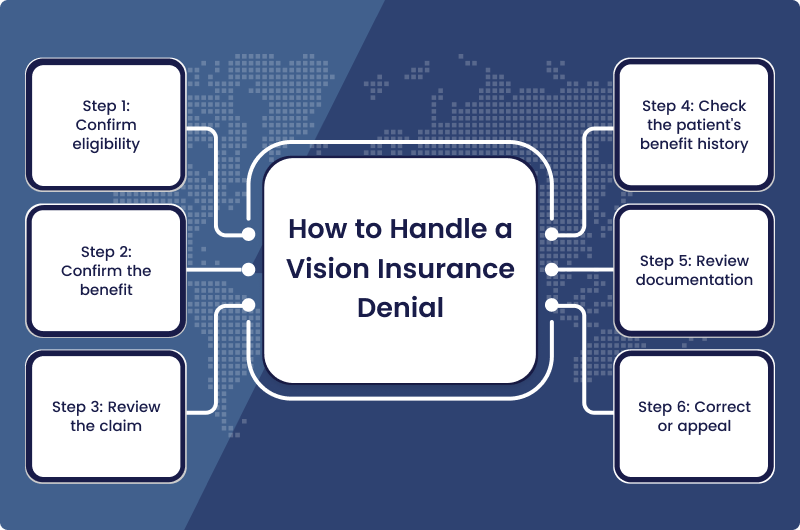
Start by reviewing the claim.
Step 1: Confirm eligibility
Was the patient covered on the date of service?
Step 2: Confirm the benefit
Did the patient have coverage for the reported service?
Step 3: Review the claim
Check member information, provider details, codes, units, and modifiers.
Step 4: Check the patient’s benefit history
Determine whether the patient already used the benefit.
Step 5: Review documentation
Make sure the record supports the service.
Step 6: Correct or appeal
If the claim contains an error, submit the appropriate correction.
If the payer incorrectly denied a supported service, follow the plan’s appeal or reconsideration process.
Vision Insurance and Prior Authorization
Routine vision benefits usually don’t require the same type of prior authorization process used for complex medical services.
However, certain medically necessary services, specialty products, procedures, or treatments may require authorization.
Never assume that authorization rules are identical across plans.
Verify the requirement before providing a service that carries a significant financial risk.
How to Improve Vision Insurance Reimbursement
Verify Benefits Before the Appointment
This is one of the easiest ways to prevent avoidable patient billing problems.
Separate Routine and Medical Workflows
Create clear rules for determining whether the service belongs under the patient’s vision benefit or medical coverage.
Keep Payer Rules Updated
Vision plans change benefit structures, networks, claims processes, and reimbursement policies.
Review Denial Trends
Don’t just work individual denials.
Look for patterns.
If one payer repeatedly denies refractions, investigate why.
If another payer frequently rejects claims because of member IDs, fix the registration process.
Track Unpaid Claims
A claim that hasn’t paid isn’t necessarily a lost claim.
Set follow up dates and work accounts before they become difficult to recover.
Vision Insurance Billing KPIs
Providers can monitor several metrics to understand their billing performance.
| KPI | What it tells you |
| Clean claim rate | How many claims pass initial submission |
| Denial rate | Frequency of payer payment problems |
| Days in A/R | How long outstanding balances remain unpaid |
| Net collection rate | How much collectible revenue the practice actually receives |
| First pass payment rate | How often claims pay without additional work |
| Eligibility denial rate | Frequency of coverage related errors |
| Timely filing denials | Whether claims reach payers on time |
| Underpayment rate | How often payers reimburse below expected amounts |
| Patient collection rate | How effectively the practice collects assigned responsibility |
A practice should use these numbers to find specific process problems, not simply to produce monthly reports.
Should Providers Outsource Vision Insurance Billing?
Outsourcing can make sense for practices that struggle with:
- High claim volume
- Multiple vision plans
- Medical and vision payer coordination
- Eligibility verification
- Denial management
- Aging A/R
- Coding review
- Underpayment identification
- Patient responsibility
- Staff turnover
A good billing partner should understand both the clinical side of eye care and the financial rules that govern different payer types.
Ask potential billing companies how they handle:
- Vision plan eligibility
- Medical vs vision payer selection
- Claim submission
- Denials
- Corrected claims
- A/R follow up
- Underpayments
- Reporting
- Payer specific requirements
Conclusion
Vision insurance billing becomes much easier once providers stop treating every eye care encounter as a routine vision claim.
A patient may carry two insurance plans, receive both routine and medical eye care, or have benefits that cover an examination but place limits on eyewear or contact lenses. The billing team needs to understand those differences before submitting the claim.
That approach gives optometrists, ophthalmologists, optical practices, and other relevant providers a clearer path from the patient’s appointment to final reimbursement.
Stop Losing Revenue to Vision Insurance Billing Errors
Medical and vision benefits can follow different rules, and a payer mismatch, eligibility error, coding issue, or unpaid claim can delay reimbursement.
RCM Xperts helps eye care practices manage eligibility, claims, denials, payment posting, and A/R follow up with a billing process built around their payer mix.
Get a Free Vision Billing Audit from RCM Xperts
FAQs
What does vision insurance cover?
Vision insurance commonly covers eligible routine eye examinations and may provide benefits or allowances for eyeglasses, frames, lenses, and contact lenses. Exact benefits depend on the patient’s plan.
Is vision insurance the same as medical insurance?
No. Vision insurance generally focuses on routine vision care and corrective eyewear, while medical insurance generally covers medically necessary diagnosis and treatment of eye conditions and injuries, subject to the plan.
Can a patient use medical and vision insurance for the same visit?
Sometimes different services from the same encounter may involve different benefits, but providers should follow the applicable payer and plan rules. Don’t automatically submit the same service to both payers.
Does vision insurance cover glaucoma?
Routine vision plans generally don’t replace medical insurance for glaucoma diagnosis and management. Glaucoma care usually falls under medical coverage when the plan covers the service.
Does vision insurance cover cataract surgery?
Routine vision insurance generally doesn’t function as the primary coverage for cataract surgery. Cataract surgery typically falls under medical insurance when medically necessary and covered by the patient’s plan.
Does vision insurance cover contact lenses?
Many vision plans provide some level of contact lens coverage or an allowance, but frequency, dollar limits, and eligibility requirements vary.
Why was my vision insurance claim denied?
Possible reasons include inactive coverage, exhausted benefits, incorrect member information, provider network status, noncovered services, incorrect coding, or submitting the claim to the wrong payer.
How often does vision insurance cover an eye exam?
The frequency varies by plan. Some plans provide benefits annually, while others use different intervals. Verify the patient’s specific benefit rather than assuming a standard schedule.