
A superbill gives patients and healthcare providers a detailed record of services, diagnoses, charges, and provider information that can support an insurance reimbursement claim.
It becomes especially useful when a provider does not submit claims directly to the patient’s health plan, such as with many out-of-network practices.
However, a superbill is not the same as a CMS 1500 claim form or a patient statement.
Understanding what information belongs on a superbill, how to create it accurately, and how to submit it according to the insurer’s requirements can prevent missing information, processing delays, and avoidable reimbursement problems.
This guide explains the complete superbill process, from preparing the document to submitting it and following up on the claim.
What Is a Superbill?
A superbill is an itemized statement that records the healthcare services provided during a patient encounter.
It generally contains:
- Patient information
- Provider information
- Date of service
- Place of service
- Procedure codes
- Diagnosis codes
- Provider charges
- Provider identifiers
- Payment information when applicable
- Other information required by the payer or practice
Unlike a simple receipt, a superbill gives the payer more detail about the services provided.
For example, a receipt might simply state:
Psychotherapy visit: $150
A superbill may identify:
Date of service: September 4, 2026
CPT code: 90834
Diagnosis: F33.1
Charge: $150
Provider NPI: Provider’s NPI
That additional information helps the insurer determine what service the patient received and whether the plan provides benefits for it.
What Is the Purpose of a Superbill?
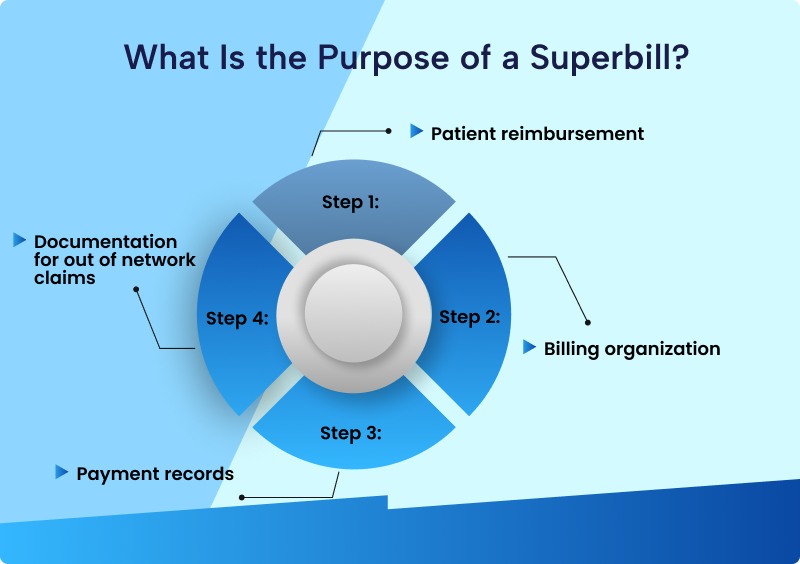
A superbill primarily helps document a healthcare service for billing or reimbursement purposes.
It can serve several purposes.
Patient reimbursement
An out-of-network provider may give the patient a superbill instead of submitting the claim directly.
The patient submits the required information to the insurance company.
If the plan provides out-of-network benefits, the insurer may reimburse the patient according to the policy.
Billing organization
A practice can use a superbill to collect information required for claim creation.
The billing team can use the documented CPT and ICD 10 CM codes, provider information, charges, and encounter details when preparing the claim.
Payment records
A superbill can help connect a specific service with the amount charged and the amount paid.
Documentation for out of network claims
Some patients use superbills when their provider does not participate with their insurance plan.
The patient should check the insurer’s submission requirements before sending the document.
Is a Superbill the Same as a Medical Bill?
A medical bill tells the patient what the practice charges or what the patient owes.
A superbill provides detailed coding and encounter information.
A superbill may include the amount charged, but its main purpose is to document the healthcare service and support claim processing.
A standard patient statement may contain:
- Patient balance
- Previous balance payments
- Insurance payments
- Current charges
- A superbill may contain:
- CPT codes
- ICD 10 CM codes
- Provider NPI
- Tax identification information
- Place of service
- Date of service
- Charges
The two documents serve different purposes.
Is a Superbill the Same as a CMS 1500 Claim Form?
No.
This is one of the most important distinctions in medical billing.
The CMS 1500 is a standardized paper claim form used to submit professional healthcare claims.
A superbill is an internal or patient-facing billing document that summarizes services and coding information.
A practice may use information from a superbill to prepare a CMS 1500 claim.
However, a superbill does not automatically qualify as a CMS 1500 claim.
The same distinction applies to electronic claims.
An electronic professional claim normally uses the 837P transaction format.
The superbill provides information that may feed into the claim creation process.
Who Uses a Superbill?
Several parties may use or interact with a superbill.
Healthcare providers
Providers can use superbills to record services and coding information.
Medical billing teams
Billing staff can use the information to prepare claims and verify that the encounter contains the necessary billing details.
Patients
Patients commonly receive superbills when they need to submit an out-of-network claim themselves.
Insurance companies
An insurer may receive a superbill from a patient as part of an out-of-network reimbursement request.
The insurer may request additional documentation.
When Does a Patient Need a Superbill?
A patient may need a superbill when a provider does not submit the claim directly to the patient’s insurance company.
This commonly occurs with:
- Out of network providers
- Some behavioral health providers
- Private practice therapists
- Psychologists
- Psychiatrists
- Nutrition professionals
- Some physical therapists
- Certain specialty practices
However, the need depends on the provider’s billing arrangement and the patient’s insurance plan.
A patient should never assume that submitting a superbill guarantees reimbursement.
The insurance policy determines whether the service qualifies for payment.
What Information Should a Superbill Include?
A well designed superbill should contain enough information to identify the patient, provider, service, diagnosis, and financial amount.
Here is a practical structure.
Patient information
Include:
- Patient full name
- Date of birth
- Address when needed
- Member identification number when appropriate
- Insurance information when applicable
Provider information
Include:
- Provider name
- Practice name
- Practice address
- Telephone number
- NPI
- Tax identification information when applicable
- Provider credentials
- Specialty when relevant
Encounter information
Include:
- Date of service
- Place of service
- Type of encounter
- Rendering provider
Procedure information
Include the appropriate CPT or HCPCS code.
Examples may include:
- 90834: Psychotherapy
- 99213: Established patient office visit
- 97110: Therapeutic exercises
The actual code must match the service documented and the coding rules that apply.
Diagnosis information
Include the applicable ICD-10-CM diagnosis code.
For example:
F33.1: Major depressive disorder, recurrent, moderate
The diagnosis should come from the provider’s documentation.
Do not add a diagnosis simply to make a claim appear more likely to receive reimbursement.
Financial information
Include:
- Charge
- Amount paid
- Patient balance when applicable
- Payment date when relevant
Superbill Template
A simple superbill can follow this structure.
| Field | Example |
| Patient name | Jane Smith |
| Date of birth | Patient date of birth |
| Date of service | September 4, 2026 |
| Provider | Jane Doe, LPC |
| NPI | Provider NPI |
| Practice | Example Behavioral Health |
| Place of service | Office |
| CPT | 90834 |
| ICD 10 CM | F33.1 |
| Charge | $150 |
| Amount paid | $150 |
| Patient balance | $0 |
This example demonstrates the structure only.
The actual codes and amounts should reflect the service and documentation.
How to Create a Superbill?
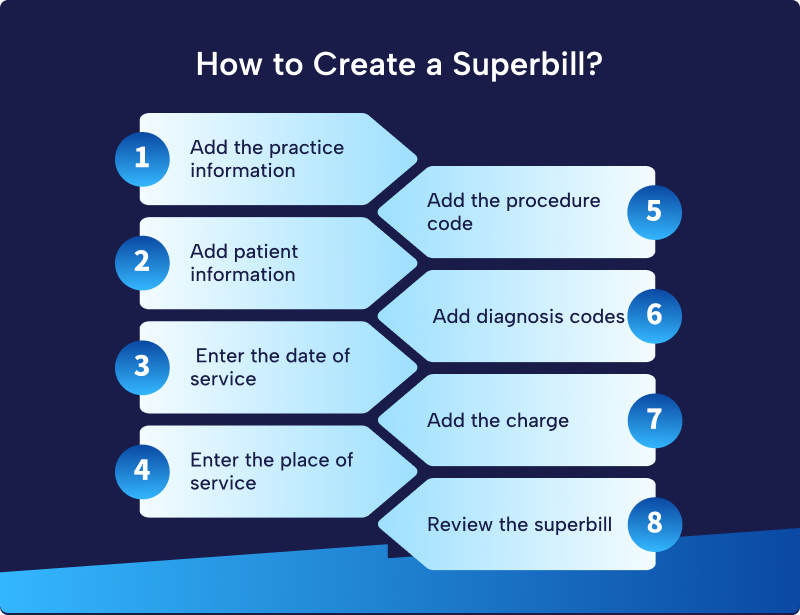
Creating a superbill does not require complicated software.
A practice can create one using its practice management system, electronic health record, billing software, or a carefully designed template.
Step 1: Add the practice information
Start with the provider and practice details.
Include:
- Practice name
- Address
- Phone
- Provider name
- Credentials
- NPI
- Tax identification information when required
Make sure the information matches the provider’s current enrollment and billing records.
Step 2: Add patient information.
Enter the patient’s identifying information.
At minimum, include the information necessary to distinguish the patient and support claim processing.
Verify spelling.
A simple name error can create unnecessary claim work.
Step 3: Enter the date of service
Record the actual date of the encounter.
Do not confuse the billing date with the date of service.
Step 4: Enter the place of service
The place of service should accurately describe where the service occurred.
Examples include:
- Office
- Home
- Hospital
- Other outpatient setting
- Telehealth when applicable
The correct POS code depends on the circumstances and payer rules.
Step 5: Add the procedure code
Enter the CPT or HCPCS code that represents the service.
The code should match the provider’s documentation.
Do not select a code simply because it produces a higher charge.
Step 6: Add diagnosis codes
Enter the applicable ICD 10 CM codes.
The diagnosis should support the service provided.
Step 7: Add the charge
Enter the provider’s charge for the service.
If the patient already paid, record the payment according to the practice’s accounting process.
Step 8: Review the superbill
Before giving it to the patient, check:
- Patient name
- Date of birth
- Date of service
- Provider information
- NPI
- CPT or HCPCS code
- ICD 10 CM code
- Charge
- Payment
- Place of service
- Insurance information
A short review can prevent a long reimbursement delay.
How to Submit a Superbill to Insurance
The submission process depends on the insurance company.
A typical patient workflow looks like this.
Check the insurance benefits
Before submitting anything, determine whether the patient’s plan covers out of network services.
The patient should check:
- Out of network benefits
- Deductible
- Coinsurance
- Reimbursement methodology
- Claim submission deadline
- Required claim form
- Required documentation
- Mailing address or electronic submission method
Obtain the superbill
The patient receives the completed superbill from the provider.
The patient should check the document before submission.
Complete the insurer’s claim form if required
Some insurers require a member claim form in addition to the superbill.
The superbill may support the claim but may not replace the insurer’s required form.
Attach the superbill
Submit the superbill according to the payer’s instructions.
The insurer may accept:
- Online submission
- Member portal upload
- Mobile application
- Other approved submission methods
The exact process varies by payer.
Keep a copy
The patient should retain:
- Superbills
- Claim forms
- Submission confirmations
- Receipts
- Correspondence
- Explanation of benefits
These records become useful if the insurer denies or delays the claim.
How Long Does Insurance Take to Process a Superbill?
There is no universal processing period.
Each insurance company establishes its own claim processing procedures.
The timeline can depend on:
- Whether the claim is complete
- Whether the provider is in network
- Whether the plan offers out of network benefits
- Whether the insurer requests records
- Whether the claim requires manual review
- Whether the claim contains coding problems
Patients should contact the insurer if the claim exceeds the plan’s normal processing period.
What Happens After the Patient Submits a Superbill?
The insurer reviews the claim.
The payer may:
- Process the claim
- Request additional information
- Apply the claim to the deductible
- Pay a portion of the eligible amount
- Deny the claim
- Determine that the service does not qualify for reimbursement
The final payment depends on the patient’s policy and the payer’s claim determination.
How Does Insurance Calculate Reimbursement?
Patients sometimes assume the insurer will reimburse a percentage of whatever the provider charges.
That may not happen.
An insurance plan may calculate reimbursement using an allowed amount, a contracted methodology, a plan specific fee schedule, or another benefit calculation.
For example:
- Provider charge: $200
- Plan eligible amount: $120
- Out of network benefit: 60 percent
The reimbursement may relate to the eligible amount rather than the provider’s full $200 charge.
The patient’s deductible may further reduce the amount paid.
The actual calculation depends on the insurance plan.
How Practices Can Improve Their Superbill Workflow
A superbill works best when the practice treats it as part of a controlled billing process.
Use a standardized template
Keep the layout consistent.
Pull information from the EHR
Automated population reduces manual entry.
Validate codes
Review CPT and ICD 10 CM codes against current coding resources.
Verify provider information
Keep NPI and other provider information current.
Review the date of service
The date should match the encounter.
Protect patient information
A superbill contains protected health information.
Use appropriate safeguards when transmitting it.
Keep an audit trail
If the practice corrects a superbill, retain appropriate records.
Give patients clear submission instructions
Tell patients to verify their insurance requirements before submitting.
Do not promise reimbursement.
Final Thoughts
A properly prepared superbill gives patients the detailed information they may need to request insurance reimbursemen.
It helps providers maintain an organized billing workflow.
The document should accurately connect the patient, provider, date of service, place of service, CPT or HCPCS codes, ICD 10 CM diagnoses, charges, and payment details.
Still, a superbill does not guarantee reimbursement because coverage, out of network benefits, deductibles, medical necessity, filing deadlines, and payer requirements determine how an insurer processes the claim.
Providers should treat superbill preparation as part of their broader revenue cycle process and review every document for accuracy before giving it to the patient.
Turn Superbill Errors into Faster, Cleaner Claims With RCM Xperts
A superbill may look simply, but one incorrect diagnosis code, missing provider detail, wrong service date, or incomplete claim submission can delay reimbursement.
RCM Xperts helps healthcare practices strengthen the billing process behind every patient encounter, from coding and claim preparation to submission, rejection management, denial follow up, and accounts receivable.
Whether your practice handles out of network patients or submits claims directly to payers, our team can help identify billing gaps and build a more consistent workflow.
Need a closer look at your billing process?
Frequently Asked Questions
What is a superbill in medical billing?
A superbill is an itemized healthcare service document containing information such as patient details, provider information, dates of service, procedure codes, diagnosis codes, and charges. Patients may use it to submit out of network reimbursement claims when the provider does not submit claims directly.
Is a superbill a bill?
Not exactly.
A superbill contains billing and coding information, but it differs from a patient statement or invoice that tells the patient what they owe.
Who creates a superbill?
The healthcare provider or practice generally creates the superbill.
Billing software and EHR systems can generate superbills automatically.
Can I create my own superbill?
A patient should generally obtain the superbill from the healthcare provider because the provider must supply accurate service, diagnosis, provider, and charge information.
Can I submit a superbill to insurance?
You may be able to submit one when your insurance plan allows members to submit out of network claims.
Check the insurer’s instructions before submitting.
Does a superbill guarantee reimbursement?
No.
The insurer determines reimbursement based on the patient’s policy, eligibility, benefits, deductible, medical necessity requirements, coding, and other applicable rules.
What codes appear on a superbill?
A superbill commonly includes CPT or HCPCS procedure codes and ICD 10 CM diagnosis codes.
What is the difference between a superbill and CMS 1500?
A CMS 1500 is a standardized professional claim form. A superbill is a detailed service summary that can support claim preparation or patient submitted reimbursement requests.
What is the difference between a superbill and an 837P?
An 837P is an electronic professional claim transaction. A superbill is a document containing information about the healthcare encounter.