Infusion Billing Services for
Every Site of Care

RCM Xpert provides infusion billing services from Flushing, New York for physician offices, ambulatory infusion centers, hospital outpatient departments and home infusion providers in all 50 states.

Our infusion billing services code the administration, bill every drug to its NDC and billing units, and track each authorization by dose, so your infusion claims leave complete and your drug spend comes back as revenue.

  • Clean claim rate: 98%
  • Days in A/R on infusion claims: Under 30 days
Call An Infusion Billing Specialist: 740-766-6083
Infusion billing specialist reviewing a claim at her desk

All 50 states
served

Certified coders
AAPC

HIPAA Business Associate Agreement

AHIMA

What Is Infusion Billing?

Infusion billing is the process of coding and claiming both the drug and its administration for infusions, injections and hydration, with the rules set by the site of care, the payer and the time each drug ran. Every treatment produces at least two claim lines: a CPT administration code that pays for the service, and a HCPCS drug code, usually a J-code, reported with the 11-digit National Drug Code (NDC) and the billed units. The administration codes are time-based, so the documented start and stop times decide which code applies and how many units follow.

The site of care then decides how the claim is paid. A physician office is paid under the Medicare Physician Fee Schedule (PFS), a hospital outpatient department (HOPD) under the Outpatient Prospective Payment System (OPPS), a home infusion supplier under the Medicare Home Infusion Therapy (HIT) benefit, and many commercial home and suite programs under a per diem.

RCM Xpert reads the infusion record line by line before any code is assigned, so the administration code, the drug line and the units all trace back to the same documented times and doses.

Assesment Form

Why Infusion Claims Get Denied

Infusion claims are denied for seven recurring reasons: missing times, the wrong initial code, unit mismatches, missing drug modifiers, lapsed authorizations, unsupported diagnoses and hydration billed when it is bundled.

Missing or Incomplete Start and Stop Times

A payer cannot verify an infusion code without a start and stop time for each drug and for hydration. An infusion must run more than 15 minutes; an intravenous administration of 15 minutes or less is an IV push. RCM Xpert holds any encounter with a missing time and queries the nurse before the claim is built.

The Wrong Initial Service Code

Only one initial service code is allowed per encounter, unless a second IV site is medically necessary or the patient returns for a separate encounter the same day. Hospitals must also rank the initial service by the facility hierarchy. We apply the rule that governs your setting on every claim, not a single rule for all.

J-Code Units That Do Not Match the NDC and Dose

The HCPCS descriptor sets the billing unit, not the vial. Infliximab (J1745) is billed per 10 mg, so a 400 mg dose is 40 units, not one. Medicaid and many commercial plans also reject a drug line when the NDC, its unit qualifier or its quantity is missing. We convert every dose to billing units and report the NDC from the vial actually used.

Missing JW, JZ or TB Modifiers

Medicare Part B requires the JW or JZ modifier on every drug from a single-dose container, and the TB modifier on separately payable drugs acquired through the 340B Drug Pricing Program. A claim without the required modifier is returned unpaid. Our team takes the modifier from the wastage log and the purchasing record, not from habit.

Expired Authorizations or the Wrong Site of Care

A biologic authorization usually covers a set number of doses, a date range and a named site of care. A dose given after the approval lapses, or given in a hospital when the plan approved the office, is denied even when the drug was necessary. We track each authorization by dose count and end date and file re-authorization before the last approved dose.

Diagnosis Codes That Miss the LCD or Payer Policy

Each Medicare Administrative Contractor (MAC) publishes local coverage determinations (LCDs) and billing and coding articles that list the ICD-10-CM codes supporting each drug. A diagnosis outside that list denies the drug line, and often the administration line with it. We check the diagnosis against the current policy before the claim is released.

Hydration Billed When It Is Not Separately Payable

Hydration that runs less than 31 minutes is not billable, and hydration given concurrently with another infusion, used as a drug diluent or run to keep the vein open (KVO) is not separately payable. We bill hydration only when the chart documents it as a treatment in its own right.

See Which of These Is Costing Your Infusion Program

Send us 90 days of infusion claims and we will show you which of these seven causes repeats, by drug and by payer.

Get My Free Billing Audit

What Our Billing Team Handles

RCM Xpert runs the full infusion revenue cycle, from the referral to the final payment, and our infusion billing services are customizable: you can hand us every step or only the ones that slow your team down.

Referral and Order Intake

We log each referral with the physician order, drug, dose, frequency, diagnosis and requested site of care, then flag missing items to the referring office before the patient is scheduled.

Benefits Verification Before Every Infusion

Coverage, deductible, coinsurance and specialty pharmacy mandates are rechecked before each dose, not only at intake, because a plan change between doses leaves the drug unpaid. benefits checks before each infusion

Prior Authorization and Re-Authorization

We submit each request with the clinical notes the payer policy asks for, track approved units and dates per drug, and file re-authorization before the last approved dose. infusion prior authorizations

Drug Administration Coding

Coders assign the initial, sequential, concurrent and add-on codes from the documented times and the hierarchy that applies to your setting. certified drug administration coding

Drug Billing

Every drug line carries the HCPCS code, the 11-digit NDC with its unit qualifier, billing units calculated from the dose, and the JW, JZ or TB modifier the payer requires.

Claim Submission

Professional claims go out on the 837P and facility claims on the 837I, checked against National Correct Coding Initiative (NCCI) edits and payer rules before they leave.

Payment Posting and Underpayment Detection

We post every remittance and compare each drug line with its contracted rate or ASP-based fee, so a short-paid drug is appealed instead of written off.

Denial Management and Appeals

Each denial is worked by root cause, appealed with the order, the infusion record and the policy citation, and fed back to intake so the same error does not repeat. infusion denial appeals

A/R Follow-Up

High-dollar drug claims are followed up first, with aging tracked by payer and by drug so no balance slips past a timely filing limit.

Credentialing and Enrollment

We enroll your providers and locations with Medicare, Medicaid and commercial plans, including Part B supplier enrollment for qualified home infusion therapy suppliers.

Patient Statements and Copay Assistance

Statements go out on a fixed schedule, and we coordinate manufacturer copay assistance claims so program funds are applied before the patient receives a bill.

Drug Margin and Payer Reporting

Monthly reports show paid versus expected by drug, payer and site of care, so you see which contracts cover acquisition cost. We work inside your EHR.

How Infusion Billing Changes by Site of Care

The site of care decides the claim form, the payment system and who buys the drug. The same infliximab dose can be billed four different ways depending on where it runs, and a claim built for one setting is denied in another.

Site of CarePOSClaim FormMedicare PaymentAdministration CodesDrug Billed By
Physician office or in-office suite11CMS-1500 / 837PPFS; drug at ASP + 6%CPT 96360 to 96549The practice (buy-and-bill)
Physician-run infusion center11CMS-1500 / 837PPFSCPT 96360 to 96549The center
Pharmacy-run infusion suite49Per commercial contractNot covered by MedicarePer diem S-codes with modifier SSThe pharmacy
Hospital outpatient department19 or 22UB-04 / 837IOPPS; separately payable drugs at ASP + 6%CPT 96360 to 96549 with revenue codesThe hospital (TB modifier if 340B)
Home infusion12837P to the DME MAC and Part B MACHIT benefit; pump and drug under DME benefit, or drug under Part DG0068 to G0070, G0088 to G0090; commercial S-codes and 99601/99602The home infusion pharmacy

Physician Offices and In-Office Infusion Suites

A physician office or in-office infusion suite bills on the CMS-1500 (837P) with place of service (POS) 11, and Medicare pays the administration under the PFS. Most offices buy the drug and bill it themselves, the buy-and-bill model, so Medicare Part B pays the drug at average sales price (ASP) plus 6%. Infusions billed incident to a physician require direct supervision.

When the physician also treats a separately identifiable problem on the infusion day, the evaluation and management (E/M) visit is billed with modifier 25 and supported by its own note. A visit that only confirms the patient is fit for treatment is part of the infusion.

Nurse starting an infusion for a patient in a physician office infusion suite

Ambulatory Infusion Centers

An ambulatory infusion center (AIC) bills in one of two ways, and ownership decides which. A physician-based infusion center bills like an office: the CMS-1500, the PFS and the same CPT administration codes, with the place of service confirmed per payer.

A pharmacy-run ambulatory infusion suite bills commercial plans a per diem S-code with modifier SS under each contract. Medicare does not cover services in a pharmacy-run suite, according to the National Home Infusion Association (NHIA). Many commercial plans now move biologics out of hospitals and into infusion centers or the home through site-of-care policies, so the site named on the authorization must match where the drug runs.

Patients receiving treatment in an ambulatory infusion center

Hospital Outpatient Infusion Departments

A hospital outpatient department bills on the UB-04 (837I) with CPT administration codes, revenue codes and the drug line, and Medicare pays under OPPS. The facility must rank the initial service in this order: chemotherapy infusion, chemotherapy push, chemotherapy injection, therapeutic infusion, therapeutic push, therapeutic injection, then hydration.

Separately payable drugs are paid at ASP plus 6%, and drugs acquired through 340B have carried the TB modifier since 1 January 2025, when the JG modifier was discontinued. The physician bills the professional service separately on the 837P with POS 19 or 22. hospital outpatient claims

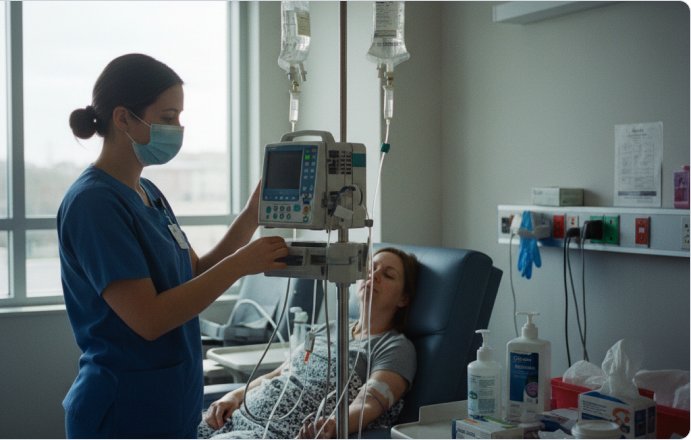
Nurse adjusting an infusion pump in a hospital outpatient department

Home Infusion Therapy

Home infusion billing splits one treatment across up to three benefits. The Medicare Home Infusion Therapy (HIT) benefit, effective 1 January 2021 under section 5012 of the 21st Century Cures Act, pays a qualified home infusion therapy supplier for professional services on the days a nurse visits.

Only a supplier that is accredited, state licensed and enrolled as a Part B supplier under specialty D6 can bill the HIT benefit. The first visit is billed with G0088 to G0090 and later visits with G0068 to G0070; for calendar year 2026, Medicare pays $388.89 for G0090 and $319.76 for G0070 before geographic adjustment.

The external infusion pump and many drugs are paid under the DME benefit through the DME MAC, and other home drugs fall under Part D. Commercial plans usually pay a per diem S-code for pharmacy services and supplies plus nursing visit codes 99601 and 99602. One patient can produce pharmacy, pump, per diem and nursing claims, each with its own enrollment, form and timely filing limit. external infusion pump claims


Home infusion nurse setting up a portable pump with a patient

RCM Xpert delivers infusion billing services in all four settings from one team, so a group that runs an office suite and a home infusion program has one set of rules applied the same way to both.

Coding Rules We Apply on Every Claim

Infusion codes are time-based and ranked, so every claim starts with the documented start and stop times and one initial service.

The Initial Service and the Hierarchy

The initial service code is reported once per encounter. In a physician office it describes the primary reason for the visit, and in a hospital it is the highest service in the facility hierarchy. A second initial code is allowed only for a medically necessary second IV site, reported with modifier 59, or a separate encounter the same day, under Palmetto GBA billing article A53778.

Time Rules for Infusions, Pushes and Hydration

An infusion must run more than 15 minutes; 15 minutes or less is an IV push. Hydration must run at least 31 minutes to be billed. An additional hour of infusion or hydration is billed only when the service runs more than 30 minutes beyond the previous hour.

Sequential and Concurrent Infusions

A sequential infusion is a new drug given after the first through the same IV access, billed once for each new drug. A concurrent infusion runs at the same time as another infusion and is billed once per encounter. The same drug pushed again later in the visit is billable only on a facility claim.

Drug Units, NDCs and Wastage Modifiers

Billing units come from the HCPCS descriptor, and the NDC is reported in the 11-digit 5-4-2 format with its unit qualifier and quantity. For single-dose containers, Medicare Part B requires the JW modifier on a separate line for the discarded amount, which Medicare pays, or the JZ modifier when nothing was discarded. JZ has been required since 1 July 2023, with claim edits since October 2023.

Infusion nurse documenting start and stop times beside the pump
Coder and nurse reviewing infusion records and drug units
ServiceCPT Codes
Hydration96360 initial (31 minutes to 1 hour); 96361 each additional hour
Therapeutic, prophylactic or diagnostic infusion96365 initial hour; 96366 each additional hour; 96367 sequential new drug; 96368 concurrent
Subcutaneous infusion96369 initial; 96370 each additional hour; 96371 additional pump set-up
Injections and IV push96372 SC/IM; 96374 IV push initial; 96375 each sequential new drug; 96376 same drug (facility only); 96377 on-body injector
Chemotherapy and complex biologics96401, 96402 SC/IM; 96409 push initial; 96411 each additional push; 96413 infusion first hour; 96415 each additional hour; 96416 prolonged pump; 96417 each sequential infusion
Pumps and access devices96521 pump refill and maintenance; 96522 implanted pump; 96523 irrigation of access device

Drug Acquisition and Payment

How a drug is bought decides who bills it and how it is paid.

Buy-and-bill

The practice or center buys, stores, administers and bills the drug, and carries the acquisition cost until the payer pays. Medicare Part B pays most separately billed infused drugs at ASP plus 6%.

White bagging and brown bagging

In white bagging, a specialty pharmacy ships the drug to the site under the patient's pharmacy benefit and the site bills only the administration. In brown bagging, the patient receives the drug and brings it in, which many sites refuse because they cannot confirm how it was stored.

Specialty pharmacy mandates

Some commercial plans require named drugs to come from their own specialty pharmacy, and a site that buys and bills the drug anyway is denied.

Biosimilars

Qualifying biosimilars are paid at ASP plus 8% of the reference product's ASP, from 1 October 2022 for five years, which runs through 30 September 2027 for existing products.

340B

Separately payable Part B drugs acquired through the 340B Drug Pricing Program carry the TB modifier from 1 January 2025.

Site-of-care policies and copay programs

Payer site-of-care policies decide where a drug may run, and manufacturer copay assistance programs lower the patient's share on many biologics.

RCM Xpert compares each drug's payment with its acquisition cost by payer every month, so you know which drugs to keep in buy-and-bill and which to move to white bagging.

Specialties and Therapies We Bill For

RCM Xpert provides infusion billing services for every specialty that runs an infusion chair or a home infusion program.

Oncology and hematology

Pembrolizumab (J9271), trastuzumab (J9355) and rituximab (J9312). chemotherapy infusion billing

Rheumatology

Infliximab (J1745) and abatacept (J0129). biologic infusions for rheumatology

Gastroenterology and IBD

Vedolizumab (J3380) and infliximab maintenance dosing.

Neurology and multiple sclerosis

Ocrelizumab (J2350) on a six-month cycle. MS infusion billing

Immunology, IVIG and SCIG

Immune globulin, for example J1569, billed per 500 mg with the brand-specific code.

Infectious disease and OPAT

IV antibiotics given in the clinic or at home under outpatient parenteral antimicrobial therapy. OPAT billing

Nephrology

Ferric carboxymaltose (J1439) and epoetin alfa for non-ESRD use (J0885).

Osteoporosis

Denosumab (J0897).

Migraine

Eptinezumab (J3032) given as a quarterly infusion.

Hydration

Hydration billed as a treatment in its own right, with the time documented.

Payers We Bill in Infusion RCM Services

RCM Xpert bills infusion claims to Medicare, Medicare Advantage, Medicaid and commercial plans, and each payer controls the drug in a different way.

Medicare Part B

Coverage follows each MAC's LCDs and billing and coding articles, and drugs are paid from the quarterly ASP pricing file.

Medicare Advantage

Plans add their own prior authorization, step therapy and site-of-care rules on top of Medicare coverage.

Medicaid

State Medicaid programs require the NDC on drug lines so the state can collect manufacturer rebates, and many set their own unit rules.

Commercial plans

UnitedHealthcare, Aetna, Cigna, Blue Cross Blue Shield plans and Humana each publish site-of-care and specialty pharmacy policies, and pay drugs at contracted rates that vary by plan.

Billing manager and nurse reviewing payer policies and infusion claims
Billing specialists reviewing an infusion coverage map

Our End to End Infusion Billing Support in All 50 States

RCM Xpert offers infusion billing services in all 50 states from Flushing, New York. Three things change by state:

  • MAC Jurisdiction & Coverage Articles
  • Medicaid NDC and Unit Rules
  • State Pharmacy Licensure for Home Infusion

A Michigan infusion center, for example, bills Part B to WPS Government Health Administrators in Jurisdiction 8, while a New York practice bills National Government Services in Jurisdiction K.

We load each state's MAC articles and Medicaid rules into the claim edits, so a multi-state group is billed to each state's rules instead of one generic set.

How Onboarding Works

RCM Xpert takes over your infusion billing in five steps and bills alongside your team until the numbers match, so claims keep going out and payments keep coming in during the switch.

  1. 01

    Free Billing Audit

    We review 90 days of infusion claims for denials, unit errors and underpayments.

  2. 02

    Drug and payer crosswalk

    We map each J-code, NDC, billing unit and contracted rate you use.

  3. 03

    System connection

    We connect to your EHR and clearinghouse.

  4. 04

    Parallel billing, then handover

    We bill alongside your team until the numbers match, then take over.

  5. 05

    Monthly drug margin review

    You receive paid versus expected by drug and payer every month.

The 4 Numbers We Hold Your Infusion Billing To

Our clients measure RCM Xpert on four numbers: clean claim rate, denial rate, days in A/R and net collection rate. These are the industry benchmarks we manage every account against.

MetricIndustry BenchmarkSource
Clean claim rate95% or higher on first submissionHFMA MAP Keys / industry best practices
Denial rateUnder 5% of claimsHFMA MAP Keys
Days in A/RUnder 40 daysMGMA / HFMA
Net collection rate95% or higherMGMA better performers

We report all four to you every month, by drug, payer and site of care, so you can see where your practice stands against each one.

In House Billing vs. RCM Xperts

FactorIn-house teamRCM Xpert
CostSalaries, benefits, software, and training,paid whether claims are paid or notStarting from 3.99%Pay only when claims are paid
Authorization coverageDepends on one or two staff membersTracked by dose and end dateFor every patient
Drug and NDC expertiseLearned on the jobUnits and NDCs checkedOn every drug line
Underpayment trackingOften not doneEach drug line comparedWith its contract rate
ReportingBuilt by handMonthly drug marginAnd payer reports
ScalabilityNew chairs or sites need new hiresCapacity added without hiring
Compliance riskRelies on individual knowledgeRules applied the same wayOn every claim

How to Choose an Infusion Billing Company

Ask any company offering infusion billing services these seven questions before you sign, and compare the answers side by side.

Question to askHow RCM Xpert answers
Which sites of care do you bill?Physician offices, infusion centers, hospital outpatient departments and home infusion.
Do you check J-code units against the NDC and dose?Yes, on every drug line before the claim leaves.
How do you handle JW, JZ and TB?From the wastage log and the 340B purchasing record.
How are authorizations tracked?Per drug, by approved doses and end date, with re-authorization filed early.
Do you track underpayments against ASP-based contracts?Yes, each drug line against its contracted rate.
What reporting will we see?Monthly paid versus expected by drug, payer and site.
What are the exit terms?30 days

Start Your Infusion Billing Review with RCM Xperts

RCM Xpert provides infusion billing services from Flushing, New York for physician offices, ambulatory infusion centers, hospital outpatient departments and home infusion providers in all 50 states.

Send us 90 days of infusion claims and we will show you where drug and administration revenue is leaking, by payer and by site of care.

Get a Free Billing Audit

Infusion Billing FAQs

What is the global period for orthopedic surgery?

Most major orthopedic procedures carry a 90-day global period, while certain minor procedures carry 0- or 10-day periods. The global surgical package generally includes the procedure and routine related postoperative care. The applicable CPT global indicator determines the period, so billing staff should verify the specific procedure rather than assume every orthopedic service has the same global period.

When do I use modifier 58, 78, or 79?

Modifier 58 applies to a staged, planned, or related procedure during a global period. Modifier 78 applies to an unplanned return to the operating room for a related procedure or complication. Modifier 79 applies when the new procedure is unrelated to the original surgery. Documentation must support the circumstances behind the selected modifier.

How are implants and hardware billed?

Implant billing depends on the site of service, payer rules, and whether the item belongs on the professional or facility claim. Documentation can include the manufacturer invoice, serial number, lot number, and operative note reference. Facility claims may use revenue code 0278 for applicable implants.

Should I bill RT and LT or modifier 50?

The correct reporting method depends on the specific CPT code's bilateral surgery indicator and the payer's instructions. RT identifies the right side and LT identifies the left side. Modifier 50 can apply when the code and payer rules support bilateral reporting. The billing team should verify the applicable fee schedule rather than choose the modifier by habit.

Why was my second procedure paid at 50 percent?

A qualifying second procedure may receive payment at 50 percent because of the multiple procedure payment reduction. The highest valued eligible procedure generally receives 100 percent, while subsequent eligible procedures receive 50 percent under the applicable payment policy. This reduction does not automatically indicate a coding mistake or underpayment.

Can I bill an E/M on the same day as an injection or procedure?

Yes, a qualifying E/M service can be reported on the same day as another procedure when the documentation supports a significant, separately identifiable service. Modifier 25 may apply. The CY2027 proposed rule includes a proposed 50 percent reduction for certain separately reported same day E/M services.

How is fracture care billed?

Fracture care can involve global fracture care when the physician assumes responsibility for treatment through healing, or separately reported services when the circumstances support itemized billing. The documentation should establish the fracture, encounter type, treatment, and provider's role in managing care.

Do you handle workers compensation billing?

Yes. Orthopedic workers compensation billing requires attention to state specific fee schedules, authorization requirements, utilization review, forms, filing rules, and claim information. RCM Xpert supports workers compensation billing across all 50 states and treats workers compensation as a separate payer workflow.

Will orthopedic reimbursement change in 2027?

CMS has proposed several CY2027 Physician Fee Schedule changes affecting orthopedic services, including proposed work RVU changes for CPT 23470, 23472, 27130, and 27447 and a proposed 50 percent payment reduction for certain separately reported same day E/M services. CMS has also finalized the Ambulatory Specialty Model, with performance years beginning January 1, 2027.

Recover What Your Practice Has Already Earned

RCM Xpert can review your current process through a Free Billing Audit and identify where orthopedic claims face avoidable billing, coding, payment, or AR problems. Request your Free Billing Audit today.

Request a Free Billing Audit