
If you are a licensed therapist who submits claims to your clients’ insurance companies, you likely have come to realize that there is no such thing as “one” Blue Cross Blue Shield. Instead, it is a federation of thirty-three individual affiliated organizations operating in various states.
Each of these affiliated organizations, however, maintains its own separate contracts, payment rates, and coverage terms. The identical sixty-minute therapy session can cost $110 in one state and $175 in another due to the fact that BCBS organization handles the claims processing.
In addition to identifying what each of the BCBS affiliate organizations’ plans offer in terms of coverage, what each client pays out-of-pocket for sessions, and how much providers are reimbursed for their services, this resource will provide you with information regarding the types of documentation that must be kept by therapists to ensure that their claims are processed correctly.
Coverage Under BCBS Therapy Plans
The Federal Employee Program (FEP): The Most Compliant Plan
Of all of the plans offered by Blue Cross Blue Shield, the FEP Blue Standard plan provides the best overall coverage. In-network mental health visits are covered completely under this plan with the client paying a flat fee of $30 per visit. Additionally, there is no deductible charged for mental health services for clients enrolled in this plan. Therefore, the client understands exactly what he/she is responsible for paying.
Under the FEP Blue Basic plan, clients pay $35 per visit for in-network mental health services with no deductible applied. While this plan offers similar coverage options to the FEP Blue Standard plan, the copayment is slightly higher.
The FEP Blue Focus plan is the lowest-cost option. Clients pay only $10 copayment for up to ten total visits annually for both mental health and medical services. Once the client reaches his/her annual limit of ten visits, the client is responsible for paying 30 percent of the maximum allowable amount established by the plan. A deductible applies once the client reaches his/her annual limit.
FEP Telehealth Services: Free of Charge
All FEP plans provide free access to telehealth services for behavioral health services when clients utilize a preferred telehealth provider. This includes both behavioral health counseling and substance abuse counseling.
Note to Therapists: To provide telehealth services under your existing BCBS contract, you must contact your affiliate and confirm whether they recognize telehealth parity. As mentioned previously, many BCBS affiliates have provided broader telehealth coverage options. However, each affiliate has unique guidelines regarding the reimbursement structure for telehealth services.
Commercial Plans: Varies Depending Upon Benefits Offered
Unlike the Federal Employee Program (FEP) plans, which follow very similar structures regardless of where they are located, commercial BCBS plans differ greatly depending upon where they are administered. Clients with commercial BCBS plans issued by BCBS of Massachusetts have different coverage structures than those with BCBS of Illinois or BCBS of Texas.
- BCBS of Illinois covers behavioral health services for both commercial and non-HMO clients. The extent of coverage differs depending upon the client’s specific benefit package. Before scheduling any appointments with clients, therapists should always verify eligibility and coverage using Availity or their preferred vendor.
- On January 1st, 2026, BCBS of Texas began administering behavioral health services differently than in previous years. Starting January 1st, BCBSTX assumed responsibility for managing behavioral health services for Blue Advantage HMO members from Magellan Health Care. As a result, the provider experience for submitting claims electronically for clients who are part of in-network panels may be handled by BCBSTX instead of through a third-party administrator.
Limitations on Physical and Occupational Therapy Visits
Effective January 1st, 2026, a major change was implemented for commercial clients of BCBS of Massachusetts. No prior approval is necessary for the first sixteen physical therapy or occupational therapy visits of each type during the calendar year. However, if the client requires more than sixteen visits of either type, prior approval must be requested by the provider.
From a practical perspective, this represents a positive development.
The first sixteen visits for each type of therapy (physical or occupational) do not require prior approval. As a result, less administrative work is required by both the providers and the client’s plan.
It is essential to understand that the above limitation on visits applies separately to PT and OT.
For example, a client may require sixteen PT visits and sixteen OT visits in the same calendar year; in neither case would prior approval be required.
Prior Authorization: When You Need It
Prior approval is required by law for various types of services provided under different BCBS plans in each state. Below are examples of what you need to know about prior approval requirements applicable to various BCBS affiliates.
BCBS of Illinois
Prior approval is required for certain types of behavioral health services for commercial clients insured under BCBSIL. By verifying eligibility and coverage via Availity or your preferred vendor you will determine which specific services require prior approval based on your client’s specific benefit plan.
Clients eligible under BCBSIL who participate in the Federal Employee Program (FEP): Only Applied Behavior Analysis requires prior approval under FEP. All other behavioral health services are subject to no prior approval requirements.
Additionally, BCBSIL offers a voluntary Clinical Review Process (CRP) designed to assist providers in determining whether a proposed service meets medical necessity standards prior to providing it to clients.
BCBS of Texas
As noted earlier effective January 1st, 2026, prior approval will now go through BCBSTX directly rather than through Magellan Health Care for Texas members participating in groups whose behavioral health management was taken over by BCBSTX. This change applies exclusively to Blue Balance Funded small and medium-sized businesses with Blue Advantage HMO coverage.
Transitional Period for Existing Clients
In an effort to minimize disruption to clients currently receiving ongoing care, those clients were granted a ninety-day transitional period to establish themselves with an in-network provider within the BCBSTX network. During this transitional period, prior approval requirements remain unchanged as prior to January 1st, 2026.
Reimbursement Rates by CPT Code
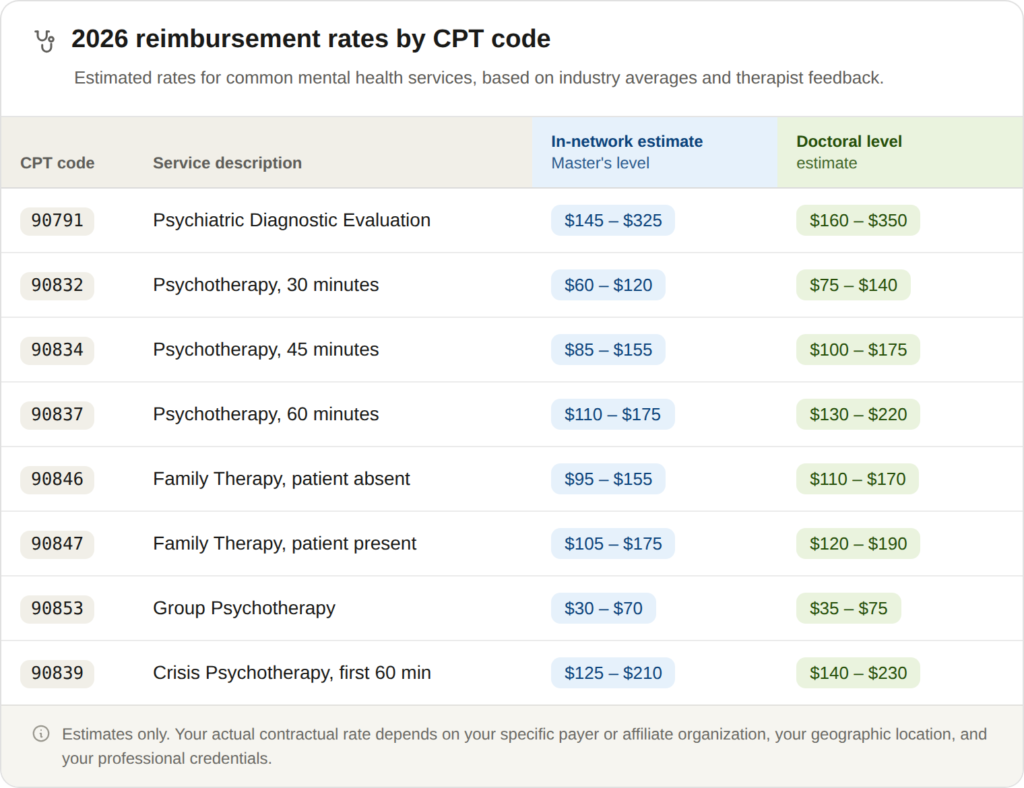
Below are the estimated 2026 reimbursement rates by CPT code for common mental health services provided by therapists based on industry averages and feedback from therapists. Again, please note that your actual contractual rate will depend on your specific affiliate organization, your location, and your professional credentials.
CPT 90837 Reimbursement Details
The 60-minute psychotherapy session is the most commonly billed code in mental health practices. BCBS in-network rates for 90837 typically fall between $110 and $175 for master’s-level providers and $130 to $220 for doctoral-level providers.
Medicare’s 2026 baseline rate for 90837 is $167.00 nationally. BCBS commercial rates often run 115% to 130% above this baseline, but the exact percentage depends on your contract and your BCBS affiliate.
State-by-State Reimbursement Variation
BCBS operates through independent affiliates, so rates vary significantly by state. The following estimates show the range for CPT 90837 based on provider-reported data.
| State | In-Network Rate (90837) | Notes |
| California | $105 – $125 | SF/LA command top rates |
| Florida | $98 – $108 | Miami/Orlando lead |
| Illinois | $105 – $115 | Chicago elevates state average |
| Massachusetts | $115 – $125 | Boston area rates among highest |
| New York | $115 – $125 | NYC rates skew state average high |
| Texas | $95 – $110 | Dallas/Austin/Houston high |
| Alabama | $88 – $98 | Regional variance |
| Alaska | $115 – $130 | Provider scarcity drives rates |
Three factors drive the variation. First, BCBS affiliates negotiate rates independently, so contracts in Massachusetts are not related to contracts in Texas. Second, market demand affects rates. Provider shortages in areas like Alaska and Hawaii lead to higher reimbursement because BCBS needs to attract providers to those networks. Third, state regulations influence how much plans must pay for behavioral health services.
Provider Credential Level and Reimbursement
Based on industry trends, it appears that BCBS generally reimburses doctoral-level professionals at a greater rate than master’s-level professionals. Psychologists (Ph.D., Psy.D.), Psychiatrists, and other doctoral-level professionals tend to be reimbursed at a rate 10-20% greater than master’s-level professionals for comparable services.
Example:
A 60-minute session billed as CPT code 90837, which reimburses an LCSW $130, may reimburse a Ph.D.-Level Psychologist $160 under the same contractual agreement. Again, while this is not universally true of all BCBS affiliates, it is generally true of most.
Documentation Requirements
BCBS is well-known for conducting extensive post-payment audits. Consequently, you must maintain adequate documentation to support each service you submit to them.
Auditor Expectations
Each progress note submitted to auditors must demonstrate medical necessity. Progress notes must be written in detail and avoid using generic or template-type entries. Each entry should include the following information:
• The interventions used;
• The presenting problems experienced by the patient;
• The responses made by the patient;
• How each service relates to developing a treatment plan;
You must document accurate amounts of time spent on each service for time-based codes. Specifically, you must document at least 53 minutes of direct face-to-face interaction time with each client for CPT code 90837. If your notes reflect forty minutes of therapy with a client, you cannot use CPT code 90837.
You must have current and signed treatment plans on file for each client. Auditors identify outdated treatment plans as one of the most frequent reasons why claims are denied.
Protecting Your Claims
Write detailed and specific language in each entry of your progress notes. “Working on coping skills” is vague language. On August tenth, the patient reported experiencing severe anxiety rated 8/10. I used deep-breathing exercises with the patient for approximately 10 minutes. Following the exercises, the patient reported a reduction in anxiety ratings from 8/10 to 4/10. The patient verbally indicated he understood how to perform deep breathing exercises. That is an audit-proof progress note!
Document start and end times for every single appointment! Start times are crucial in supporting time-based codes; i.e., CPT code 90837 requires fifty-three minutes of direct face-to-face interaction time.
Keep Treatment Plans Updated Regularly
Every ninety days (or as required by your state), update treatment plans for each client. This will prevent denial of future claims due to inadequate documentation.
Timelines Regarding Credentialing
Average credentialing timelines for BCBS take anywhere from ninety to one hundred twenty days — longer than many other payers. If you are planning on hiring a new staff member or adding an associate provider to your panel, start the credentialing process immediately after agreeing on employment terms or contracting.
Seamless Access to Patients Outside of Their Home State via BlueCard
Once you are credentialed with BCBS, you may treat clients outside of your home state without needing to obtain additional credentials via the BlueCard program. This will expand your potential pool of clients.
Conclusion
BCBS offers varying levels of coverage throughout multiple states and regions as well as between different plans; therefore, therapists must research which specific plan(s) their clients have selected to ensure that their clients’ expectations are met. FEP plans offer copayments ranging from $30-$35 for mental health visits, while commercial plans may charge anywhere from $110-$220 for a sixty-minute therapy session, depending on which affiliate organization processes your claim, your credential level, etc. Documentation is critical since auditing is stringent and weak documentation may reduce your income. Credentialing may take ninety to one hundred twenty days; therefore, schedule accordingly. Finally, verifying each client’s eligibility and coverage before each session, as well as maintaining compliant documentation, will maximize your income.