

Mental health providers get credentialed with insurance companies by choosing target payers, building a complete CAQH ProView profile, submitting each payer’s enrollment application, passing primary source verification, and signing a network contract with a confirmed effective date. Commercial payers verify credentials in 60 to 90 days. Medicare and Medicaid verify in 40 to 60 days. From first application to the date you can bill as an in-network provider, plan on 90 to 180 days.
Credentialing decides whether an insurer recognises you as an eligible participating provider. It also sets your effective date, which controls every claim you submit afterwards. For mental health professionals, the process carries variables that general provider guides skip: licence type determines which panels accept you, behavioural health carve-outs route your application to a specialty vendor rather than the health plan, and interstate compacts change what you can do across state lines.
This guide covers the twelve-step process, the documents payers verify, realistic timelines by payer type, Medicare and Medicaid enrollment, contracting and fee schedules, what you can do while an application is pending, and the maintenance work that keeps you in network afterwards.
What Is Insurance Credentialing for Mental Health Providers?
Provider credentialing is the process an insurance company uses to verify a healthcare professional’s qualifications before allowing the provider to participate in its network.
For a mental health professional, the payer verifies:
- Professional license
• Education and training
• National Provider Identifier (NPI)
• Taxonomy
• Board certification, when applicable
• Work history
• Malpractice insurance
• DEA registration, when applicable
• Hospital privileges, when applicable
• Professional liability history
• Medicare or Medicaid enrollment, when applicable
• Sanctions and disciplinary history
• Practice locations
• CAQH profile information
Credentialing and contracting represent different steps.
How Primary Source Verification Works
Payers do not take your application at face value. Under NCQA credentialing standards, the health plan verifies your credentials with the body that issued them, a process called primary source verification.
That means the payer contacts your state licensing board directly rather than accepting a copy of your license, confirms your degree with the university that granted it, and queries federal databases for sanctions and disciplinary history. Verification includes a National Practitioner Data Bank query, a check against the OIG List of Excluded Individuals and Entities, and a SAM.gov exclusion search.
You cannot speed up primary source verification. You can only avoid slowing it down by making sure the name, license number, and institution details on your application match the records those sources hold.
Who Approves Your Application
A credentialing committee makes the final decision. The committee is made up of the plan’s medical or clinical staff and meets on a fixed schedule, often monthly or twice monthly.
This matters for your timeline. If verification finishes two days after a committee meeting, your file waits for the next one. When you follow up with a payer, ask two questions: whether verification is complete, and which committee date your file is scheduled for. That second question gets you a real answer instead of a status code.
Credentialing verifies that you meet the payer’s professional requirements.
Contracting establishes the agreement between you and the insurance company, including network participation and reimbursement terms.
A provider may complete credentialing but still needs to complete contracting before treating patients as an in-network provider.
Credentialing vs Contracting vs Paneling
Providers use three terms for overlapping parts of the same process, and payers treat them as distinct stages.
| Term | What It Means | What It Does Not Do |
| Credentialing | The payer verifies your licence, education, training, work history, malpractice coverage and sanctions history through primary source verification, then a credentialing committee approves or denies you. | Does not set your rates. Does not make you in-network. Does not let you bill. |
| Contracting | You and the payer sign a participating provider agreement that sets reimbursement terms, covered services, claims requirements, and the effective date. | Does not begin until credentialing is approved. |
| Paneling | The everyday term therapists use for the combined process of joining a payer’s provider network. A panel is open when the payer accepts new providers in your area and specialty, and closed when it does not. | Not a formal payer stage. Panel status is checked before you apply, not after. |
Who Needs Insurance Credentialing?
Many mental health professionals need credentialing when they want to join an insurance network and bill the payer for covered services.
Depending on payer rules and practice structure, this can include:
- Psychiatrists
• Psychologists
• Licensed Clinical Social Workers (LCSWs)
• Licensed Professional Counselors (LPCs)
• Licensed Mental Health Counselors (LMHCs)
• Licensed Marriage and Family Therapists (LMFTs)
• Psychiatric Mental Health Nurse Practitioners (PMHNPs)
• Clinical Nurse Specialists
• Other independently licensed behavioral health professionals
Mental Health Taxonomy Codes for Credentialing
Your taxonomy code identifies your specialty in NPPES, on your credentialing application and on every claim. A mismatch between the taxonomy on your NPI record and the taxonomy on your payer application is one of the most common enrollment rejections.
| License Type | Taxonomy Code | Notes |
|---|---|---|
| Licensed Clinical Social Worker (LCSW) | 1041C0700X | Most widely credentialed independent behavioral health license |
| Licensed Professional Counselor (LPC) | 101YP2500X | Enrolls with Medicare under the Mental Health Counselor category |
| Licensed Mental Health Counselor (LMHC) | 101YM0800X | State title varies. Confirm which code your state board maps to |
| Licensed Marriage and Family Therapist (LMFT) | 106H00000X | Medicare eligible since January 1, 2024 |
| Substance use disorder counselor | 101YA0400X | Often credentialed through a separate SUD network |
| Clinical Psychologist | 103TC0700X | Doctoral level. Reimbursed at 100 percent of the Medicare fee schedule |
| Psychiatrist | 2084P0800X | Prescriber. DEA registration required |
| Psychiatric Mental Health Nurse Practitioner | 363LP0808X | Check state supervision and collaboration requirements |
| Psychiatric Clinical Nurse Specialist | 364SP0808X | Recognized by Medicare as an independent provider |
| Mental Health Clinic or Center | 261QM0801X | Type 2 organizational NPI, used for group credentialing |
Verify the current code against the NUCC health care provider taxonomy code set before you submit, since the set is updated twice a year.
Can Associate and Pre-Licensed Clinicians Be Credentialed?
Most commercial payers credential independently licensed clinicians only. An associate-level clinician working toward full licensure, such as an LMSW, LPC-Associate, LMFT-Associate, or postdoctoral psychology fellow, generally cannot be credentialed as an individual participating provider.
Three arrangements exist, and which one applies depends on the payer and the state.
- Some Medicaid managed care plans credential associate-level clinicians directly under documented supervision, with the supervisor named on the application.
- Some commercial plans allow the group practice to bill for associate-level services under the supervising clinician’s NPI, provided the supervision arrangement meets the plan’s written policy. Payer policies on this differ sharply, so get the rule in writing before you bill.
- Many plans do not reimburse pre-licensed services at all, which means those sessions run as private pay until the clinician is fully licensed and credentialed.
If you run a group practice, confirm each payer’s policy before you hire. A practice that builds its staffing model on supervised billing and later discovers the payer does not permit it faces retroactive recoupment on every claim submitted.
Individual Credentialing vs Group Credentialing
Solo practitioners credential as individuals under a Type 1 NPI and their own tax identification number. Group practices operate differently, and applying the wrong way restarts the process.
A group practice holds a Type 2 organizational NPI and a group contract with the payer. Individual clinicians are credentialed and then linked to that group contract through a provider roster. The payer credentials the clinician, then adds them to the group’s roster so claims billed under the group TIN pay correctly.
Three points decide whether this goes smoothly.
1.The group contract must exist before individual clinicians can be rostered to it. A new practice credentials the entity first, then the clinicians.
2.Roster adds are usually faster than fresh credentialing for clinicians who are already credentialed with that payer elsewhere, though the payer still verifies the new practice location and effective date.
3.A clinician who leaves the group must be removed from the roster. Leaving a departed clinician on the roster creates directory inaccuracies and claim problems for the practice.
Requirements vary by payer and state. Some plans credential certain provider types while others may use different network arrangements.
Before starting the application, confirm that the payer accepts your specific license type and specialty.
Before You Apply, Get Your Provider Information Ready
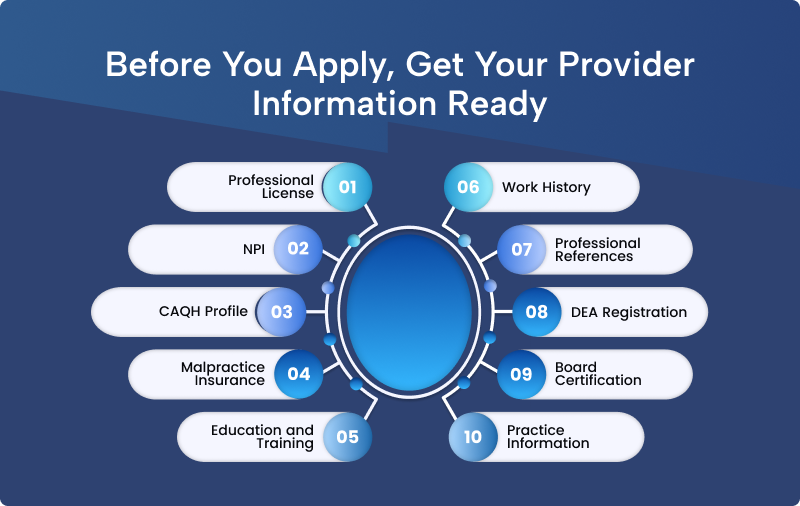
Credentialing applications usually require information from several different sources. Gathering everything first can prevent repeated requests from the payer.
Create a credentialing folder containing the following.
1. Professional License
Provide your current state license and make sure the name matches the information on your credentialing application.
Check:
- License number
• State
• Issue date
• Expiration date
• Professional designation
• Current status
If you hold licenses in multiple states, prepare documentation for each applicable state.
2. NPI
Most independently practicing mental health professionals need an individual Type 1 NPI.
If you operate a group or organization, the organization generally uses a Type 2 NPI.
Your NPI information should match your credentialing application, taxonomy, practice information, and claims.
An NPI itself does not create insurance network participation. It simply identifies the provider in applicable healthcare transactions.
3. CAQH Profile
Many commercial insurers use CAQH to collect and maintain provider credentialing information.
Your CAQH profile may contain:
- Education
• Licensure
• Work history
• Practice locations
• Malpractice coverage
• Professional references
• Hospital affiliations
• Certifications
• Disclosure information
Complete the profile carefully and upload the requested documents.
Then authorize the payer to access your information when required.
4. Malpractice Insurance
Prepare your current professional liability insurance certificate.
Check that it includes:
- Provider name
• Coverage dates
• Policy number
• Coverage limits
• Insurer information
Don’t upload an expired certificate.
5. Education and Training
Depending on your provider type and payer, you may need documentation related to:
- Graduate degree
• Internship
• Residency
• Fellowship
• Postgraduate training
• Professional certifications
Use the exact name of the institution and dates requested by the payer.
6. Work History
Credentialing applications often ask for a detailed employment history.
Avoid unexplained gaps.
If the application requests five years of work history, provide the full period requested rather than listing only your current employer.
Explain gaps according to the payer’s instructions.
7. Professional References
Some payers may request professional references or other verification information.
Keep the contact details current and confirm that the individuals you list can verify your professional relationship.
8. DEA Registration
Psychiatrists, PMHNPs, and other eligible prescribers may need DEA information when applicable to their scope of practice and payer requirements.
Don’t provide DEA information when the application doesn’t require it.
9. Board Certification
If you’re board certified, prepare current certification information.
For psychiatrists and certain other professionals, board certification can form part of the payer’s credentialing review.
10. Practice Information
Prepare accurate information for every practice location.
This can include:
- Legal practice name
• Doing Business As (DBA) name
• Physical address
• Mailing address
• Phone number
• Fax number
• Billing address
• Office hours
• Telehealth availability
• Group NPI, if applicable
• Tax Identification Number (TIN)
Small inconsistencies can create unnecessary enrollment problems.
How to Get Credentialed with Insurance Companies
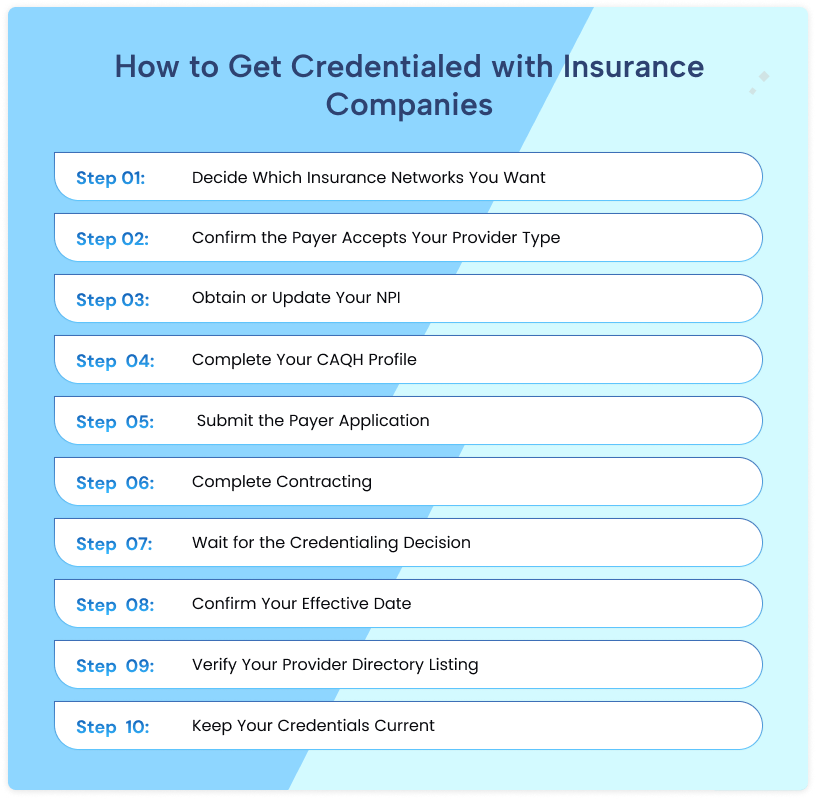
Step 1: Decide Which Insurance Networks You Want
Don’t submit applications to every payer simply because they’re available.
Start with the plans that matter to your practice.
Consider:
- Patient demand
• Local insurance market
• Payer reimbursement
• Referral opportunities
• Your specialty
• Geographic coverage
• Telehealth demand
• Existing group contracts
For example, a therapist in New Jersey may prioritize major commercial plans and applicable Medicaid managed care organizations based on the insurance coverage common among local patients.
A PMHNP may prioritize different networks from a psychologist or LCSW.
Build a target payer list before starting applications.
Step 2: Confirm the Payer Accepts Your Provider Type
This step can save weeks of unnecessary work.
Contact the payer or review its provider enrollment requirements to confirm:
- Your license qualifies
- Your specialty qualifies
- The payer accepts new providers in your geographic area
- The network remains open
- The payer accepts your practice arrangement
- The payer’s credentialing pathway applies to your provider type
Some insurers may close certain networks temporarily.
Don’t assume that a payer accepting psychologists will automatically accept every behavioral health provider type.
Step 3: Obtain or Update Your NPI
Make sure your NPI record contains accurate information before submitting credentialing applications.
Review:
- Legal name
• Practice address
• Mailing address
• Taxonomy code
• Other identifiers
If you recently changed your name, address, specialty, or practice arrangement, update the applicable records before enrollment.
Step 4: Complete Your CAQH Profile
If the payer uses CAQH, create or update your profile.
Complete every applicable section.
Then upload current supporting documents.
One of the most common mistakes involves completing only the basic profile and assuming the process ends there.
Credentialing teams may need access to the complete profile, current documents, and an authorization that allows the payer to retrieve the information.
Step 5: Submit the Payer Application
Some insurers use CAQH for credentialing data but still require a separate payer enrollment application.
Follow the payer’s exact instructions.
Provide consistent information across:
- CAQH
• NPPES
• Payer application
• W 9
• License records
• Malpractice certificate
• Practice management system
Your legal business name, TIN, NPI, address, and provider information should align.
Step 6: Wait for the Credentialing Decision
Credentialing can take weeks or months depending on the payer and application.
During this period, the payer may:
- Verify your license
• Verify education
• Review work history
• Verify malpractice insurance
• Check sanctions
• Review disclosures
• Contact references
• Request additional documentation
• Conduct primary source verification
Respond quickly when the payer requests additional information.
A missing document can delay the application.
Step 7: Complete Contracting
After credentialing review, the payer may send a provider agreement.
Review:
- Reimbursement terms
• Effective date
• Covered services
• Provider responsibilities
• Claims requirements
• Termination provisions
• Telehealth provisions
• Credentialing obligations
Don’t assume that completing credentialing automatically makes you an in network provider.
Wait for confirmation of network participation and the applicable effective date.
How to Review a Behavioral Health Fee Schedule
The fee schedule is not always attached to the agreement you receive. If it is missing, request it before you sign. A payer will often send a rate sheet only when asked.
Review rates against the codes you actually bill rather than the whole schedule. For most outpatient mental health practices, six codes carry the majority of revenue.
| CPT Code | Service | Why It Matters |
|---|---|---|
| 90791 | Psychiatric diagnostic evaluation | Billed at intake for nearly every new patient |
| 90792 | Diagnostic evaluation with medical services | Prescriber equivalent of 90791 |
| 90832 | Psychotherapy, 16 to 37 minutes | Lowest of the three psychotherapy tiers |
| 90834 | Psychotherapy, 38 to 52 minutes | The most commonly billed outpatient therapy code |
| 90837 | Psychotherapy, 53 minutes or more | Highest reimbursing therapy code and the one payers scrutinize most |
| 90847 | Family psychotherapy with the patient present | Often reimbursed above 90834, and frequently underused |
| 90853 | Group psychotherapy | Revenue per hour depends entirely on group size |
| 90833, 90836, 90838 | Psychotherapy add-on codes with an E/M service | Prescribers only. Billed alongside 99213 to 99215 |
Compare the offered rate for 90837 and 90834 against what other plans in your market pay. A schedule that looks acceptable on 90791 can still be poor on the code you bill four hundred times a year.
When and How to Negotiate Reimbursement Rates
Rate negotiation is possible but it extends your timeline, and payers rarely negotiate with a solo clinician entering a network for the first time. Negotiation works best when you can point to something the plan needs.
- A specialty the plan is short on in your county, such as child and adolescent therapy, substance use treatment, or prescribing capacity
- Language capability the plan’s directory lacks
- Group size, since a practice bringing eight clinicians has leverage a single clinician does not
- Evening, weekend or crisis availability, which directly affects the plan’s access measures
Send your top codes with the request rather than asking for a general increase. A specific request on five codes gets a response. A general request usually does not.
Requesting a Retroactive Effective Date
Ask the contracting representative directly whether the plan grants a retroactive effective date. A minority of payers do, and they almost never volunteer it.
If your plan grants one, hold the affected claims rather than submitting them as out of network. Once the retroactive date is confirmed in writing, file the held claims against it. If the plan does not grant one, you know to bill those sessions as out of network or under a single case agreement instead of discovering it after the denials arrive.
Keep the participation letter the payer sends. It contains your effective date and your payer issued provider ID, and you will need both for EDI enrollment and for every appeal you file in the first year.
Step 8: Confirm Your Effective Date
Don’t start treating patients as an in-network provider based only on the date you submitted the application.
Confirm the payer’s actual effective date.
Keep written confirmation for your records.
The effective date can affect how you bill claims and whether the payer considers services in network.
Step 9: Complete EDI, ERA and EFT Enrollment
A signed contract and a confirmed effective date do not connect your billing system to the payer. Three separate enrollments do that, and each one is filed after the contract loads.
EDI enrollment authorizes electronic claim submission between your clearinghouse and the payer. Until it is active, claims either reject at the clearinghouse or route to paper.
ERA enrollment turns on electronic remittance advice, which posts payments and denials back into your practice management system automatically instead of arriving as paper explanations of benefits.
EFT enrollment sets up direct deposit so payments reach your bank account rather than arriving as checks.
You need your payer issued provider ID and the payer ID for your clearinghouse to complete these. Both come from the participation letter the payer sends after the contract loads, which is why you should keep that letter rather than filing it away.
New practices routinely finish credentialing, start seeing patients, and then wait an extra four to six weeks for a first payment because nobody filed EDI enrollment. Handle it in the same week the contract loads.
Step 10: Verify Your Provider Directory Listing
After enrollment, check the payer’s online provider directory.
Confirm that it shows:
- Correct provider name
• Correct specialty
• Correct location
• Correct phone number
• Correct network
• Telehealth availability, when applicable
A directory error can send patients to the wrong location or make it appear that you’re not accepting their insurance.
Step 11: Keep Your Credentials Current
Credentialing doesn’t end when you join the network.
Payers periodically recredential providers.
You also need to update information when something changes.
Common updates include:
- License renewal
• Address change
• New practice location
• Malpractice policy renewal
• Name change
• Taxonomy change
• New board certification
• New group affiliation
• Practice ownership change
Keep your CAQH profile and payer records current.
Medicare and Medicaid Enrollment for Mental Health Providers
Medicare and Medicaid do not use the commercial credentialing pathway. Neither one uses CAQH. Both require their own applications, and Medicare eligibility for behavioral health providers changed recently enough that many guides are still out of date.
Which Mental Health Providers Medicare Enrolls
Medicare enrolls psychiatrists, clinical psychologists, licensed clinical social workers, psychiatric mental health nurse practitioners and psychiatric clinical nurse specialists. As of January 1, 2024, Medicare also enrolls marriage and family therapists and mental health counselors, a category that includes licensed professional counselors in most states.
Reimbursement differs by provider type. Clinical psychologists and psychiatrists are paid at the full physician fee schedule amount. Licensed clinical social workers, marriage and family therapists and mental health counselors are paid at 75 percent of the physician fee schedule amount for the same service.
How to Enroll in Medicare Through PECOS
Medicare enrollment runs through the Provider Enrollment, Chain and Ownership System, known as PECOS. The form you file depends on your practice structure.
| Form | Purpose | Who Files It |
|---|---|---|
| CMS-855I | Individual provider enrollment | Every individual clinician enrolling in Medicare |
| CMS-855B | Clinic, group practice or supplier enrollment | Group practices enrolling the organization |
| CMS-855R | Reassignment of Medicare benefits | Clinicians assigning their billing rights to a group |
| CMS-855O | Enrollment for ordering and referring only | Clinicians who order or refer but do not bill Medicare |
| CMS-588 | Electronic funds transfer authorization | Every enrolling provider, for direct deposit |
| CMS-460 | Medicare participating provider agreement | Providers electing to accept assignment on all claims |
A solo clinician typically files the CMS-855I and the CMS-588. A clinician joining a group files the CMS-855I and the CMS-855R so payments reassign to the group’s tax identification number.
How Long Does Mental Health Credentialing Take?
Commercial payers verify credentials in 60 to 90 days. Medicare and Medicaid verify in 40 to 60 days. From your first application to the effective date you can bill against, plan on 90 to 180 days for commercial plans, and commonly four to six months when several payers run at once.
The ranges below assume a complete application submitted to an open panel. Missing documents, closed panels and multi-state licensure all push these numbers out.
| Payer Type | Verification | Application to Effective Date | What Drives the Timeline |
|---|---|---|---|
| Commercial plans (Aetna, Cigna, UnitedHealthcare, Blue Cross Blue Shield) | 60 to 90 days | 90 to 180 days | Contract is typically drafted around day 90, the fee schedule is built in roughly 45 days, and the payer loads the signed contract in about 30 days |
| Behavioral health carve-out vendors | 60 to 90 days | 90 to 180 days | Your application routes to the specialty vendor rather than the health plan. Confirm which entity credentials your license type before applying |
| Medicare | 40 to 60 days | 60 to 90 days | Submitted through PECOS. Effective dates are frequently retroactive to the filing date |
| State Medicaid | 40 to 60 days | 60 to 120 days | Direct state enrollment usually has to complete before any MCO application will process |
| Medicaid managed care organizations | 40 to 60 days | 60 to 120 days | Requires an active state Medicaid ID first. Behavioral health may be carved out to a separate vendor |
Two habits shorten these ranges more than anything else. Respond to payer document requests within 48 hours, and call every two weeks to confirm your file is moving rather than sitting on hold behind an expired certificate.
Common causes of delays include:
- Incomplete applications
• Expired licenses
• Missing malpractice certificates
• Incomplete work history
• CAQH information that doesn’t match the payer application
• Incorrect NPI information
• Tax ID discrepancies
• Missing signatures
• Unanswered payer requests
• Closed networks
• Primary source verification delays
Don’t build your practice launch around an assumed credentialing date.
Instead, create a credentialing timeline with application dates, payer contacts, pending items, and expected next steps.
The Medicare Opt-Out Affidavit
If you do not want to enroll in Medicare but you want to treat Medicare beneficiaries privately, you must formally opt out by filing an opt-out affidavit with your Medicare Administrative Contractor. You cannot simply decline to enroll and then bill the patient directly.
An opt-out affidavit is valid for two years and renews automatically unless you cancel it. While opted out, you sign a private contract with each Medicare patient, and neither you nor the patient can submit the claim to Medicare.
Medicaid and Behavioral Health Carve-Outs
Medicaid enrollment happens at the state level, and the requirements change from state to state. Enroll with your state Medicaid program first and obtain a state Medicaid provider ID, because most Medicaid managed care organizations will not process an application without one.
Behavioral health is frequently carved out of the main Medicaid contract and administered by a specialty vendor such as a behavioral health organization contracted to the plan. When that happens, your credentialing application goes to the vendor, not to the health plan whose name is on the member’s card. Confirm which entity credentials mental health providers before you send anything.
What to Do While Your Credentialing Application Is Pending
You cannot bill as an in-network provider before your effective date. Submitting an application does not create network participation, and claims filed before the effective date are processed as out of network or denied outright.
Three options keep patients in care and revenue moving while the application works through the payer.
Single Case Agreements
A single case agreement is a contract between you and the payer covering one specific patient. The plan authorizes in-network level benefits for that patient to see you as an out-of-network provider, usually for a defined number of sessions.
Behavioral health is where plans grant these most readily, because network shortages are common and the plan has an obligation to provide access. A single case agreement is easiest to obtain when you can show one of the following.
- The patient has an established treatment relationship with you and interrupting care would cause harm
- No in-network provider within a reasonable distance is accepting new patients
- You offer a specialty the network lacks, such as a specific evidence-based modality, a language, or age-group expertise
The patient usually initiates the request by calling member services, though you provide the clinical justification. Get the authorized session count and rate in writing before the first session.
Out-of-Network Billing and Superbills
Patients with out-of-network benefits can pay you directly and submit a superbill for partial reimbursement. Confirm the patient’s out-of-network deductible and reimbursement percentage before starting, because a plan with a high out-of-network deductible leaves the patient paying in full regardless.
Private Pay During the Gap
For patients without out-of-network benefits, private pay with a written fee agreement bridges the gap. Tell patients at intake that your credentialing is pending and give them an expected effective date, so the switch to insurance billing later is not a surprise.
Delegated vs Non-Delegated Credentialing for Group Practices
Most practices credential one clinician at a time with each payer, which is non-delegated credentialing. Larger groups can apply for delegated credentialing, where the payer transfers the credentialing function to the practice itself.
Under a delegation agreement, your practice verifies its own clinicians against the payer’s standards and submits a roster. The payer audits your process rather than repeating the verification.
| Non-Delegated | Delegated | |
|---|---|---|
| Who verifies credentials | The payer | Your practice, audited by the payer |
| Time to add a new clinician | Full credentialing cycle, 60 to 180 days | Often 30 days or less through a roster submission |
| Requirements | None beyond a complete application | NCQA-aligned internal credentialing program, written policies, a credentialing committee, and a payer audit |
| Best suited to | Solo practices and small groups | Groups with sustained hiring volume and dedicated credentialing staff |
| Main risk | Slow onboarding for every new hire | Audit failure suspends delegation and reverts every clinician to payer credentialing |
Delegation is worth pursuing when clinician turnover or growth means you are credentialing continuously. It is not worth pursuing for a practice adding one or two clinicians a year, because the internal program the payer requires costs more to maintain than the time it saves.
Multi-State and Telehealth Credentialing for Mental Health Providers
Credentialing is state-specific. A payer credentials you to deliver services in the states where you hold a license and where that payer holds a contract, which means a therapist treating patients in three states usually needs credentialing in three states.
Interstate Practice Compacts
Compacts let you practice across member states without obtaining a separate full license in each one. They resolve the licensing question. They do not automatically resolve the credentialing question.
| Compact | Who It Covers | What It Provides |
|---|---|---|
| PSYPACT | Psychologists | Telepsychology practice and temporary in-person practice across member states through an E.Passport or IPC |
| Counseling Compact | Licensed professional counselors | A privilege to practice in member states without separate licensure |
| Social Work Licensure Compact | Licensed social workers, including LCSWs | Multistate authorization to practice across member states |
| Interstate Medical Licensure Compact | Physicians, including psychiatrists | An expedited pathway to full licensure in member states |
| Nurse Licensure Compact and APRN Compact | Nurses and advanced practice nurses, including PMHNPs | A multistate license or multistate privilege depending on the compact |
What Compacts Do Not Cover
A compact privilege establishes that you may lawfully practice in the state. Whether a payer will credential and reimburse you there is a separate decision.
- Payers frequently require a practice location in the state before adding you to that state’s network
- Medicaid programs generally require full state licensure rather than a compact privilege
- Some plans issue state-specific contracts, meaning a new state means a new contract even with the same payer
Before you build a multi-state telehealth practice, confirm with each payer how they handle compact privileges. The answer differs by plan and it determines whether your expansion produces billable patients or unpaid sessions.
Why Behavioral Health Insurance Panels Open and Close
Your draft tells providers to check whether a panel is open. It does not explain what moves panel status, and that explanation is what turns a closed panel from a dead end into a timing question.
Mental Health Parity and Network Access
Under the Mental Health Parity and Addiction Equity Act, health plans that cover mental health and substance use treatment must offer those benefits on terms no more restrictive than medical and surgical benefits. That obligation reaches network access, not just copays and visit limits.
A plan that makes members drive ninety minutes to see a therapist while a primary care physician sits ten minutes away has a parity problem, and regulators have increasingly treated it that way.
Network Adequacy and Ghost Networks
Regulators have documented directories listing behavioral health providers who are not accepting new patients, no longer practicing, or unreachable. These are known as ghost networks, and enforcement pressure on them has pushed plans to recruit behavioral health providers actively rather than passively.
Two practical consequences follow for a provider applying today.
- A panel that was closed twelve months ago may be open now. Ask again rather than assuming the answer holds. Panel status changes fastest in counties where a plan is short on licensed behavioral health providers.
- Directory accuracy matters more than it used to. A plan under adequacy scrutiny audits its directory, and a listing showing the wrong address or a closed practice can put your participation at risk rather than simply costing you referrals.
How to Use This When a Panel Is Closed
A closed panel is a negotiating position, not a final answer. When you receive a closure notice, respond in writing and document what you offer that the network lacks.
- Availability within a specific underserved county or ZIP code
- A specialty the plan’s directory is thin on, such as child and adolescent care, substance use treatment, eating disorder treatment or prescribing capacity
- Language capability
- Evening, weekend or same-week intake availability
Plans grant network exceptions on these grounds more often than providers expect, because each one addresses an adequacy measure the plan is being held to.
Common Mental Health Credentialing Mistakes
Applying With Inconsistent Information
If your CAQH profile lists one practice address while your payer application lists another, the payer may request clarification.
Keep your records synchronized.
Letting CAQH Documents Expire
An expired malpractice certificate or license can cause the payer to request updated information.
Check expiration dates regularly.
Ignoring Provider Directory Information
You can complete credentialing successfully and still lose referrals if your payer directory listing contains the wrong address or specialty.
Review your listing after enrollment.
Assuming Credentialing Equals Contracting
These processes connect, but they aren’t identical.
Credentialing verifies qualifications.
Contracting establishes the network relationship and reimbursement agreement.
Billing Before the Effective Date
Don’t assume that submitting an application gives you in-network status.
Verify the effective date first.
Forgetting Recredentialing
Credentialing requires ongoing maintenance.
A provider can fall out of compliance if they ignore recredentialing requests.
Letting the CAQH Attestation Lapse
CAQH requires reattestation every 120 days. An expired attestation makes your profile unusable to the payer even when every document inside it is current. Payers do not always tell you this has happened. They simply stop retrieving your data and your application stalls. Set a recurring calendar reminder at 100 days.
Skipping EDI, ERA and EFT Enrollment
Practices routinely complete credentialing, sign a contract, start seeing patients, then wait an extra four to six weeks for a first payment because nobody enrolled the payer in the clearinghouse. Contracting and electronic enrollment are separate tasks. File both.
Applying Individually When the Payer Credentials by Roster
If your practice bills under a group tax identification number, individual applications submitted outside the group contract can be processed and then fail to link, producing clean credentialing and denied claims. Confirm whether the payer credentials you as an individual or adds you to a group roster before you submit anything.
Keeping Your Credentials Current
Credentialing is a maintenance obligation, not a one-time task. Three separate cycles run in parallel once you are in network, and missing any of them can suspend your participation.
| Obligation | Cycle | Consequence of Missing It |
|---|---|---|
| CAQH reattestation | Every 120 days | Payers cannot retrieve your data. Applications stall and recredentialing fails |
| Payer recredentialing | Every 3 years under NCQA standards, 1 to 3 years depending on the plan | Network termination. Reinstatement usually means credentialing from the start |
| Provider directory verification | Every 90 days under the Consolidated Appropriations Act | Plans may suppress your listing, which removes you from patient search results |
| License and malpractice renewal | Per your state board and carrier | An expired document in CAQH halts every pending and future application |
Report Changes Immediately
Notify every payer when any of the following changes, rather than waiting for the next recredentialing cycle: license renewal, address or practice location, malpractice policy, legal name, taxonomy, board certification, group affiliation, or practice ownership.
Update CAQH and NPPES at the same time. A change reflected in one system and not the other creates the exact mismatch that stalls applications.
Conclusion
Getting credentialed with insurance companies requires more than filling out an application. Your license, NPI, CAQH profile, practice information, malpractice coverage, work history, payer application, and contracting documents all need to tell the same story.
Start with the payers that matter most to your practice, prepare your documents before applying, keep CAQH current, respond quickly to payer requests, and confirm your actual effective date before billing as an in-network provider.
For mental health practices, credentialing also deserves ongoing attention. Provider changes, license renewals, new locations, payer recredentialing, and directory updates can all affect your ability to stay properly enrolled.
Face Issues with Mental Health Insurance Credentialing?
Credentialing delays can postpone your network participation and create billing problems before your practice even gets started.
RCM Xperts can help manage the administrative side of mental health provider credentialing, payer enrollment, recredentialing, and billing.
Let our mental health credentialing experts review your current credentialing workflow and identify the steps needed to move your payer enrollment forward.
Talk to our Mental Health Credentialing Specialist
Frequently Asked Questions
How do I get credentialed with insurance companies as a mental health professional?
Start by identifying the insurance networks you want to join and confirming that they accept your provider type.
Gather your license, NPI, CAQH profile, malpractice insurance, education, work history, and other required documents. Complete the payer application, respond to verification requests, complete contracting when required, and confirm your effective date before billing as an in-network provider.
Do therapists need CAQH for insurance credentialing?
Many commercial insurers use CAQH to collect provider credentialing information, but requirements vary by payer and provider type. A complete CAQH profile can simplify the credentialing process when a payer uses the platform.
How long does insurance credentialing take for a therapist?
Credentialing timelines vary by payer, provider type, state, network availability, application completeness, and verification requirements. Some applications may take several weeks, while others can take longer. Submit complete information and respond quickly to payer requests to avoid unnecessary delays.
Can I see patients while my credentialing application is pending?
You can generally provide care according to your license and practice arrangement, but you shouldn’t assume that the payer will treat you as an in-network provider while your application remains pending. Confirm the payer’s rules and effective date before billing as an in-network provider.
Does every mental health provider need an NPI?
Many individual mental health professionals who conduct healthcare transactions need an individual Type 1 NPI. An organization or group practice generally uses a Type 2 NPI. Your NPI requirements depend on your role and the transactions you conduct.
What happens if my CAQH profile expires?
If your CAQH profile becomes incomplete or requires reattestation, a payer may have difficulty accessing current credentialing information. Keep your CAQH profile updated and complete required attestations on time.
How much does insurance credentialing cost for a therapist?
Credentialing itself is free when you apply directly to a payer. Costs arise from the supporting requirements: state licensure and renewal, malpractice coverage, and NPI registration, which is free. Outsourced credentialing services typically charge per payer application or a flat monthly fee covering multiple payers and ongoing maintenance.
What is the difference between credentialing and paneling?
Paneling is the everyday term therapists use for joining an insurance network. Credentialing is the formal verification stage inside that process. Getting paneled means completing both credentialing and contracting, and being loaded into the payer’s system with an active effective date.
Can I bill insurance while my credentialing application is pending?
No. You cannot bill as an in-network provider before your confirmed effective date. Claims submitted earlier are processed as out-of-network or denied. While an application is pending, use a single case agreement, out-of-network billing with a superbill, or private pay.
What is a single case agreement in mental health billing?
A single case agreement is a contract between a provider and a payer covering one specific patient, authorizing in-network level benefits for an out-of-network provider. Plans grant them most often in behavioral health when no in-network provider is available, when a patient has an established treatment relationship, or when the provider offers a specialty the network lacks.
Which insurance panels are easiest for therapists to join?
Panel difficulty depends on your county, license type, and specialty rather than the plan’s name. Medicaid managed care plans and behavioral health carve-out vendors often accept new providers when commercial panels are closed. Panels for child and adolescent care, substance use treatment, and prescribing capacity open more readily than general adult therapy in most markets.
Do I need separate credentialing for telehealth?
Most payers credential the provider rather than the delivery modality, so a credentialed provider can usually deliver telehealth under the same contract. You do need to attest to telehealth availability on your application and directory listing, and you need credentialing in each state where your patients are located.
What taxonomy code should an LCSW use for credentialing?
Licensed clinical social workers use taxonomy code 1041C0700X. The same code should appear on your NPPES record, your credentialing application and your claims. A mismatch between NPPES and the payer application is one of the most common enrollment rejections.
How often do I need to reattest my CAQH profile?
CAQH requires reattestation every 120 days. An expired attestation prevents payers from retrieving your data even when every document in the profile is current, which stalls pending applications and can cause recredentialing to fail.
What should I do if an insurance panel is closed in my area?
Request the closure in writing and submit a network exception request documenting what you offer that the network lacks, such as availability in an underserved county, a scarce specialty, language capability, or evening and weekend access. Panel status changes, so recheck every six months. Network adequacy requirements have pushed many plans to reopen behavioral health panels.